Week 5 - Rayleigh Taylor Instability
AIM:Rayleigh Taylor Instability
OBJECTIVE:
- What are some practical CFD models that have been based on the mathematical analysis of Rayleigh Taylor waves? In your own words, explain how these mathematical models have been adapted for CFD calculations.
- Perform the Rayleigh Taylor instability simulation for 2 different mesh sizes with the base mesh being 0.5 mm. Compare the results by showing the animations( Attach them from your google drive). Observe the differences in the animation and explain the effect of mesh size on simulation. Also, explain why a steady-state approach might not be suitable for these types of simulation.[ Choose Air and Water for this simulation]
- Run one more simulation with water and user-defined material(density = 400 kg/m3, viscosity = 0.001 kg/m-s) for refined mesh.
- Define the Atwood Number. Find out the Atwood number for both the cases and explain how the variation in Atwood number in the above two cases affects the behavior of the instability.
- Kelvin–Helmholtz instability:
The Kelvin–Helmholtz instability typically occurs when there is velocity shear in a single continuous fluid, or additionally where there is a velocity difference across the interface between two fluids. A common example is seen when wind blows across a water surface; the instability constant manifests as waves. Kelvin-Helmholtz instabilities are also visible in the atmospheres of planets and moons, such as in cloud formations on Earth or the Red Spot on Jupiter, and the atmospheres of stars, including the sun's
- Richtmyer–Meshkov instability:
The Richtmyer–Meshkov instability (RMI) occurs when two fluids of different density are impulsively accelerated. Normally this is by the passage of a shock wave. The development of the instability begins with small amplitude perturbations which initially grow linearly with time. This is followed by a nonlinear regime with bubbles appearing in the case of a light fluid penetrating a heavy fluid, and with spikes appearing in the case of a heavy fluid penetrating a light fluid. A chaotic regime eventually is reached and the two fluids mix. This instability can be considered the impulsive-acceleration limit of the Rayleigh–Taylor instability
- Plateau–Rayleigh instability:
The Plateau–Rayleigh instability, often just called the Rayleigh instability, explains why and how a falling stream of fluid breaks up into smaller packets with the same volume but less surface area. It is related to the Rayleigh–Taylor instability and is part of a greater branch of fluid dynamics concerned with fluid thread breakup. This fluid instability is exploited in the design of a particular type of ink jet technology whereby a jet of liquid is perturbed into a steady stream of droplets.
The driving force of the Plateau–Rayleigh instability is that liquids, by virtue of their surface tensions, tend to minimize their surface area. A considerable amount of work has been done recently on the final pinching profile by attacking it with self-similar solutions.
DIAGRAM:
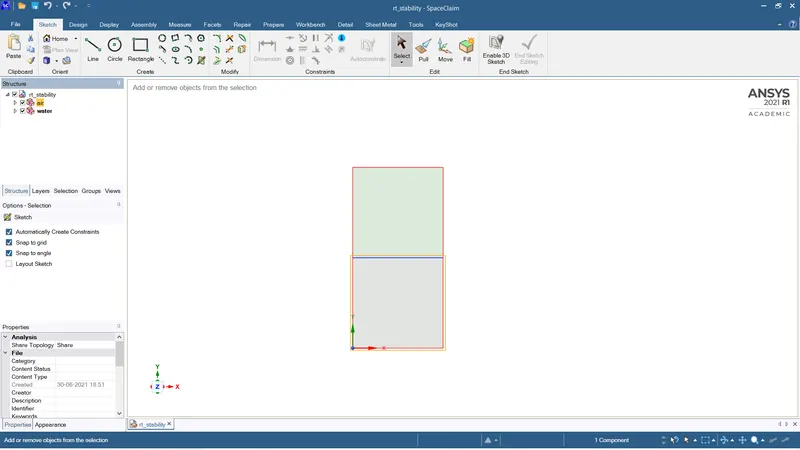
We have create diagram on two components as water and air. Ensure share topology at the contact point between bodies.
MESHING:
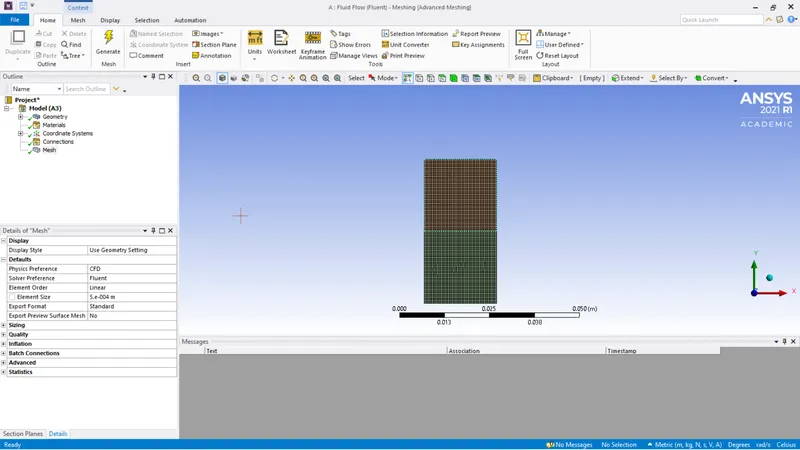
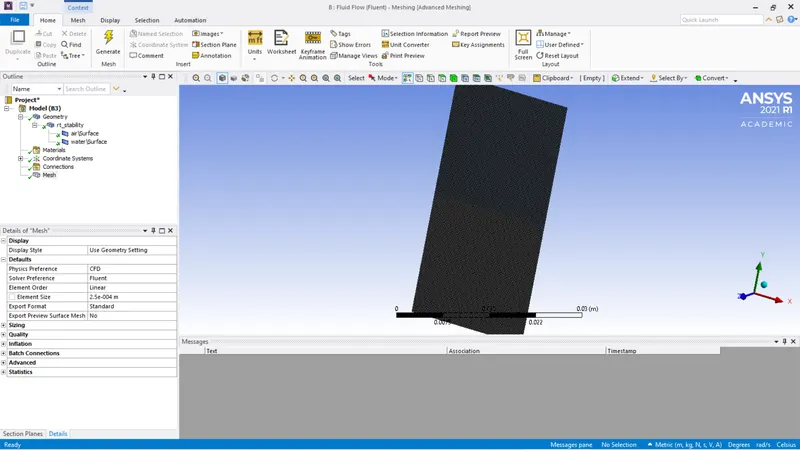
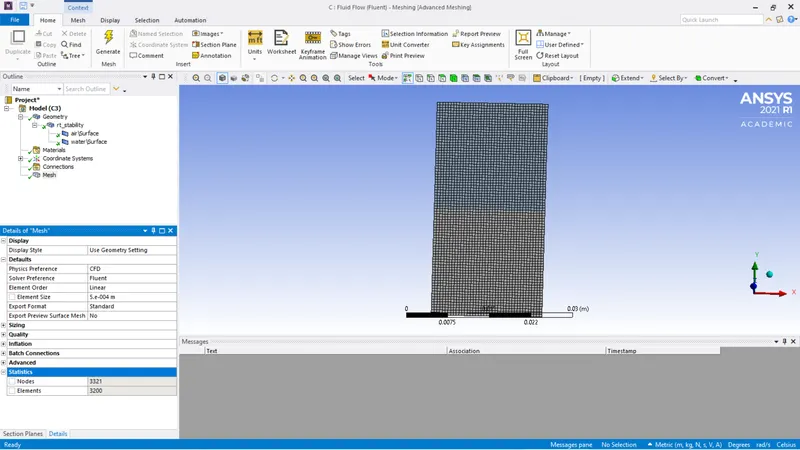
Mesh cases 1) 0.5mm 2) 0.25mm
IMPLICIT CONDITION:
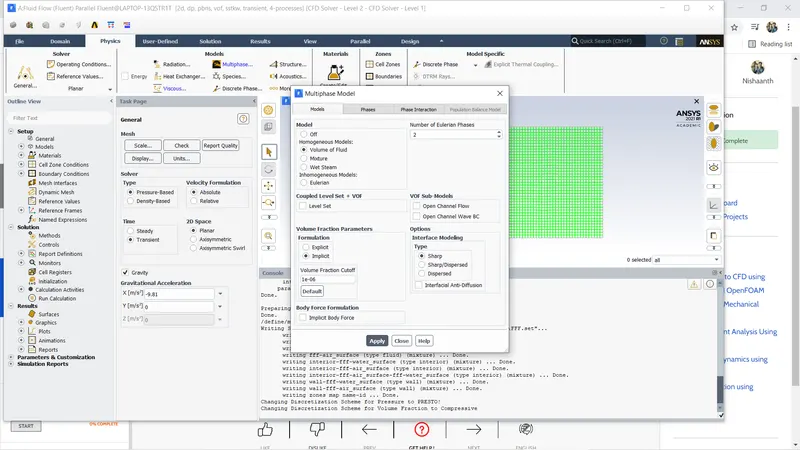
MATERIAL SELECTION:

STEADY-STATE APPORACH vs TRANSIENT:
In the steaduy state, we could see only the converged solution whereAs in the transient approach we will be able to see the solution for every small time step. Instability is much visible in the transient method. With the finer mesh we can notice the irregularities, forming of bubble, transition of fluid very clearly.
RESULTS:
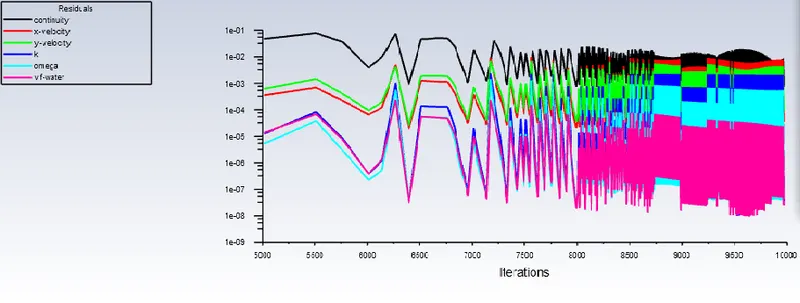
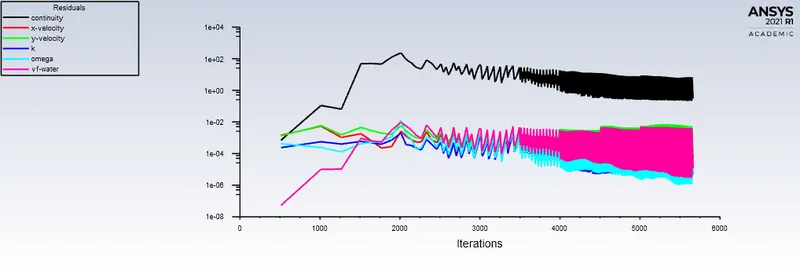
RESIDUALS:
FOR CASE 1:
FOR CASE 2:
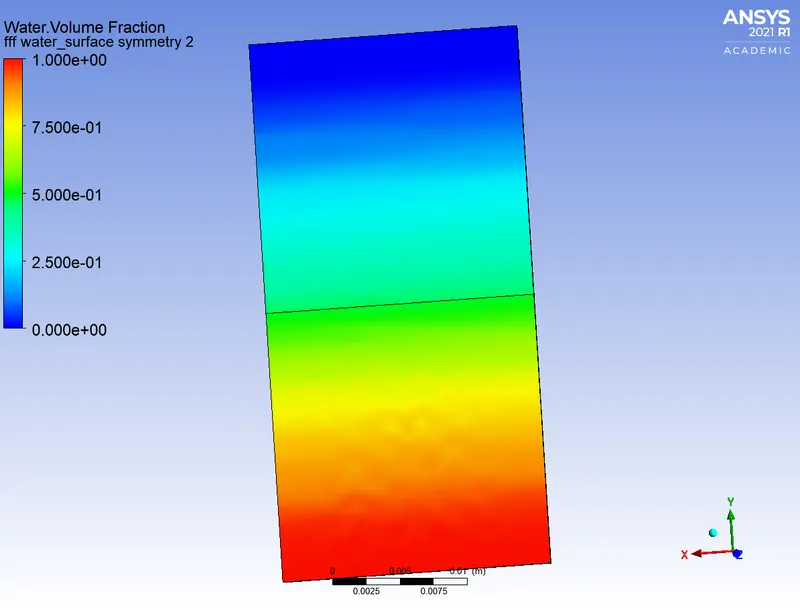
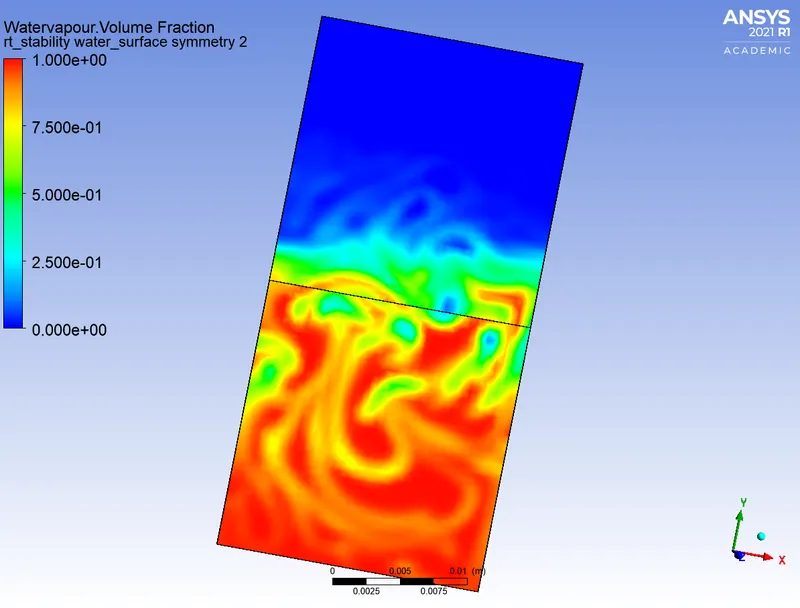
CONTOUR AND ANIMATION:
CASE 1: BASE MATERIAL AND BASE MESH
CASE 2: REFINED MESH AND BASE MATERIAL
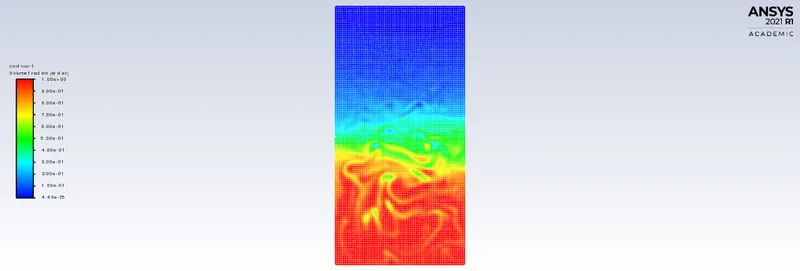
CASE 3: USER MATERIAL AND REFINED MESH
ATWOOD NUMBER:
The Atwood number (A) is a dimensionless number in fluid dynamics used in the study of hydrodynamic instabilities in density stratified flows. It is a dimensionless density ratio defined as

where
 = density of heavier fluid
 = density of lighter fluid
It says penetration distance of heavier fluid into the lighter one is directly propotional to the atwood number. If the atwood number is close to 1, then the heavier fluid above the lighter one produces instability in form of bubbles.
CONCLUSION:
From the annimation, it is clear that finer mesh have the better way of depicting the rayleigh instability.