Week 5 - Rayleigh Taylor Instability
Aim:
To perform Rayleigh Taylor instability simulation for different mesh sizes using FLUENT and to compare the results by providing the animations.Also to discuss he effect of Atwood Number and viscosity on the Instabilty criterion.
DESCRIPTION:
The Rayleigh Taylor instability is a fingering instability on the interface between two fluids of different densities,which is occuring whwn the light fluid is pushing the heavy fluid. The simple criterion for the onset of the Taylor instability at the interface between two fluids of different densities.
This instability can have significant implications in various fields, such as astrophysics, fluid dynamics, and inertial confinement fusion. In Computational Fluid Dynamics, mathematical models based on the Rayleigh-Taylor instability have been adapted to simulate and analyze fluid flow in different scenarios such as
Volume-of-Fluid (VOF) Method:
The VOF method tracks the interface between different fluids by solving a transport equation for the volume fraction of each fluid.
In Rayleigh-Taylor simulations, the VOF method helps capture the evolution of the interface as the instability develops, enabling the visualization of the mixing process.
Level Set Method:
The Level Set method represents the interface as the zero level set of a higher-dimensional function.
For Rayleigh-Taylor simulations, the Level Set method provides a convenient way to track the evolution of the interface and capture the complex interfacial structures that arise during the instability.
Reynolds-Averaged Navier-Stokes (RANS) Models:
RANS models, such as the k-ε turbulence model, are often used to simulate turbulent flows in Rayleigh-Taylor systems.
These models provide insights into the turbulence characteristics, vorticity, and mixing at the fluid interface, allowing for a more detailed analysis of the instability.
Large Eddy Simulation (LES):
LES resolves large-scale turbulent structures and models the smaller scales.
In Rayleigh-Taylor simulations, LES can provide a more accurate representation of turbulent mixing, capturing the dynamics of the larger vortical structures that contribute to the overall instability.
MHD (Magnetohydrodynamics) Models:
In cases where magnetic fields are involved, MHD models are essential.
Rayleigh-Taylor instability in magnetized fluids requires special consideration, and MHD models are adapted to simulate the interactions between the magnetic field and the fluid dynamics.
- Kevin-Helmholtz Instability:
The theory predicts the onset of instability and transition to turbulent flow in fluids of different densities moving at various speeds.The instability occurs where there is a velocity shear or velocity difference between the interface of two fluids
1.GEOMETRY:
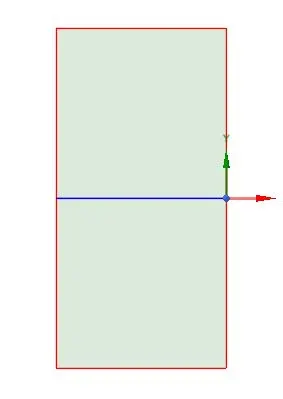
Two regions have been created for the fluid domain with one domain over the other with a sizing of 20 mm x 20 mm.
2.MESH:
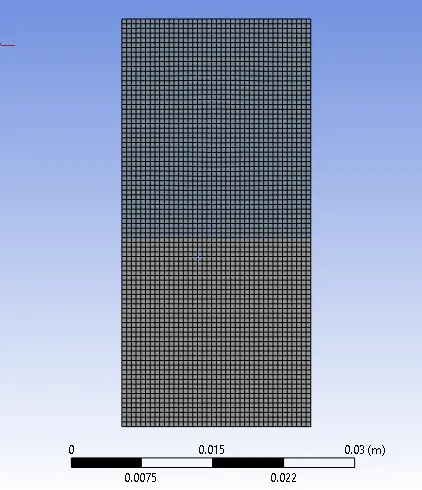
- The meshing has been done for two different cases of simulation, as discussed below:
CASE 1) Here, the size of the mesh is: 0.5 mm
CASE 2) Here, the size of the mesh is: 0.25 mm
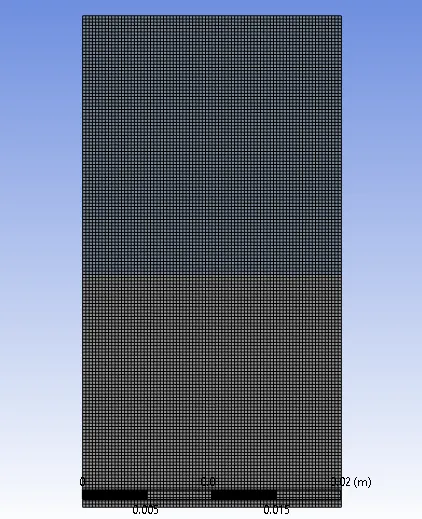
Case 3) Mesh size is 0.25 mm
3.SETUP:
Solver - Type : Pressure-Based
Time : Transient
Velocity Formulation : Absolute
Gravity : -9.81ms2">9.81ms29.81��2along y direction as the 2D viewer has the effect of flow downwards
A multiphase model with 2 Eulerian Phases is chosen to see the mixture of air and water.
- Laminar Model
- Energy OFF
Materials - Fluid : Air ( for CASE 1)
water-liquid.
Initialization : Hybrid Initialization
- Patching has been done in all the cases.
- 4. Results:
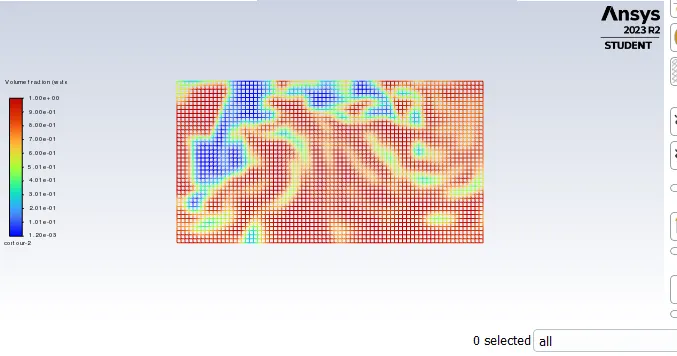
Case 1)
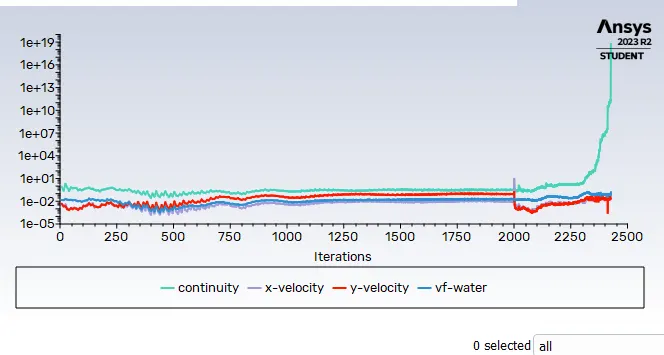
Case 2)
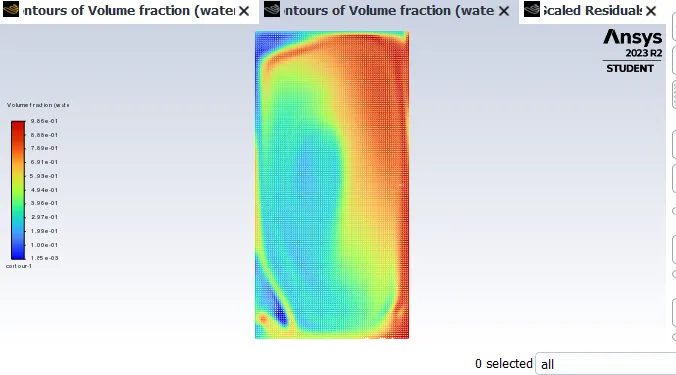
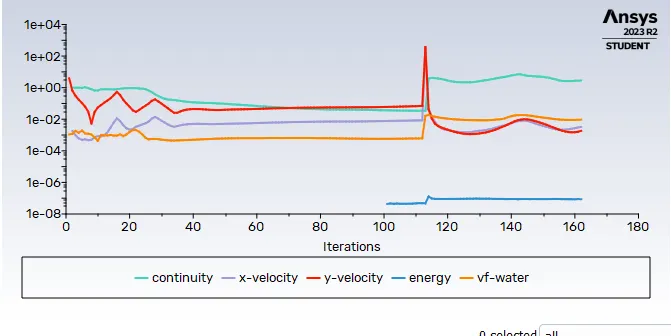
Case 3)
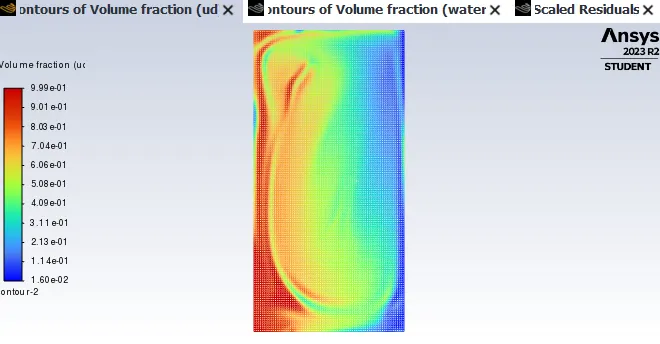
Atwood Number:
The Atwood number (A) is dimensionless in fluid dynamics used in the study of hydrodynamic instabilities in density stratified flows. It is a dimensionless density ratio defined as

where
 = density of heavier fluid
 = density of the lighter fluid
In Rayleigh-Taylor instability, the penetration distance of heavy fluid bubbles into the lighter fluid is a function of the acceleration time scale, where g is the gravitational acceleration and t is the time.
A = ρ1−ρ2ρ1+ρ2�1-�2�1+�2 = 998.2−1.225998.2+1.225998.2-1.225998.2+1.225= 0.9975
RTI evolves in three distinct stages: Linear stability, mushroom head(falling) or bubble(rising) formation, long term evolution due to bubble merging and mixing. For low Atwood number, bubble and mushroom head shape is relatively symmetrical, the disturbances or perturbations are linear for a larger time. In contrast, for large Atwood number, bubble and mushroom head shape is less symmetrical, also it occurs very rapidly at an accelerating rate which leads to a nonlinear growth rate.