Week 5 - Rayleigh Taylor Instability
PRACTICAL CFD MODELS
Kelvin–Helmholtz instability: According to the hypothesis, fluids moving at varied speeds and with varying densities will eventually become unstable and change to turbulent flow. This instability happens when the interface of the two fluids experiences shear or a velocity differential.
Richtmyer–Meshkov instability: An abrupt acceleration between two fluids can cause this kind of instability. When there is a shock at a higher speed, this kind of instability may happen. Small amplitude perturbations that first increase linearly with time are the beginning stages of the instability's development. After that, a nonlinear regime sets in, where bubbles occur when a light fluid penetrates a heavy fluid and spikes appear when a heavy fluid penetrates a light fluid. The two fluids eventually combine as a chaotic regime. This instability can be thought of as the Ryleigh-Taylor instability's impulsive-acceleration limit.
Plateau–Rayleigh instability: A falling stream of fluid fragments into smaller packets with the same volume but less surface area. This phenomenon is explained by the Plateau-Rayleigh instability, also known as the Rayleigh instability. The Rayleigh-Taylor instability is a factor in it. It belongs to a larger subfield of fluid dynamics that deals with fluid thread breaking. A specific kind of ink jet technology takes advantage of this fluid instability by perturbing the jet of liquid into a continuous spray of droplets.The Plateau-Rayleigh instability is caused by the tendency of liquids to minimise their surface area due to their surface tensions.
OBJECTIVE : To perform multi-phase analysis depicting Rayleigh-Taylor Instability in water-air interface and water - user defined fluid interface
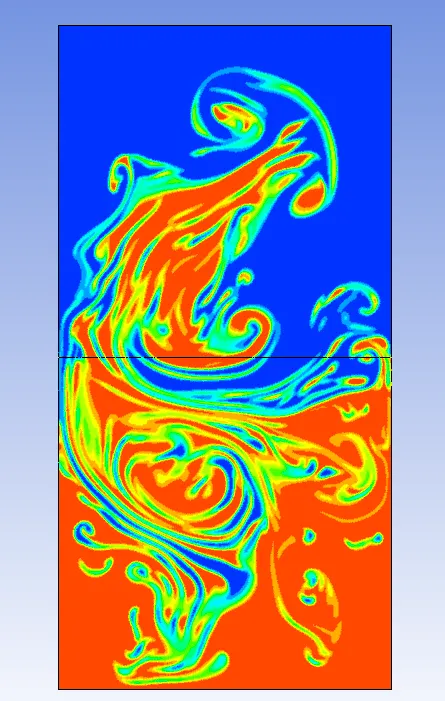
Rayleigh Taylor instability is the disturbances that occur between the interface of two fluids of different densities under the force of gravity. The lighter fluid pushes into the heavier fluid in order to minimize the potential energy of the system. The resulting fluid pattern depends on the Atwood number. The ligher fluid pushes into the heavier fluid in a "bubble-like" pattern and the heavier fluid falls down in the form of "spikes"
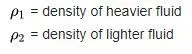
ATWOOD NUMBER : Fluid dynamics uses the Atwood number, a dimensionless number, to analyse hydrodynamic instability in density-stratified flows. The ratio of the difference in mass densities to their total is known as the Atwood number.

SIMULATION SET-UP
1) The Rayleigh-Taylor instability can be simulated in 2D and the patterns created can be observed. Create a 20x20 mm rectangle corresponding to air and 20x20 mm rectangle corresponding to water domain
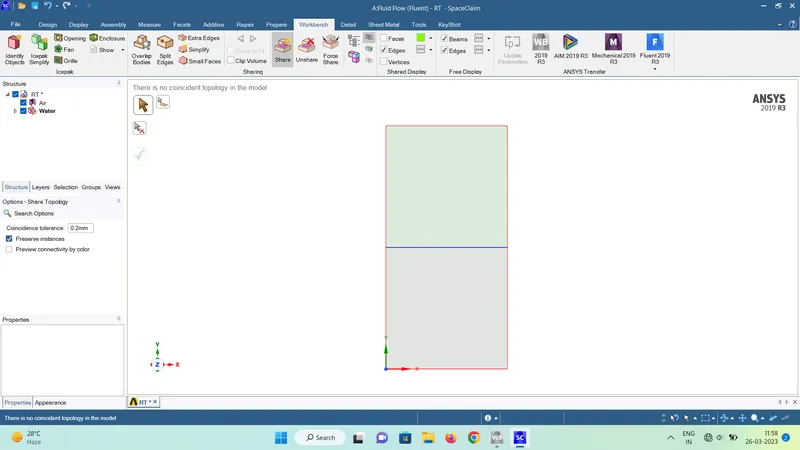
2) Enable share topology in order to get conformal mesh
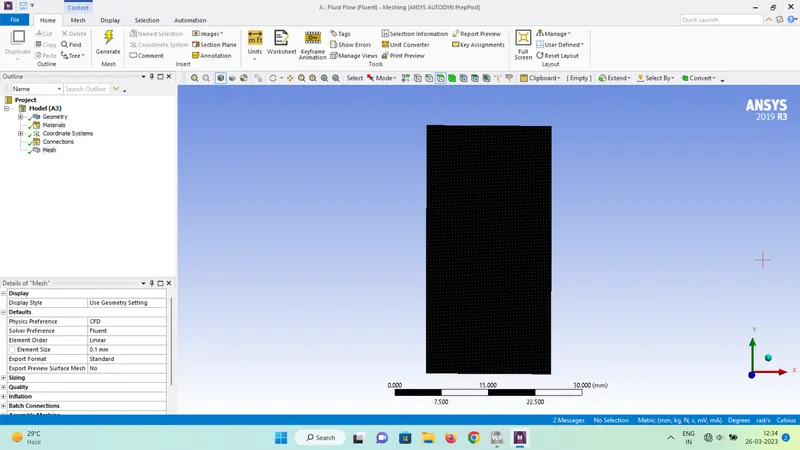
3) Mesh the geometry and set-up the multiphase simulation by volume of fluid method
4) Select the primary and secondary phase and initialize the case. After standard initialization, patch the volume fraction as 0 and 1 to get the initial phase condition
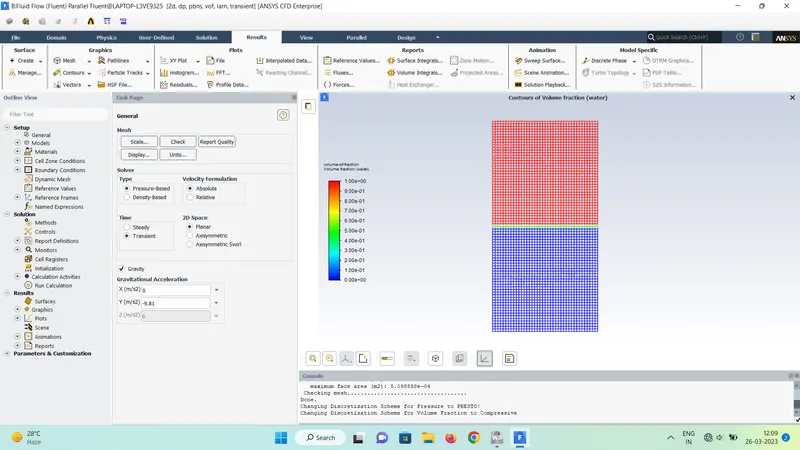
Water-air Interface
Viscous Model : Laminar
Type : Multi-phase ( Volume of Fluid method )
Mesh Size : Case -1 (0.5 mm) ; Case - 2 ( 0.1 mm)
Primary phase : air
Secondary phase : water
Time Step : 0.005 s
Atwood Number : 0.99
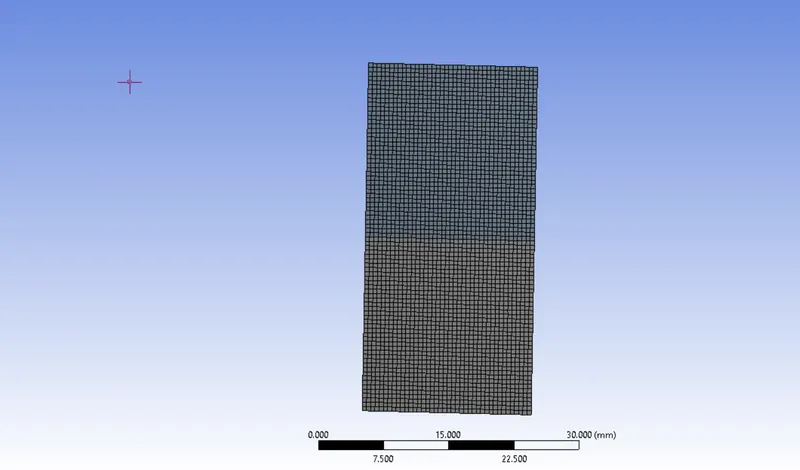
CASE -1 ( 0.5 mm )
MESH
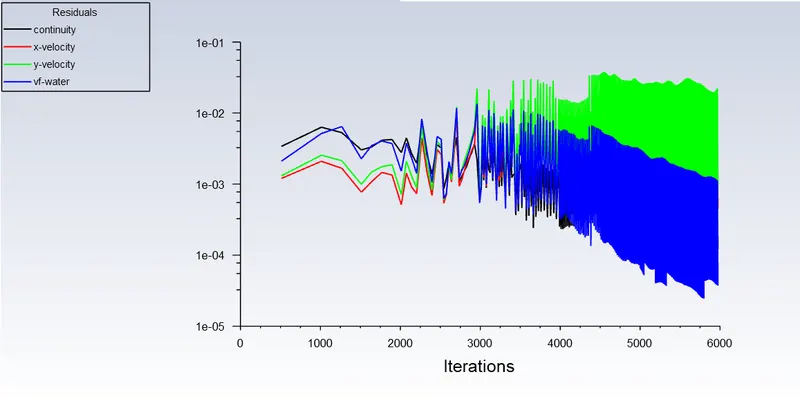
Animation
Water-Air Interface Mesh size 0.5 mm Animation
CASE-2 MESH ( 0.1 mm )
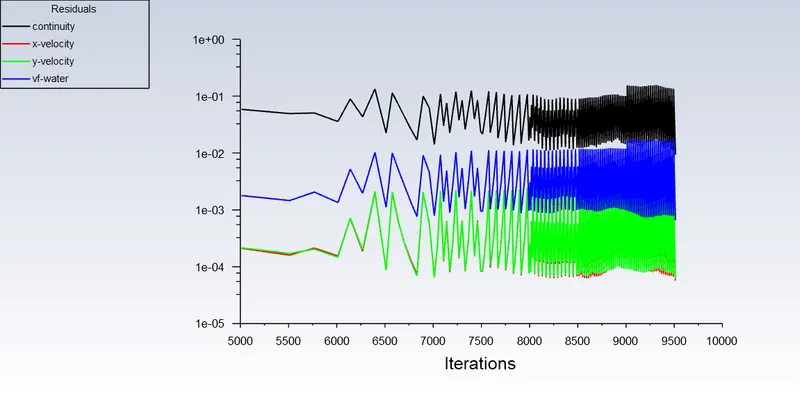
Animation
Water-Air Interface Mesh size 0.1 mm Animation
Water-User Defined Fluid Interface
Viscous Model : Laminar
Type : Multi-phase ( Volume of Fluid method )
Mesh Size : 0.1 mm
Primary phase : water
Secondary phase : user-defined
Time Step : 0.005 s
Atwood Number : 0.4
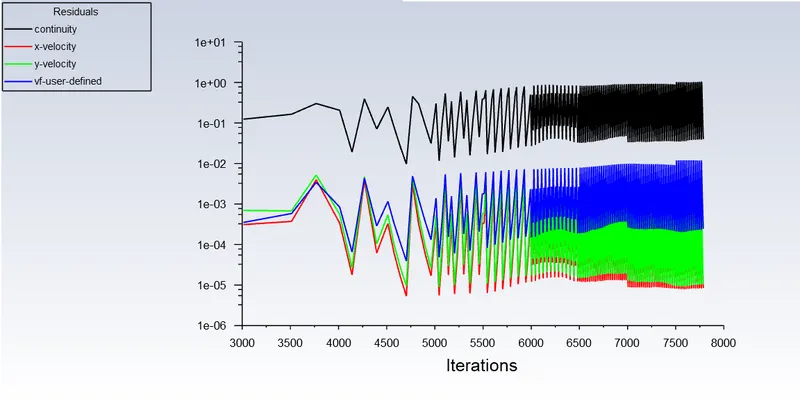
Animation
Water - User Defined Fluid Interface Mesh size 0.1 mm Animation
OBSERVATIONS
In the Water-Air Interface with higher Atwood number (0.99), it is observed that the interface stabilizes quickly than the Water - User defined fluid interfcae with lesser Atwood number (0.4). The falling of the heavier fluid in the form of spikes and the lighter fluid goes up in the form of bubbles. This can be observed as the heavier fluid tries to settle down due to the effect of gravity. No such spike-bubble formation is observed in the water-user defined fluid interface, only finger like formation of user defined fluid is observed which slowly tries to go upwards.
CONCLUSION
The Rayleigh-Taylor instability flows resemble symmetric fingers of fluid for Atwood numbers close to 0.The much lighter fluid beneath the heavier fluid manifests itself as larger bubble-like plumes when Atwood number approaches 1.