Week 5 - Rayleigh Taylor Instability
Rayleigh Taylor instability is the interpenetration of materials with different densities where the the lighter density fluid pushes the heavier fluid. The heavier density fluid goes down due to gravity and most of the case it is considered as 2D simulation so the gravity is negative.
1) Some of the practical CFD model that have been used based on the mathematical analysis of rayleigh taylor waves are :
- Kelvin - Helmholtz instability
This is the phenomenon where there is a velocity shear between two different fluid there occur as wave like structure forming .
- Richtmyer-Meshkov instability
This instability occurs when two different density fluid occurs intensionally accelerated by using shock waves .
- Plateau - Rayleigh instability
This instability describes why the falling fluid breaks into smaller pieces with small surface area and same volume.Due to surface tension this happens and detail about this instability is called as plateau-rayleigh instability.
- Saffman - Taylor instability
This is called as viscous fingering instability , where the low viscous fluid displace the high viscous fluid the instability occurs and in inverse condition when the high viscous fluid displace the low viscous fluid the instability not occur.
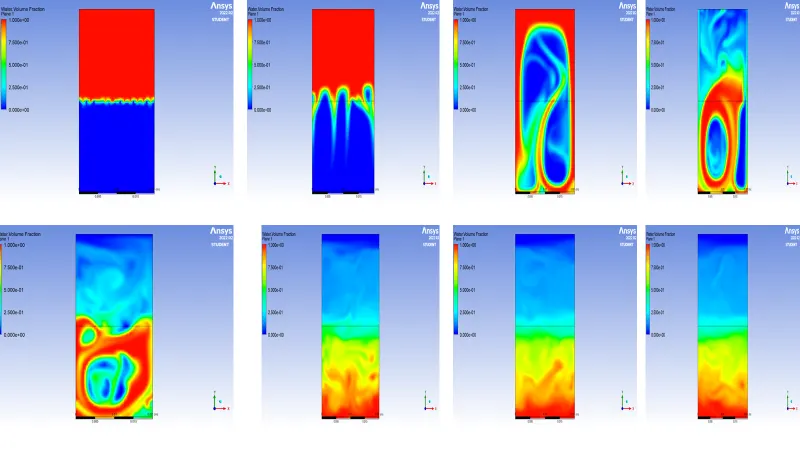
2) CFD simulation for Air and Water for two different cases of mesh is done:
Case 1: 0.5 mm target length
- open Space claim and sketch a rectangular box with 20 x 20 mm one over the other where the lower one is of less density of air and upper one is of larger density of water.
- pull option is used to make it 3d and the boundary is shared by share topology.
- open the mesh and initially generate the basic mesh run and change the target length into 0.5 mm and update.
- open setup --> pressure based solver and transient state and considerd the laminar flow.
- material should be air and water ( water material should be added from the data base)
- multiphase zone --> transient state is implicit where we considered only ( time step and time zone)--> phases of liquid and air is considerd as volume of fraction . since the two different phases are used the water phase is used as 1 and air phase is used as 0 to differentiate.
- both the phases are under the gravity and it is 2d simulation so Y axis is considered as gravity and -9.81 m/s^2.
- Initiallize the problem and patch the solution by clicking the patch--> In patch the seperation of the volume of fraction is done.
- contour of the phases is made and animation is created.
- Now calculate the problem by the time step of 0.01 for 500 iteration.
- Post processing solution is done.
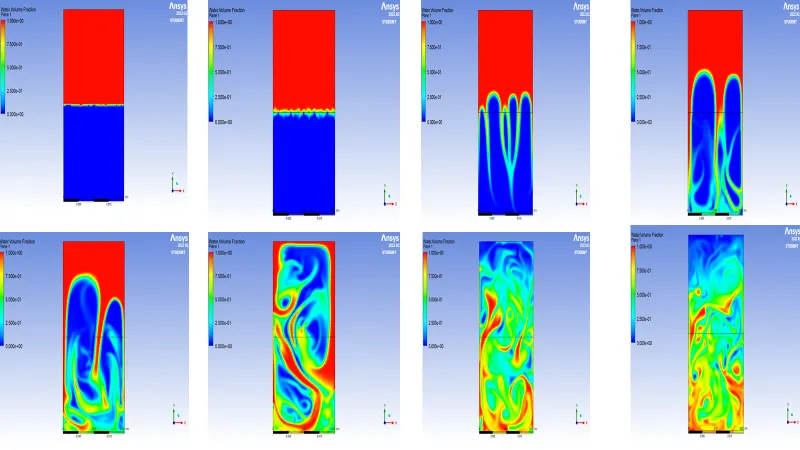
Case 2: 0.3 mm target length
- open Space claim and sketch a rectangular box with 20 x 20 mm one over the other where the lower one is of less density of air and upper one is of larger density of water.
- pull option is used to make it 3d and the boundary is shared by share topology.
- open the mesh and initially generate the basic mesh run and change the target length into 0.3 mm and update.
- open setup --> pressure based solver and transient state and considerd the laminar flow.
- material should be air and water ( water material should be added from the data base)
- multiphase zone --> transient state is implicit where we considered only ( time step and time zone)--> phases of liquid and air is considerd as volume of fraction . since the two different phases are used the water phase is used as 1 and air phase is used as 0 to differentiate.
- both the phases are under the gravity and it is 2d simulation so Y axis is considered as gravity and -9.81 m/s^2.
- Initiallize the problem and patch the solution by clicking the patch--> In patch the seperation of the volume of fraction is done.
- contour of the phases is made and animation is created.
- Now calculate the problem by the time step of 0.005 for 250 iteration.
- Post processing solution is done.
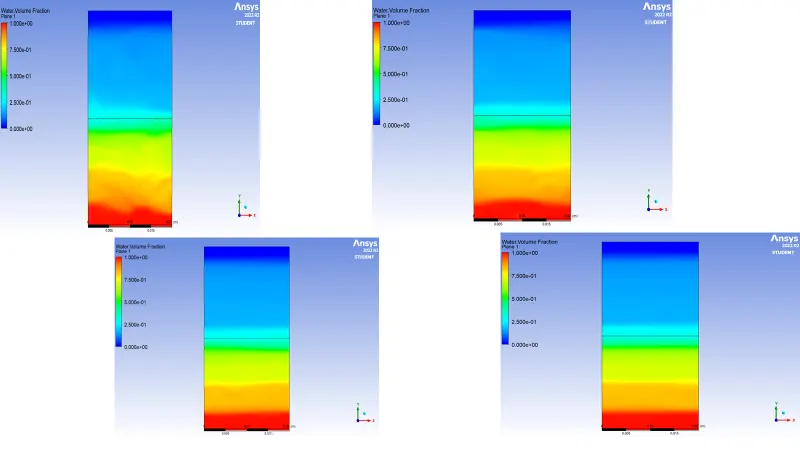
Case 3: 0.2 mm target length
- open Space claim and sketch a rectangular box with 20 x 20 mm one over the other where the lower one is of less density of air and upper one is of larger density of water.
- pull option is used to make it 3d and the boundary is shared by share topology.
- open the mesh and initially generate the basic mesh run and change the target length into 0.2 mm and update.
- open setup --> pressure based solver and transient state and considerd the laminar flow.
- material should be air and water ( water material should be added from the data base)
- multiphase zone --> transient state is implicit where we considered only ( time step and time zone)--> phases of liquid and air is considerd as volume of fraction . since the two different phases are used the water phase is used as 1 and air phase is used as 0 to differentiate.
- both the phases are under the gravity and it is 2d simulation so Y axis is considered as gravity and -9.81 m/s^2.
- Initiallize the problem and patch the solution by clicking the patch--> In patch the seperation of the volume of fraction is done.
- contour of the phases is made and animation is created.
- Now calculate the problem by the time step of 0.005 for 250 iteration.
- Post processing solution is done.
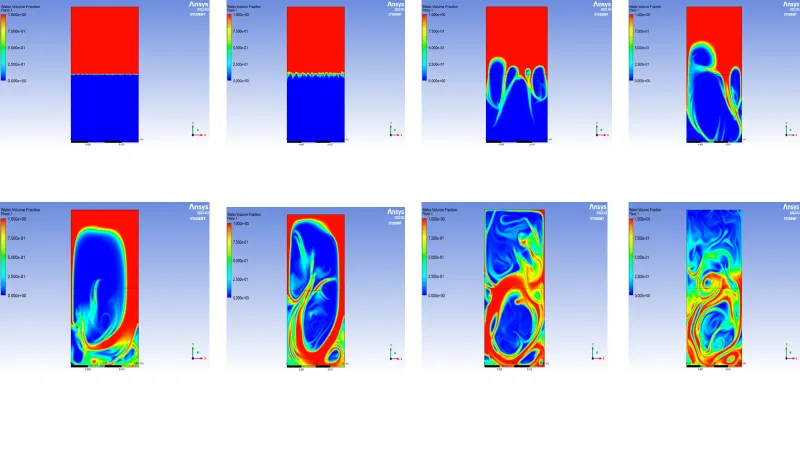
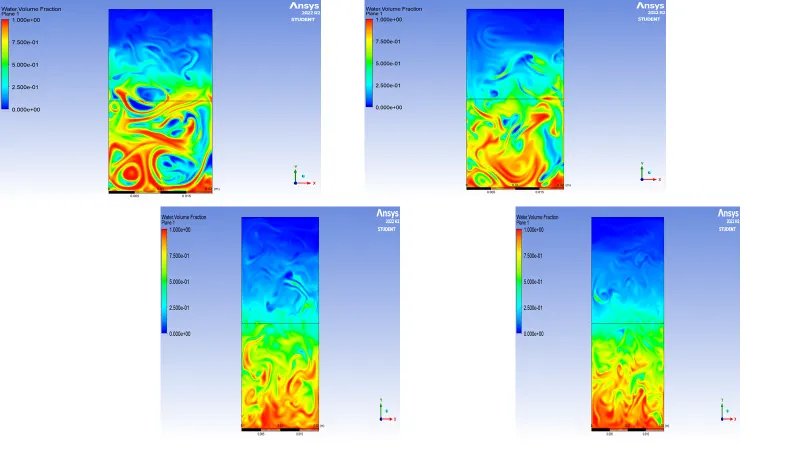
Interpretation :
As long as the mesh length goes finer the transition of instability from light fluid to heavy fluid attains smoothly.
But at the same time the computation time is more. So for 0.5 mm of target length the transition period with the time step of 0.01 is easily achievable for 500 iteration but it is reduced to the 0.005 and 0.0025 for the next two finer mesh and the iteration also reduced half from the base mesh like 250 and 125 iteration .
So that the settling of the fluid does not happen as like in 0.5 mm target mesh length.
In implicit method , time step should be take care for the computational time and result achievement.
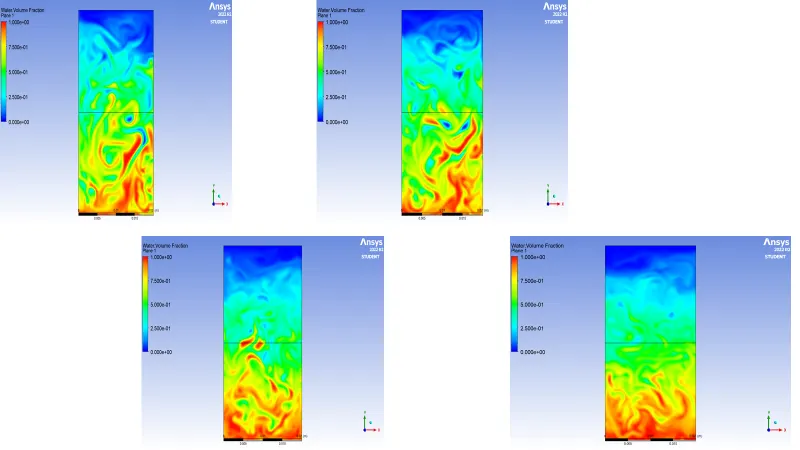
3) CFD simulation of the Water and user defined material such as density of 400 Kg/m^3 and Viscosity of 0.001 Kg/ms.
- open Space claim and sketch a rectangular box with 20 x 20 mm one over the other where the lower one is of less density of air and upper one is of larger density of water.
- pull option is used to make it 3d and the boundary is shared by share topology.
- open the mesh and initially generate the basic mesh run and change the target length into 0.3 mm and update.
- open setup --> pressure based solver and transient state and considerd the laminar flow.
- Create the material which is defined withits density and viscosity and add to the fluent base.
- material should be user defined and water ( water material should be added from the data base)
- multiphase zone --> transient state is implicit where we considered only ( time step and time zone)--> phases of liquid and air is considerd as volume of fraction . since the two different phases are used the water phase is used as 1 and new material phase is used as 0 to differentiate.
- both the phases are under the gravity and it is 2d simulation so Y axis is considered as gravity and -9.81 m/s^2.
- Initiallize the problem and patch the solution by clicking the patch--> In patch the seperation of the volume of fraction is done.
- contour of the phases is made and animation is created.
- Now calculate the problem by the time step of 0.005 for 250 iteration.
- Post processing solution is done.
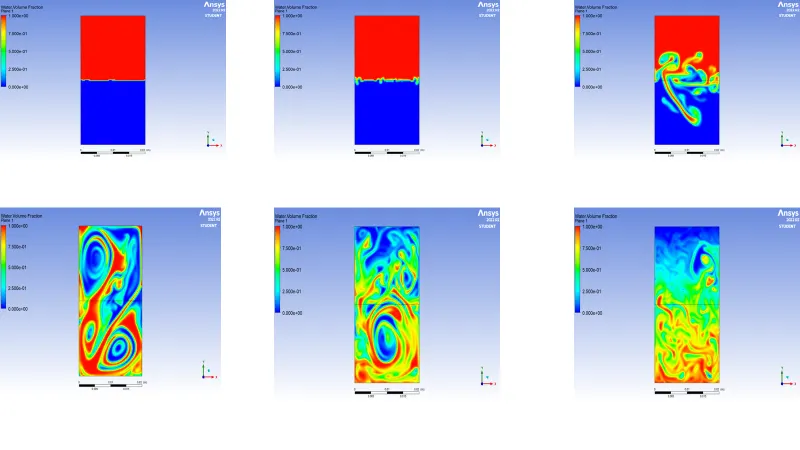
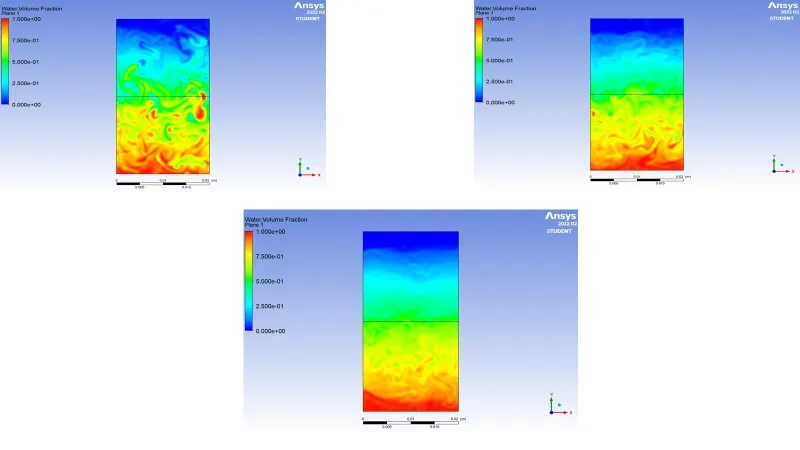
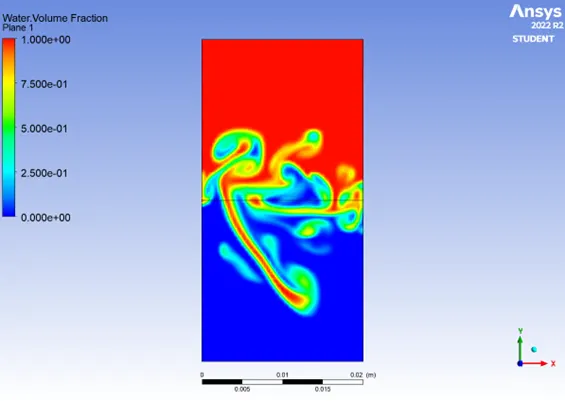
The transition of instability for the water and user defined material.
4) Atwood number :
Atwood number is the dimension less number which is used in the study of fluid flow with different densities.
mainly defined as the ratio of difference in the desnities to their sum
Atwood number near to 0 ( takes the fluid flow in the form of symmetric)
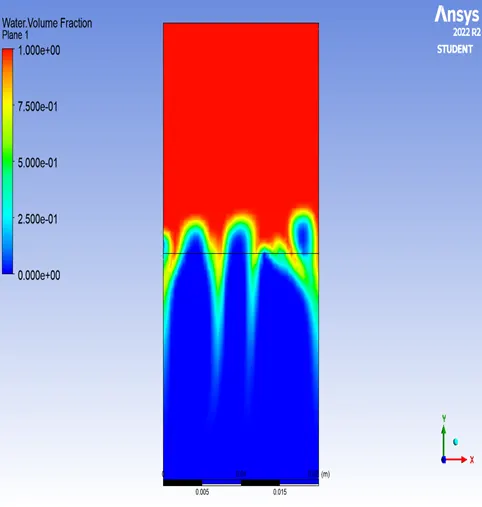
Atwood number near to 1 (takes the fluid flow of the lighter fluid below the heavier fluid takes the bubble like form of flow.
In case of air and water :
Atwood number = ( density of water - density of air)/(density of water + density of air)
= (998.2-1.225)/(998.2+1.225)
=0.99(bubble like transition takes palce)
Incase of water and user defined material:
Atwood number = ( density of water - density of defined material)/(density of water + density of defined material)
= (998.2-400)/(998.2+400)
=0.42( symmetric transition takes place )
Link:
https://drive.google.com/file/d/1F5ayhdbLvYI-BhOjHlZtAN-sAPHWMQwR/view?usp=share_link
https://drive.google.com/file/d/1M3nR2zlHMmtFmP7jsu_U5S44dwnmxyYk/view?usp=share_link