Week 5 - Rayleigh Taylor Instability
AIM:-
- What are some practical CFD models that have been based on the mathematical analysis of Rayleigh Taylor waves? In your own words, explain how these mathematical models have been adapted for CFD calculations.
- Perform the Rayleigh Taylor instability simulation for 2 different mesh sizes with the base mesh being 0.5 mm. Compare the results by showing the animations( Attach them from your google drive). Observe the differences in the animation and explain the effect of mesh size on simulation. Also, explain why a steady-state approach might not be suitable for these types of simulation.[ Choose Air and Water for this simulation]
- Run one more simulation with water and user-defined material(density = 400 kg/m3, viscosity = 0.001 kg/m-s) for refined mesh.
- Define the Atwood Number. Find out the Atwood number for both the cases and explain how the variation in Atwood number in the above two cases affects the behavior of the instability.
OBJECTIVE:-
1. In this challenge we have to performed the ssimulation of 2 different cases with the mesh 0.5mm.
2. case-2 we have taken 0.4mm mesh.
3. run one more simulation with water and user defined material density = 400kg/m^3 and viscosity = 0.001.
4. in this challenge we have used two different fluids.
5. water has consists of higher density and air has less density.
6. we have to plot the scaled resudules and volume fraction.
7. we have create the animation also for three cases.
IMPORTANT POINTS:-
# RAYLEIGH TYLOR INSTABILITY:- The rayleigh tylor instability or RT instability is an interface between the two fluilds of different densities which occurs an the lighter fluid is pushing the havier fluid.
# INSTABILITY:- The computational results may include exponentially growing and sometimes oscillating features that bear no relation to the solution of the original differential equation. This type of behavior is referred to as a computational instability.
# INTERFACE:- Interfaces are patches where the model parts (regions) are connected. The regions communicate through interfaces.
# SHARETOPOLOGY:- Share Topology combines all overlapping faces between two solids into one face.
#PATCH:- Assigning properties in selected(patched) regions is patching
# MULTIPHASE:- On the upshot, multiphase flow is the interaction of more than one matter or phase of matter that exist simultaneously.
CONDITIONS:-
# LAMINAR FLOW
# TRANSIENT CONDITION
# IMPLICITY
# VOLUME FRACTION:- Volume fractions represent the space occupied by each phase, and the laws of conservation of mass and momentum are satisfied by each phase individually.
- What are some practical CFD models that have been based on the mathematical analysis of Rayleigh Taylor waves? In your own words, explain how these mathematical models have been adapted for CFD calculations.
RT instability is the instability of an interface between two fluids of different densities which occurs when the lighter fluid is pushing the heavier fluid. Water suspended atop oil is an everyday example of Rayleigh–Taylor instability, and it may be modeled by two completely plane-parallel layers of immiscible fluid, the more dense on top of the less dense one and both subject to the Earth's gravity. The equilibrium here is unstable to any perturbations or disturbances of the interface: if a parcel of heavier fluid is displaced downward with an equal volume of lighter fluid displaced upwards, the potential energy of the configuration is lower than the initial state. Thus the disturbance will grow and lead to a further release of potential energy, as the more dense material moves down under the (effective) gravitational field, and the less dense material is further displaced upwards.
2. CASE_1 WITH BASE MESH 0.5mm:-
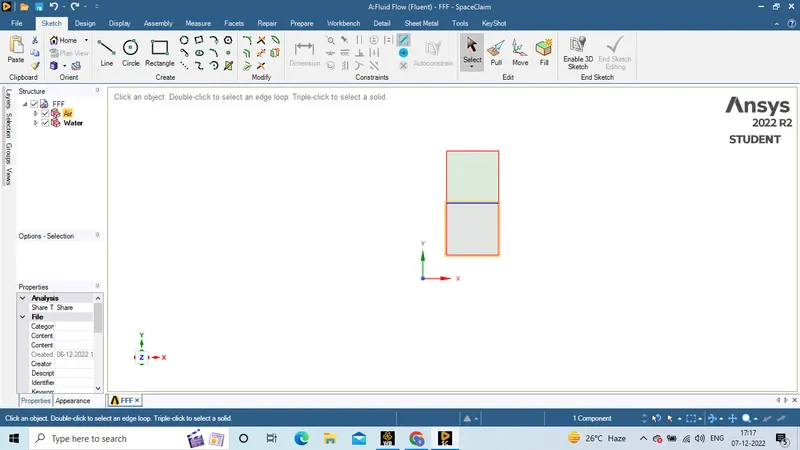
1. GEOMETRY:- IN geometry section we have to created two different types of rectangles with respect to y-axis. to click the pull option and created the ssurfaces and also created new component water and air. share topology tool used in geometry.
GEOMETRY OUT-PUT:-
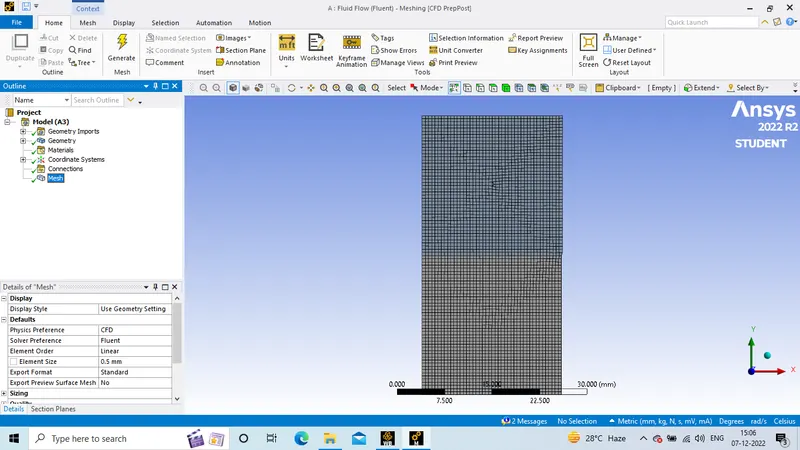
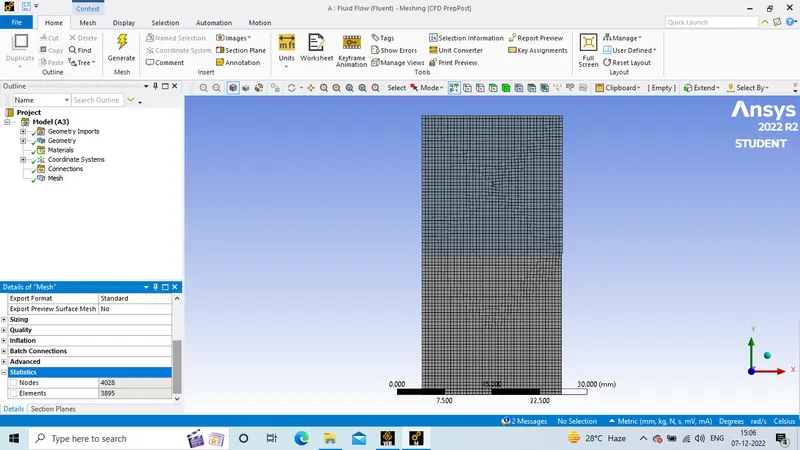
MESHING :- in meshing we have used in base line mesh 0.5mm so the mesh process is very simple.
set-up:-
# transient condition
# accleration due to gravity -9.81
# laminar condition
# material - water and air
# multiphase - implicity
# phases- 1.air 2. water
# initilize flow
# patch - water- volume fraction - phase -2 -1
# air-volume fraction -0
# contours - phase -2
# animation
out-puts:-
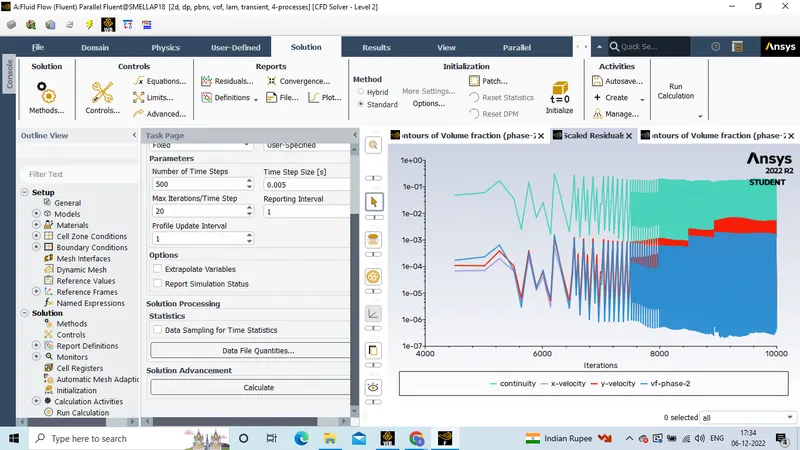
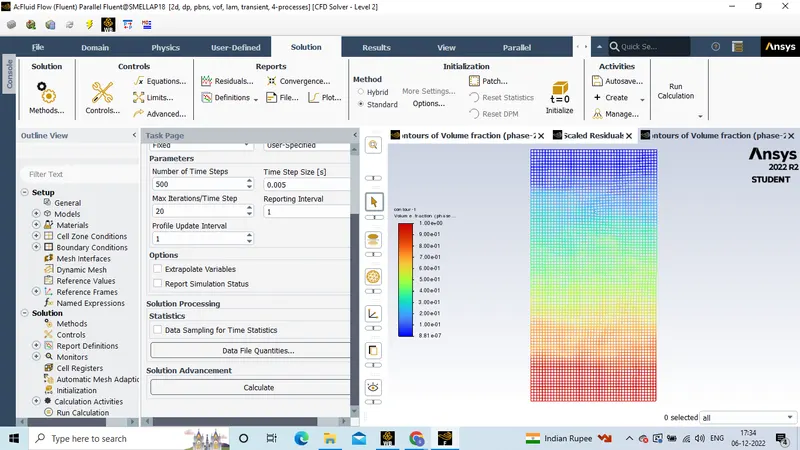
RESULTS:-
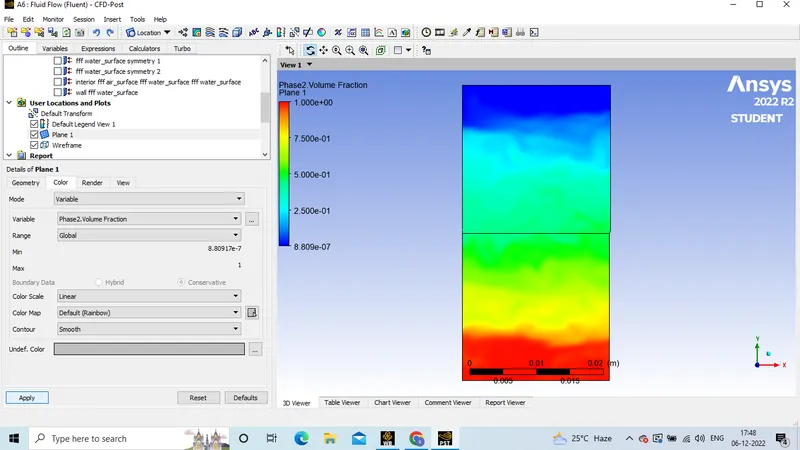
ANIMATION:-
https://drive.google.com/file/d/1TnGgKcEYl-TTIEg2fKSaL4ooMJwobyGq/view?usp=sharing
CASE_2 0.4MM MESH:-
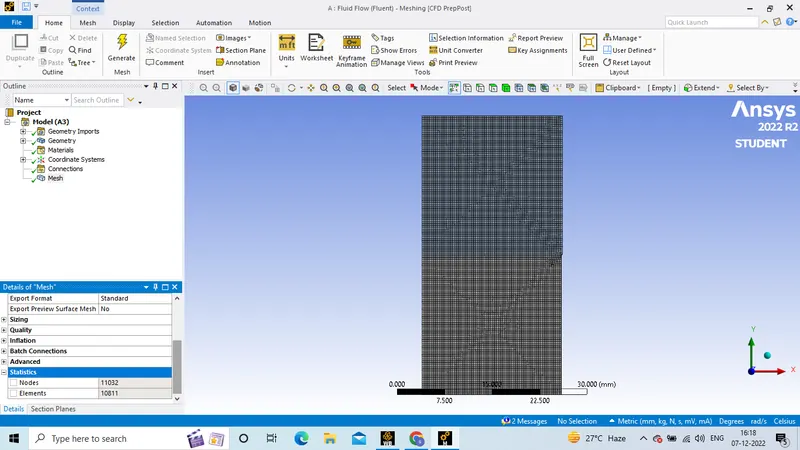
SET-UP:-
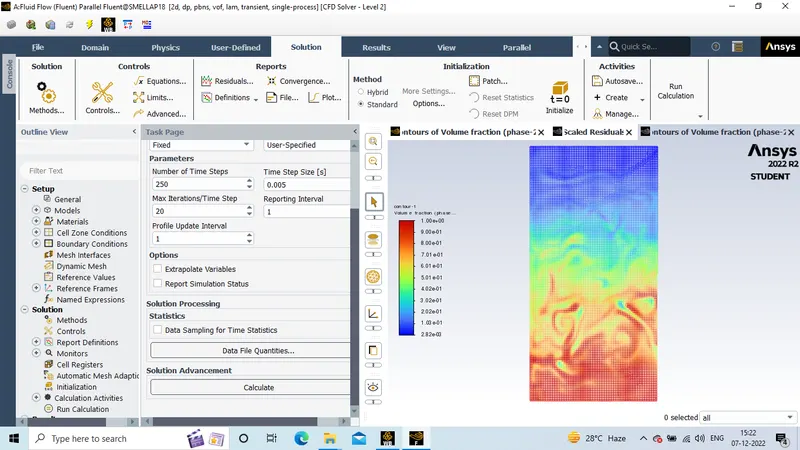
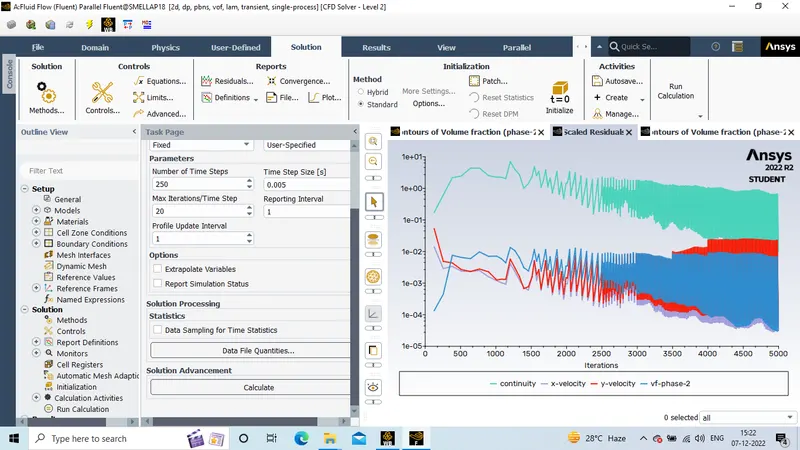
RESULTS:-
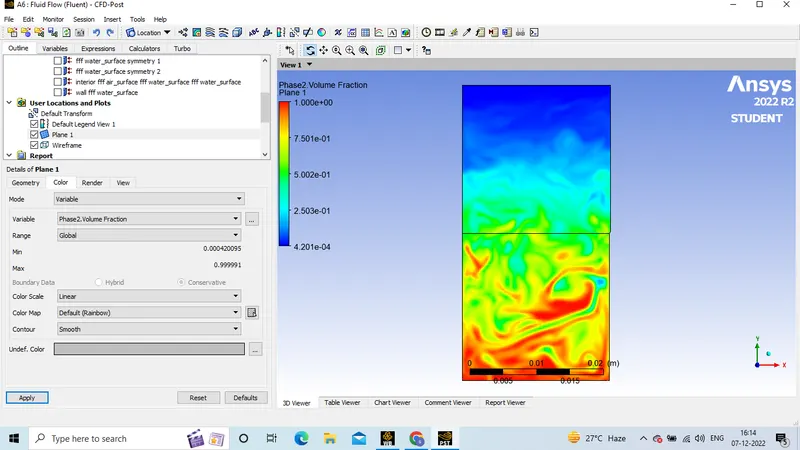
ANIMATION LINK:-
https://drive.google.com/file/d/16Y dQl2hdKdJeZmUaOO10YED5zdlbFuCF/view?usp=sharing
3. MESH 0.4MM AND DENSITY- 400KG/M^3 AND VISCOSITY - 0.01
MESH:-
SET-UP:-
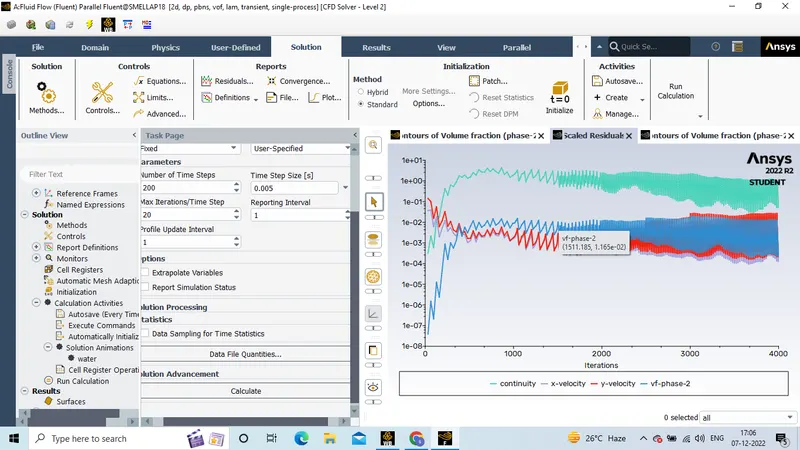
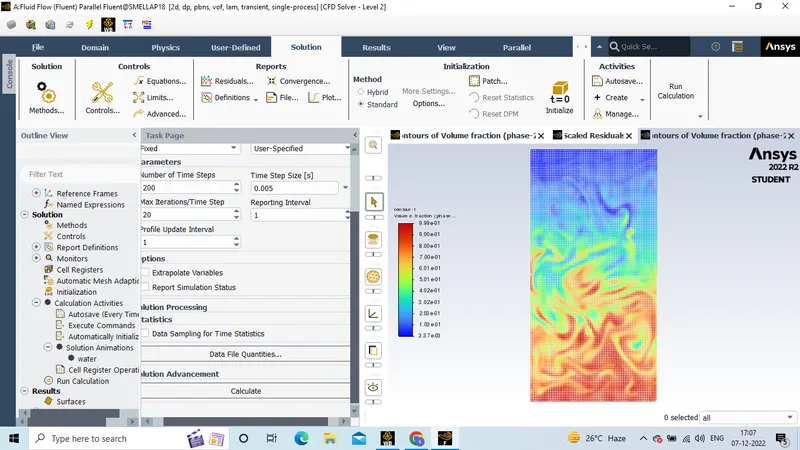
RESULTS:-
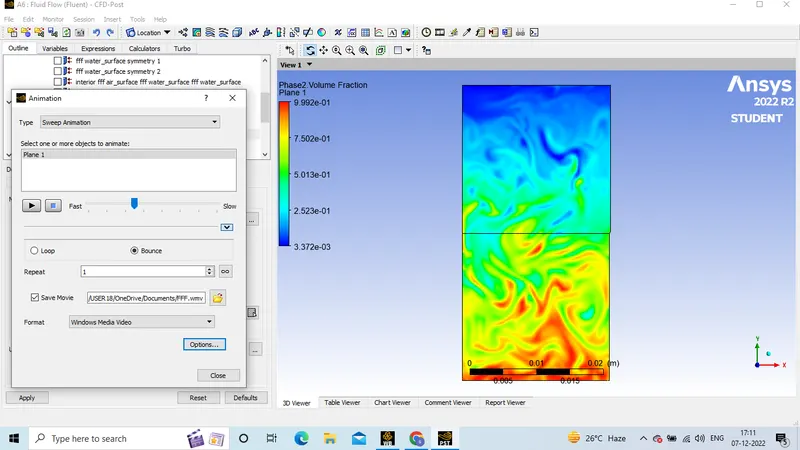
ANIMATION LINK:-
https://drive.google.com/file/d/1-ZTbS-6fWbEWIEAVEF6zTZlN8C7GMZ78/view?usp=sharing
4. ATWOOD NUMBER:-
The Atwood number (A) is a Dimensionless number in fluid dynamics used in the study of hydrodynamic instabilites in density stratified flows. It is a dimensionless density ratio defined as

where`rho1`-`rho2`/`rho1`+`rho2`
`rho1` = density of heavier fluid
`rho2` = density of lighter fluid
case_1 = 998.2 - 1.225/998.2 + 1.225 = 0.997
case-3
where`rho1`-`rho2`/`rho1`+`rho2`
`rho1` = density of heavier fluid
`rho2` = density of lighter fluid
998.2-400/998.2+400 = 0.427
conclusions:-
1. in this challenge we have used two different fluid air and water.
2. mesh is very important to the challenge for the simulation
3. first two cases we have the mesh size 0.5mm and 0.4mm
4. first case simulation is taken lot of time .
5. in this we have plot volume of fraction
6. in this case we have calculated ATWOOD number
7. higher atwood number steady state more rapidly.
8. lower atwood number is a instability and reach the steady state slowly.