Week 5 - Rayleigh Taylor Instability
Rayleigh Taylor Instability
Aim: To perform Rayleigh taylor instability.
Objective:
- Practical CFD models that have been based on the mathematical analysis of Rayleigh Taylor waves.
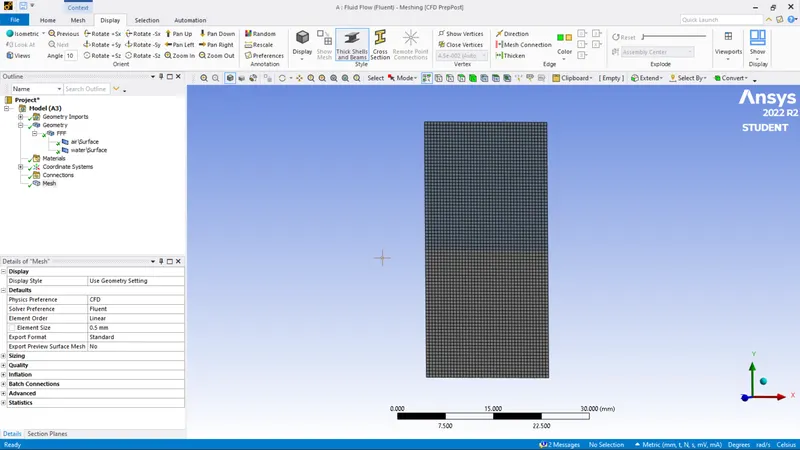
- Perform the Rayleigh Taylor instability simulation for 2 different mesh sizes with the base mesh being 0.5 mm. Explain why a steady-state approach might not be suitable for these types of simulation.[ Choose Air and Water for this simulation]
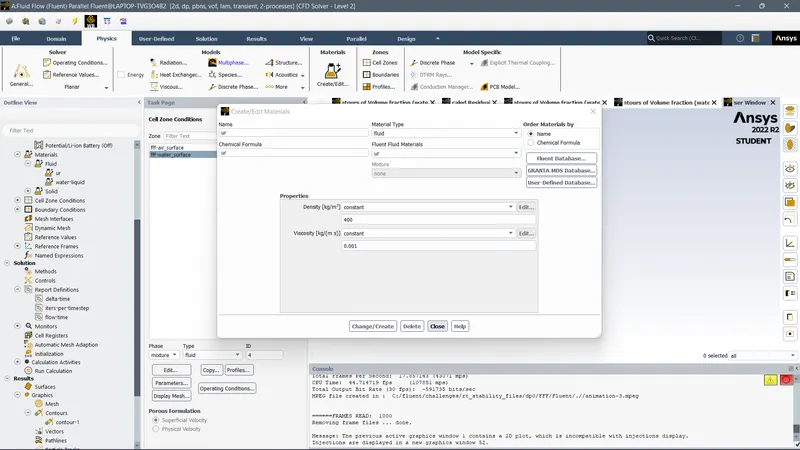
- Run one more simulation with water and user-defined material(density = 400 kg/m3, viscosity = 0.001 kg/m-s) for refined mesh.
- Define the Atwood Number. Find out the Atwood number for both the cases and explain how the variation in Atwood number in the above two cases affects the behavior of the instability.
Theory:
CFD models that have been based on Rayleigh taylor waves:
Kelvin–Helmholtz instability:
It describes the instability and transition to turbulent flow in fluids of different densities moving at various speeds, this aoccurs where there is a velocity shear or velocity difference between the interface of the two fluids.
Richtmyer–Meshkov instability:
The instability occurs when there is an impulsive accelaration between two fluids or shock at greater speeds. The development of the instability begins with small amplitude perturbations which initially grow linearly with time.
Plateau–Rayleigh instability:
It is described as the instability of falling stream of fluid breaks up into smaller packets with the same volume but less surface area
The Rayleigh–Taylor instability:
It is the measure of instability between the interface of two fluids of different densities which occurs when the lighter fluid is pushing the heavier fluid.
Rayleigh taylor instability develops, as the initial perturbations progress from a linear growth phase into a non-linear growth phase, eventually developing "plumes" flowing upwards in case of the gravitational buoyancy sense and "spikes" in falling downwards case.
Procedure:
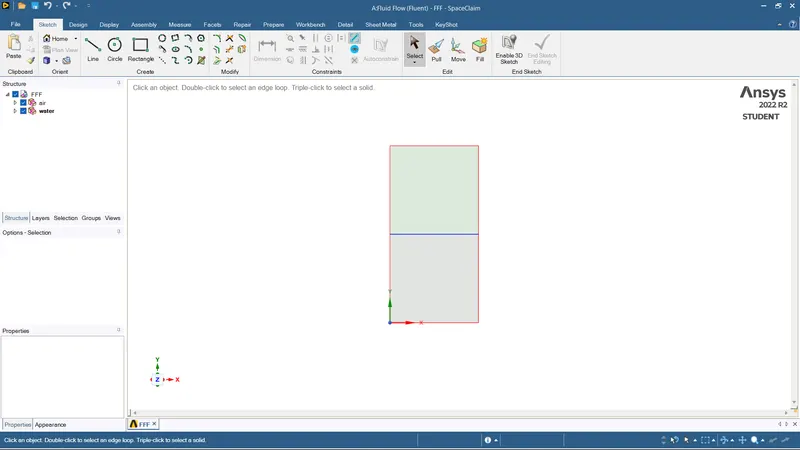
Open Spaceclain to create the geometry
Geometry:
Create the interface of water and air.
Meshing:
Setup:
Solver:
Viscous - Laminar
Transient state is preferred over steady state, To see how the interface happens when two fluid interacts with each other.
Density based.
Gravity = 9.8m/s^2.
Materials
Air:
Density = 1.225 kg/m^3
Viscosity = 1.7894e-05 kg/m-s
Water:
Density = 998.2 kg/m^3
Viscosity = 0.001003 kg/m-s
Time step size= 0.005
Time steps= 1000
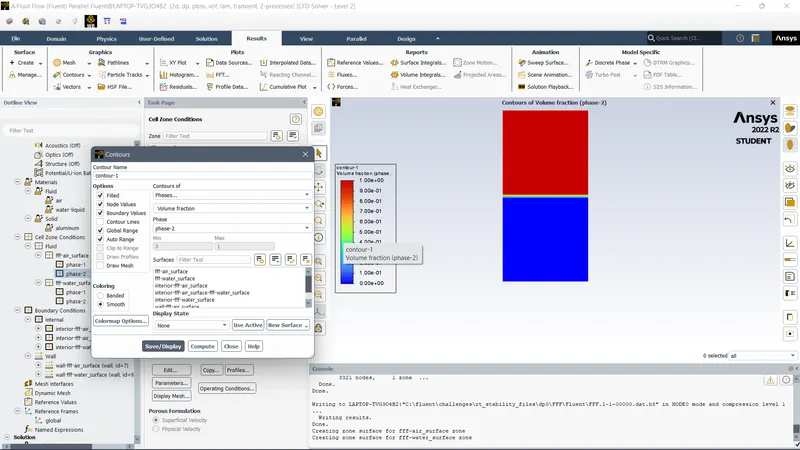
Patch the surafecs with water as 0 and 1
Animation video:
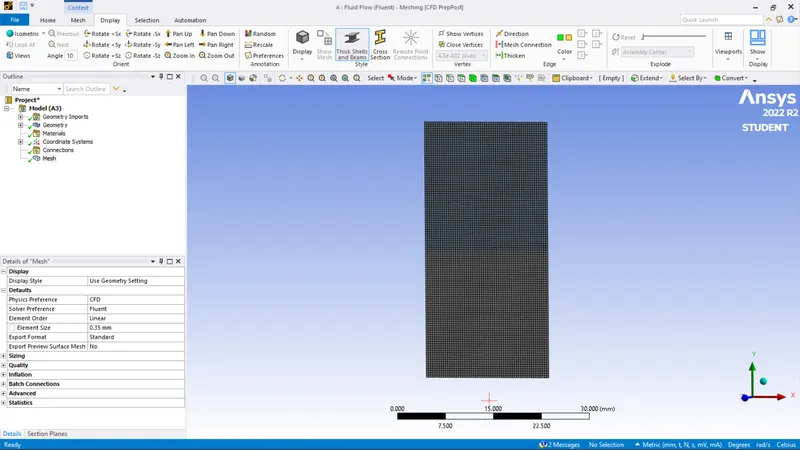
Refined Mesh:
Size: 0.35 mm
Patch the surfaces
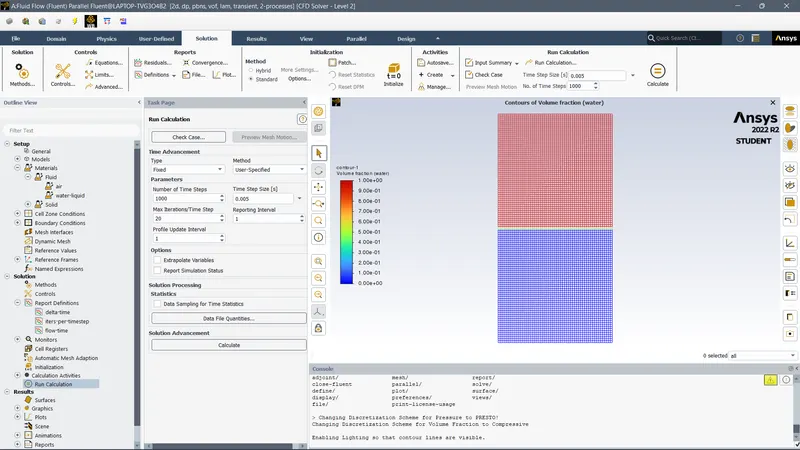
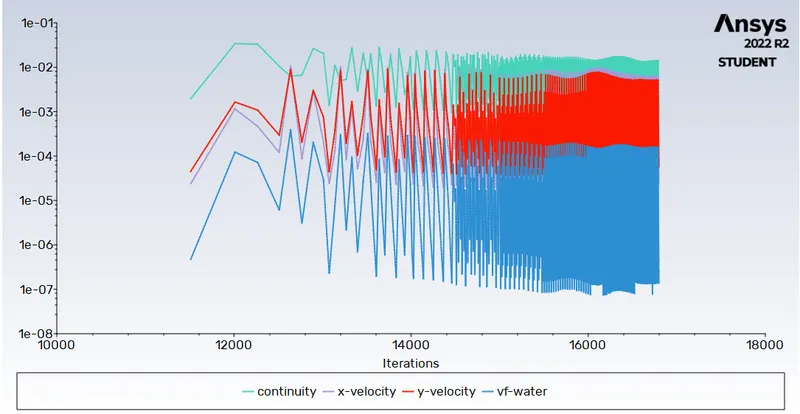
residulas:
Animation:
Creating user defined material:
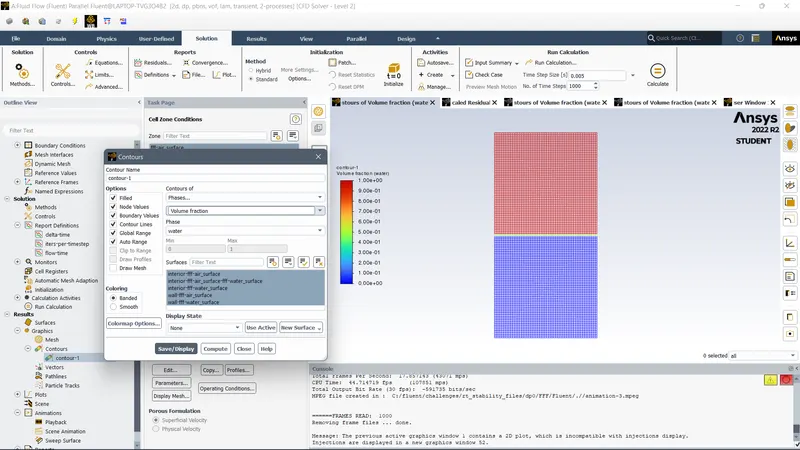
Patch the surfaces:
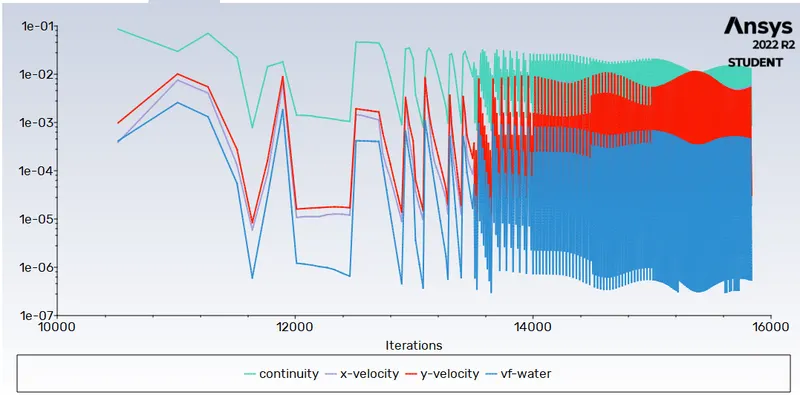
Residuals:
Animation video:
Atwood number:
It is dimensionless number defined as the ratio of difference between densities of the two fluids and to the sum of two fluids.
`A= (rho_1 - rho_2)/(rho_1 + rho_2)`
For air and water interface:
A = (998.2 - 1.25) / (998.2 + 1.25) = 0.997
For air and user defined interface:
A = (998.2 - 400) / (998.2 + 400) = 0.427
Atwood number on instability:
Rayleigh–Taylor instability at high Atwood numbers is characterized by rapid development of instability due to the increasing growth rates, larger asymmetry in the mixing region.
Conclusion:
Obtained the animation for the rayleigh taylor instability.
Atwood number is obtained for both the cases.