Week 5 - Rayleigh Taylor Instability
Rayleigh-Taylor Instability
Aim:
To perform Rayleigh-Taylor instability CFD simulation using Ansys Fluent and to understand its flow instability.
Objectives:
* To Develop a CFD model for Numerical case setup to perform Rayleigh-Taylor Instability(RTI) problem using Ansys Fluent.
* To conduct Grid independency test with base mesh & refined mesh to understand the variation with a better resolution in RTI.
* To define Atwood number and understand the effect of changing density(changes in atwood number) in the refined simulation.
Introduction:
Rayleigh-Taylor Instability,
Rayleigh-Taylor (RT) instability is a phenomena in which heavier fluid is superposed over a lighter one in a gravitational field where the fluid interface is unstable.
Any perturbation of this interface will in general develop with time, exhibiting the penetration of both heavier and lighter fluids into one another.
The RT instability due to the gravitational field was initially proposed by Rayleigh and subsequently has been applied to all fluids by Taylor.
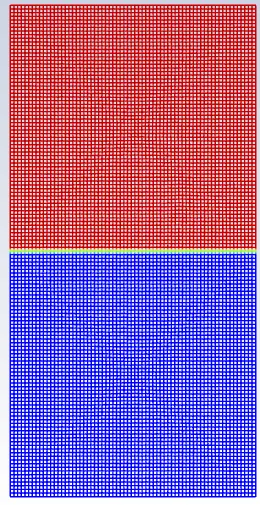
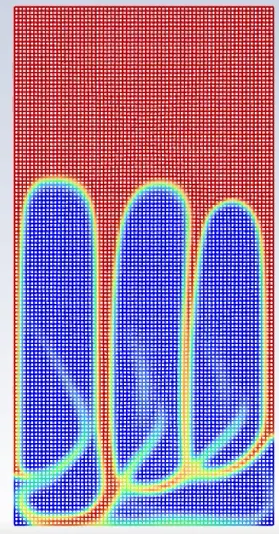
Before Instability After Instability
Red colour indicates heavier fluid , whereas Blue colour indicates lighter fluid.The Figure shown is before and after Instability,
* Initially at time t= 0, the system of two fluids is in hydrostatic equlibrium. The denser fluid at top of lighter fluid in a constant gravitational field.
* As the Simulation is set transient (time dependent), perturbation(changes) develops at the interface. These changes grow rapidly as the denser fluid accelerates to move in a downward direction. Near boundaries heavier fluid pushes the lighter fluid and moves downward, which in turn lets lighter fluid to move in upward direction.
* Pressure imbalances on either side which drives the flow. The flow is generally driven by pressure gradients below and top of the fluid.
* In general, the density dissimilarity between two fluids determines the subsequent non-linear Rayleigh-Taylor instabilities.
Atwood number:
The Atwood number is a dimensionless number in fluid dynamics used in the study of hydrodynamic instabilities in density-stratified flows. The Atwood number equals the ratio of the difference in mass densities to their sum.
`A = (rho2 - rho1)/(rho2+rho1)`
where,
`rho1`= density of lighter fluid
`rho2` = density of heavier fluid
Case studies:
Case study 1: Effect of mesh refinement over CFD results.
*In this study, the results obtained from Case 1 and Case 2 will be evaluated on the basis of mesh refinement.
Case study 2: Effect of Atwood number over Rayleigh-Taylor instabilities.
*For same mesh characteristics the two case set-up's Case 2 and Case 3 with different Atwood number(lighter fluids with different densities)will be evaluated to understand the effect on Rayleigh-Taylor instabilities.
Model and approach
Pre-Processing:
Geometry:
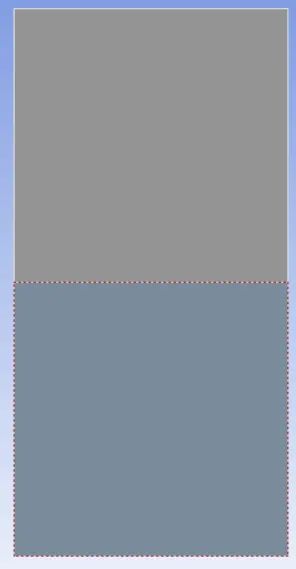
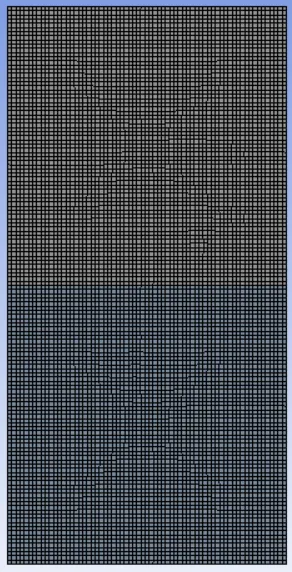
* Geometry is created using SpaceClaim with two different components (surfaces) named as "air" and "water".
* The dimensions of the constraint domain is 20 x 20 mm for each surface. Both surfaces are equal in dimension.
* The interface between the surface is shared using "share topology" to have a conformal mesh and to share information through the interface.
 >>
>> 
Case set-up:
* Transient state calculation.
Why not steady-state calculation?
The steady state calculations are useful when the study is focused to calculate and simulate the end results. Here in this study, the instabilities information is sensitive and completely time-dependent. At each and every time step, the instabilities grow exponentially. Eventhough steady state simulation is capable to capture those instabilities but the results would not be time-accurate. So we use transient state calculation with reduced time-steps can capture these instabilities at each and every time-steps and time dependent results can be obtained.
* Gravity is enabled in -9.81 in Y-axis.
* Multiphase model is turned on along with volume of fluid and number of Eulerian phases is chosen as 2. Accordingly, implicit scheme is selected.
* Viscous model - Laminar
* After initialising, Patch to be done for the volume of the two phases is performed before start of the simulation. Phase used for patching is water and volume fraction of 1.
| Base mesh | Refined mesh |
Refined mesh with change in atwood number |
|
| Element size | 3200 | 8948 | 8948 |
| Density of phase1 `(kg)/(m^3)` | Air - 1.225 | Air - 1.225 | 400 |
|
Density of phase2`(kg)/(m^3)` |
Water - 998.2 | Water - 998.2 | Water - 998.2 |
| Atwood number | 0.9975 | 0.9975 | 0.4278 |
| Link of animation file | https://drive.google.com/file/d/1SzmlSkTkV-afGSHiwU3M0vl2N-nEkMT7/view?usp=sharing | https://drive.google.com/file/d/15c4zfcNx-ns-EFgZj3X-VDJkPbkBXWMf/view?usp=sharing | https://drive.google.com/file/d/1fTD7LW79AWUJWLsECAcv83-t8eDFGoq4/view?usp=sharing |
The variation of Atwood number has direct impact on the perturbation amplitude and evolution of interface growth. The implementation of finer mesh and smaller time-steps gave promising visualization(better resolution) of Rayleigh-Taylor instability.
* In case1, basemesh produced initial results and gave confirmation about the case set-up.
The results obtained using base mesh lack in resolution of the numerical solution.
It seems like most of the instabilities are averaged and constructed as an increment on time-step.
The initial changes in the interface is asymmetrical and pre-maturely much unstable.
The interface is bit thicker because of coarser mesh, which has cell-centroids spaced bit away from the interface. As a function of time increment the interface gets overly spread due to numerical diffusion within the interfaces.
This causes inappropriate capture of instabilities at the interface.
* The case with finer mesh resulted in good resolution of the numerical solution due to small/finer interface. This is because more number of cells capture the volume of fluid and provides fluidity to numerical solution.
* case 3 with smaller Atwood number, the density dissimilarity between the two sides of the interface is small and the density distribution of the upper and lower layer is nearly symmetrical. The initial density stratification plays a dominant role and the expansion compression effect has a little influence.
* But in case 2 the stabilization effect of the initial density stratification decreases and the instability caused by expansion compression effect becomes more significant. as atwood number is greater when compared to case 3.
- The evolution of interface grows faster with increase in Atwood number.
- Larger Atwood number results in larger amplitude of perturbation.
Conclusion:
In this study of Rayleigh Taylor's Instability, the transient simulation approach was implemented. For the grid dependency, the interface thickness has significant impact on numerical diffusion. The interface with mesh refinement produces better results than Base mesh whereas, the variation of Atwood number has direct impact on the perturbation amplitude and evolution of interface growth.The evolution of interface grows faster with increase in Atwood number. Larger Atwood number results in larger amplitude of perturbation.The implementation of finer mesh and smaller time-steps gave better Resolution for the visualization of Rayleigh-Taylor instability.