Week 5 - Rayleigh Taylor Instability
Aim:
- To simulate the Rayleigh Taylor Instability in Ansys Workbench Fluent.
Description:
- Rayleigh Taylor Instability (RTI) is a phenomenon that occurs at the interface of fluids of different density wherein the lighter fluid pushes the heavier fluid due to the density difference. It is a dynamic process wherein the system tries to reduce its combined potential energy.
- Initially the system is in a state of hydrostatic equilibrium, in which the heavier fluid(ex: water) sits atop a lighter fluid(ex: air) in a constant gravitational field. As the RTI develops, the initial perturbations progress from a linear growth phase, eventually developing "plumes" flowing upwards(in the gravitational buoyancy sense) and "spikes" falling downwards. In the linear phase, equations can be linearized and the amplitude of perturbations is growing exponentially with time. In the non-linear phase, the perturbation amplitude is too large for the non-linear terms to be neglected. In general, the density disparity between the fluids determines the structure of the subsequent non-linear RT instability flows (assuming other variables such as surface tension and viscosity are negligible here).
- Examples include supernova, water suspended atop oil, mushroom clouds formed due to volcanic eruptions.
CFD models based on mathematical analysis of Rayleigh Taylor waves:
1. Mass diffusion model:
- The mass diffusion equation describes the transport of mass and energy due to model viscosity and hence drives actual mixing in the fluids. Even if any configuration is Rayleigh-Taylor unstable, the diffusion process could be responsible for significant mixing if the viscosity is sufficiently large.
2. Single fluid model:
Potential flow model
- This model is valid for all instability changes from the linear stage through the early non-linear to the asymptotic but limited to Atwood number = 1. In this model, single-mode perturbation expands the flow equations to second-order around the bubble tips, hence obtaining an ordinary differential equation for the bubble velocity.
Buoyancy drag model
- It is valid for every Atwood number but limited to the non-linear stages of the instability. It uses ordinary differential equations to evolve the width of the mixing layer. The bubble, or spike, amplitudes are described by balancing the inertia, buoyancy and drag forces. These models cannot model multiple mixing interfaces; cannot be easily extended to 2 or 3 dimensions, and as a rule, do not address demixing, also known as counter gradient transport, i.e. reduction of total fluid masses within the mixing zone. To address the above problems, two-fluid(or multi-fluid)models have to be used.
Besnard-Harlow-Rauenzahn(BHR)
- It is a more advanced version of the single-fluid model. The BHR model is based upon the evolution equations arising from second-order correlations and gradient-diffusion approximations. Using a mass-weighted averaged decomposition, the original BHR model includes full transport equations for the Reynold stresses, turbulent mass-flux velocity, density fluctuations, and the turbulent kinetic energy dissipation rate.
3. Multi-Fluid model:
- These models use a separate set of equations for each fluid in addition to the main flow equations and provide an accurate modeling framework for demixing by correctly capturing the relative motion of the different fluid fragments.
- The first step for the development of turbulence models is to perform Reynold averaging of the governing equations and resultant terms.
Two equation K-L turbulence model:
- The K-L turbulence model involves equations for turbulent kinetic energy K and turbulent length scale L. The starting point for deriving the model equations are the buoyancy-drag models for the self-similar growth of RT instabilities.
Three-equation K-L-a turbulence model:
- The three equation model was developed as an extension to the two-equation K-L model by including a third equation for the turbulent mass-flux velocity.
Four-equation K-L-a-b turbulence model:
- The four equation model was developed as an extension to the three-equation K-L model by including a fourth equation for density-specific volume covariance. The model can accurately reflect the effects of the changes in the density fluctuations.
Simulation Procedure:
- Open Ansys workbench drag the ansys fluent to the main window.
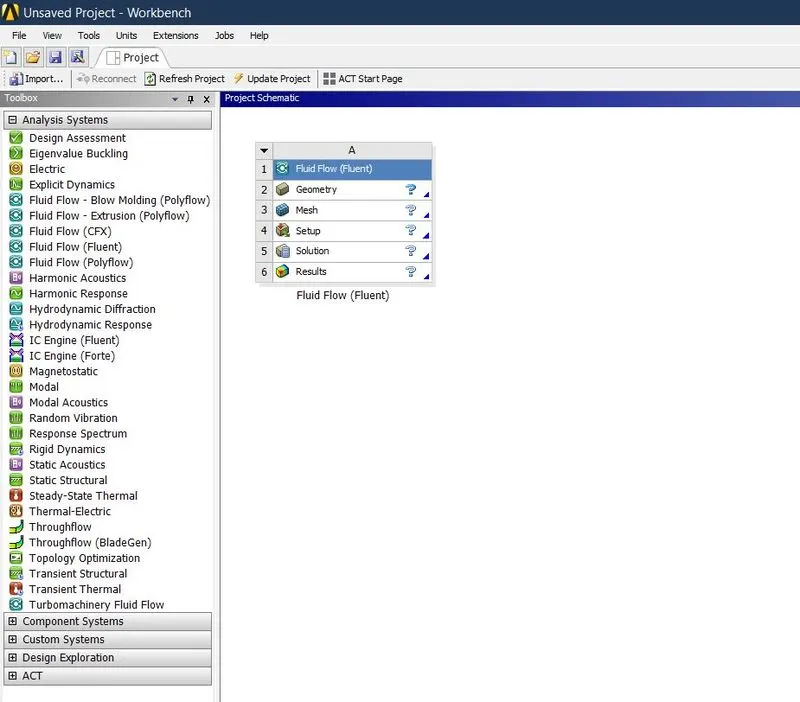
- Go to the geometry to create a geometry.
- Slect new sketch and xy plane to draw a square with appropriate dimension and then select a pull option to make a drawing into surface and then select the surface move into new component and named the new component as air.
- Then draw another square with appropriate dimension again use pull tool to make into surface then move the surface into new component then name that new component as water.
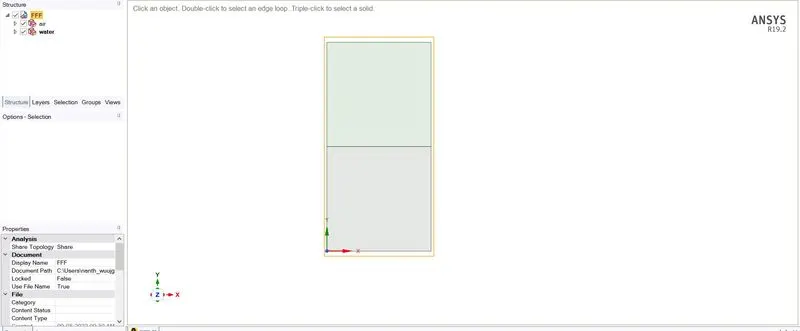
- Go to workbench option click share option to share the informtion between two surfaces.
- Then go to mesh in the main window then change the mesh size as 0.5 mm foe the base line mesh then generate the mesh. For the next refinement change the mesh size as 0.2 mm.
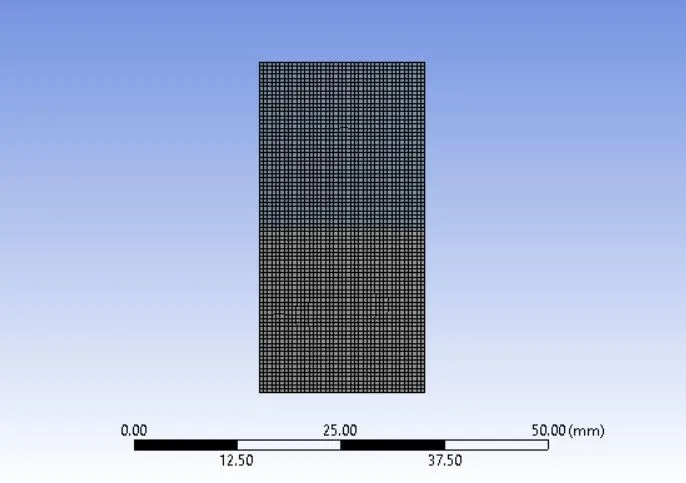
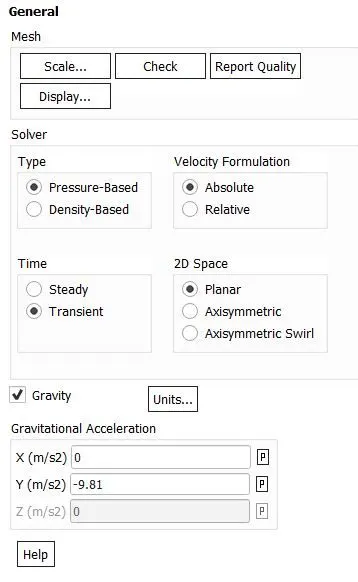
- Update the meshing in the main window, then go to the setup select the Laminar-Transient - Pressure based solver to solve the Rayleigh Taylor Instability. Select gravity enter the gravit acceleration value as -9.81 m/s^2 in y-axis.
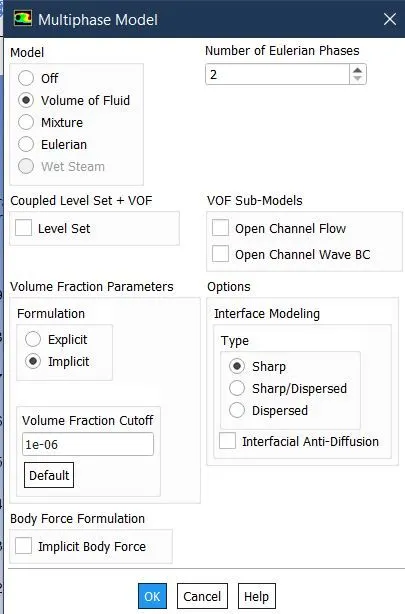
- Go to setting up physics select the Multiphase option in model, change the model into volume of Fuid and chnge the volume fraction parameter as implicit method.
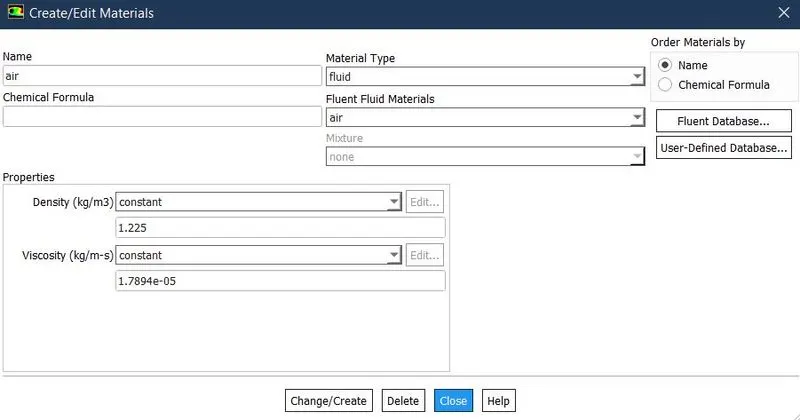
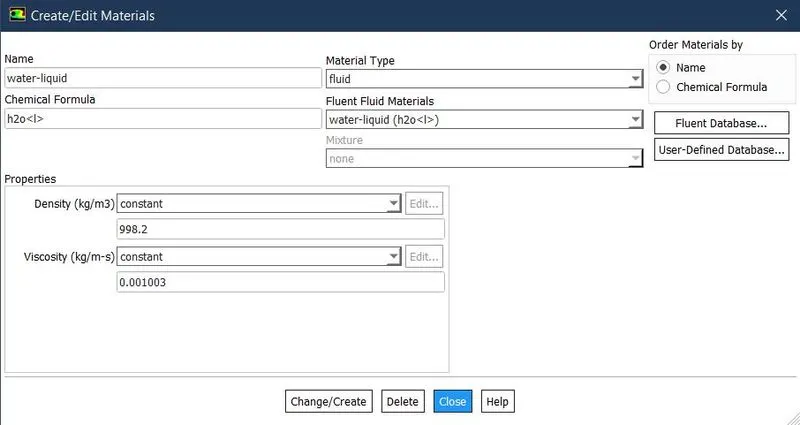
- Go to material select the two material (Air and Water) in the fluent data base.
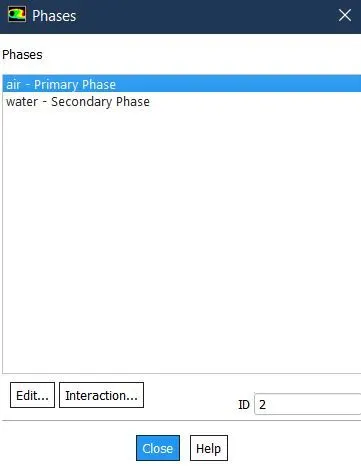
- Go to phase select primary phase as air and secondary phase as water.
- Intialize the simulation then patch select the patch as water select volume fraction value as 1 for water and 0 for air.


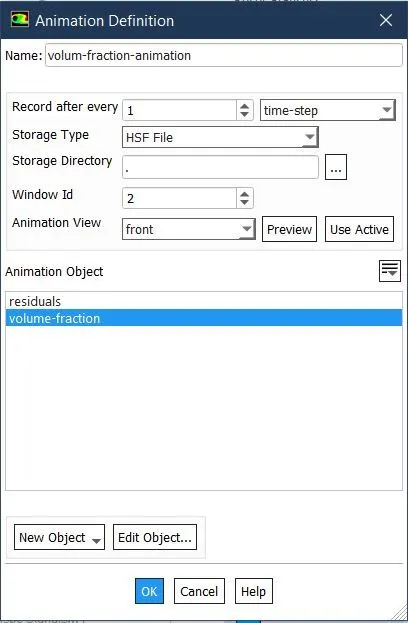
- Create a contour plot for volume fraction for every timestep. And then create ananimation file for volume fraction for every timestep.
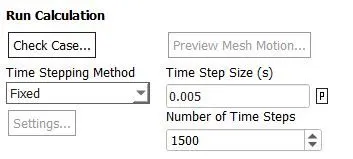
- Set the Time step size and number of time steps.Run the simulation.
- Repet the same procedure for next refinment and the user deined material.
Results:
Baseline mesh:
Mesh Size = 0.5mm
Materials : Air and Water.
Reidual:
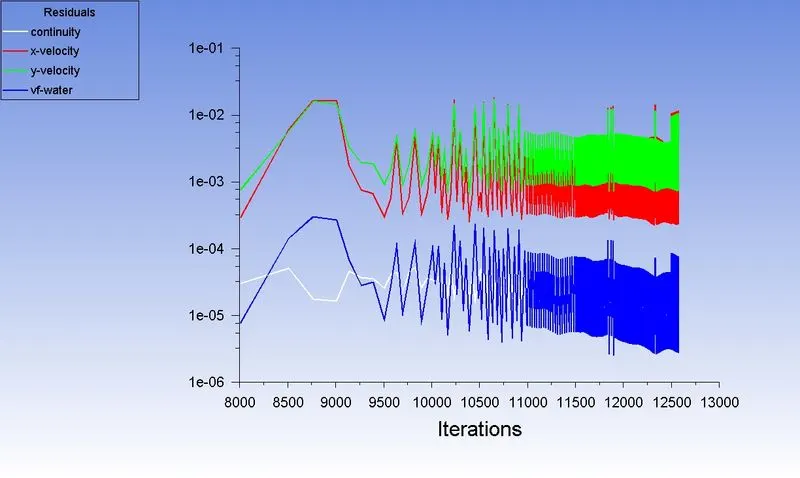
Volume fraction Contour Plot:
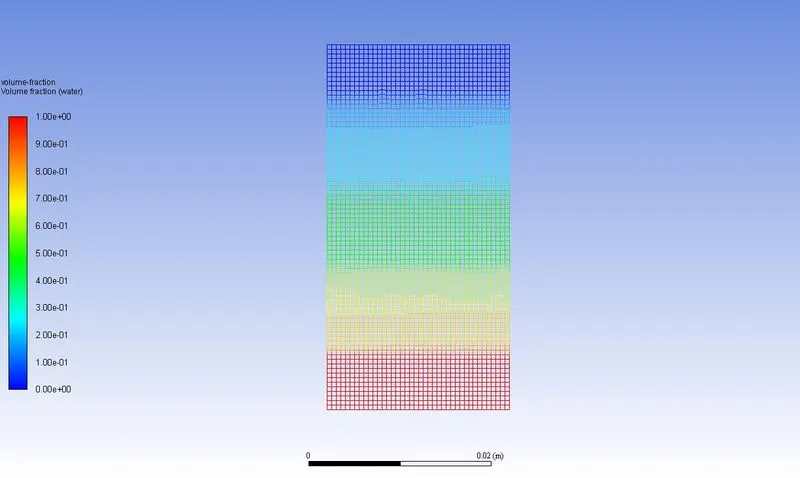
Volume fraction Animation:
https://drive.google.com/file/d/1JqsIKmAGg32Rh8NeeJVCArWLQThEX_7O/view?usp=sharing
Refined mesh:
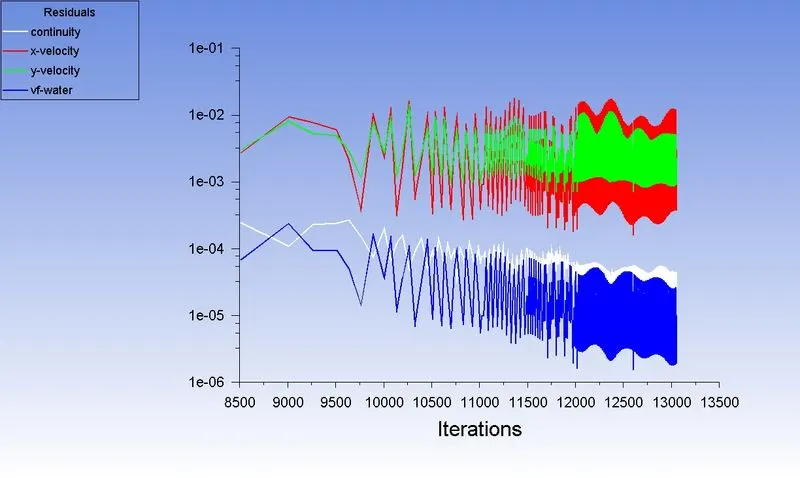
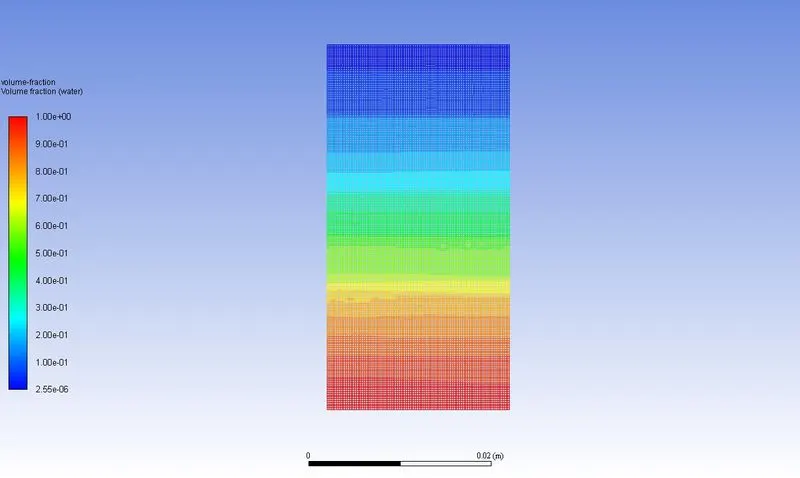
Mesh Size = 0.2mm
Materials : Air and Water.
Reidual:
Volume fraction Contour Plot:
Volume fraction Animation:
https://drive.google.com/file/d/1ts9IbcDtnuc0Vdfdk4LZLjM742eekWWl/view?usp=sharing
Refined mesh:
Mesh Size = 0.2mm
Materials : Air and User defined.
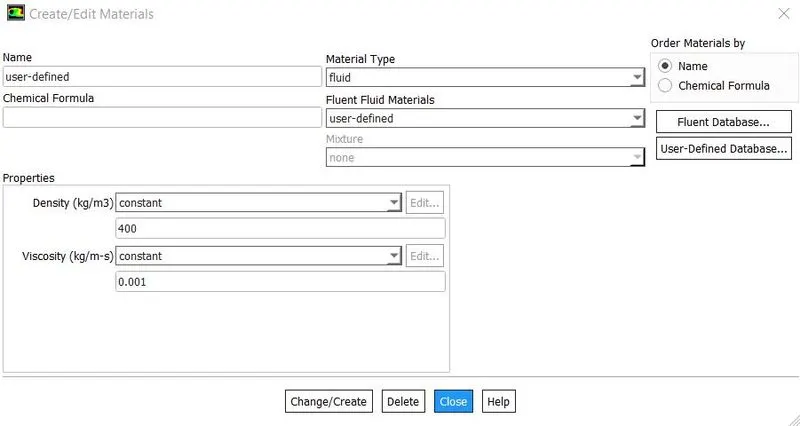
Reidual:
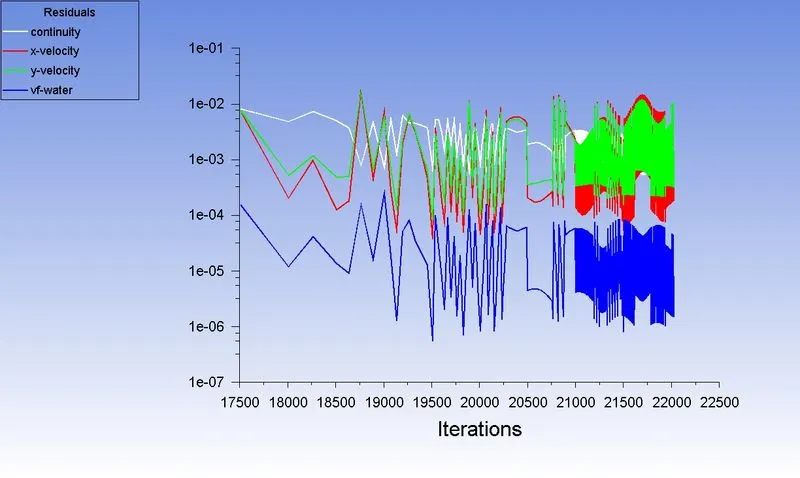
Volume fraction Contour Plot:
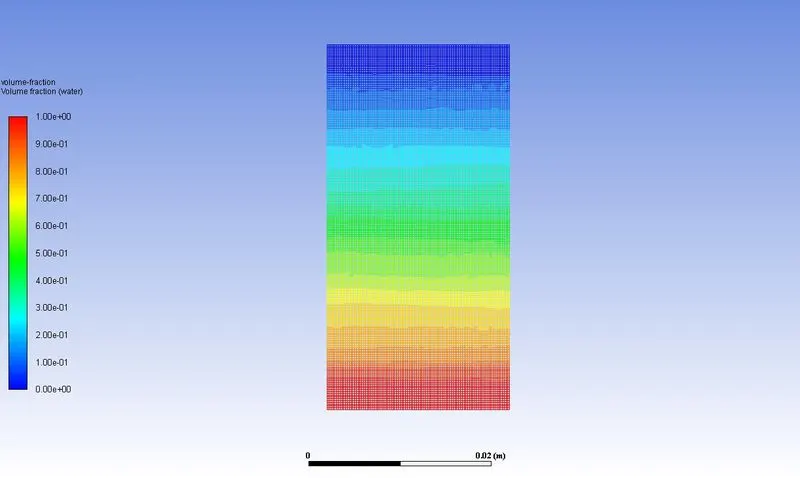
Volume fraction Animation:
https://drive.google.com/file/d/1uKJ8-5-nKFPuDv2TSng3aF6yGAY3S_5_/view?usp=sharing
Atwood Number
It is a dimensionless number that is used to study hydrodynamic instabilities in density stratified flows.
`A = (ρ1 − ρ2)/ (ρ1 + ρ2 )`
`ρ1` is density of heavier fluid
`ρ2` is density of lighter fluid
For Air-water Rayleigh Taylor Instability,
`ρ1 = 998.2`kg/m^3 [Water density]
`ρ2 = 1.225`kg/m^3 [Air density]
A = (998.2-1.225)/(998.2+1.225)
A = 0.998
For water- User Defined material Rayleigh Taylor Instability,
`ρ1 = 998.2`kg/m^3 [Water density]
`ρ2 = 400` kg/m^3 [User Defined material density]
A = (998.2-400)/(998.2+400)
A = 0.428
Behaviour of Rayleigh Taylor Instability(RTI) on variation of Atwood number:
- RTI evolves in three distinct stages: Linear stability , mushroom head(falling) or bubble(rising) formation , long term evolution due to bubble merging and mixing. For low Atwood number, bubble and mushroom head shape is relatively symmetrical, the disturbances or perturbations are linear for a larger time. In contrast, for large Atwood number, bubble and mushroom head shape is less symmetrical, also it occurs very rapidly at an accelerating rate which leads to a non linear growth rate.