Week 5 - Rayleigh Taylor Instability
Aim: To Perform the Rayleigh Taylor instability simulation on two different fluids using Ansys 21R1.The aim of this report is to perform grid dependency test on Rayleigh Taylor Instability for 2 different mesh size, and compare the results for the variation in Atwood Number.
- Perform the Rayleigh Taylor instability simulation for 2 different mesh sizes with the base mesh being 0.5 mm and Compare the results by showing the animations.
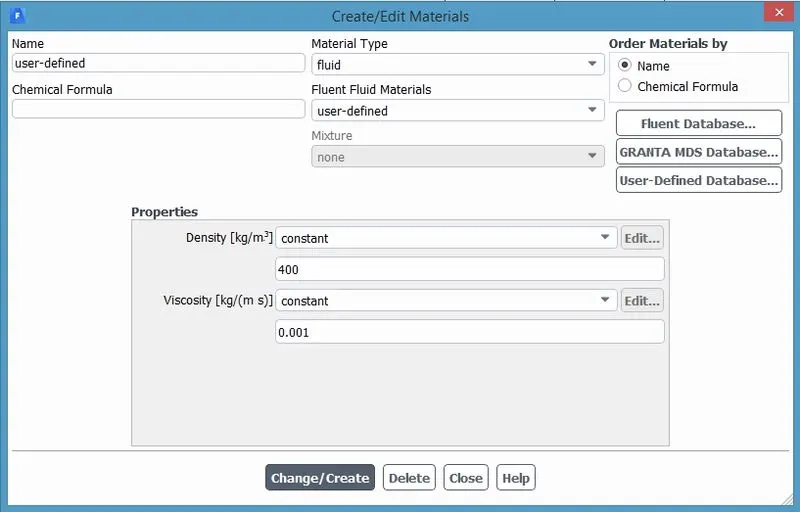
- Run one more simulation with water and user-defined material(density = 400 kg/m3, viscosity = 0.001 kg/m-s) for refined mesh.
Introduction:
Rayleigh-Taylor instability:
It is occurance of instability between two fluids with different densities at the interface.Rayleigh Taylor instability is based on the densities of the fluid and its shearing.sir Rayleigh observed that when two fluids of different densities mixed together(i.e)when one fluid is above another fluid the interface becomes unstable and the heavier fluid comes down due to gravity.And he observed different patterns of interface disturbances depending on the difference between densities of the fluid.In the following report we are going to simulate two different fluids with the water i.e air and water.
Practical applications of Rayleigh-Taylor in CFD:
Flow instabilities are used to increase the heat and mass transfer rates as well as to fuse the fluids of dissimilar properties (viscosity, elasticity, density, etc.). In other technological applications, these instabilities are accountable to unstable the multilayer and free-surface flows.
Mass diffusion model:
Mass diffusion model is used to find the mixing efficiency of the fluids.This model is mostly used in the pharmaseutical ,Food and chemical industries.The mole fractions are known and the total mole fraction is found after mixing.This model helps to know how well and fast the mixing can happen.
Buoyancy–drag model
A general buoyancy–drag model is used for the evolution of the Rayleigh–Taylor and Richtmyer–Meshkov instabilities.This model is used to find how the perturbations grow i.e it describes the instabilities.These perturbations are described by Buoyancy–drag equations.
It is known that a heavier fluid on the top of lighter fluid causes disturbances or instabilities .In this we are going to look at hown the instabilities develop and grow.Three cases are considered for the simulation.
Problem solving and modelling approach:
Geometry creation:
- Creating box of dimensions 20,20mm and pull tool is used to create surface in space claim.
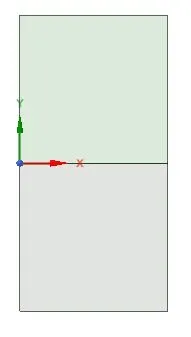
- Repeating the above procedure to create another surface adjacent to it.
Share topology:
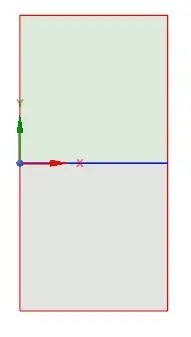
- check share topology is set to share and share is used to share the single edge between the above created surfaces.
- create the above two objects intwo components and name them.
- Perform Meshing.
CFD Case Setup
- Pressure based solver and Absolute velocity is used.
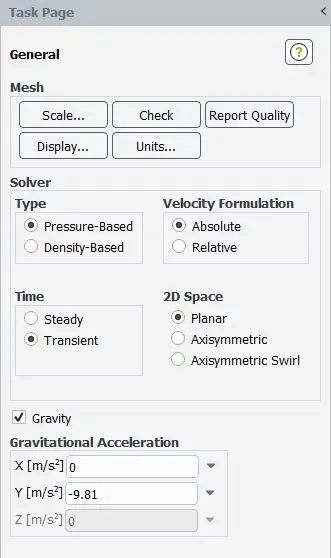
- Transient-state Calculation is performed.(Because it is unstable)
The mixing of the fluids with the heavy fluid on the top of the lighter fluid is unstable so transient state calculations are performed.The instabilities are never close to stable.The mixing becomes stable only after the heavy fluid reaching the bottom of light fluid due to gravity.
- Compressible fluid flow is chosen.
- Gravity is enabled in -ve Y axis and 9.81 value is given.
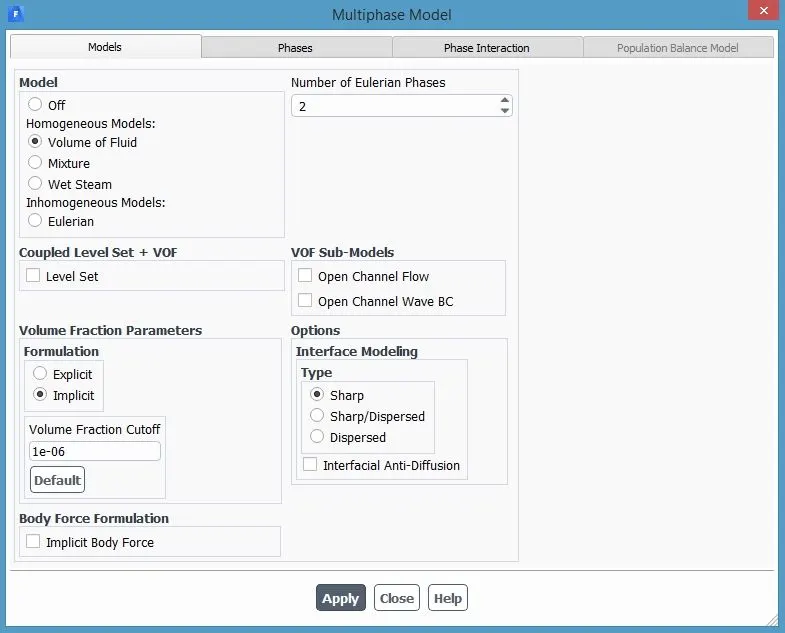
- Multiphase Model is turned on along with Volume of Fluid and number of Eulerian phases is chosen as and Implicit scheme is selected.
- Viscous model-Laminar is used.( As reynolds number is very small)
- Cell zone selected as Fluid-air;water-surface:water-liquid|Fluid-user defined;water-surface:water-liquid
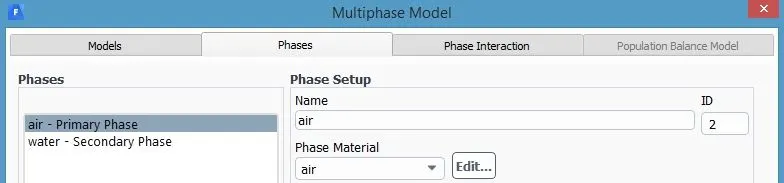
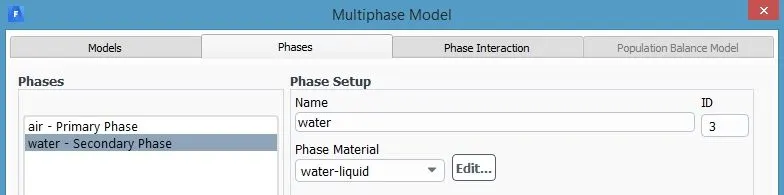
- Patching of the volume fraction of the two phases is performed before the start of simulation.
- patching was water and volume fraction of 1 is taken for water surface and 0 for air surface.This should be performed after Initialization.
- In Pressure velocity coupling SIMPLE scheme is used.
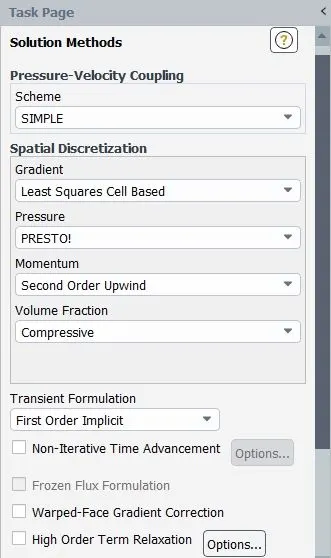
- Define the required plots or contours.
- run fluent solver.
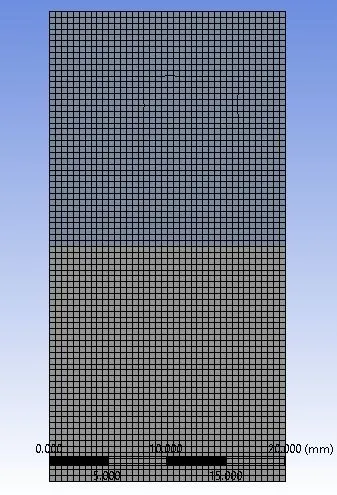
Case 1:Mesh size 0.5mm ,Materials Air,Water
Mesh:
Elements:3300
Nodes:3321
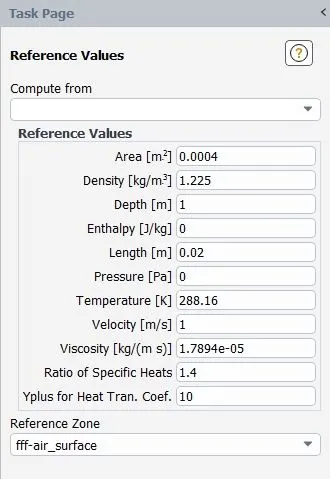
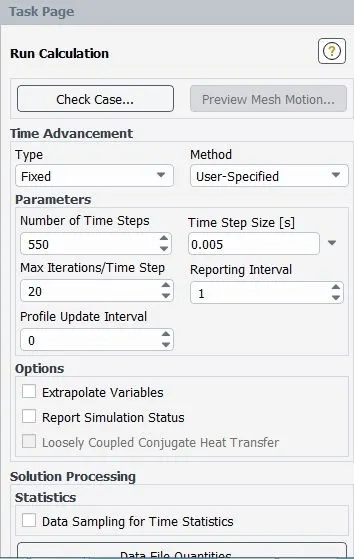
Residuals:
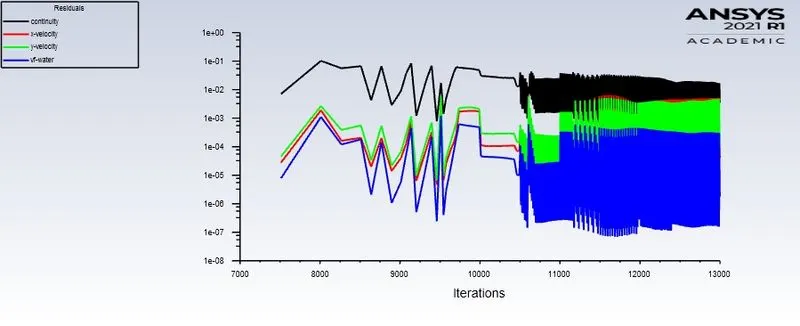
Animation of mixing of air and water with mesh size 0.5mm:
Case 2: Mesh size 0.2mm,Materials Air and water
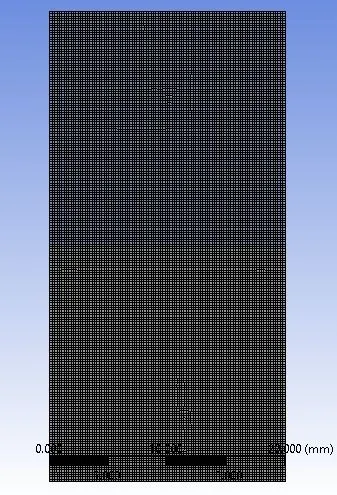
Mesh:
Elements:20,000
Nodes:20,301
Residuals:
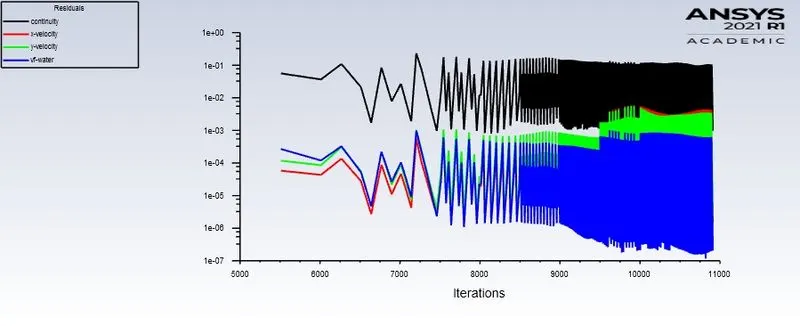
Animation of mixing of air and water with mesh size 0.2mm:
Case 3:Mesh size 0.2mm,Materials user defined and Water
Residuals:
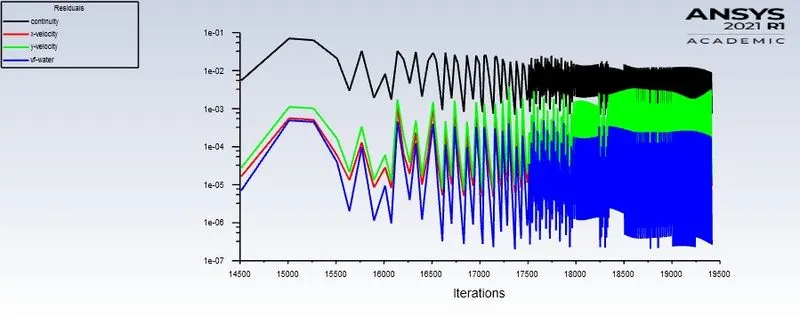
Animation of mixing of User defined material and water with mesh size 0.2mm:
Conclusion:
- The baseline Mesh simulation time is lesser than the refined mesh
- The detailing in the Baseline mesh is lesser than the detailing in the refined mesh
- When comparing the air,Water interface and user definedd material,Water interface The disturbances in the Air,water interface are quick and the vortex formed are large.The settling of these vortex takes less time.And the votexes are very less.The shearing of the fluids is more and the momentum exchange of fluids is more.The spikes of heavier fluid are long.
- In the User defined material and water interface many votexes are formed and the disturbances dont start quickly.There are many tiny disturbances at the start of instability.The shearing of the fluids is less and the momentum exchange of fluids is also less.Spikes of heavier fluid areshort.
- There is some symmetry in the disturbances above and below the interface unlike the air and Water interface.
- The disturbances are multi dimensional and the bubbles are slowly propogating through the fluid.
Atwood number:
The Atwood number is a dimensionless number in fluid dynamics used in the study of hydrodynamic instabilities.It is related to the density difference between two fluids which are in interaction.If the atwood number is small the differences between the densities of the two fluids is small.
A =`(rho_1-rho_2)/(rho_1+rho_2)`
`rho_1=`Density of heavier fluid
`rho_2=`Density of lighter fluid
- Atwood number for air and water is 0.9975
- Atwood number for User defined and water is 0.42857
- If the atwood number is small the interface disturbances are not spontaneous and there are more number of disturbances.
- If the atwood number is large or close to 1 the disturbances are spontaneous and there are less number of bubbles.