Week 5 - Rayleigh Taylor Instability
Rayleigh Taylor Instability
What are some practical CFD models that have been based on the mathematical analysis of Rayleigh Taylor waves?
Introduction
Rayleigh Taylor Instability (RTI) is a phenomenon that occurs at the interface of fluids of different density wherein the lighter fluid pushes the heavier fluid due to the density difference. It is a dynamic process wherein the system tries to reduce its combined potential energy.
Theory
Initially the system is in a state of hydrostatic equilibrium, in which the heavier fluid (ex: water) sits atop a lighter fluid (ex: air) in a constant gravitational field. As the RTI develops, the initial perturbations progress from a linear growth phase, eventually developing "plumes" flowing upwards (in the gravitational buoyancy sense) and "spikes" falling downwards. In the linear phase, equations can be linearized and the amplitude of perturbations is growing exponentially with time. In the non-linear phase, the perturbation amplitude is too large for the non-linear terms to be neglected. In general, the density disparity between the fluids determines the structure of the subsequent non-linear RT instability flows (assuming other variables such as surface tension and viscosity are negligible here).
Practical CFD models that are based on mathematical analysis of rayleigh taylor waves:
Kelvin-Helmholtz instability:
The theory predicts the onset of instability and transition to turbulent flow in fluids of different densities moving at various speeds. This instability occurs where there is a velocity shear or velocity difference between the interface of the two fluids.
Richtmyer-Meshkov instability:
This type of instability occurs when there is an impulsive accelaration between two fluids. This type of instability can occur when there is a shock at greater speeds. The development of the instability begins with small amplitude perturbations which initially grow linearly with time. This is followed by a nonlinear regime with bubbles appearing in the case of a light fluid penetrating a heavy fluid, and with spikes appearing in the case of a heavy fluid penetrating a light fluid. A chaotic regime eventually is reached and the two fluids mix. This instability can be considered the impulsive-acceleration limit of the Ryleigh- taylor instability.
Plateau-Rayleigh instability:
The Plateau-Rayleigh instability, often just called the Rayleigh instability, explains why and how a falling stream of fluid breaks up into smaller packets with the same volume but less surface area. It is related to the Ryleigh-taylor instability, and is part of a greater branch of fluid dynamics concerned with fluid thread breakup. This fluid instability is exploited in the design of a particular type of ink jet technology whereby a jet of liquid is perturbed into a steady stream of droplets.The driving force of the Plateau-Rayleigh instability is that liquids, by virtue of their surface tensions, tend to minimize their surface area. A considerable amount of work has been done recently on the final pinching profile by attacking it with self- similar solutions.
Rayleigh-taylor instability simulation:
The rayleigh taylor instability occurs when the interface of two fluids with different densities when the lighter fluid is pushing the heavier fluid. In this simulation there are 2 surfaces Place over each other.
Practical CFD models
SPH method (Smoother particle hydrodynaics)
Smoothed particle hydrodynamics (SPH) is a computational method used for simulating the mechanics of continuum media, such as solid mechanics and fluid flows.Smoothed particle hydrodynamics is being increasingly used to model fluid motion as well. This is due to several benefits over traditional grid-based techniques. First, SPH guarantees conservation of mass without extra computation since the particles themselves représent mass. Second, SPH computes pressure from weighted contributions of neighboring particles rather than by solving linear systems of equations. Finally, unlike grid-based techniques, which must track fluid boundaries, SPH creates a free surface for two-phase interacting fluids directly since the particles represent the denser fluid and empty space represents the lighter fluid.
SINGLE-FLUID MODEL
A typical approach used for the analysis of two-phase flows is a mixture model, Le. the individual fluid phases are assumed to behave as a flowing mixture described in terms of the mixture properties. The applied single-fluid model is a five-equation model consisting of the mass momentum and energy equations for a vapor/liquid mixture, and two equations describing the formation and growth of the liquid phase.
TWO-FLUID MODEL
in the two-fluid model separate sets of the governing equation for the vapor and liquid phases have been used. The interaction between the droplets and the heat exchange between the liquid phase and the solid boundary are not modelled here as well. Additionally, the velocity slip between vapor and the liquid phase is in this model taken into account.
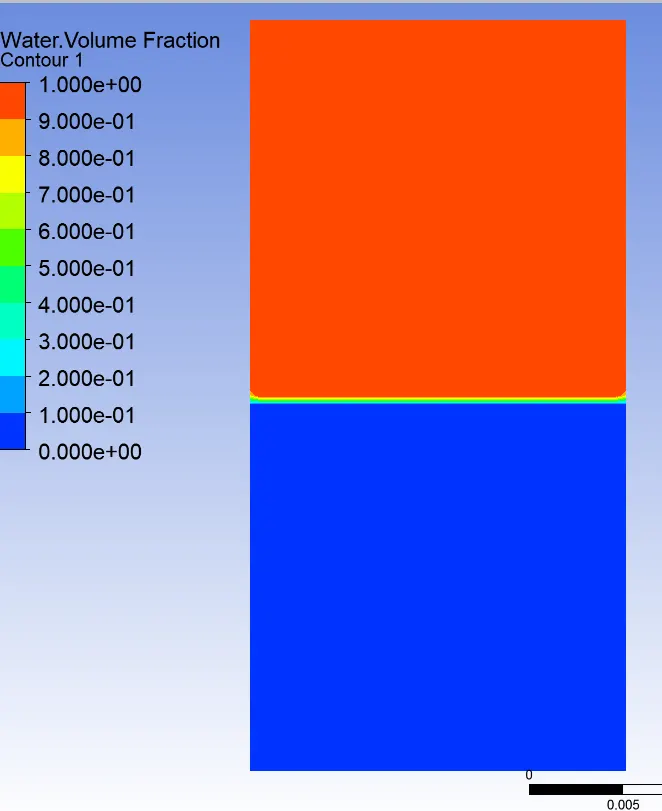
Perform the Rayleigh Taylor instability simulation for 2 different mesh sizes with the base mesh being 0.5 mm. Compare the results by showing the animations.
Case 1 : base mesh
Step1 : Create geometry
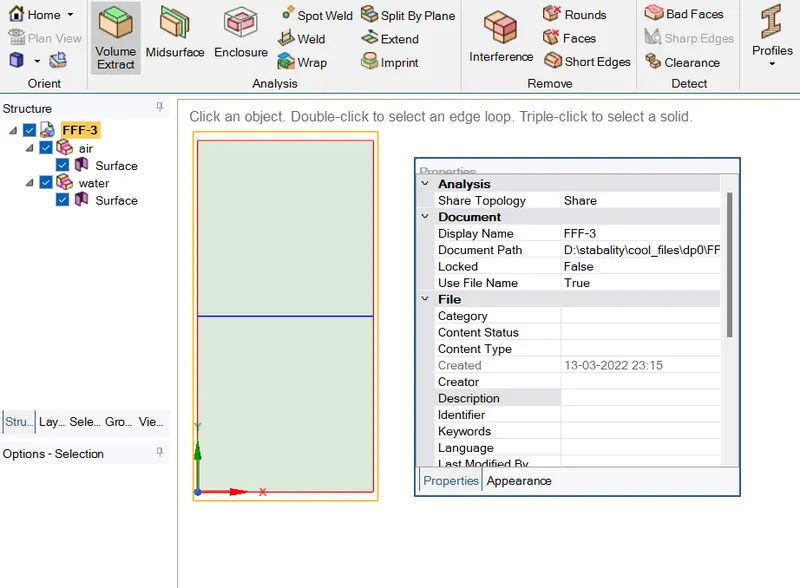
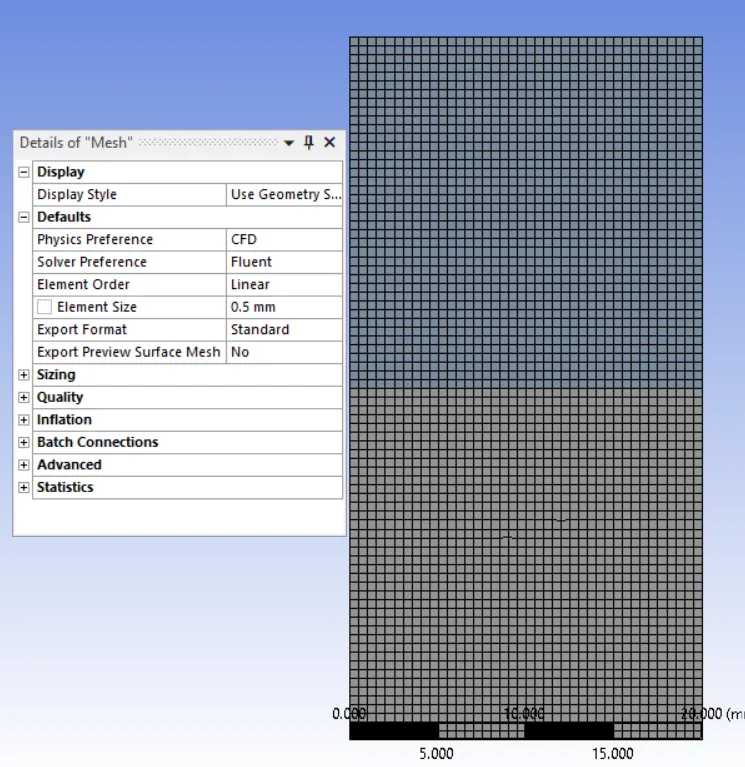
Step 2 : Meshing
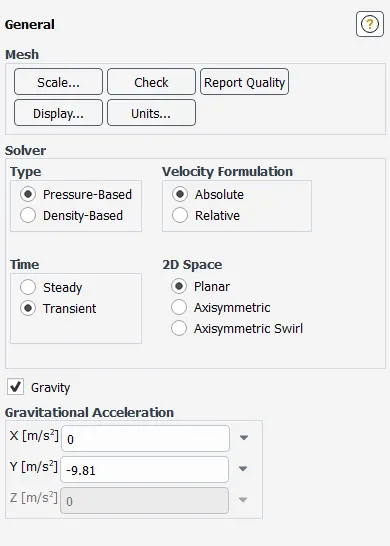
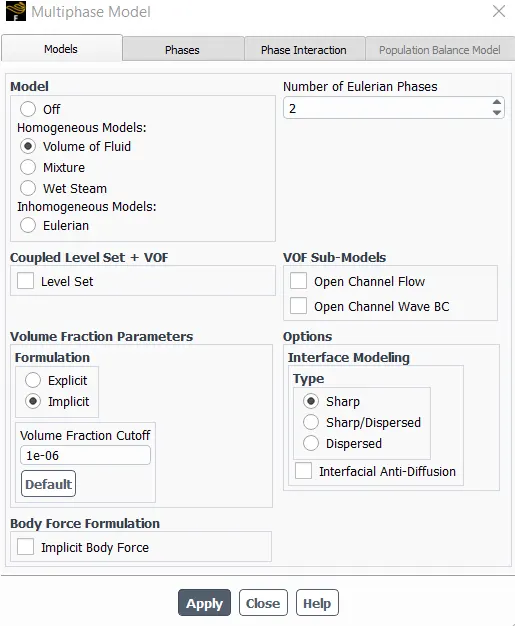
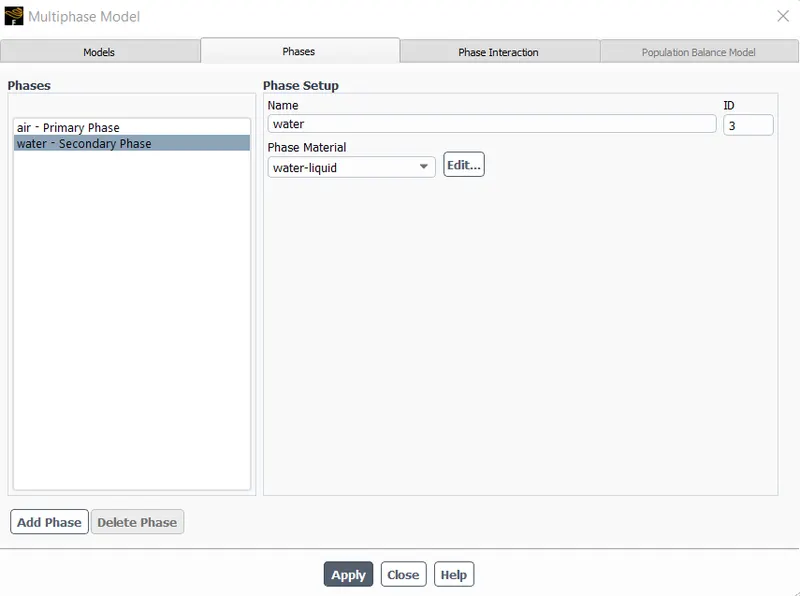
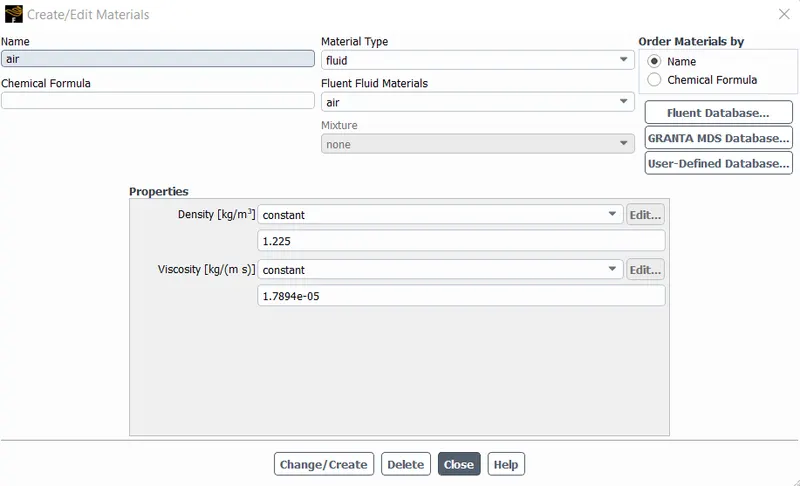
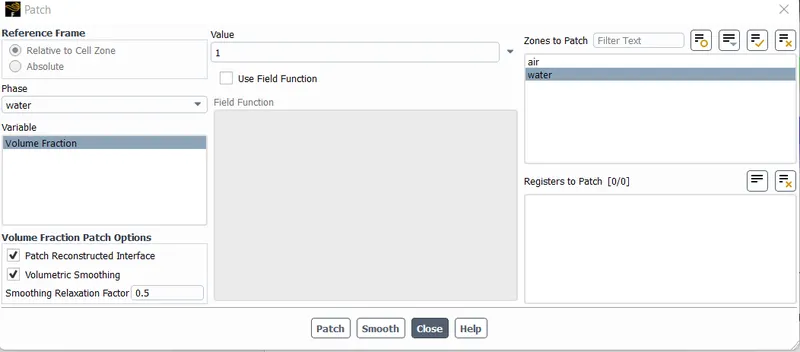
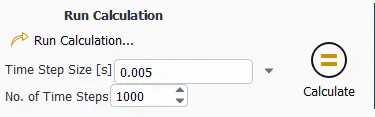
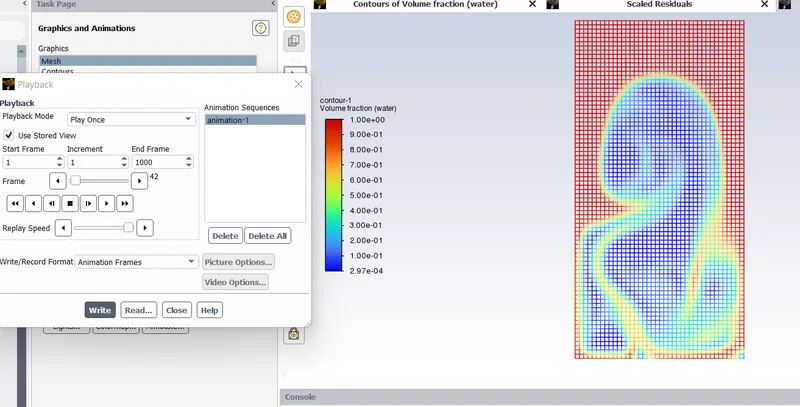
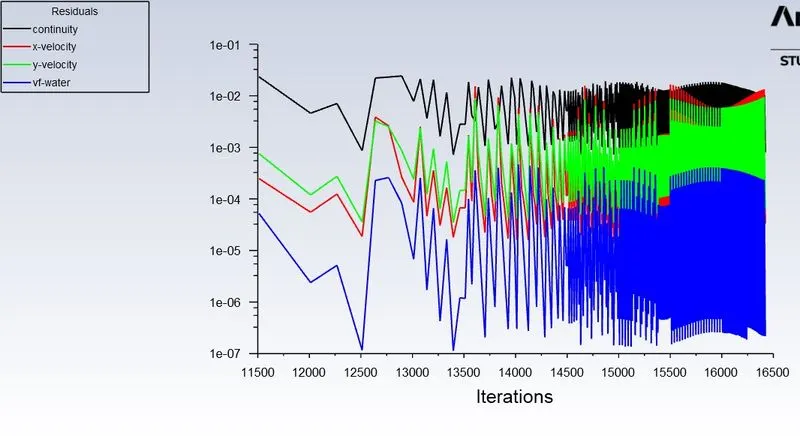
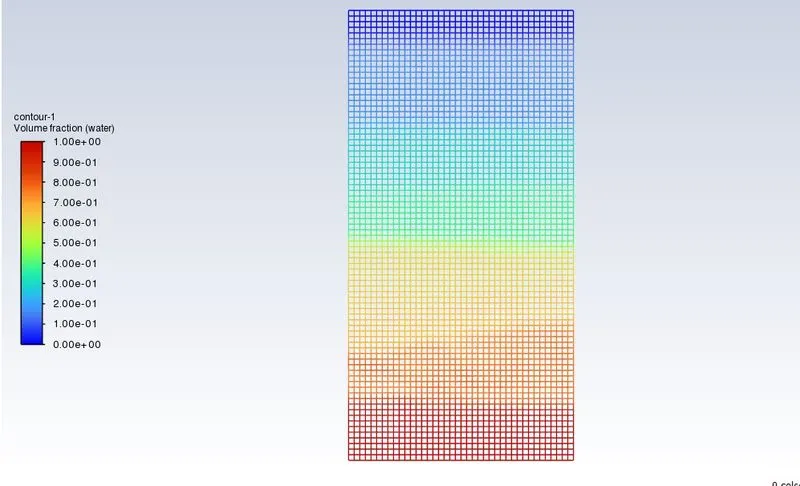
Youtube link for animation
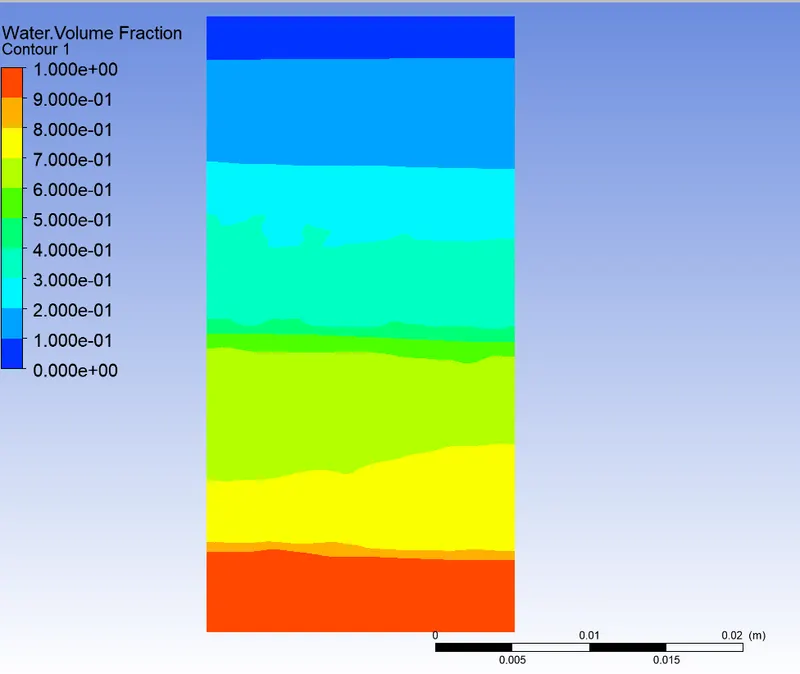
Case 2
refined mesh of 0.2mm
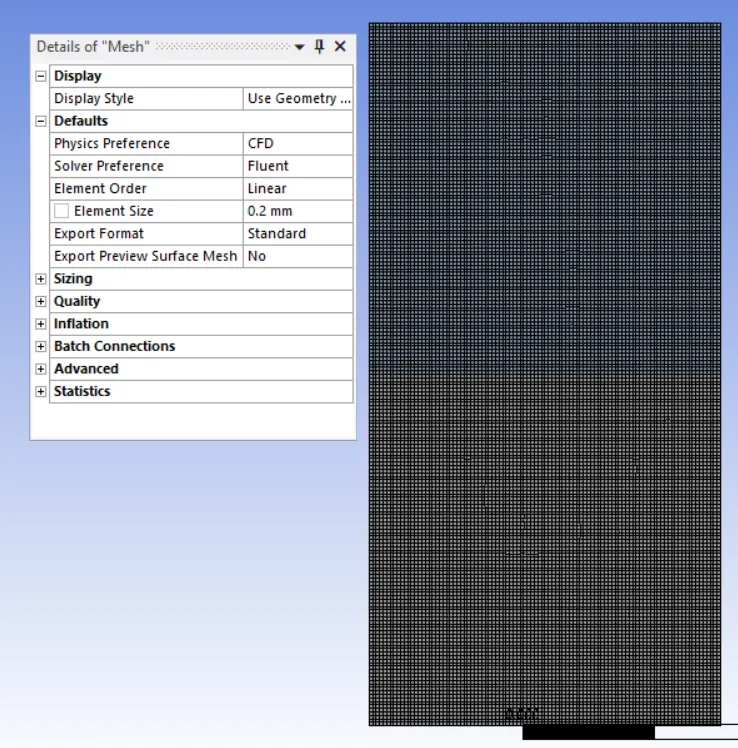
Youtube link for animation
Case3:
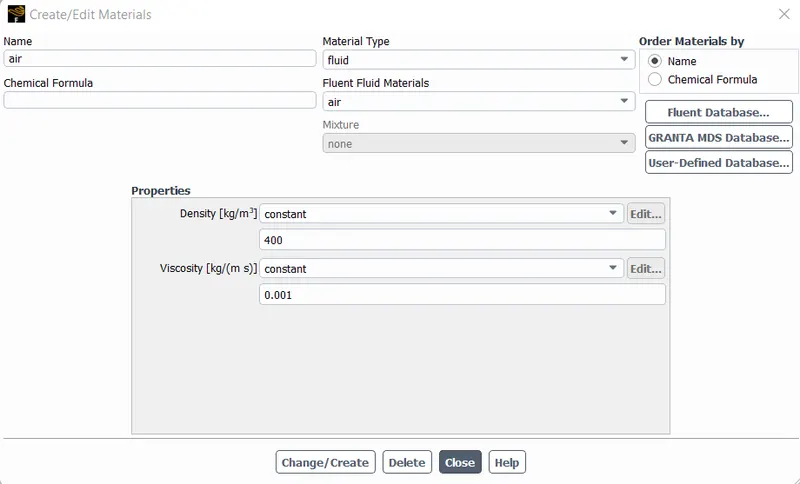
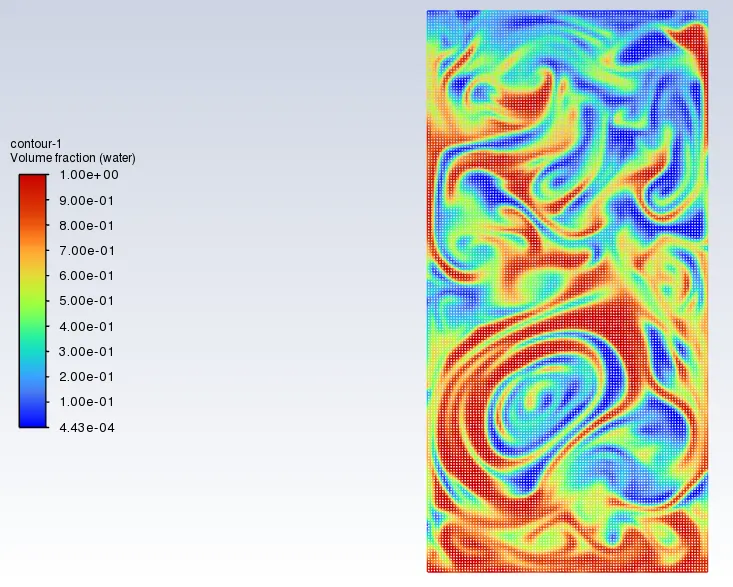
User defined case
density = 400 kg/m3, viscosity = 0.001 kg/m-s
mesh of 0.2mm
Youtube link for animation
Define the Atwood Number?
The Atwood number (A) is a dimensionless number in fluid dynamics used in the study of hydrodynamic instabilities in density stratified flows. It is a dimensionless density ratio defined as:
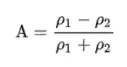
where
P1= density of heavier fluid
P2= density of lighter fluid
Atwood number is an important parameter in the study of Rayleigh-Taylor instability. For Atwood number close to 0, RT instability flows take the form asymmetric "finger" of fluid; for Atwood number close to 1, the much lighter fluid "below" the heavier fluid takes the form of larger bubble-like plumes.
The calculated Atwood number is close to 1 and from the simulation results, it is found that when high dense fluid i.e. water poured upon low dense fluid i.e. air under gravity, the formation of air bubble-like plumes takes place which travels towards upward region in the form of waves and some gets trapped at the lower regions during the initial stages, which afterward try to move towards upper region and at the end, both phases gets separated with some diffusivity left at the middle portion between them. Thus, the calculated Atwood number is validated for our simulation results
case 1:
heavier fluid (water)
density 1-998,2 kg/m^3
lighter fluid (air)
density 2-1225 kg/m^3
Atwood number(A) (density I density2)/(density 1+density2)
Atwood number(A)=0.996
case 2:
heavier fluid (water)
density 1-998.2 kg/m^3
lighter fluid (user-defined material)
density 2=400 kg/m^3
Atwood number(A) = (density 1-density2)/(density 1+density2)
Atwood number(A)=0.427
Find out the Atwood number for both the cases and explain how the variation in Atwood number in the above two cases affects the behavior of the instability?
Atwood number is an important parameter in the study of Rayleigh-Taylor instability. Simply, For Atwood number close to 0, RT instability flows take the form of symmetric "fingers" of fluid; for Atwood number close to 1, the much lighter fluid "below the heavier fluid takes the form of larger bubble-like plumes or At small density differences, 4,<0.1. up-welling (bubble') and down-welling ('spike') disturbances form a symmetrical mixing region that expands away from the initial position of the density interface, asymmetries in the penetration of rising bubbles and falling spikes are not readily apparent until Ap0.5.
so by the explaination above given we can see asymentric formmation of bubble like plumes we can say that the simulation is right as per Atwood number calculation
Conclusion :
The results is simulated according to the above questions
****************************************************************************************************