Week 5: Prandtl Meyer Shock problem
AIM:
To perform prandtl meyer shock problem.
Objective:
To do a literature search on what BC's are typically used for shock flow problems.
To describe the physics behind shock waves.
To study the effect of SGS parameter on shock location.
INTRODUCTION:
Prandtl Meyer expansion fan is a two dimensional simple wave. It is a centered expansion process that occurs when a supersonic flow turns around a convex corner. The fan consists of a finite number of Mach waves diverging from a sharp corners. When a flow turnsaround a smooth and circular corners, these waves can be extended backwards to meet a point.
Each wave in the expansion fan turns the flow gradually. Near the expansion fan,the flow accelerates and the Mach number increases, while the static pressure , temperature and density decreases. As the process is isentropic process, the total temperature, total pressure remains constant across the fan.
Shock wave:
In physics, a shock wave is a type of propagating disturbance that moves faster than the local speed of sound in the medium. Like an ordinary wave, a shock wave carries energy and can propagate through a medium but is characterized by an abrupt, nearly discontinuous, change in pressure, temperature, and density of the medium.
For the purpose of comparison, in supersonic flows, additional increased expansion may be achieved through an expansion fan, also known as a Prandtl–Meyer expansion fan. The accompanying expansion wave may approach and eventually collide and recombine with the shock wave, creating a process of destructive interference. The sonic boom associated with the passage of a supersonic aircraft is a type of sound wave produced by constructive interference.
Unlike solitons (another kind of nonlinear wave), the energy and speed of a shock wave alone dissipates relatively quickly with distance. When a shock wave passes through matter, energy is preserved but entropy increases. This change in the matter's properties manifests itself as a decrease in the energy which can be extracted as work, and as a drag force on supersonic objects; shock waves are strongly irreversible processes.
Boundary conditions:
1.Dirichlet boundary conditions:-
The Dirichlet boundary conditions state the value that the solution function f to the differential equation must have on the boundary of the domain C. The boundary is usually denoted as ∂C.
2.Neumann Boundary Conditions:-
When imposed on an ordinary or a partial differential equation, the condition specifies the values of the derivative applied at the boundary of the domain.
3.Robin Boundary Conditions:-
When imposed on an ordinary or a partial differential equation, it is a specification of a linear combination of the values of a function and the values of its derivative on the boundary of the domain. Other equivalent names in use are Fourier-type condition and radiation condition.
Procedure:
A. GEOMETRY
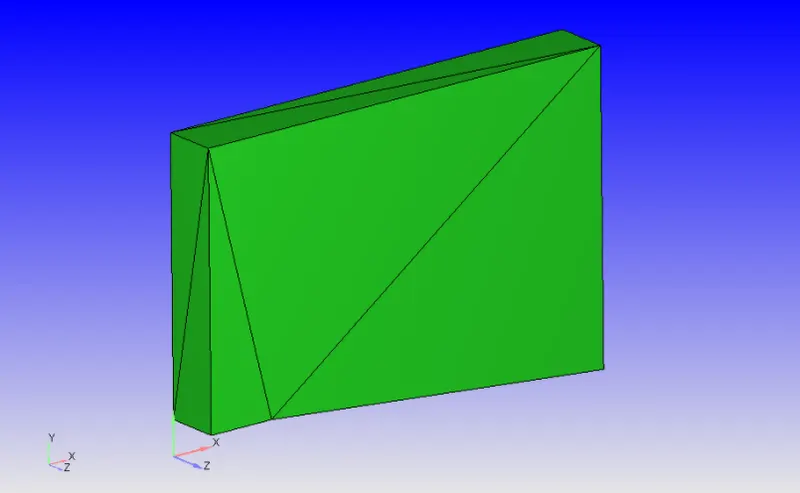
1. Geometry Setup
The geometry is setup in converge studio as shown in the figure below -
2. Diagnosis Check
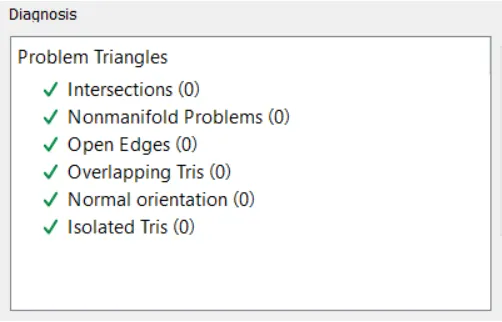
A diagnosis check is performed to check for errors -
3. Boundary Flagging
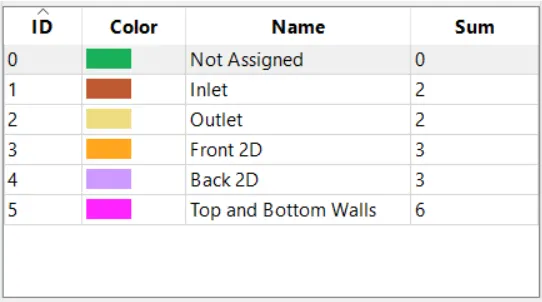
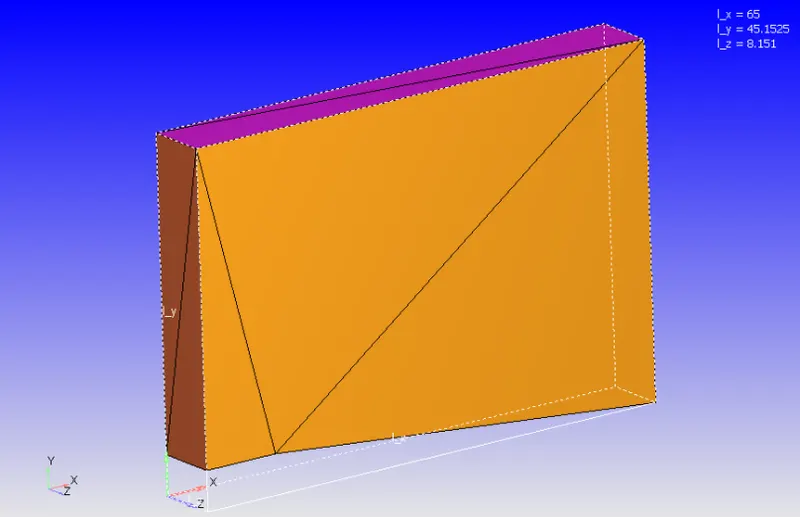
The boundaries are flagged into five components as shown in the figure below -
B. CASE SETUP
1. Fluid: Air:
- Mass fraction of Nitrogen: 0.77
- Mass fraction of Oxygen: 0.23
2.Slover:
A steady-state density-based solver is used to simulate the flow.
3. Simulation Cycles:
- Total Number of Cycles: 25,000 cycles
- Minimum number of cycles to be executed by the steady-state solver: 25,000 cycles
- Initial time-step: 1e-9 s
- Minimum time-step: 1e-9 s
- Maximum time-step: 1 s
4.Boundary Condition:
Neumann Boundary Condition
5. Regions and Initialization:
- Flow Region: Volumetric Flow Region
- Velocity: 680 m/s(x-direction)
- Total Pressure: 50000 Pa
- Temperature: 300 K
- Species: Air
6. Turbulence Model: In our simulation, we don't have to use Turbulence modeling since there is no Reynolds stress because the flow is inviscid.
7. Grid Control:
Base Grid:
- dx = dy = dz = 0.8 m
Adaptive Mesh Refinement: - AMR Group 1
Active Region: - Volumetric Flow Region
Temperature: - Embedded Type: Sub-Grid Scale (SGS)
- Maximum Embedding Level: 2
- Sub-grid criterion: 0.05 K
- Timing Control Types: Sequential
- Start: 5000 cycles
- End: 999999999 cycles
8. Output Files:
- Time interval for writing 3-D output files: 1000 cycles
- Time interval for writing restarting files: 1000 cycles
C. OUTPUT
1. Mesh
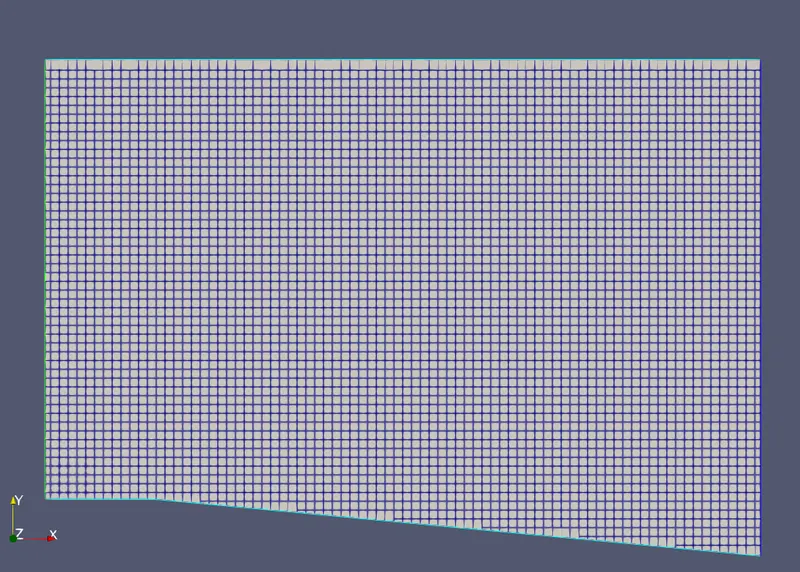
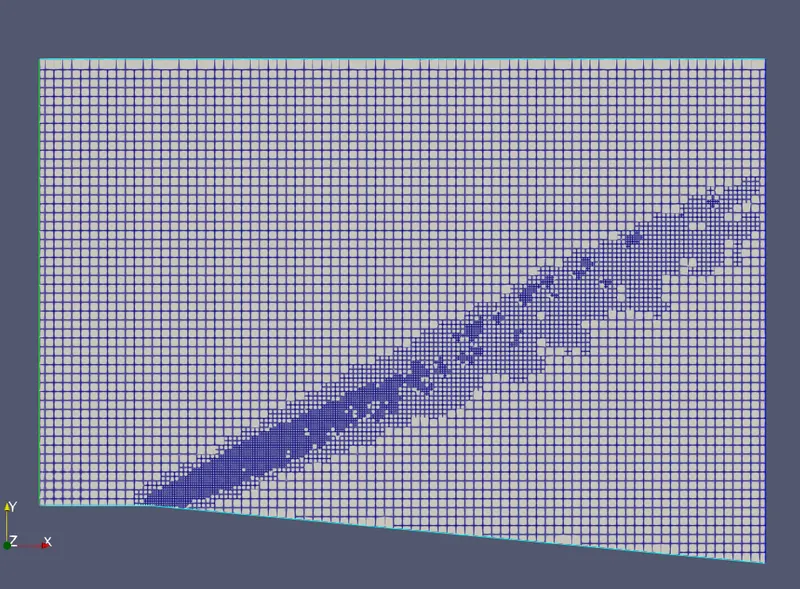
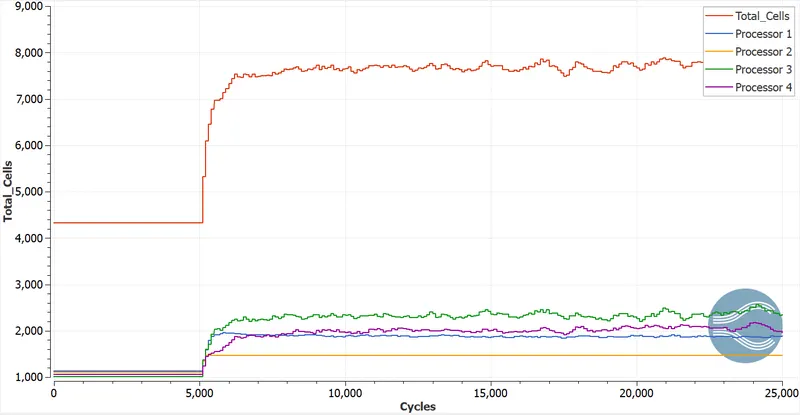
For the first 5000 cycles mesh is constant.
Mesh (At the start of the simulation)
Mesh (At the end of the simulation)
2.Temperature, Velocity, Pressure, and Density Contours
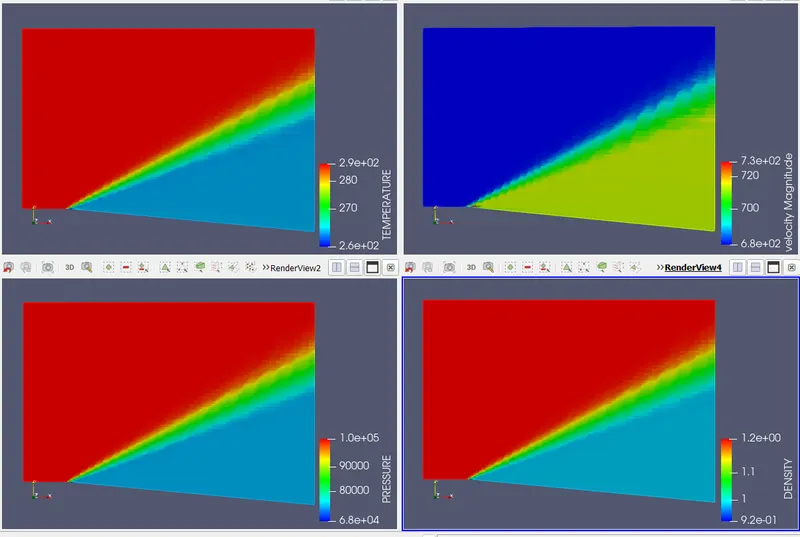
It can be seen that supersonic fluid flows past the expansion corner is accompanied by the decrease in temp., pressure, density of the fluid & increase in velocity.
Velocity Contour:
https://drive.google.com/file/d/1-StSOIsdAej6tMPK1j5wolvc6-vX20-u/view?usp=sharing
Temp. Contour:
https://drive.google.com/file/d/1oA8akGdUbpSTjVsSDOsY6_hAnR3fFZk_/view?usp=sharing
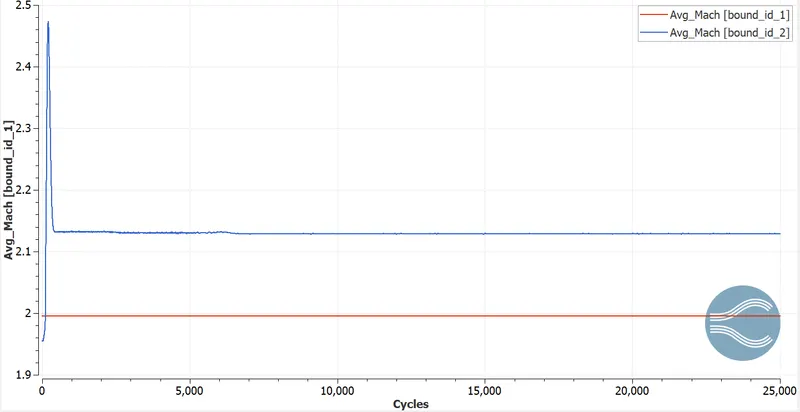
D.VARIATION OF FLOW PROPERTY AT INLET AND OUTLET
1. Variation of Mach number w.r.t. Number of Cycles
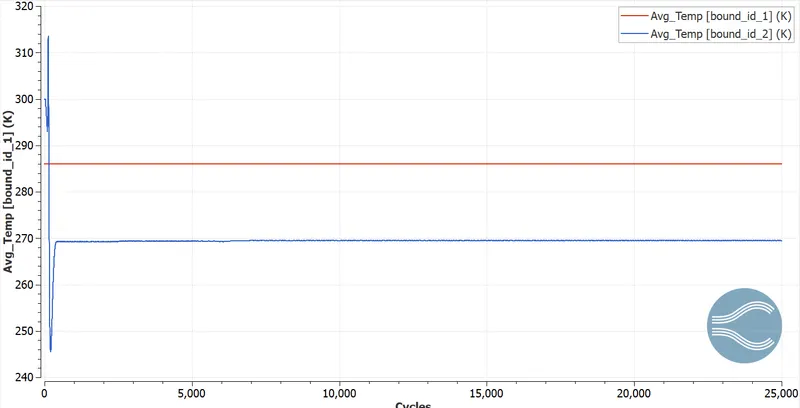
2. Variation of Temperature w.r.t. Number of Cycles
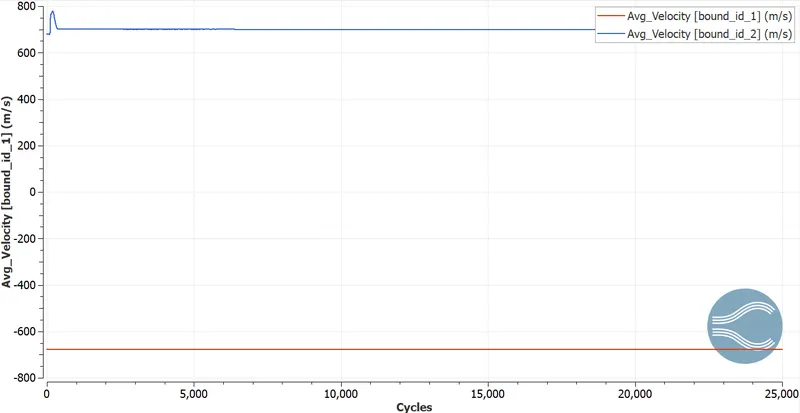
3. Variation of Velocity w.r.t. Number of Cycles
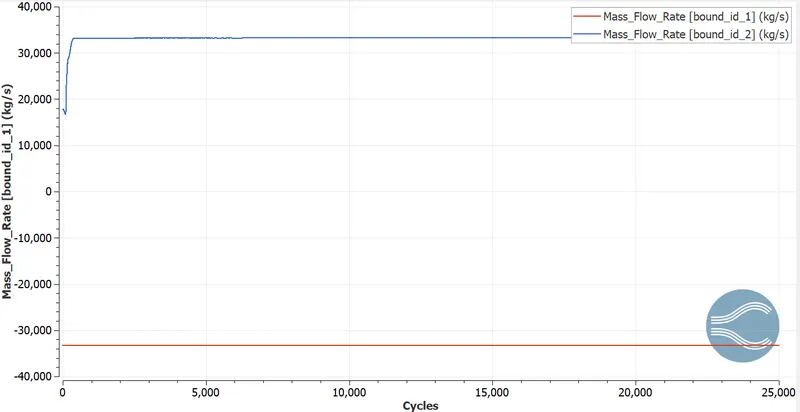
4. Variation of Mass Flow Rate w.r.t. Number of Cycles
5. Variation of Cell Count w.r.t. Number of Cycles
E. RESULTS
1. The Prandtl-Meyer expansion fans are isentropic processes that generate continuous and smooth changes in the flow, causing the flows to total properties to be conserved.
2.Due to the presence of the expansion fan there is a decrease in static temperature, pressure, and density as well as an increase in the Mach number and velocity of flow from the inlet to the outlet.
3.The Mach number of supersonic flow increases through an expansion fan.
EFFECTS OF SUB-GRID SCALE (SGS) ON THE FLOW PROPERTIES
A. GEOMETRY
The geometry is the same as used in the previous simulation.
B. CASE SETUP
The case setup is similar to the one used in the previous simulation. Since we are observing the effects of the SGS parameter on the flow properties, we will simulate four cases having the following SGS values -
- Case 1: SGS= 0.01K
- Case 2: SGS= 0.05K
- Case 3: SGS= 0.1K
- Case 4: SGS= 0.3K
C. RESULTS
Temp. Contours for different SGS
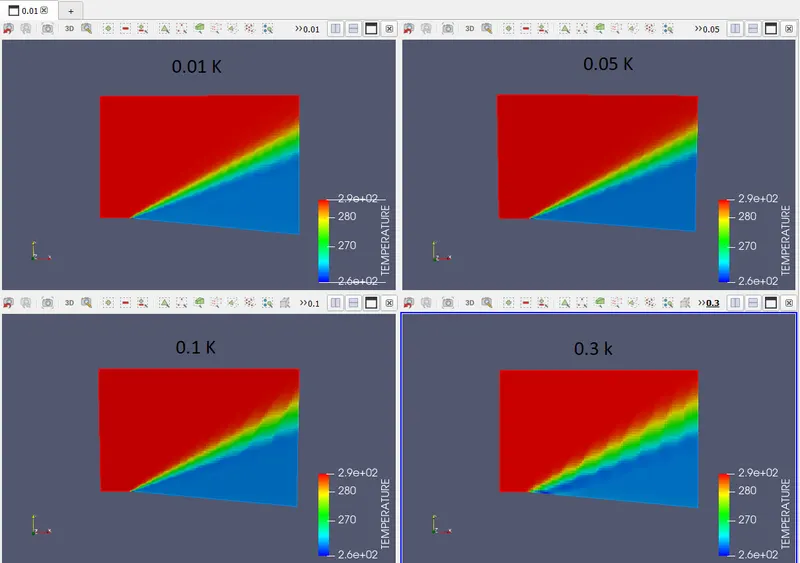
It can be seen that as SGS parameter increases, the expansion fan becomes less distinct & the mesh is unable to capture the effect of fan accurately. From this it can be concluded that AMR is dependent on SGS value.
Subsonic flow over an expansion corner:
- Flow Region: Volumetric Flow Region
- Velocity: 680 m/s(x-dir.)
- Total Pressure: 50000 Pa
- Temperature: 300 K
- Species: Air
RESULTS:
Flow Parameters Contour
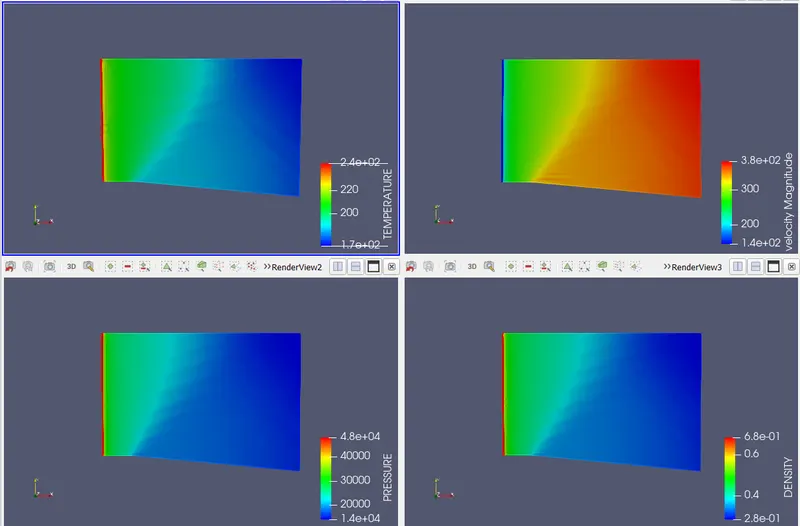
Contours obtained for subsonic flow are different from those of supersonic flow. There is expansion fan generated & no abrupt change in the flow parameters.
A small increase in velocity and decrease in pressure is observed at the expansion corner, which can turn into expansion fans if the flow turns to supersonic.
Conclusion:
We were able to simulate the flow of air over an expansion corner & analyse the effect of SGS parameter. We also simulated the subsonice flow of air over an expansion corner.