Week 5: Prandtl Meyer Shock problem
Prandtl Meyer Shock Problem
OBJECTIVE
What is a Shock Wave?
It is a very thin region in a flow which gets created when the velocity of flow exceeds or equals to the speed of sound which we refer as a Mach number, Hence it occurs in a supersonic and hypersonic flow
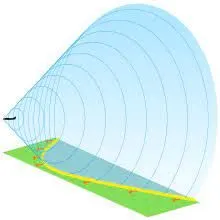
In this region of the shock wave the gas properties such as pressure, temperature.
Shock flow boundary conditions
Even the density of air changes which is the function of time.
Shock wave gets created when huge energy explodes from a tiny spot and shakes the material around it. This disturbs the atmosphere around it which leads to change the gas parameters and parameters li pressure, temperature, flow speed, etc.
It is a quick phenomenon which doesn't last long and it flows through any kind of medium
Physics behind the shock waves ?
When an obstruction is suddenly introduced into the flow, something interesting happens. The particles in front of it slow down instantaneously, creating an increase in local pressure.
Since the fluid is a continuum, the information of whatever happens in one place is transmitted
To oher region in the form of pressure waves this pressure waves then cause the incoming fluid to against its properties. Travels in the form of compression and rerefractions happens in acoustic waves.
BOUNDARY CONDITIONS:
A boundary value problem is a differential equation put together with additional constraints called the boundary conditions. The various types of boundary conditions
are:
Types of Boundary Conditions:
1. Dirichlet Boundary Condition.
2. Neumann Boundary Condition.
3. Robin Boundary Condition.
4. Mixed Boundary Condition.
5. Cauche Boundary Condition.
DIRICHLET BOUNDARY CONDITION:
The values of dependent variables are provided along the boundary of the domain. It is also known as a fixed boundary condition. T specified at the boundary.
NEUMANN BOUNDARY CONDITION:
The value of the gradient of the dependent variable (flux) is provided along the boundary of the domain. Because the heat flux is related to temperature in Fourier's law.
CAUCHY AND ROBIN BOUNDARY CONDITIONS:
These boundary conditions are a weighted combination of both Dirichlet and Neumann Boundary Conditions.
MIXED BOUNDARY CONDITIONS:
In this condition, neither temperature or q is specified but one is expressed as a function of others at the boundary condition.
Why Boundary Conditions are used in shock flow problems? And why Neumann?
Shock Waves are supersonic phenomena associated with breaking the sound barrier in general. In a normal atmosphere, the signals always can travel as fast as the speed of sound. In a supersonic phase, the fluid within the domain cannot travel as fast to match the flow properties in the outlet. Hence information at the boundary cannot be taken to the inlet, which therefore requires an additional set of conditions called the initial conditions.
What is Prandtl–Meyer shock?
A supersonic expansion fan, technically known as Prandtl–Meyer expansion fan, a two-dimensional simple wave, is a centered expansion process that occurs when a supersonic flow turns around a convex corner. The fan consists of an infinite number of Mach waves, diverging from a sharp corner. When a flow turns around a smooth and circular corner, these waves can be extended backwards to meet at a point.
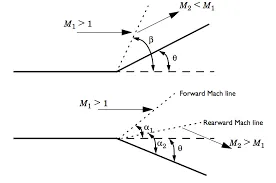
Each wave in the expansion fan turns the flow gradually (in small steps). It is physically impossible for the flow to turn through a single "shock" wave because this would violate the second law of thermodynamics.
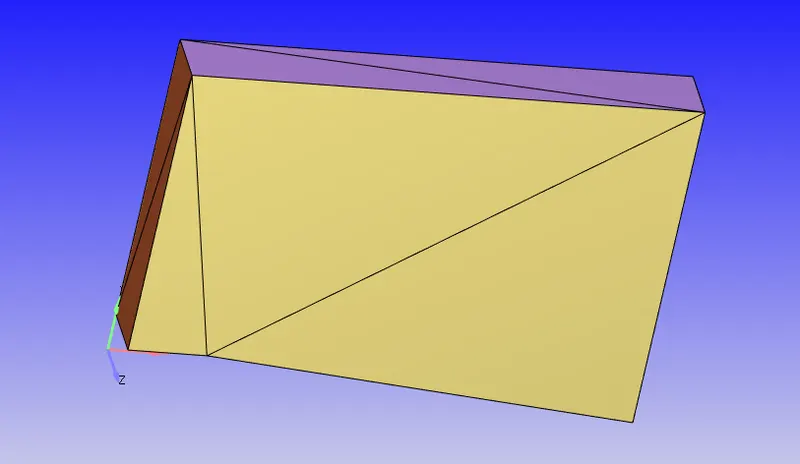
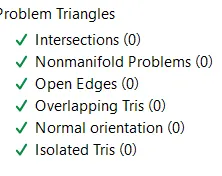
Lets open the geometry and do the dignosis and make a case set up
CASE SETUP:
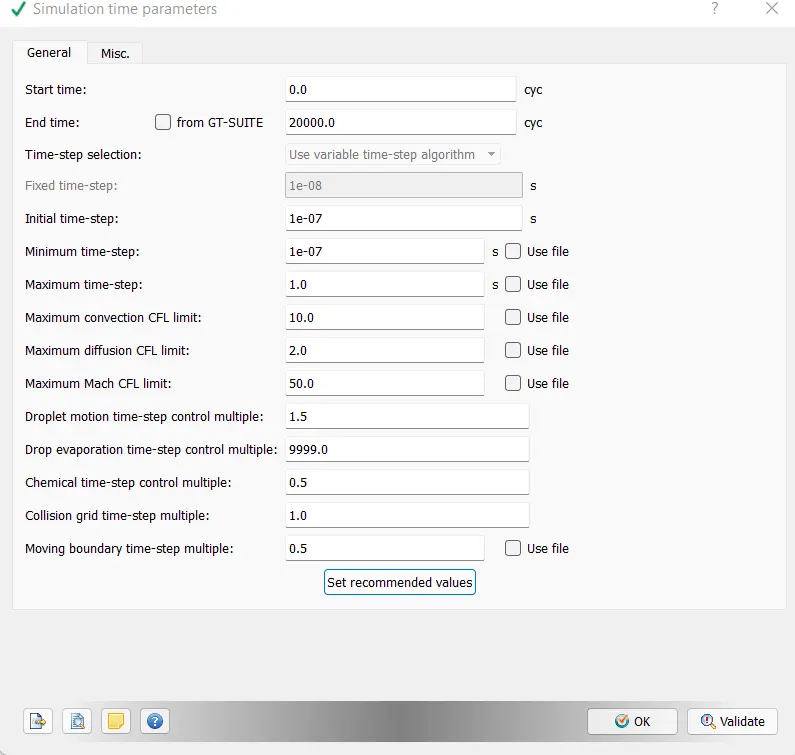
Start Time: 0 Cycles
End Time: 25000 Cycles
Initial Time Step: le^(-7)
Minimum Time Step: le^(-7)
Maximum Time Step: 1
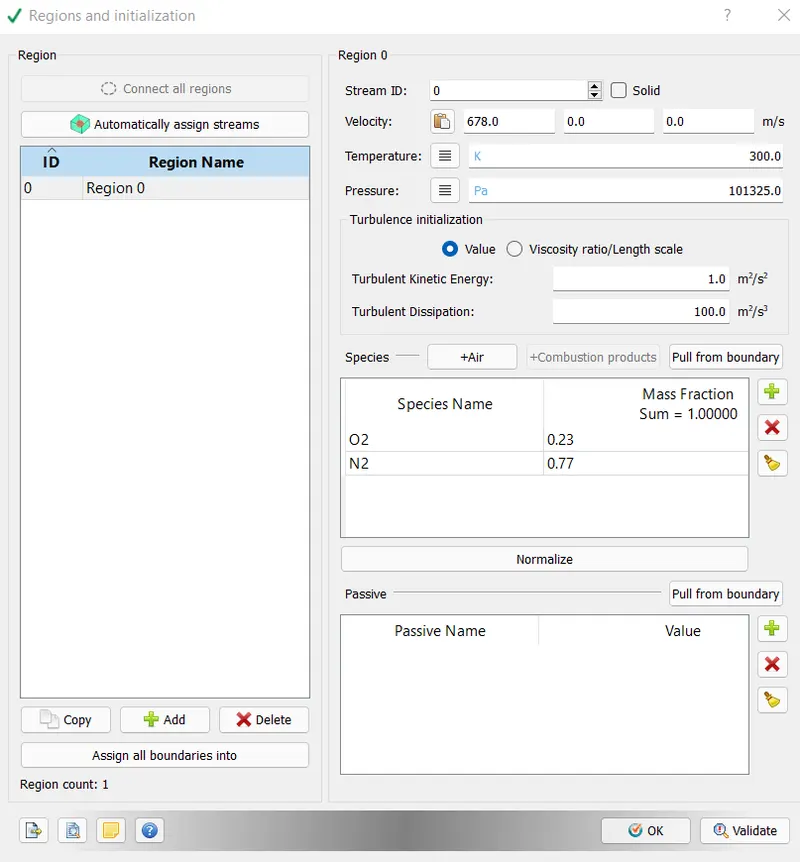
Species: O2 and N2
Turbulence Model: RNG k-E
Base Grid:0.8m
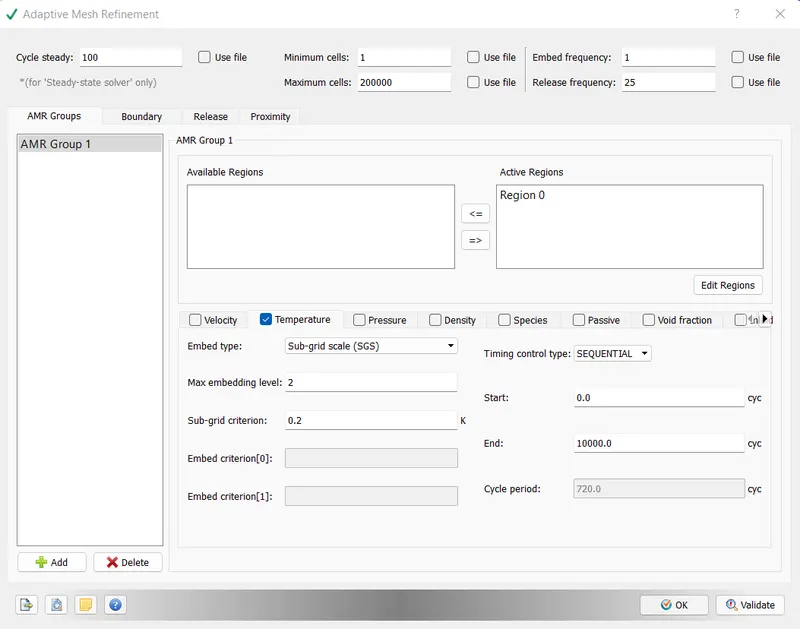
Solver: Density-based steady state solver
Initial condition: 680m/s
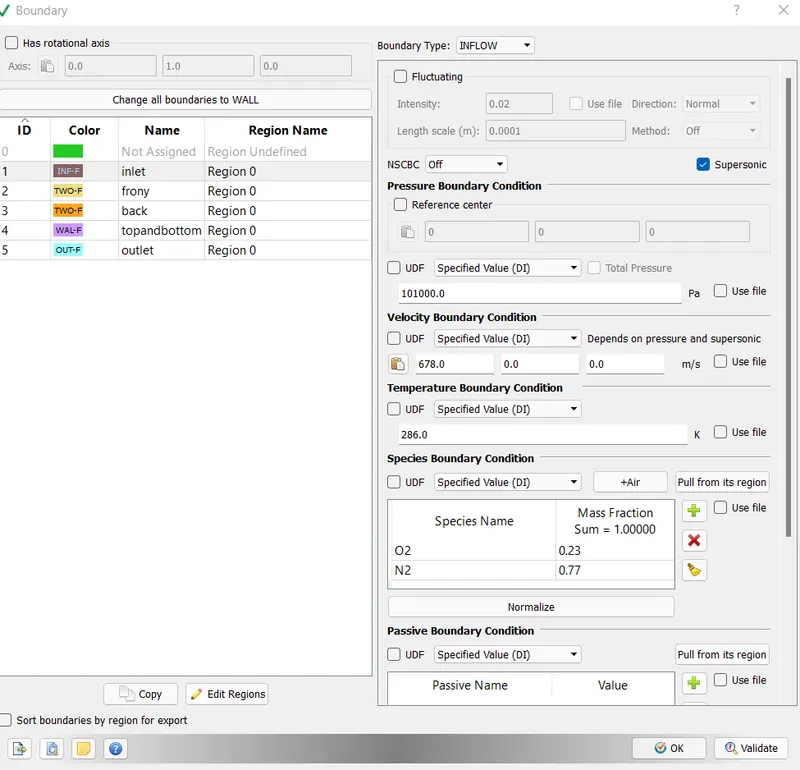
The temperature at inflow is kept about 286.1 k, which 340m/s with an inlet flow velocity of 680m/s. This makes it Mach 2.
For outlet, the Neumann boundary conditions are used which is dependent on the initial condition of flow.
For Front and back, the boundary conditions are kept 2D¹
For Top and Bottom, wall motion type is kept stationary with 'slip condition at the surface.
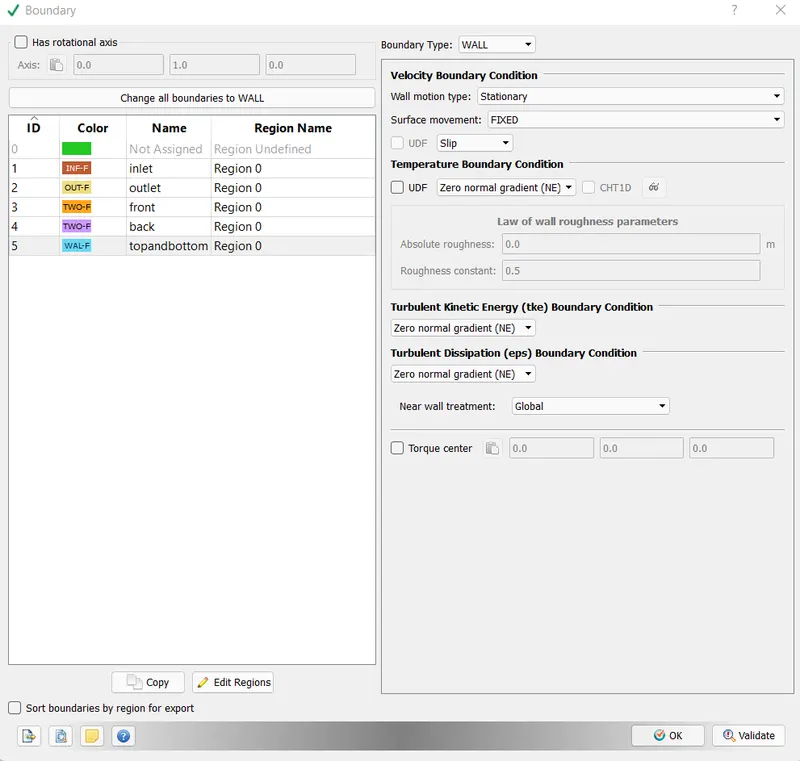
The input files were exported to a file and using Cygwin command line, we used converge-intelmpi solver to run a parallel simulation with 2 processors.
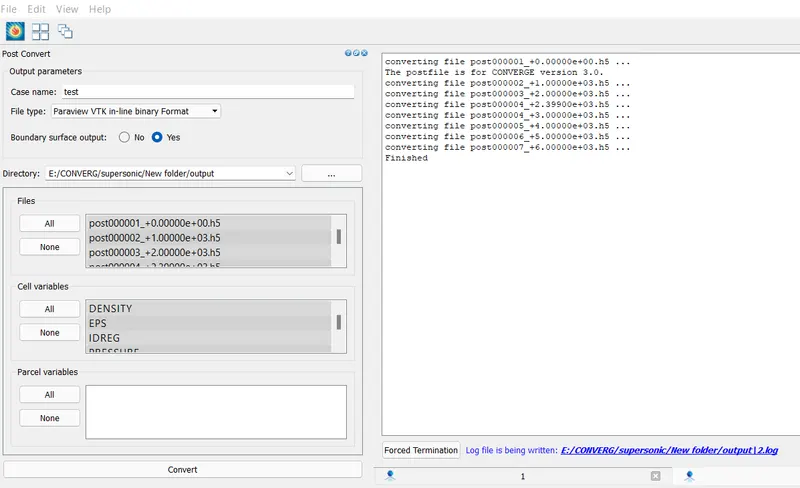
Using the post-processing tools, the output files obtained were converted into Ensight file type which can be then opened by ParaView.
Cases 1 :
SGS : 0.05
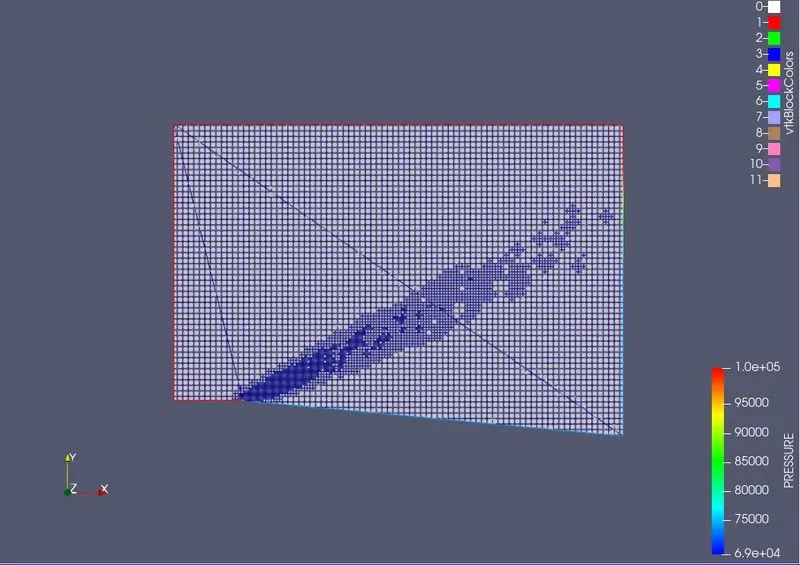
case 2 :
SGS : 0.1
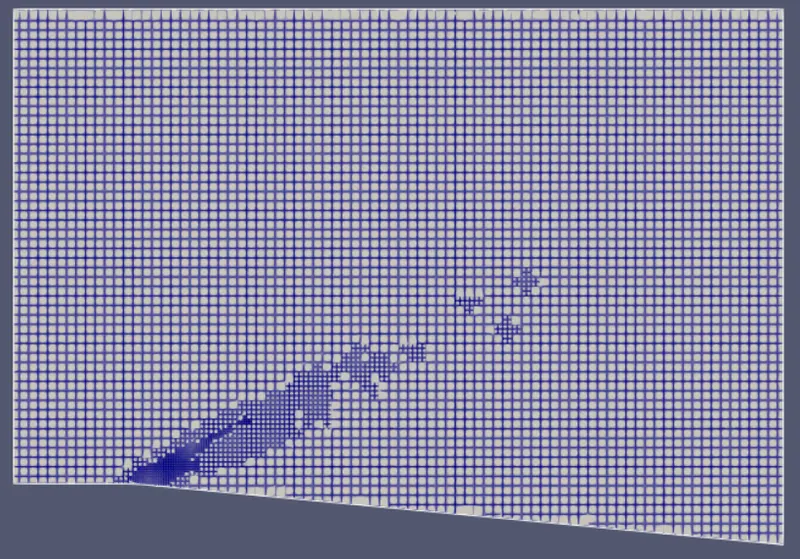
case 3
SGS : 0.001
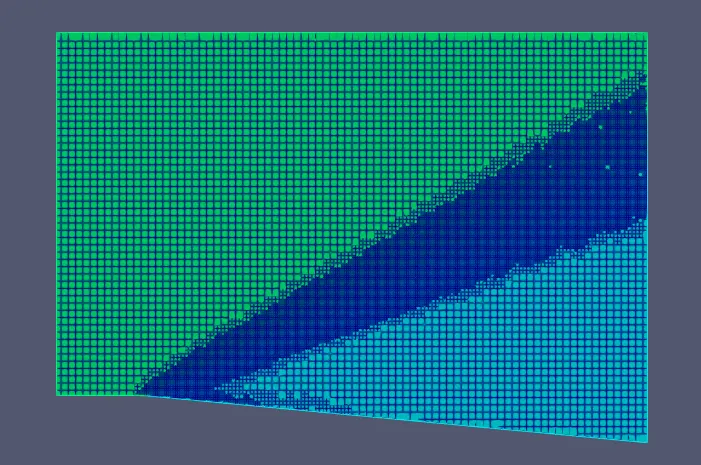
Explanation of plots
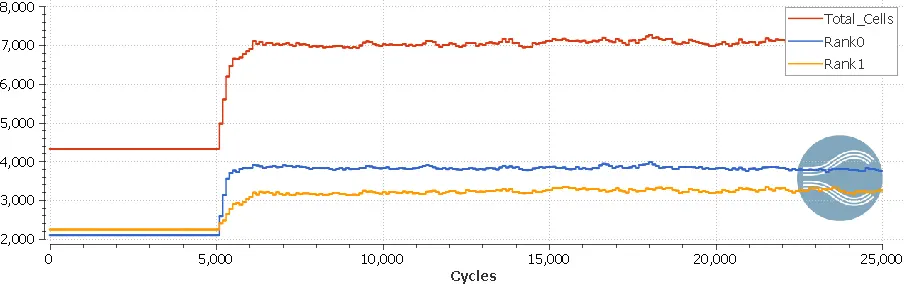
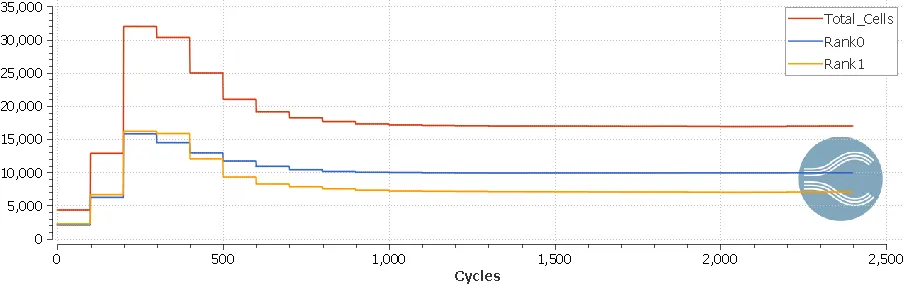
Cell count
Comparative Study and effect of SGS:
In this study variation of the SGS parameter on mesh refinement and temperature are studied.
Four different cases are taken into consideration with SGS of 0.05,0.1,0.001.
With the decrease in SGS value cells are more refined locally and the number of cells through the simulation is increased which is as shown below.
Velocity plot
D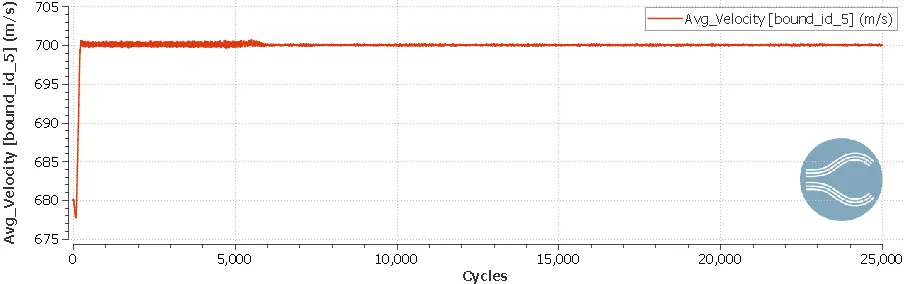
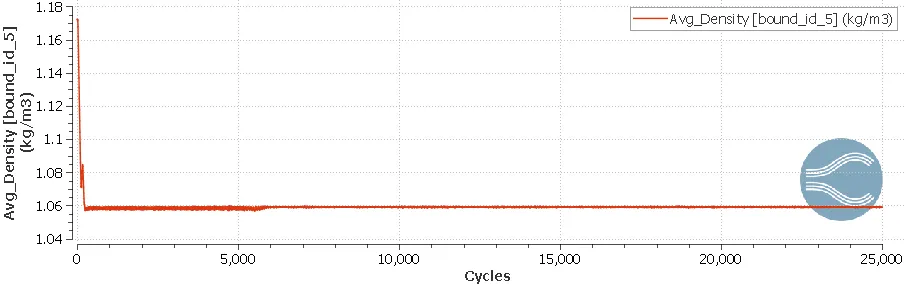
Density Plot
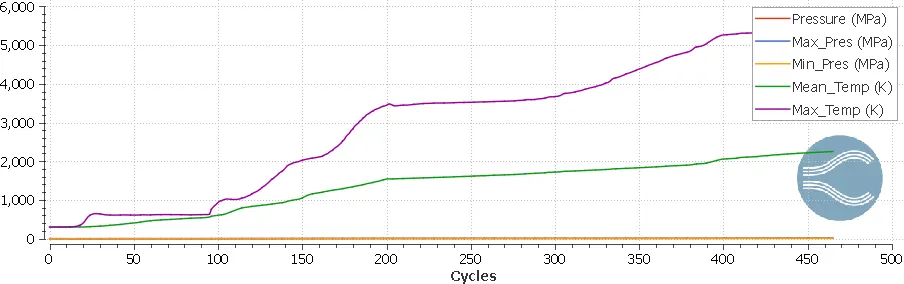
Temprature plot
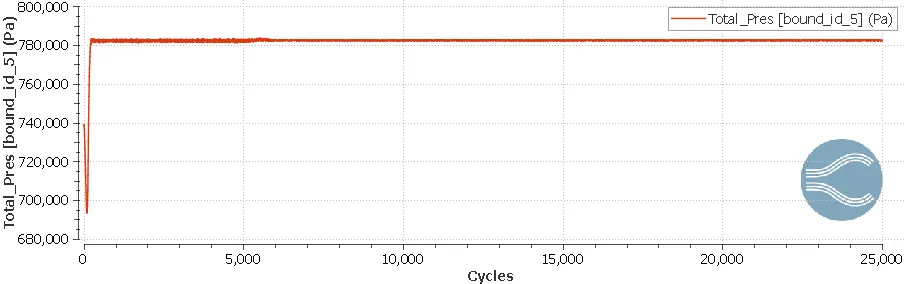
Pressure
YouTube links for the animation
Conclusion:
Temperature Sub-grid-scale of 0.01 is able to capture the Mach waves better than 01 and 0.001 which under-capture respectively.
The call-count increases when we decrease the temperature sub-grid scale criteria.
The pressure, temperature, density decrease across the Mach waves, however the velocity incremes, for the supersonic inlet.
The 0.1 Temperature Sub-grid-scale criteria isn't able to capture the Mach wave properly hence the pressure value does not decrease as much as it should.
By increasing the cell-count Le by reducing the Temperature Sub-grid-scale criteria, we are able to capture the shock more accurately because of the cell-count in and around the shock increases.
In the case of the Subsonic inlet, there is no formation of Mach waves around the expansion comer as expected Since the cross-sectional area increases past the comer, the flow velocity close to the comer increases rapidly locally, thus proving the laws of conservation of mass since the mass flow rates will be equal at inlet and outlet.