Week 5 - Compact Notation Derivation for a simple Mechanism
Aim:To derive the reaction rate ODEs of a simple reaction mechanism.
Reaction Mechanisms:
CO + O2 <-> CO2 + O
O + H2o <-> OH + OH
CO + OH <-> CO2 + H
H + O2 <-> OH + O
There are four reactions given and the total number of species in the reactions are 7.
To calculate a concentration of particular species we have formula as.

This is the way we calculate the rate of change of concentration of each species.
Here,
Kf1 = forward reaction rate
Kr1 = reverse reaction rate
The forward reaction is negative because there is decrease of concentration of CO.
For programming above formulation to calculate concentration of each species we choose a process which can be easily coded and provide same terminology.
Let us assume a table for reactions and species
|
i |
Reactions |
|
1 |
R1 |
|
2 |
R2 |
|
3 |
R3 |
|
4 |
R4 |
|
J |
species |
|
1 |
CO |
|
2 |
O2 |
|
3 |
CO2 |
|
4 |
O |
|
5 |
H2O |
|
6 |
OH |
|
7 |
H |
Once we have defined the species and reactions we will now calculate the matrices for both reactants and products.
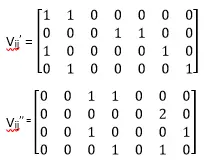
Where,
Vij’ = Reactants concentration matrix
Vij’’ = Products concentration matrix
Vij = Vij’’ - Vij’
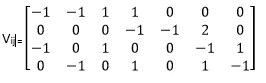
And for number of reaction we have reaction rate given by formula

Here the Greek word ‘pi’ is used for product of terms.
The last formula is to calculate the production rate, its denoted by w.

L = no of reactions
Let’s calculate the production rate with concentration rate equation for ‘CO’.
Wco = V11 q1 - V13 q3
V11 is taken to define first species in first reaction, q1 and q3 are taken because we can find CO only in reaction 1 and 3.
Now on substituting the values we get
Wco = (-1) (kf1 [Xco] [Xo2] – kr1 [Xco2] [Xo]) – (1) (kf3 [Xco] [Xoh] – kr3 [Xco2] [Xh])
Wco = -kf1 [Xco] [Xo2] + kr1 [Xco2] [Xo]) – kf3 [Xco] [Xoh] + kr3 [Xco2] [Xh]

We can calculate the production rate for all species and calculate rate of concentration of each.
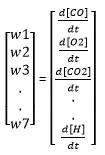
We can write a code to calculate concentration with this logic.