Week 5 Challenge
Question 1:
Consider a scenario where an aggressive driver is accelerating very rapidly and braking harshly in a city driving. Is battery better a choice to supply power than UC in this scenario?
- True
- False
Ans: False, battery is not a better choice to supply power. The ultracapacitor is more suitable to hybridize with the fuel cell than the battery, although both of them can provide peaking power and absorb the regenerative braking energy. The reasons are as follows.
1. The ultracapacitor has higher power density than the battery. The major role of the auxiliary source is to supply the peaking power the fuel cell can’t provide. With higher power density, the ultracapacitor can provide more peaking power than the battery, so that it can further decrease the fuel cell’s rating power and its cost.
2. The ultracapacitor can be quickly charged and discharged with its static electricity characteristic. It enables the ultracapacitor to instantly respond to the loads’ varying. The battery can’t achieve that because of the electrochemical reaction happening inside. The electrochemistry reaction always takes some time to take place and the speed of the reaction time also depends on the surrounding temperature.
3. The ultracapacitor has much longer life than the battery owe to its electrostatic property. The ultracapacitor charges and discharges by storing or releasing electrons on the surface of the ultracapacitor’s layers. For the battery, the electrochemical reactions are always undergoing internally when it sends out or absorbs energy. The material consumption and structure degradation are much more severe for the battery than for the ultracapacitor.
4. Ultracapacitor recapture the braking energy from the load. When the vehicle is braking, the motor’s kinetic energy is transferred to the electrical energy. At this time, the motor acts as the generator and ultracapacitor are able to absorb the regenerative braking energy to increase the system’s efficiency.
Question 2:
Consider the following components.
1) Lead acid battery 2) Nickel cadmium battery 3) Nickel Metal hydride battery 4) Lithium ion (specify chemistry) battery 5) Ultra Capacitor
Note: In case of a range of energy density, take the average value for the plot.
Create a plot with energy density on the X Axis and cell voltage on the Y axis.
Comment on the capabilities of these batteries based on the plot created.
Ans:Energy Density:
Energy density is the measure of how much energy a battery contains in proportion to its weight. This measurement is typically presented in Watt-hours per kilogram (Wh/kg). A watt-hour is a measure of electrical energy that is equivalent to the consumption of one watt for one hour. Energy density is one of the many battery characteristics used chiefly to compare one type of battery system to another. The energy density is a function of the weight of the battery. A battery with a higher energy density will be lighter than a similar capacity battery with a lower energy density. The higher the energy density, the lower the run time of battery will be.The below battery comparison chart illustrated in fig1: the volumetric (i.e. energy density) and specific energy densities showing smaller sizes and lighter weight cells.
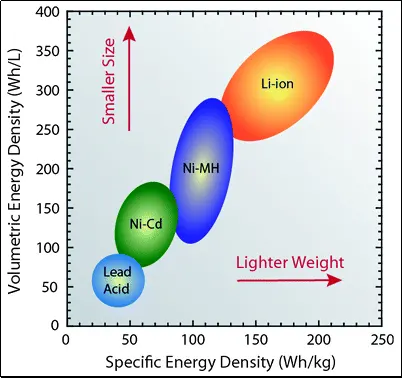
fig1: Battery Energy densities
Cell Voltage:
The voltage of a battery is a fundamental characteristic of a battery, which is determined by the chemical reactions in the battery, the concentrations of the battery components, and the polarization of the battery. The voltage calculated from equilibrium conditions is typically known as the nominal battery voltage. Since the electric potential (voltage) from most chemical reactions is on the order of 2V while the voltage required by loads is typically larger, in most batteries, numerous individual battery cells are connected in series.Due to the polarization effects, the battery voltage under current flow may differ substantially from the equilibrium or open circuit voltage. A key characteristic of battery technology is how the battery voltage changes due under discharge conditions, both due to equilibrium concentration effects and due polarization.Battery discharge and charging curves are shown below in fig2: for several different battery systems.
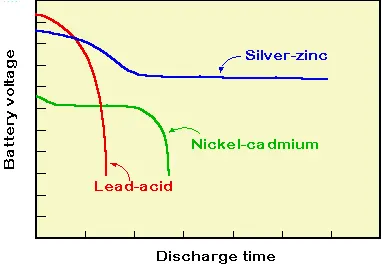
fig2: Variation of voltage with state of charge for several different types of batteries.
The discharge and charge curves are not necessarily symmetric due to the presence of additional reactions that may be present at the higher voltages encountered in charging. A battery system that maintains a more constant voltage with discharge rate will have a high voltage efficiency and will be more easily used to drive voltage sensitive loads.
Voltage monitoring is possibly the most important function of the Battery management systes (BMs).The BMs typically monitors the voltage across each series group of cells. Voltage excursions due to overcharge, overdischarge, or high power pulses can lead to significantly reduced life and safety issues. Cell voltage is also a critical input to the cell balancing algorithm and the state of charge and state of health algorithms. The most important reason for monitoring cell voltage is overcharge avoidance. Lithium ion cells must not be overcharged. Excess overcharge will result in a combination of chemical reactions and temperature rise that leads to cell venting. This, obviously, ruins the cell and creates a serious safety concern. The vented gases are, to date, highly flammable. In addition, severe overcharge can heat a cell sufficiently to cause it to catch on fire. Overcharge can be prevented if the cell voltage is monitored and the charging power source is disabled before the voltage rises to an overcharge value. The design of a battery pack must include a robust method for monitoring cell voltage to ensure overcharge and overdischarge are very rare, detectable occurrences.
Based on the above explanation on energy density & cell voltage, below fig3: shows the plot of Cell voltage (V) & Energy density (Wh/kg), for batteries & capacitors.
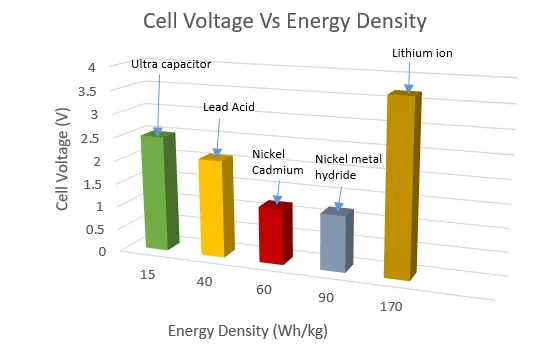
fig3: Cellvoltage Vs Energy density for batteries & ultra capacitors
From the fig3:, it is evident that batteries & ultra capacitors both are of storage methods. Batteries have high energy density to store energy for it to use later. Below are the observation from fig3:
1. Although lead acid batteries have a low energy density, only moderate efficiency and high maintenance requirements, they also have a long lifetime.
2. While nickel cadmium batteries have high energy density & low cell voltage, un doubtedly it has higher life span compared to lead acid batteries further more the electrolyte in nickel-cadmium is less corrosive to battery parts than in a lead-acid battery which also increases lifetime.
3. Both nickel cadmium & Nickel metal hydride batteries have same cell voltage, the life span of nickel metal hydride is less becuse of capacity deterioration upon cycling induced by alloy pulverisation and corrosion, and high self-discharge as a result of active material decomposition.
4. Lithium-ion batteries have higher energy densities than lead-acid batteries or nickel-metal hydride batteries, so it is possible to make the battery size smaller than others while retaining the same storage capacity.This results in an increase in travel distance with less self discharge.
5. Ultra capacitors has less energy density, means it can charge faster & discharge faster & increases the life span than the batteries.
Question 3:
For the above-mentioned components on the same plot (retain the previous plot) created in the previous
Create a plot with power density on the X axis and cell voltage on the Y axis.
Ans: Power density implies how much power a battery can deliver on demand.Power density is normally mentioned in the units of Watts/L or Watts/Kg.If a system has a high power density, than it can output large amounts of energy based on its volume. Below fig4: shows the relation between cell voltage (V) & power density (W/kg) for batteries & ultra capacitors.
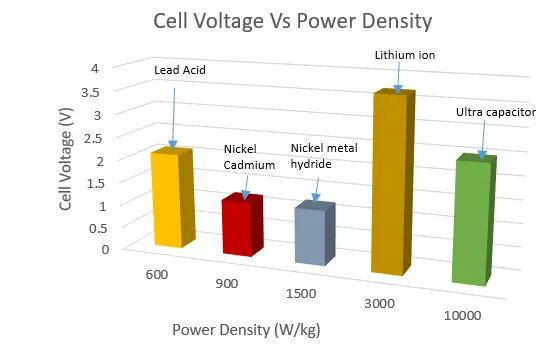
fig4: Cellvoltage Vs Power density for batteries & ultra capacitors
From the above fig3 & 4, batteries are more suited for higher energy density applications, for example, an application where a device needs to run for long periods on a single charge. On the other hand, Supercapacitors have a much higher power density than batteries. It makes them ideal for high-drain applications like powering an electric vehicle.
Ultra capacitors also have a much longer lifespan than batteries.unlike a battery, ultra capacitors have a higher power throughput, which implies it can charge and discharge in a fraction of the time. Still, they have a very low specific energy as compared to batteries. While a Supercapacitor with the same weight as a battery can hold more power, its Watts / Kg (Power Density) is up to 10 times better than lithium-ion batteries. However, Supercapacitors’ inability to slowly discharge implies its Watt-hours / Kg (Energy Density) is a fraction of what a Lithium-ion battery offers.
Question 4:
Consider the following scenario:
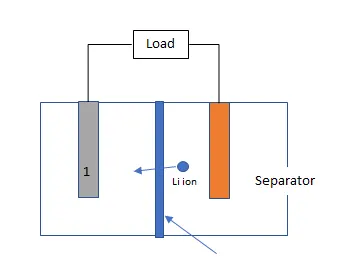
A battery has just been manufactured in the battery and has been connected to a charger for the first time. The electrode marked as (1) in the picture below is the negative electrode.
- True
- False