Week 1 Challenge
1. First models of fuel cell vehicles developed in Asia, Europe and North America? What were the specifications of these vehicles
General motors from North America was first to develop first fuel cell road vehicle Chevrolet Electrovan in 1966. It had PEM fuel with a range of 120miles with top speed of 70miles/hr. Electro van had two seats, the fuel cell stack and large tanks of hydrogen and oxygen were place at the rear portion of the van. Below is the image of chevrolet electro van
Fig-1: Chevrolet electro van. First fuel cell road vehicle by General motors.
In Asia, Japan is the first country to develop fuel cell vehicle. In 2008, Honda FCX clarity was the first concept car was introduced in Japan & southern california.
Hyundai ix35 FCEV or Tucson FCEV is hydrogen fuel electric vehicle developed by Hyundai. The first generation was introduced in 2001 and had a range of 100 miles (160 km), with a top speed of 78 mph (126 km/h). The production of Tucson FCEV started in 2013 in south korea.
Fig-2: Tucson FCEV. First fuel cell road vehicle by hyundai.
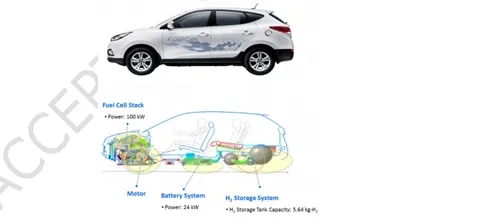
Fig-3: Photo and a package layout of the world’s first mass-produced Tucson FCEV of Hyundai.
The Hyundai Nexo is the hydrogen fuel powered cross over SUV which was reveled in 2018 replacing Tucson FCEV. Nexo is the flagship for Hyundai's eco car portfolio
Fig-4: Nexo FCEV.
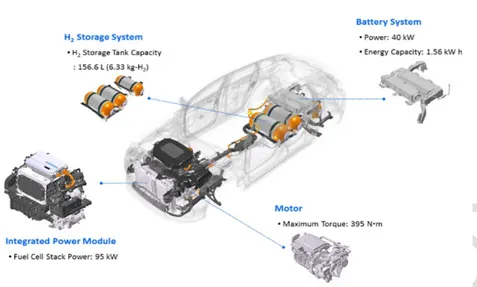
Fig-5: Photo and a package layout of Nexo FCEV of Hyundai.
As compared to Tucson FCEV which used a heavily modified version of the Tucson's underpinnings, the Nexo uses a purpose-built platform from an FCEV point of view. Nexo has a lighter construction, a more powerful drivetrain, and a higher driving range. Below is the comparison between Tucson FCEV & Nexo.
|
Specifications |
Hyundai Tucsan |
Hyundai Nexo |
|
Year |
2013 |
2020 |
|
Fuel cell system |
Hydrogen Fuel cell |
Hydrogen Fuel Cell |
|
Fuel Cell power (Max) |
100kW |
135 kW |
|
Electric motor type |
Induction |
Permanent Magnet |
|
Electric motor power (max) |
100kW |
120 kW |
|
Battery type |
Li-Polymer |
Lithium-ion polymer (Li-Po) |
|
Battery energy |
0.95 (kWh) |
1.6 kWh |
|
Battery Power (max) |
24kW |
40 kW |
|
horse power |
134hp |
161 hp |
|
Torque |
221lb-ft |
291 lb·ft |
Toyota Mirai:
Toyota Mirai is mid size hydrogen fuel cell vehicle manufactured by Toyota. It is one of the first FCV automobiles to be mass produced and sold commercially.
Fig-6: Toyota Mirai FCEV.
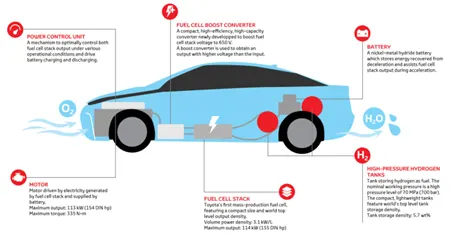
Fig-7: Photo and a package layout of the first mass-produced Mirai FCEV of Toyota
Toyota Mirai features a fuel cell system with an output power density of 3.0 kW/L. The FCV concept also uses portions of Toyota's hybrid synergy drive technology including the electric motor, power control unit and other parts and components from its hybrid vehicles to improve reliability and minimize cost.The hybrid technology is also used to work together with the fuel cell. At low speeds such as city driving, the FCV runs just like any all electric car by using the energy stored in its battery, which is charged through regenerative braking. . At higher speeds, the hydrogen fuel cell alone powers the electric motor. When more power is needed, for example during sudden acceleration, the battery supports the fuel cell system as both work together to provide propulsion. Below is the specification of Toyota Mirai.
|
Specifications |
Toyota Mirai |
|
Year |
2014-2020 |
|
Fuel cell system |
Hydrogen Fuel cell |
|
Fuel Cell power (Max) |
128kW |
|
Electric motor type |
Permanent magnet, synchronous |
|
Electric motor power (max) |
113kW |
|
Battery type |
Lithium ion (Li-ion) battery |
|
Battery energy |
1.24kWh |
|
Horse power |
182hp |
|
Torque |
221lb·ft |
2a. Trend of cost in USD per kW of fuel cell production in the past and the prediction of the cost in the future.
Fuel cells provide an efficient way to convert hydrogen, and possibly other renewable fuels, into electricity. Sales of fuel cells and hydrogen systems generated over $1 billion in 2012 and are forecast to increase to over $2 billion in 2013. Production costs of low temperature fuel cells for transportation purposes are falling as platinum loadings continue to fall. However, market penetration for fuel cell vehicles and portable fuel cells is predicted to remain low in the near future
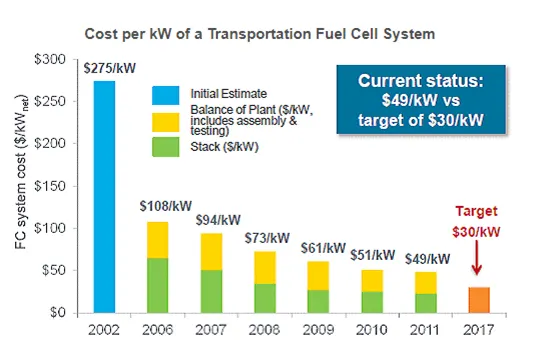
From the above graph, cost per kW has decreased from 2002 to 2011. The traget to reach $30/kW will be realised by 2017.
2b. Reasons for the improvement.
a. Hydrogen production:
Hydrogen as a fuel has high purity and is, thus, costly. Raw materials and technologies determine that hydrogen production from fossil fuels (coal and natural gas) are the main methods for large-scale hydrogen production. However, as environmental pressures increase in the future,
hydrogen production from fossil fuels will endure stricter purification requirements and higher carbon trading prices. The cost of hydrogen from fossil fuels will increase.
Hydrogen production from water electrolysis can be used for small-scale onsite pure hydrogen production. The cost is not affected by purification but mainly limited by the price of electricity. The promotion and application of renewable electricity provide a new way to reduce the price of electricity for hydrogen production from water electrolysis.
b. Battery cost:
Mainstream lithium-ion batteries, now driving a rapidly expanding market for electric vehicles, were a pricey proposition just a decade ago. Lithium-ion battery packs cost US$1,183 per kilowatt hour in 2010; nine years later, the price had dropped nearly tenfold to US$156/kWh in 2019, according to BloombergNEF data.
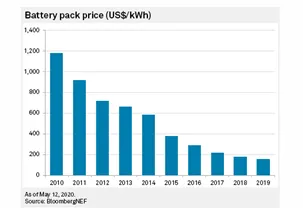
Experts pointed to momentum in expanding production as a reason for the price drop as well as incremental innovation in battery chemistry. Manufacturers have been shifting away from some more expensive battery ingredients such as cobalt as they ramp up nickel-heavy battery designs that have become cheaper to produce as factories expand.
Manufacturers are closing in on a point where electric vehicles will reach cost parity with their fossil fuel-powered cousins at around US$100/kWh, or perhaps a little less, experts said. That price is widely seen as a tipping point in the sector, where consumers will no longer regard electric vehicles as pricier options.
BloombergNEF forecast battery costs falling under US$100/kWh in 2024 and hitting around US$60/kWh by 2030, Frith said. Likewise, Bernstein analysts have projected 2024 as the year that mainstream electric vehicles reach cost parity with gas and diesel vehicles, while electric vehicle leaders in the sector may reach the same point by 2022 or 2023.