Week 2 Challenge
1. Four different types of fuel cells and their applications.
A variety of fuel cells are in different stages of development. The most common classification of fuel cells is by the type of electrolyte used in the cells and includes
1) polymer electrolyte fuel cell (PEFC)
2) alkaline fuel cell (AFC)
3) phosphoric acid fuel cell (PAFC)
4) molten carbonate fuel cell (MCFC)
Broadly, the choice of electrolyte depends on the operating temperature range of the fuel cell. The operating temperature and useful life of a fuel cell depends on the physicochemical and thermomechanical properties of materials used in the cell components (i.e., electrodes, electrolyte, interconnect, current collector, etc.). Aqueous electrolytes are limited to temperatures of about 200 °C or lower because of their high vapor pressure and rapid
degradation at higher temperatures. The operating temperature also plays an important role in the degree of fuel cell processing. In low-temperature fuel cells, all the fuel must be converted to hydrogen prior to entering the fuel cell. In addition, the anode catalyst in low temperature fuel cells (mainly platinum) is strongly poisoned by CO. In high-temperature fuel cells, CO and even CH4 can be internally converted to hydrogen or even directly oxidized electrochemically. Below table shows the comparison between the fuel cells.
| Polymer electrolyte fuel cell (PEFC) |
Alkaline fuel cell (AFC) |
Phosphoric acid fuel cell (PAFC) |
Molten carbonate fuel cell (MCFC) |
|
| Electrolyte | Hydrated Polymeric Ion Exchange Membranes | Mobilized or Immobilized Potassium Hydroxide in asbestos matrix | Immobilized Liquid Phosphoric Acid in SiC |
Immobilized Liquid Molten Carbonate in LiAlO2 |
| Electrodes | Carbon | Transition metals | Carbon | Nickel and Nickel Oxide |
| Catalyst | Platinum | Platinum | Platinum | Electrode material |
| Interconnect | Carbon or metal | Metal | Graphite | Stainless steel or Nickel |
| Operating Temperature | 40 – 80 °C | 65°C – 220 °C | 205 °C | 650 °C |
| Charge Carrier | H+ | OH- | H+ | CO3= |
| External Reformer for hydrocarbon fuels |
Yes | Yes | Yes | No, for some fuels |
| External shift conversion of CO to hydrogen | Yes, plus purification to remove trace CO | Yes, plus purification to remove CO and CO2 | Yes | No |
| Prime Cell Components |
Carbon-based | Carbon-based | Graphite-based | Stainless based |
| Product Water Management |
Evaporative | Evaporative | Evaporative | Gaseous Product |
| Product Heat Management |
Process Gas + Liquid Cooling Medium |
Process Gas + Electrolyte Circulation |
Process Gas + Liquid cooling medium or steam generation |
Internal Reforming + Process Gas |
Table1: Comparison of different types of fuel cell.
Polymer Electrolyte Fuel Cell (PEFC):
The electrolyte in this fuel cell is an ion exchange membrane (fluorinated sulfonic acid polymer or other similar polymer) that is an excellent proton conductor. The only liquid in this fuel cell is
water; thus, corrosion problems are minimal. Typically, carbon electrodes with platinum electro-catalyst are used for both anode and cathode, and with either carbon or metal interconnects.
Applications:
PEFCs are being pursued for a wide variety of applications, especially for prime power for fuel cell vehicles (FCVs). As a consequence of the high interest in FCVs and hydrogen, the investment in PEFC over the past decade easily surpasses all other types of fuel cells combined. Although significant development of PEFC for stationary applications has taken place, many developers now focus on automotive and portable applications.
Alkaline Fuel Cell (AFC):
The electrolyte in this fuel cell is concentrated (85 wt percent) KOH in fuel cells operated at high temperature (~250 °C), or less concentrated (35 to 50 wt percent) KOH for lower temperature (<120 °C) operation. The electrolyte is retained in a matrix (usually asbestos), and a wide range
of electro-catalysts can be used (e.g., Ni, Ag, metal oxides, spinels, and noble metals). The fuel supply is limited to non-reactive constituents except for hydrogen. CO is a poison, and CO2 will react with the KOH to form K2CO3, thus altering the electrolyte. Even the small amount of CO2 in air must be considered a potential poison for the alkaline cell. Generally, hydrogen is considered as the preferred fuel for AFC, although some direct carbon fuel cells use (different) alkaline electrolytes.
Applcations:
The AFC was one of the first modern fuel cells to be developed, beginning in 1960. The application at that time was to provide on-board electric power for the Apollo space vehicle. The AFC has enjoyed considerable success in space applications, but its terrestrial application has been challenged by its sensitivity to CO2. Still, some developers in the U.S. and Europe pursue AFC for mobile and closed-system (reversible fuel cell) applications.
Phosphoric Acid Fuel Cell (PAFC):
Phosphoric acid, concentrated to 100 percent, is used as the electrolyte in this fuel cell, which typically operates at 150 to 220 °C. At lower temperatures, phosphoric acid is a poor ionic conductor, and CO poisoning of the Pt electro-catalyst in the anode becomes severe. The relative stability of concentrated phosphoric acid is high compared to other common acids; consequently the PAFC is capable of operating at the high end of the acid temperature range (100 to 220 °C). In addition, the use of concentrated acid (100 percent) minimizes the water vapor pressure so water management in the cell is not difficult. The matrix most commonly used to retain the acid is silicon carbide (1), and the electro-catalyst in both the anode and cathode is
Pt.
Applications:
PAFCs are mostly developed for stationary applications. Both in the U.S. and Japan, hundreds of PAFC systems were produced, sold, and used in field tests and demonstrations. It is still one of the few fuel cell systems that are available for purchase. Development of PAFC had slowed 1-11 down in the past ten years, in favor of PEFCs that were thought to have better cost potential. However, PAFC development continues.
Molten Carbonate Fuel Cell (MCFC):
The electrolyte in this fuel cell is usually a combination of alkali carbonates, which is retained in a ceramic matrix of LiAlO2. The fuel cell operates at 600 to 700 °C where the alkali carbonates form a highly conductive molten salt, with carbonate ions providing ionic conduction. At the high operating temperatures in MCFCs, Ni (anode) and nickel oxide (cathode) are adequate to promote reaction. Noble metals are not required for operation, and many common hydrocarbon fuels can be reformed internally.
Applications:
The focus of MCFC development has been larger stationary and marine applications, where the relatively large size and weight of MCFC and slow start-up time are not an issue. MCFCs are under development for use with a wide range of conventional and renewable fuels. MCFC-like technology is also considered for DCFC. After the PAFC, MCFCs have been demonstrated most extensively in stationary applications, with dozens of demonstration projects either under way or completed. While the number of MCFC developers and the investment level are reduced compared to a decade ago, development and demonstrations continue.
2. Power Density Vs energy density of various battery types like lithium ion, lead acid, Nickel Cadmium, Ultracapacitor, fuel cell.
Energy density is the amount of energy that can be stored in a given mass of a substance or system. The higher the energy density of a system or material, the greater the amount of energy stored in its mass. Energy can be stored in many different types of substances and systems.A material can release energy in four types of reactions. These reactions are nuclear, chemical, electrochemical and electrical.
Power density is a measure of power output per unit volume. While it is not as commonly used a measurement as energy density, it is still useful for conversations about energy systems (often for portable applications like transportation). It's helpful to understand power density vs. energy density.
If a system has a high power density, than it can output large amounts of energy based on its volume. For example, a tiny capacitor may have the same power output as a large battery. Because the capacitor is so much smaller, it has a higher power density. Since they release their energy quickly, high power density systems can also recharge quickly.
Batteries
Batteries are electrochemical devices that convert chemical energy into electrical energy. We can distinguish between primary or secondary batteries. Primary batteries convert chemical energy to electrical energy irreversibly. For example, zinc carbon and alkaline batteries are primary batteries.
Secondary batteries or rechargeable batteries, as they are more commonly called, convert chemical energy to electrical energy reversibly. This means that they can be recharged when an over-potential is used. In other words, excess electrical energy is stored in these secondary batteries in the form of chemical energy. Typical examples for rechargeable batteries are lead acid or lithium ion batteries.
Types of Batteries.
Lead-acid batteries are the oldest and most mature technology available. Other examples are nickel-metal hydride (NiMH) and nickel cadmium (NiCd) batteries.
NiMH batteries have a high energy density, which is comparable to that of lithium-ion batteries (discussed below). However, NiMH batteries suffer from a high rate of self discharge. On the other hand, NiCd batteries have much lower energy density than lithium ion batteries. Furthermore, because of the toxicity of cadmium, NiCd batteries are widely banned in the European Union for consumer use. Additionally, NiCd batteries suffer from what is called the memory effect: the batteries loose their usable energy capacity if they are repeatedly charged after only being partially discharged. These disadvantages make NiMH and NiCd batteries unsuitable candidates for PV storage systems. Lithium ion batteries (LIB) and lithium-ion polymer batteries, which are often referred to as lithium polymer (LiPo) batteries, have been heavily investigated in recent years. Their high energy density already has made them the favourite technology for light-weight storage applications for example in mobile telephones. However, these technologies still suffer from high costs and low maturity.
Lithium-Ion-battery
A lithium-ion (Li-ion) battery is an advanced battery technology that uses lithium ions as a key component of its electrochemistry. During a discharge cycle, lithium atoms in the anode are ionized and separated from their electrons. The lithium ions move from the anode and pass through the electrolyte until they reach the cathode, where they recombine with their electrons and electrically neutralize. The lithium ions are small enough to be able to move through a micro-permeable separator between the anode and cathode. In part because of lithium’s small size (third only to hydrogen and helium), Li-ion batteries are capable of having a very high voltage and charge storage per unit mass and unit volume.
Li-ion batteries can use a number of different materials as electrodes. The most common combination is that of lithium cobalt oxide (cathode) and graphite (anode). Other cathode materials include lithium manganese oxide (used in hybrid electric and electric automobiles) and lithium iron phosphate. Li-ion batteries typically use ether (a class of organic compounds) as an electrolyte. There are are different types of lithium ion batteries.
a. Lithium Cobalt Oxide (Lithium Cobalate or lithium-ion-cobalt)
b. Lithium Manganese Oxide (Lithium Manganate or lithium-ion-manganese)
c. Lithium iron Phosphate
d. Lithium Nickel Manganese Cobalt Oxide (lithium-manganese-cobalt-oxide)
e. Lithium Nickel Cobalt Aluminum Oxide
f. Lithium Titanate
Lead Acid Batteries
Lead–acid batteries are a mature technology because they have existed since the late 19th century. They have a low cost for their high performance, they are easily recycled, and they are simple to charge.They have a relatively high efficiency of approximately 80–90% . However, their usable capacity decreases when high power is discharged. For this reason, lead–acid batteries have a limited dpth of discharge. They have a typical cycle life of approximately 1500 cycles at 80% depth of discharge. Lead–acid batteries contain metallic lead, lead dioxide, lead sulfate and sulfuric acid [1,2,3,6]. The negative electrodes are made of metallic lead containing also minor fractions of e.g., calcium, tin, antimony. The positive electrodes are made of lead oxides in various compositions. Lead and the lead oxides are categorized as hazardous heavy metal materials according to international health and environmental standards. The electrolyte is a concentrated solution of sulfuric acid (35%–40%).
There are different types of lead–acid batteries, including vented designs and maintenance-free valve-regulated lead–acid batteries. Lead–acid batteries have seen relatively wide deployment due to their low cost and relatively long service life.
Nickel Cadmium Batteries (Ni-Cd)
Nickel cadmium batteries has been in existence since 1950 and are well established technology for industrial purposes. This application is made up of nickel and cadmium species with positive and negative electrodes as well as alkali solution being the electrolyte. Ni(OH)2 and Cd(OH)2 are the two compounds that are being discharge from positive and negative electrode, respectively. KOH alkaline solution always serves as the electrolyte during the discharging process. KOH is made up of two different categories that depends on the application, e.g., in a sealed portable equipment and flooded form in its entire applications. Its level of efficiency during operation require a high charging rate at a very quick cycle. The Ni–Cd battery has low-level internal resistance but high level of discharge cycle at a very short time. This is because they are able to inject up to 2 h power rate during operations. Other merits of these storage medium include long cycle life of more than 3500 and low maintenance requirement as well.
Nickel–cadmium batteries have higher power density and energy efficiency than nickel–iron-based batteries as presented in below table2
| Battery | Specific energy (Wh kg− 1) | Specific power (W kg− 1) |
| Nickel–iron | 30-60 | 100 |
| Nickel–cadmium | 50-60 | 200 |
| Nickel–zinc | 80–100 | 170–1000 |
| Nickel–metal hydride | 60–70 | 170–1000 |
Table2: Characteristics of nickel based batteries
Ultra capacitors (Super capacitors)
Ultracapacitors, also called supercapacitors, double-layer capacitors, or electrochemical capacitors, are a type of energy storage system.They can be thought of as a cross between an ordinary capacitor and a battery, yet they are different from both.
Ultracapacitors have a very high capacitance compared to their traditional alternatives -- hence the name. Just like a battery, ultracapacitor cells have a positive and negative electrode separated by an electrolyte. But unlike batteries, ultracapacitors store energy electrostatically (in the same way as a capacitor) rather than chemically like a battery. Ultracapacitors also have a dielectric separator dividing the electrolyte - just like a capacitor. This internal cell structure allows ultracapacitors to have a very high energy storage density, especially when compared to a normal capacitor. Ultracapacitors do store less energy than a similarly-sized battery. But they are able to release their energy much more rapidly, as the discharge is not dependent on a chemical reaction taking place.
Ultra cpacitors attain the highest power density (1–10 kW kg− 1) when compared with other energy storage systems such as Li-ion batteries, Ni-MH batteries, and lead acid battery cells. In other words, they can be fully charged or discharged in shorter times. Therefore, they have an important role in complementing or replacing batteries in terms of power density.
Fuel cells
Fuel cells are electrochemical devices to convert chemical energy into electrical energy. They offer higher electrical efficiency (≥40 %) compared to conventional power generation systems such as reciprocating engines (≈35 %), turbine generator (30–40) %, photovoltaics (6–20) % and wind turbines (≈25 %). Other advantages include fuel flexibility, base load and off-grid applications. Noise-free operation and modular construction are added features that allow its further application in small residential, automotive, portable electronic devices, as well as off-grid electricity generation in remote areas, marine and space applications
Power Density Vs energy density Plot
Comparison graph of power density (W/kg) Vs energy density (Wh/kg) is shown below for lithium ion , lead acid, nichel cadmium batteries, ultra capacitors & fuelcells
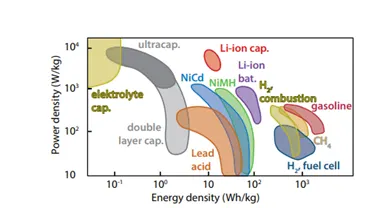
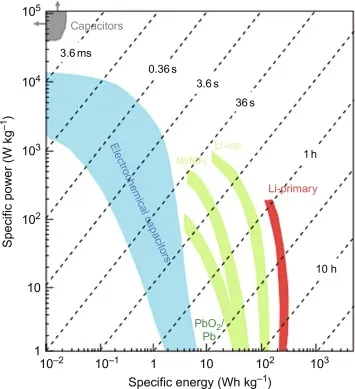
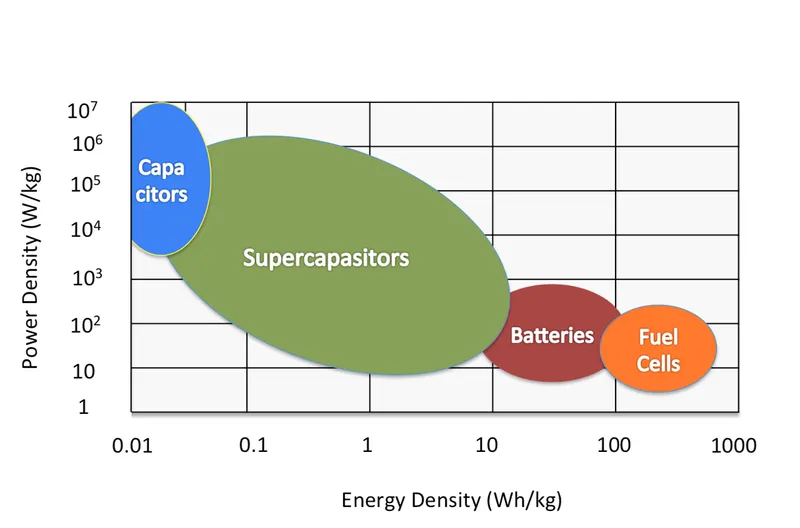
Fig1: Graph of power density (W/kg) Vs energy density (Wh/kg) for lithium ion, lead acid, nichel cadmium batteries, ultra capacitors & fuelcells
From the above graphical comparison, It is clear that super capacitors attain the highest power density when compared with other energy storage systems such as Li-ion batteries, Ni-MH batteries, lead acid batteries & fuel cells