Week 5 Challenge
1. False
The battery is not a better choice to supply power in the given driving scenario.
- Battery and Ultracapacitor complement each other by covering up each other's limitations.
- The battery has high energy density but low power density.
- Batteries have a chemical reaction happening in them through which they conduct electricity.
- Ultracapacitors have a quick charge/discharge rate. They can absorb a lot of energy quickly.
- Ultracapacitors have very high power density but very low energy density. Because of this reason, they are very good for transients.
- Ultracapacitors can increase the life of batteries when used to handle transients.
Hence, the ultracapacitor is the best choice for vehicles that accelerate & decelerate very frequently.
2.
| Battery Type | Energy Density (Wh/kg) | Cell Voltage (V) |
| Lead-acid battery | 35 - 40 | 2.1 |
| Nickel Cadmium | 40 - 60 | 1.2 |
| Nickel Metal Hydride | 60 - 120 | 1.2 |
| Lithium-ion | 100 - 265 | 3.7 |
| Ultracapacitor | 89.6 | 3.5 |
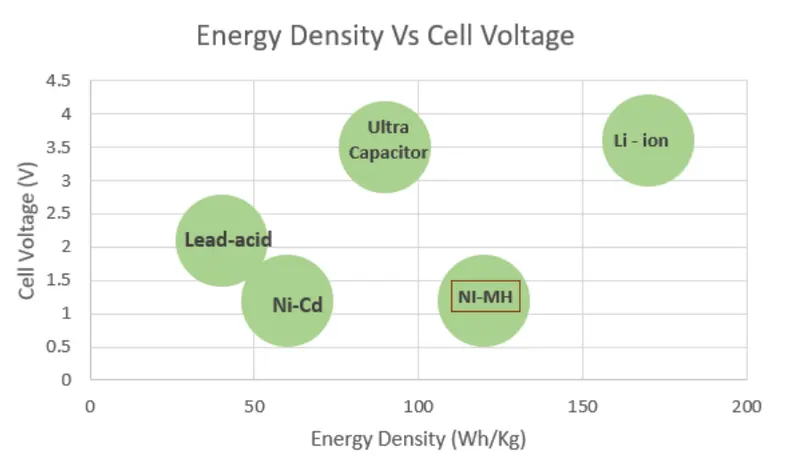
From the above plot, we can say that
- Lead-acid batteries have relatively low energy density.
- Nickel Cadmium batteries have a much high energy density compared to lead-acid batteries.
- Ni-MH batteries can have two to three times the capacity of NiCd batteries of the same size, with high significance and also much less than lithium-ion batteries.
- Lithium-ion batteries have a high energy density.
- Energy density is more in ultracapacitors compared to capacitors.
3.
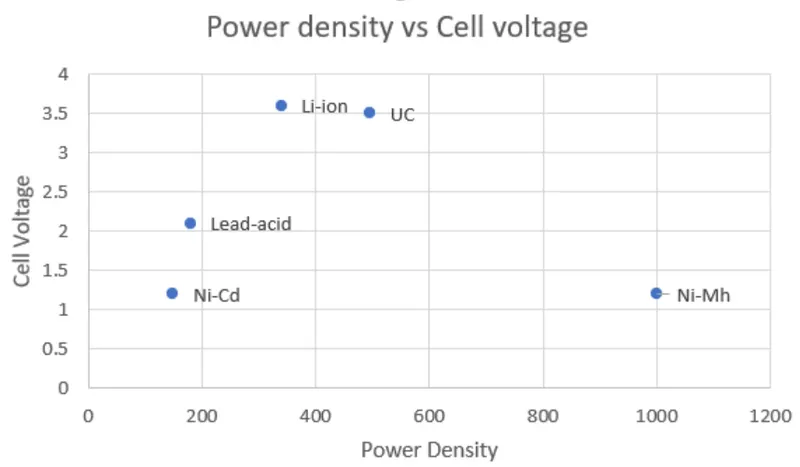
| Battery Type | Power Density (W/kg) | Cell Voltage (V) |
| Lead-acid battery | 180 | 2.1 |
| Nickel Cadmium | 150 | 1.2 |
| Nickel Metal Hydride | 1000 | 1.2 |
| Lithium-ion | 340 | 3.7 |
| Ultracapacitor | 496 | 3.5 |
4. True. The electrode marked as (1) is the negative electrode.
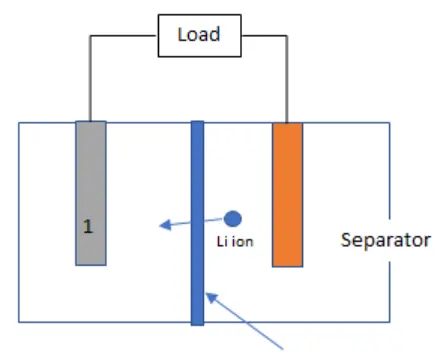
- The negative electrode is typically graphite and can be intercalated.
- It doesn't contain any lithium initially since it is graphite.
- During charging, the external potential is applied, and the lithium dissociates into lithium-ion, Li+ and electron.
- During the discharge process, the reverse of this happens.
- Once the graphite has enough lithium, when connected to the load, it powers the load.
- The lithium inside the graphite releases electrons and moves back to the positive electrode.