Week 5 Challenge
Question 1:
Consider a scenario where an aggressive driver is accelerating very rapidly and braking harshly in a city driving. Is battery better a choice to supply power than UC in this scenario?
- True
- False
Why?
answer:
It's False, Ultra-capacitors (UCs) have a much faster response time when it comes to accelerating and braking than batteries, and they also have a higher power density than batteries. This means that they can produce more power in a shorter amount of time, which is beneficial for an aggressive driving style. Additionally, the range of a vehicle equipped with ultra-capacitors would not be affected as much by aggressive driving as compared to batteries, as ultra-capacitors are able to charge and discharge energy much faster and are less affected by high power demands.
=========================================================================
Question 2:
Consider the following components.
1) Lead acid battery 2) Nickel cadmium battery 3) Nickel Metal hydride battery 4) Lithium ion (specify chemistry) battery 5) Ultra Capacitor
Note: In case of a range of energy density, take the average value for the plot.
Create a plot with energy density on the X Axis and cell voltage on the Y axis.
Comment on the capabilities of these batteries based on the plot created.
answer:
- Lead acid battery - Energy density: 30-40 Wh/kg; Cell voltage: 2V
- Nickel cadmium battery - Energy density: 40-60 Wh/kg; Cell voltage: 1.2V
- Nickel Metal Hydride battery - Energy density: 60-120 Wh/kg; Cell voltage: 1.2V
- Lithium ion (Li-ion) battery - Energy density: 150-250 Wh/kg; Cell voltage: 3.6V-4.2V
- Ultra-capacitor - Energy density: 5-10 Wh/kg; Cell voltage: 2.5V-3.5V
these are approximate values and may vary depending on the specific type of battery or ultra-capacitor. The energy density of a battery refers to the amount of energy stored per unit of weight, while the cell voltage refers to the voltage of a single cell in the battery or ultra-capacitor.
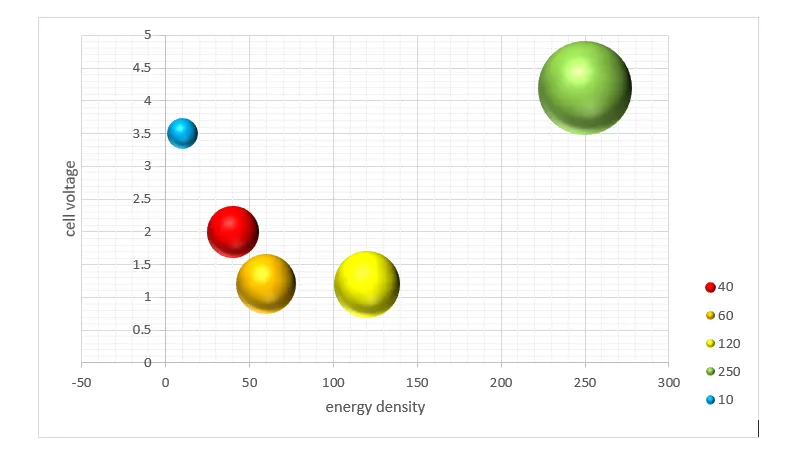
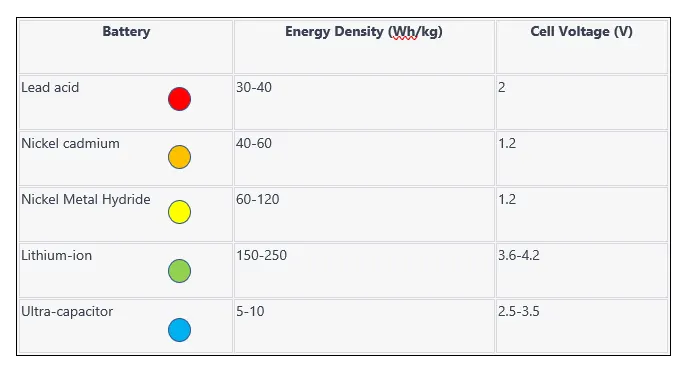
Based on the given details for energy density and cell voltage, we can make the following observations:
-
Lead acid battery: Lead acid batteries have a relatively low energy density and a cell voltage of 2V. This means that they can store less energy per unit weight and have a lower voltage output than other types of batteries. They are commonly used in automotive applications and backup power systems due to their low cost and high reliability.
-
Nickel Cadmium battery: Nickel Cadmium batteries have a slightly higher energy density than lead acid batteries and a cell voltage of 1.2V. They are known for their long service life, good performance in low temperatures, and high discharge rates. They are used in portable electronics and some power tools.
-
Nickel Metal Hydride battery: Nickel Metal Hydride batteries have a much higher energy density than lead acid and nickel cadmium batteries, and a cell voltage of 1.2V. They are considered a more environmentally friendly alternative to nickel cadmium batteries, as they do not contain cadmium which is toxic. They are commonly used in hybrid electric vehicles, portable electronics and some power tools.
-
Lithium ion (Li-ion) battery: Lithium-ion batteries have a very high energy density, and a cell voltage of 3.6V-4.2V. This makes them a popular choice for portable electronic devices, electric vehicles and energy storage systems. They have good performance in high temperatures and high discharge rates but are relatively expensive.
-
Ultra-capacitor: Ultra-capacitors have a relatively low energy density compared to batteries but a high power density, and a cell voltage of 2.5V-3.5V. They are known for their high charge and discharge rates, long cycle life, and good performance in extreme temperatures. They are often used in applications where high power is needed for a short period of time, such as regenerative braking in hybrid electric vehicles and energy storage systems.
=========================================================================
Question 3:
For the above-mentioned components on the same plot (retain the previous plot) created in the previous
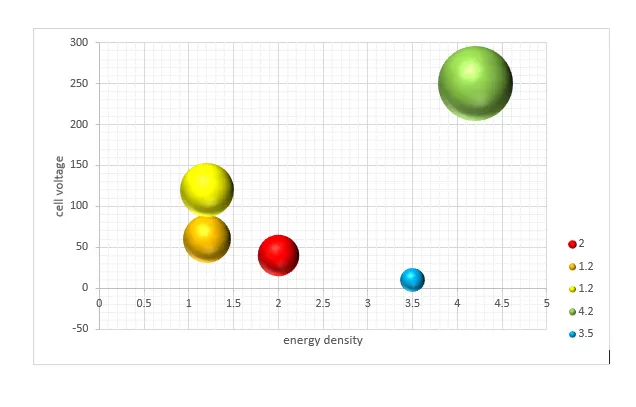
Create a plot with power density on the X axis and cell voltage on the Y axis.
answer:
=========================================================================
Question 4:
Consider the following scenario:
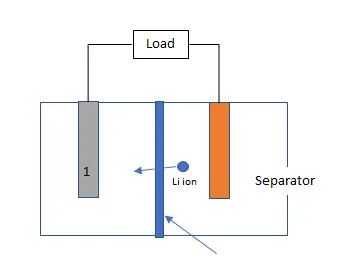
A battery has just been manufactured in the industry and has been connected to a charger for the first time. The electrode marked as (1) in the picture below is the negative electrode.
- True
- False
answer:
true for charging.
in a rechargeable battery, the anode is typically the negative electrode and the cathode is typically the positive electrode.
An anode is the electrode where oxidation occurs and in a rechargeable battery, the anode is the electrode where electrons are removed during discharge and re-inserted during charging.
The cathode is the electrode where reduction occurs and in a rechargeable battery, the cathode is the electrode where electrons are inserted during discharge and removed during charging.
==============================================================================