Week 5 Challenge
Question 1:
Consider a scenario where an aggressive driver is accelerating very rapidly and braking harshly in a city driving. Is battery better a choice to supply power than UC in this scenario?
- True
- False
Why?
False. The battery is not going to be the best choice in the given scenario.Beacuse as the driver is requesting the accelerating rapidly, the batteries cannot provide the high power in short time because the batteries are high energy dense but not high power dense. So using the battery in this scenario is not the best choise. Instered the UC can be used because they are Hifg power dense but for long time it cannot supply the power because they are not high Energy dense.In case of braking the the driver is barking harshly in other words bringing the vehicle to low speed in shot time means the driver is not giving time to use the Regenerative Braking which results in loss of battery Energy which is not preferable. By rapid braking the most of the Energy in the motion of the vehicle i.e., KE in the wheels is going to waste. If we give time for braking the Regenerative braking can be applied and power in the wheels can fed back to battery and charge it and can be used for accelerating power. So the choosing the Battery over the UC for the power supply in the given scenario it is not Prefered.
Question 2:
Consider the following components.
1) Lead acid battery 2) Nickel cadmium battery 3) Nickel Metal hydride battery 4) Lithium ion (specify chemistry) battery 5) Ultra Capacitor
Note: In case of a range of energy density, take the average value for the plot.
Create a plot with energy density on the X Axis and cell voltage on the Y axis.
Comment on the capabilities of these batteries based on the plot created.
| Name of the ESS | Energy Dencity(Wh/L) | Average Energy Dencity (Wh/L) | Cell voltage (V) |
| Lead acid | 80-90 | 85 | 2.1 |
| Nicakel Cadmium | 50-150 | 100 | 1.2 |
| Nicakel metal Hydrate | 140-300 | 220 | 1.2 |
| Li-ion | 250-693 | 471.5 | 3.6 |
| Ultra Capaciters | 1.5-15 | 8.25 | 2.6 |
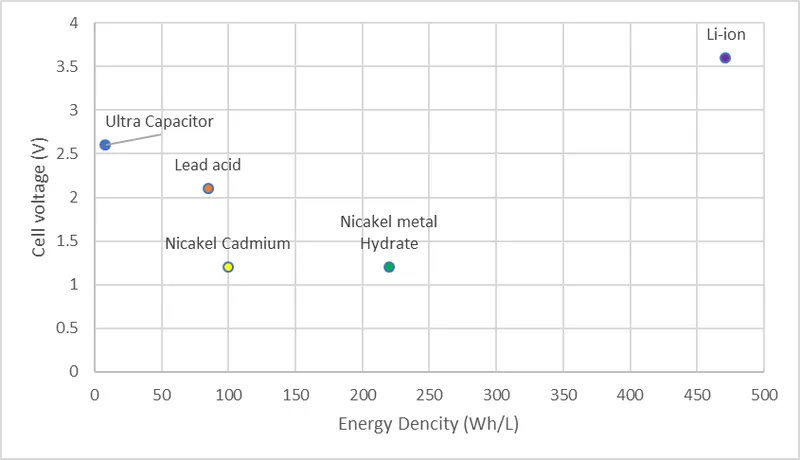
By observing the graph, Li-ion has the high voltage and high energy density which is sutable for Enery Storage System(ESS). Ultracapaciter has the least Energy density. So the Li-ion batteries are used for High volatge and High Energy applications. Ultra capaciters are used for High Power applications. Lead acid batteries are used for low voltage applications. Nicalkel cadmium nad Nicakel Metal Hydrate are used for Low voltage and high energy applications.
Question 3:
For the above-mentioned components on the same plot (retain the previous plot) created in the previous
Create a plot with power density on the X axis and cell voltage on the Y axis.
| Name of the ESS | Cell Volatge (V) | Power Density (W/L) |
| Lead acid | 2.1 | 90 |
| Nickel Cadmium | 1.2 | 75 |
| Nickel metal Hydrate | 1.2 | 306 |
| Li-ion | 3.6 | 203 |
| Ultra Capaciters | 2.6 | 496 |
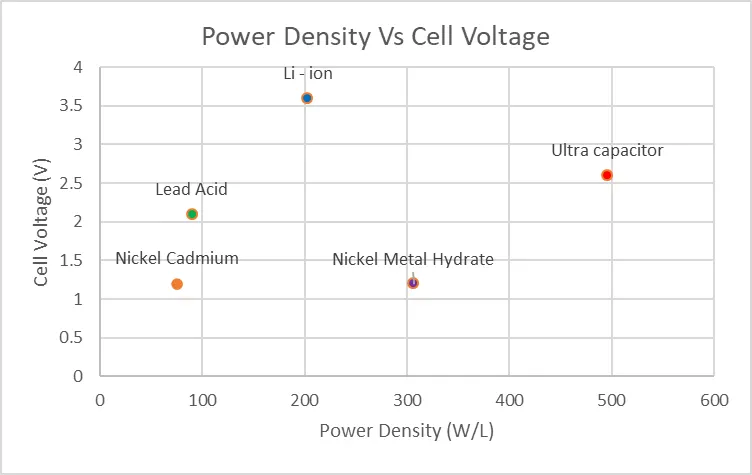
We can observe that Ultra capaciter has the most high power density with high cell voltage of all other batteries. Second the Nickel Metal Hydrate with low voltage. Third the Li-ion Batterie with very high cell volatge, 4th lead acid with high voltage and at last nickel cadmium with very low voltage. Hence the ultra capaciters are used where the High Power density with high voltage are necessary.
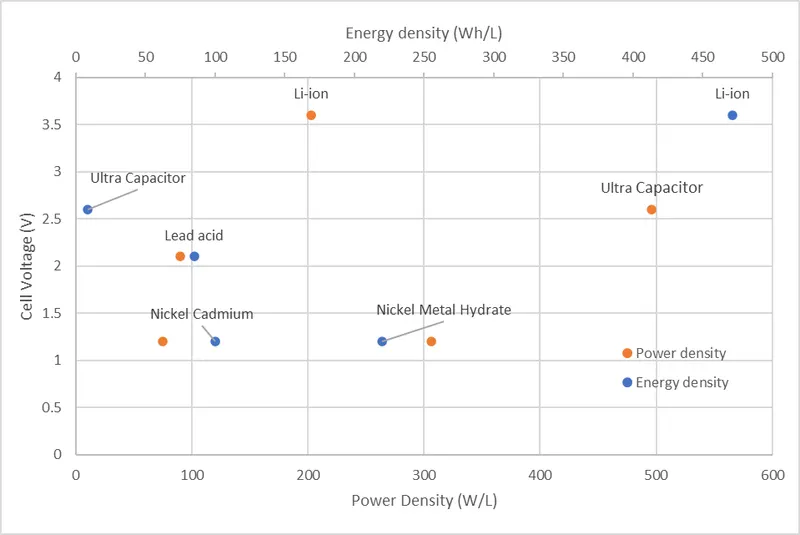
The above graph indecates the combination of power density and energy density. We can observe that the Li-ion and Ultra capaciters are used mostly because of their High cell voltage and according to the requriment. In the application wher power density is not necessary and Energy density is necessary the Li-ion is choosen. In the application wher Energy density is not necessary and Power density is necessary the Ultra Capacitors ion is choosen.
Question 4:
Consider the following scenario:
A battery has just been manufactured in the industry and has been connected to a charger for the first time. The electrode marked as (1) in the picture below is the negative electrode.
- True
- False
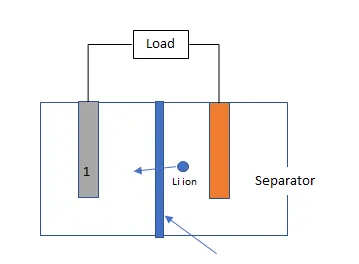
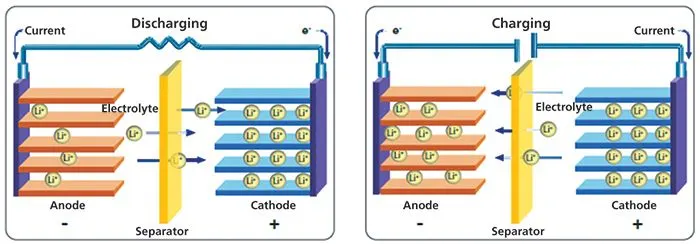
False, Because during the Charging of Lithium ion battery, the lithium ions from Cathode are travelled to anode through the saparator. During the charging the anode is connected to negitive and cathode is connected to positive. But in the given figire the load is connected and the Lithium ion is travelling to electrode - 1 i.e., it indecting the dischagring mode which tells that electrode -1 is Anode which is negitive. In the charging mode the reaction is reversed that is the lithium ions are moving from cathode to anode i.e., positive to negitive. From the above diagram given in the question is discharging mode and the lithium ions are moving from anode to cathode i.e., negitive to positive. Hence the elctrode -1 is Positive, so the given question The electrode marked as (1) in the picture below is the negative electrode is FALSE.