Week 5 Challenge
1.
- In the scenario of aggressive driving by rapid acceleration and harsh breakingit is Not True that the battery is better choice to supply power than UC(Ultracapacitors).
- Becauseultracapacitors plays a major role to provide sudden high power reqirement from battery and sudden high current charging during breaking.
- Eventhough both batteries and ultra capacitors are energy storing devices, they are similar in delivery power.
- Batteries excel at storing energy, while supercapacitors rate better for power. In practical terms, this means that supercapacitors are better at discharging their stored energy quickly, while batteries save more energy in the same amount of material.
- So while sudden accelerations in short duration high power is required which can be provided by ultracapacitors and for harsh braking high current is regenerated, so ultra capacitors can absorb that.
- For these reasons during aggressive driving by rapid acceleration and harsh breakingthe ultracapacitors are the better choice over battery.
2.
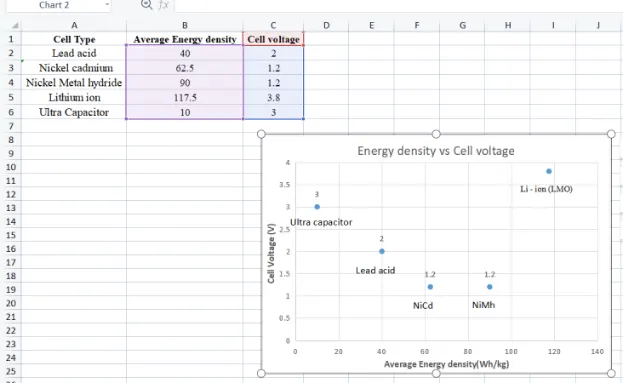
The cell voltage and eergy densitis of the gien cell types are
|
Cell Type |
Cell voltage(V) |
Energy density(Wh/kg) |
Average Energy density(Wh/kg) |
|
Lead acid |
2 |
30-50 |
40 |
|
Nickel cadmium |
1.2 |
45-80 |
62.5 |
|
Nickel Metal hydride |
1.2 |
60-120 |
90 |
|
Lithium ion LMO |
3.8 |
100-135 |
117.5 |
|
Ultra Capacitor |
3 |
1-20 |
10 |
https://in.docworkspace.com/d/sIMPT3PQt5vKgjQY
From the plot we can observe that
- Lithium ion battery has the higher voltage level and energy densitywhen compared to the other battery types and that is the reason these batteries are now widely being used in EV’s, mobiles and many other applications.
- Lead Acidbatteries has high cell voltage value but when compared to the other batteries like NiMH and NiCd it has low energy density. These batteries are first preferred for the electric vehicles but they are being replaced because they require frequent maintenance.
- Nickel metal hydride and Nickel cadmium have almost similar cell voltage value but energy density of NiMH is very high than NiCd.Where NiMH batteries are highly recommend in applications that call for long duration but not a high amp load and Nicd are best suitable for portable power application.
- Ultracapacitors hashigh voltage but has low energy density than all the batteries thus UC can't be used for high energy demanding applications. And these are used in electric vehicles to provide a quick burst of acceleration over short distances and to start the main motor.
3.
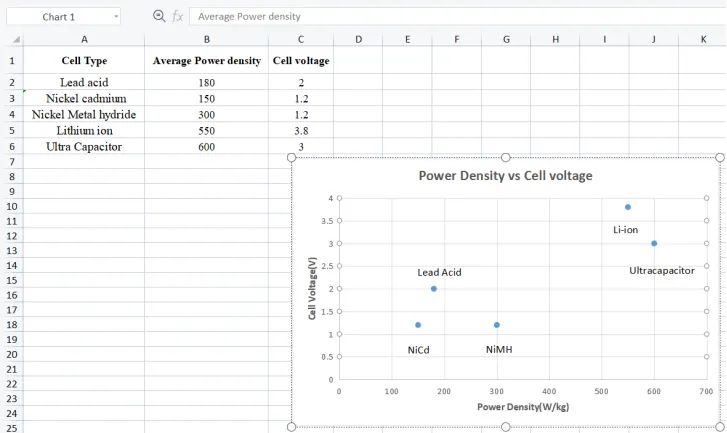
The cell voltage and power densities of the given cell types are
|
Cell Type |
Cell voltage(V) |
Average Power density(W/kg) |
|
Lead acid |
2 |
180 |
|
Nickel cadmium |
1.2 |
150 |
|
Nickel Metal hydride |
1.2 |
300 |
|
Lithium ion LMO |
3.8 |
550 |
|
Ultra Capacitor |
3 |
600 |
https://in.docworkspace.com/d/sIHDT3PQthPOgjQY
From the plot we can observe that
- Ultra capacitor has the highest power density when compared to the other batteries.
- Lithium ion Batteries have high cell voltage as well high power densities than remaining types.
- NiCd & NiMH has same cell voltage but they differ in the Power density and NiCd has low power density than all.
- And lead acid is in between the NiMH and NiCd batteries.
4.
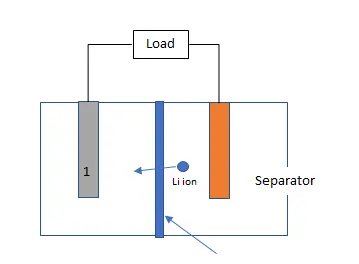
In the scenario given that a battery had been manufactured and had been connected to a charger for the first time. It is true that the electrode marked as (1) in the picture below is the negative electrode.
This is because initially in Li-ion battery anode doesn’t consist of ions but cathode side has the ions according to the Lithium ion chemistries. So, during the above condition for first charging electrons move from cathode to anode here.
So here cathode being the active material it is termed as positive here and anode is negative.