Week 5 Bending of iPhone
Objective:
The aim of this challenge is to simulate the bending of an iphone and find out the deformation, stress and strain generated. The challenge involved 2 cases: first, in which given model was run as shown in the video and second, in which the position of the bottom fingers was changed as well as fatigue life needed to be assessed.
Case setup and execution:
Case 1:
First, the static strucutural module was opened. In the engineering data, the aluminum alloy and polyethelene were added to the material library. The polyethelene card was duplicated and the necessary properties were changed as in the video, to create glass material.
Then the given geometrical model was opened in Spaceclaim. Using the merge faces option under Repair tab, the number of faces was reduced to as low as possible.
Then in the Ansys mechanical, the respective parts were named as glass, frame, inside, thumb1 and thumb2. The glass was assigned glass material, frame was of aluminum alloy, inside was of polyethelene and the all the fingers were assigned structural steel material. The behaviour of all the fingers except one of the thumbs, was made rigid.
Then in the Contacts, the 2 contacts between adjacent fingers were deleted. The rest were renamed as per definition. The contact between glass and frame was made bonded, while the rest were made frictionless.
Then, by selecting each finger one by one, all fingers except the thumbs were provided a fixed joint. The two thumbs were provided a translational joint and their x-axes were oriented with the global Y-axis.
Then the boundary conditions were provided. The frame was hidden and the two opposite faces on the top and bottom of the phone were given fixed support. The sideways faces of the frame were made free in Y-direction but constrained in x and z direction by giving the displacement boundary condition.
The two thumbs were given joint-displacement in global Y-direction as shown below:

In the analysis settings, 8 load steps were chosen. The direct solver was used. Weak springs were program controlled and large deflection was turned on. In non-linear settings, the constant stabilisation factor was used and stabilization force limit of 0.1 for energy. in output controls all the options were changed to "Yes".
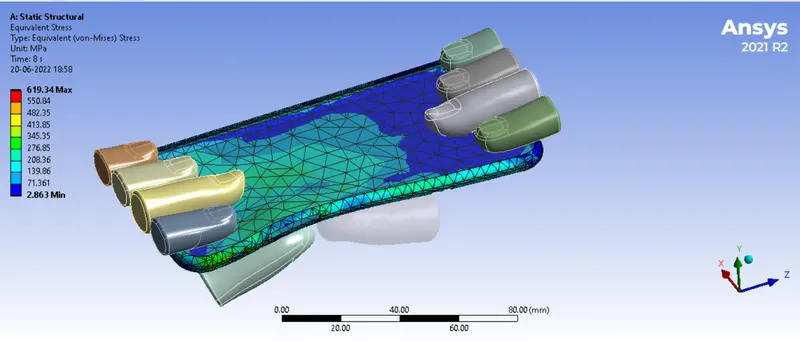
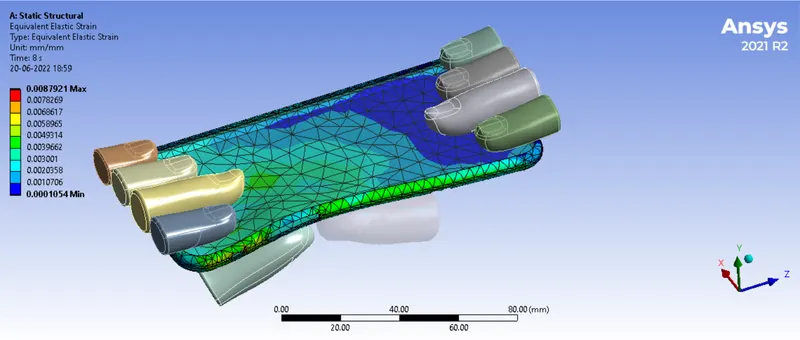
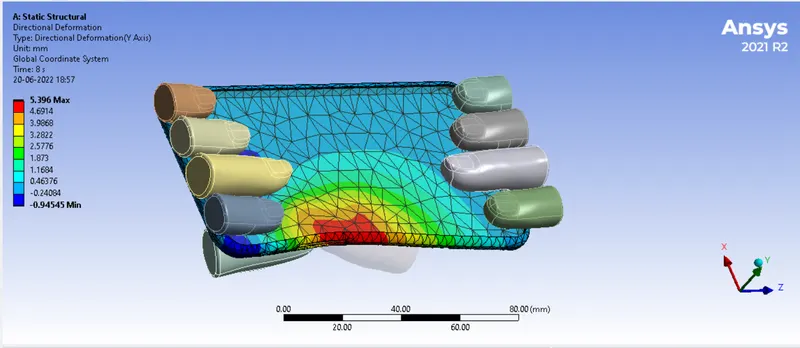
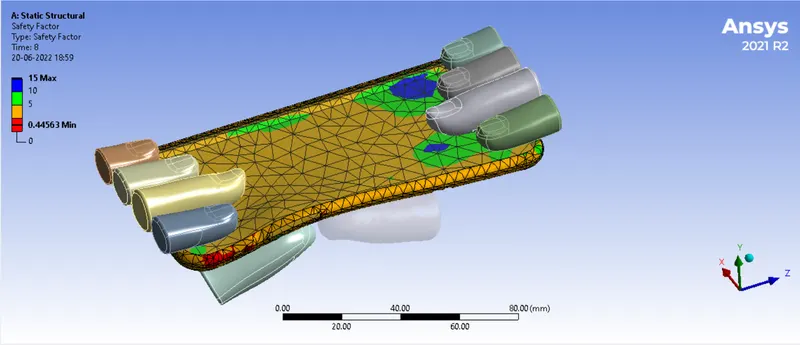
For the outputs, equivalent stress, strain, Y-directional deformation and Stress tool-safety factor were inserted.
The model was run successfully.
Case 2 :
For case 2, in the engineering data, under "Life" tab, S-N curve option was selected and the given data was input for aluminium alloy.
Then in Spaceclaim, "move" option was used. The 2 thumbs were selected . Then on the l;eft hand side panel, in general settings, XYZ coordinates option was selected. The thumbs were moved to the middle of the iphone.
The rest of the setup was similar to case 1.
In the output, fatigue tool was inserted and life and safety factor outputs were requested.
But when the model was run, it failed with the error in Fatigue module: S-N curve is absent or invalidly defined.
Hence in the fatigue tool, for life as well as safety factor, instead of all bodies, only 1 body i.e. Frame was selected. Then the model ran successfully.
Results:
Case 1:
Equivalent stress:
Equivalent strain:
Directional deformation:
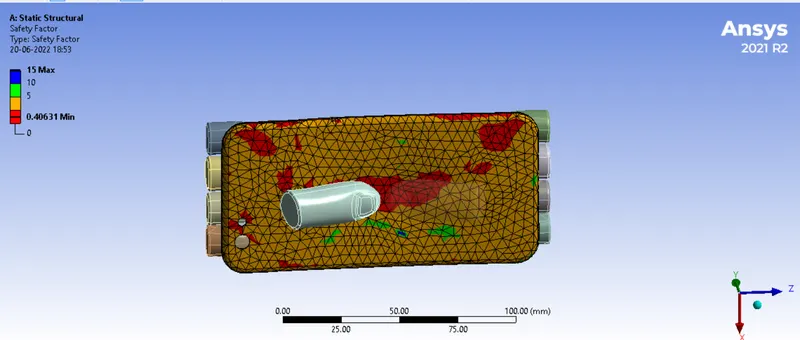
Safety factor:
Case 2:
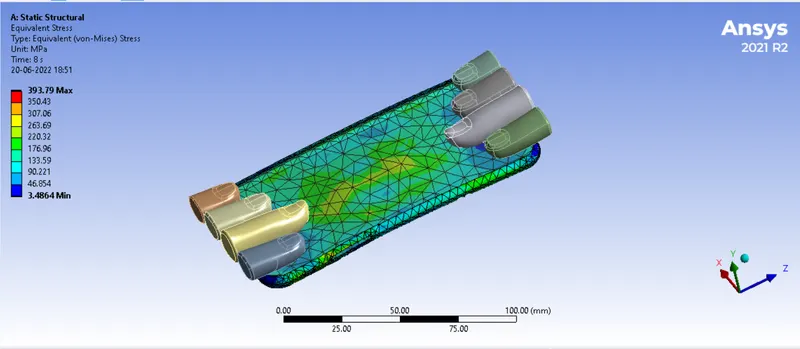
Equivalent stress:
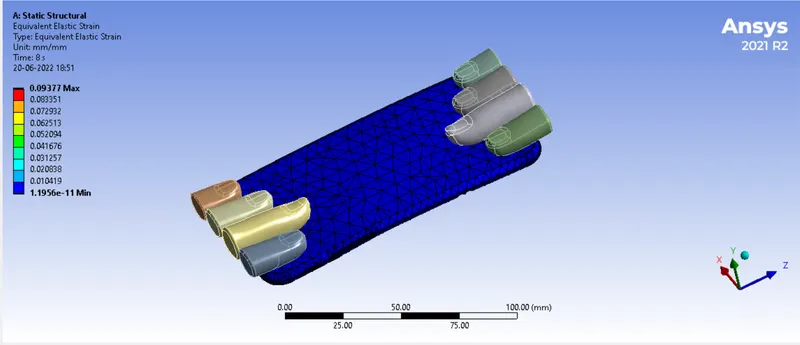
Equivalent strain:
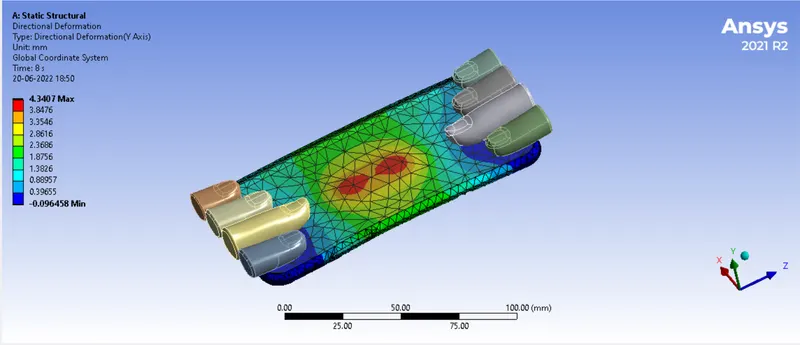
Directional deformation:
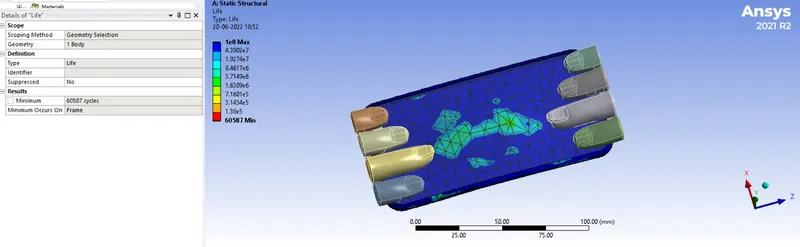
Life:
Fatigue safety factor:
The following table summarises the results:
| Case 1 | Case 2 | |
| Equivalent stress (MPa) | 619.34 | 393.79 |
| Equivalent strain (MPa) | 0.0087921 | 0.09377 |
| Maximum Y-deformation (mm) | 5.396 | 4.3407 |
| Minimum Saftey factor | 0.44563 | 0.40631 |
| Minimum Life (cycles) | - | 60587 |
Conclusion:
As can be seen, the safety factor has reduced in the Case 2 due to the fatigue. Fatigue has also reduced the strength of the material, leading to more strain, but with lesser stress. The deformation is lower in Case 2 mainly because the pushing is happening in the middle of the iphone. In case 1 pushing happened at the edge which is more free to move than the middle part of the phone. The zip files are attached with the report.