Week 5.2 - Mid term project - Steady vs unsteady state analysis
Week 5.2 - Mid term project - Steady vs unsteady state analysis:
Aim:
To compare the convergence rate [Number of iterations] of the steady state and transient [explicit and implicit] simulations and justify the numerics.
Governing equation:
2D steady state heat conduction equation is represented as,
`(del^2T)/(delx^2)+(del^2T)/(dely^2)=0`
Since it is a steady state equation the time term is zero and diffusivity is constant.
2D Unsteady state heat conduction equation is represented as,
`(delT)/(delt)+alpha*(del^2T)/(delx^2)+(del^2T)/(dely^2)=0`
Here the equation is hyperbolic as the time/information is traveeling in only one direction.
Boundary conditions:
Nodes that are representing X axis is "i"
Nodes that are representing Y axis is "j"
At any (i,j) temperature is represented by T(i,j)
The temperature at the top is represented by T(i,j+1)
The temperature at the bottom is represented by T(i,j-1)
The temperature at the rigth is represented by T(i+1,j)
The temperature at the left is represented by T(i-1,j)
The number of time steps is represented by 'n'
i)2D Unsteady heat conduction equation:
Explicit method:
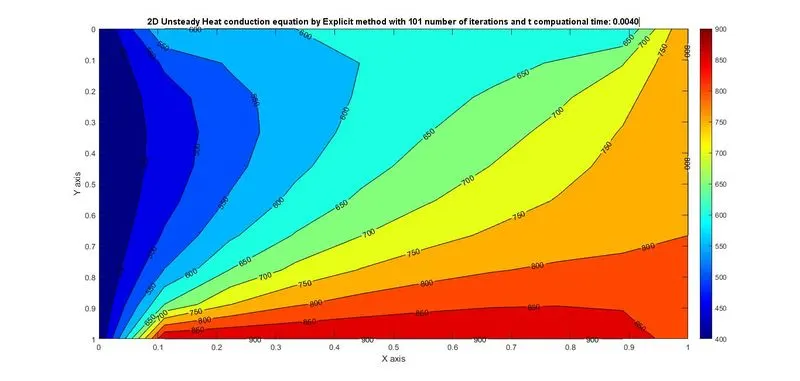
In an explicit method, forward differencing scheme can be implemented to the left-hand aspect of the equation while backward differencing is implemented to the right-hand aspect of the equation. The right-hand aspect of the equation will incorporate phrases from the preceding time steps while the left-hand aspect of the equation will incorporate the time period from the existing time step.
The Matlab output graph for transient state explicit approach is shown below.
Implicit method:
In an explicit approach forward differencing will be applied to the left-hand side of the equation whereas backward differencing is applied to the right-hand side of the equation. The right-hand side as well as left hand side of the equation will contain terms from the present time steps except T(i,j) of LHS will be of previous time steps.
As compared to explicit implicit requires iterative solvers to reach to a particular solution.
Iterative methods are as follows;
k1=alpha*(dt/dx^2);
k2=alpha*(dt/dy^2);
Jacobi Implicit method:
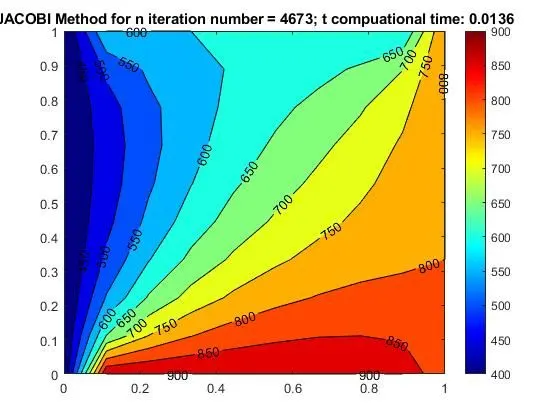
As the solution marches forward jacobi will use the value of previous time steps and compute the present value till convergence.
The Matlab output graph for transient state Jacobi Implicit approach is shown below.
Gauss Seidel Implicit method:
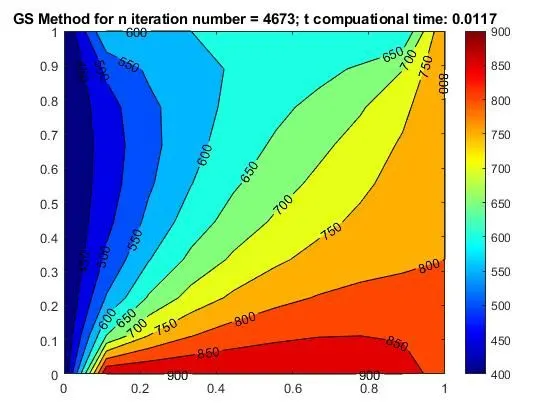
In this type of method for calculating the value of temperature of the 2nd node,it will use the updated value at node 1 and previous value of node 3.
The Matlab output graph for transient state Gauss Seidel Implicit approach is shown below.
Successive Over Relaxation implicit method:
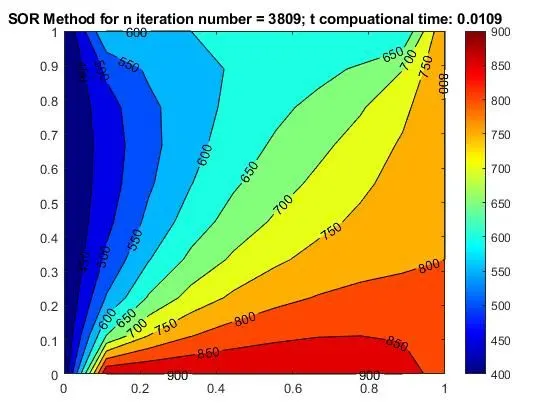
It is a variant of Gauss Seidel method. It uses a relaxation factor "omega". When omega is greater than one it is called as Over relaxation and when it is lesser than one it is called Under relaxation.
The Matlab output graph for transient state SOR Implicit approach is shown below.
ii)2D Steady heat conduction equation:
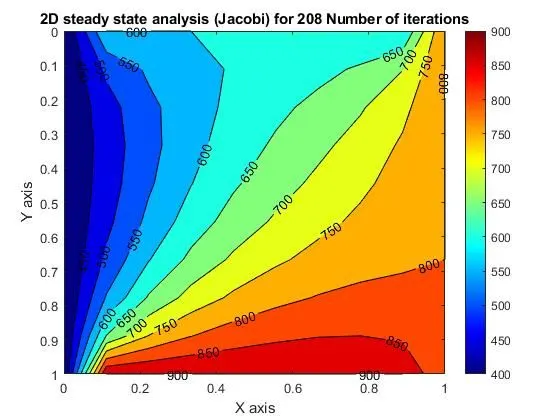
Jacobi method:
As the solution marches forward jacobi will use the value of previous time steps and compute the present value till convergence.
The Matlab output graph for Steady state Jacobi Implicit approach is shown below.
Gauss Seidel method:
In this type of method for calculating the value of temperature of the 2nd node,it will use the updated value at node 1 and previous value of node 3.
The Matlab output graph for Steady state Gauss Seidel Implicit approach is shown below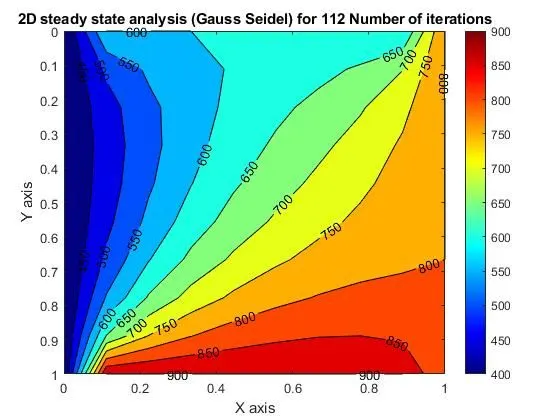
Successive Over Relaxation method:
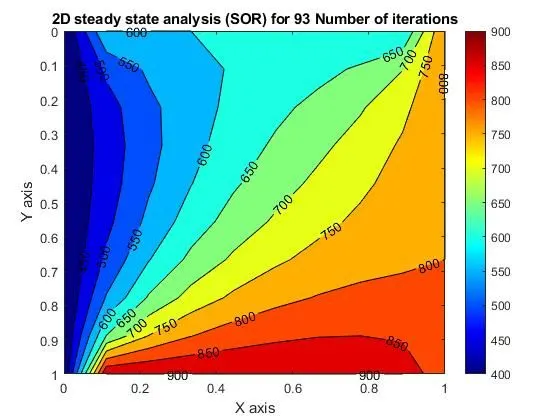
It is a variant of Gauss Seidel method. It uses a relaxation factor "omega". When omega is greater than one it is called as Over relaxation and when it is lesser than one it is called Under relaxation.
The Matlab output graph for Steady state SOR Implicit approach is shown below.
Conclusion:
1) The steady state solver is obviously faster. This is beacue of the mathematical simplification of the problem. There is no thermal diffusivity and no time integration. Therefore there is no nummerical diffusion and the solution will always be stable, we just need to chose a decent dx and dy
2) In the transient solvers, the explicit schemes are usually easier to solve. This is because in the explicit case, we have a system of linear equations (nodes) that can be solved independently without iteration. This scherne actually works exactly like the steady case. The time integration here is just the convergence loop in the steady case.
The implicit solvers require iteration until convergence in the spatial node, plus then the same time integration than the explicit solvers. They are therefore computationally more expensive.
3) In any transient solver we need to be careful with a new factor: k=alpha*dt/(dx^2)
This term will determine whether our transient schemes converge or diverge. The thermal diffusivity is given, so therefore we must be careful with the spatial node size and time step. Usually, the number of nodes will be selected based on the geometry, and then the time step must be chosen accordingly (for convergence).
However, the advantange of implicit solvers vs explicit solvers is, usually, implicit solvers are more stable. This is the maximum (this is maximum value of k in which the method is still stable) k value (and therefore, the maximum time step size that can be selected is higher A deeper explanation of this, with examples, will be explained in the next challenge.
4) Note, obviously that we are talking about the higher time step for convergence, but the solution will always be precises we use a smaller time step. This is due to induced comoutational errors, such as nummerical diffusion
It can be concluded that the successive over relaxation method gives faster rate of convergence than the other two methods as the number of iteration is least for successive over relaxation method and maximum for jacobi method.Explicit method are time sensitive, wrong time steps may result in unstabe graph.