Week 3.1 - Stoichiometric Combustion Calculator
Your Answers
Week 3.1 - Stoichiometric Combustion Calculator
Objective:
The aim of this project is to determine and plot the comparison and the effect of number of molecules of carbon (c) on the stoichiometric co-efficient (ar) for the combustion reaction.
The ideal combustion process during which the fuel is burned completely with theoretical air is called the stoichiometric combustion of that fuel. Stoichiometric plays a very important role which indicates theoretical oxidizer required for the combustion of wealth. Assuming that the products will be carbon-di-oxide, water and nitrogen. Keeping that all the taken products to be remained same for ideal condition.
Stoichiometric coefficient (ar) is the ratio of actual amount of air required for complete combustion of the fuel, the theoretical (Stoichiometric) air required for combustion process.
- Stoichiometric combustion reaction for alkanes:
Cn H2n+2 + ar (O2 + 3.76N2) = aCo2 + bH2O + cN2
Where n =number of moles of carbon(C)
ar = stoichiometric coefficient
a = number of moles of CO2
b = number of moles of H2O
c = number of moles of N2
Performing element wise balancing in the stoichiometric reaction equation:
No of moles of Carbon:n=a
No of moles of Hydrogen: (2n+2) = 2b -->b = n+1
No of moles of Nitrogen: 2*3.76ar = 2C -->C = 3.76 ar
No of moles of Oxygen: 2*ar = 2a+b -->ar = (2a+b)/2
By substituting all the values, we get ar = (3/2)*n + 1/2.
- Stoichiometric combustion reaction for alkenes:
Cn H2n + ar (O2 + 3.76N2) = aCo2 + bH2O + cN2
Performing element wise balancing in the stoichiometric reaction equation:
No of moles of Carbon: n=a
No of moles of Hydrogen: 2n = 2b -->b = n
No of moles of Nitrogen: 2*3.76ar = 2C --> C = 3.76 ar
No of moles of Oxygen: 2*ar = 2a+b --> ar = (2a+b)/2
By substituting all the values, we get ar = (2n+n)/2
ar= (3/2)*n
- Stoichiometric combustion reaction for alkynes:
Cn H2n-2 + ar (O2 + 3.76N2) = aCo2 + bH2O + cN2
Performing element wise balancing in the stoichiometric reaction equation:
No of moles of Carbon: n=a
No of moles of Hydrogen: (2n-2) = 2b --> b = n-1
No of moles of Nitrogen: 2*3.76ar = 2C --> C = 3.76 ar
No of moles of Oxygen: 2*ar = 2a+b -->ar = (2a+b)/2
By substituting all the values, we get ar = (2n+(n-1))/2
ar = (3/2)*n – (1/2)
Using the above equations, a relationship between the number of moles of carbon and the stoichiometric coefficient of Alkanes, Alkenes, Alkynes are established using the following matlab code.
MALAB Code:
clear all
close all
clc
% Creating an array for 25 carbon atoms
% Number of moles of carbon is denoted by 'n'
%Stoichiometric coefficient is denoted by 'ar'

n=linspace(1,25,25);
i=1:length(n);

for i=1:length(n)
    %stoichiometric coefficient of Alkanes
    ar_alkanes(i)=((3*n(i))+1)/2;
    %stoichiometric coefficient of Alkenes
    ar_alkenes(i)=(3*n(i))/2;
    %stoichiometric coefficient of Alkymes
    ar_alkynes(i)=((3*n(i))-1)/2;

end
%plotting the graph between Stoichiometeric coefficient(ar) vs number of
%moles of carbon for different fuels

figure(1)
plot(n,ar_alkanes,'linewidth',2,'marker','+')
hold on
grid on
plot(n,ar_alkenes,'linewidth',2,'marker','x')
hold on
plot(n,ar_alkynes,'linewidth',2,'marker','*')
title('Stoichiometric Coefficient(ar) vs. Number of moles(n)')
xlabel('Number of moles(n)')
ylabel('Stoichiometric Coefficient(ar)')
legend('Alkanes','Alkenes','Alkynes')
Effect of No.of Moles of carbon(n) on Stoichiometric Coefficient (ar)
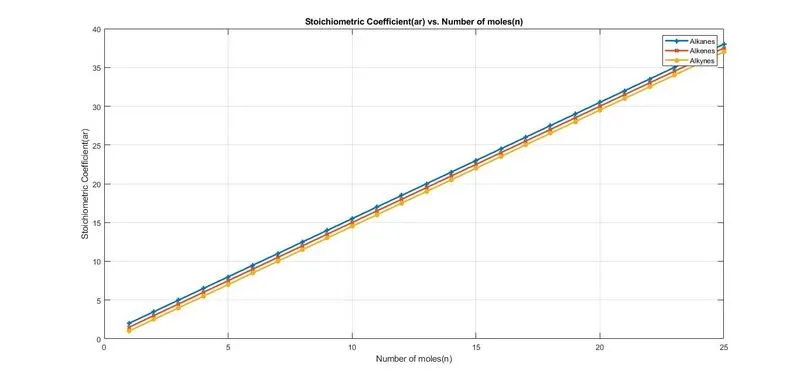
From the above plot of moles ranging from 1 to 25 , it can be inferred that the stoichiometric coefficient(ar) varies linearly with the no of moles(n) for any type of hydrocarbon fuel. As the number of moles of carbon increases, the stoichiometric coefficient for the reaction also increases lineraly.It is also inferred that the same number of moles of carbon the stoichiometric coefficient of Alkanes is higher that of Alkenes and Alkynes which results in the requirement of more oxygen for combustion. The value of Stoichiometric coefficeint at certain mole no could also be established.