Solving the steady and unsteady 2D heat conduction problem
OBJECTIVE
The primary objective of this task is to conduct a steady state and transient state analysis of a 2D heat conduction equation by using the point iterative techniques.
TASK DESCRIPTION
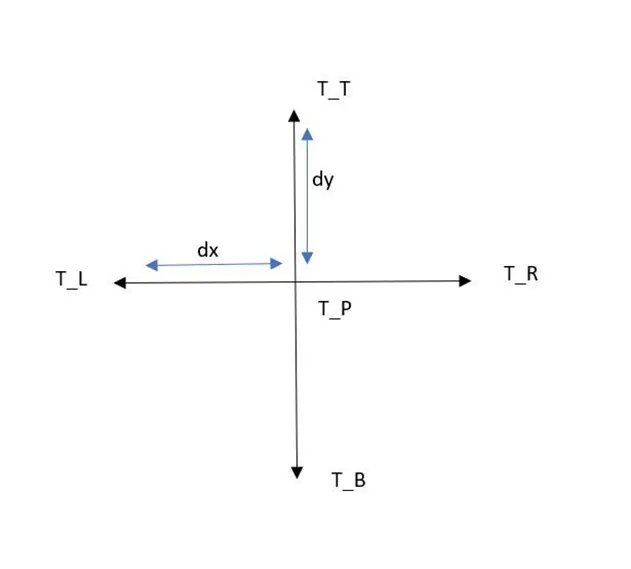
A unit square grid of 10 grid points, with boundary conditions of temperature 400K,800K,600K and 900K at left, right, top and bottom boundaries respectively are given. An initial temperature of 300K is specified inside the grid (except the boundaries).
T_L=400K
T_R=800K
T_T=600K
T_B=900K
The steady state equation has to be solved implicitly, whereas the transient state has to be solved both explicitly and implicitly. Solving an equation implicitly employs three iteration techniques:
- Jacobi Iteration
- Gauss Siedel Iteration
- Successive over Relaxation Iteration
THEORY
Heat equation is a partial differential equation which describes the change/distribution of a quantity with time, within a domain, as the quantity moves according to the gradient(i.e, from higher region to lower region). It is of the form
, where u is a function of (x,y,z,t).
There are two types of heat conduction: Transient and steady state heat conduction.
Transient conduction is the period where the temperature changes with time at any place in the domain. It is also called as non-steady state conduction, signifying its temperature dependence.
The 3D transient heat conduction is given by
where α is a real coeffecient, that represents the diffusivity of the medium.
Steady state conduction occurs when the temperature difference, that acts as the driving force of conduction, is a constant. In other words, the derivatives of temperature with respect to time is zero, hence,
BOUNDARY CONDITIONS REPRESENTATION
DISCRETIZATION
The heat conduction equation is a PDE and must be discretized so as to solve it.
STEADY STATE:
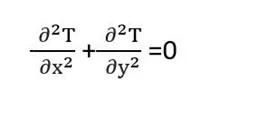
Upon discretization,
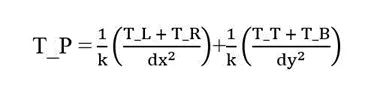
where,
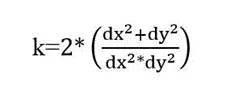
For solving the equation implicitly using:
- Jacobi Iteration, the equation can be written as
- Gauss-Siedel Iteration, the equation can be written as

- Successive over Relaxation Iteration, the equation can be written as

where, ω is the relaxation factor.
If ω >1, over relaxation
ω<1, under relaxation
TRANSIENT STATE:
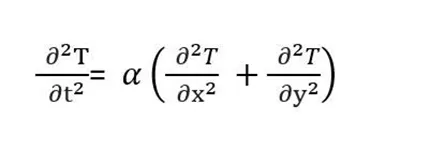
-
Upon discretization,
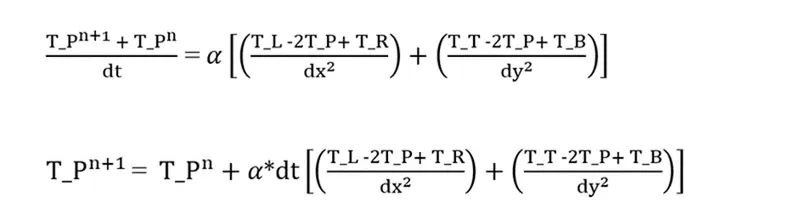
where, α is the thermal diffusion.
To solve this explicitly, no iterative techniques are needed, since all the values are known. Hence,


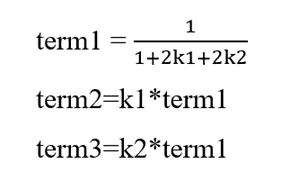
k1 and k2 are the CFL numbers along x and y directions respectively.
In the case of explicit diffussion processes, the total CFL number should be less than or equal to 0.5, otherwise, the solution becomes unsteady.
For solving the equation implicitly 
After rearranging,
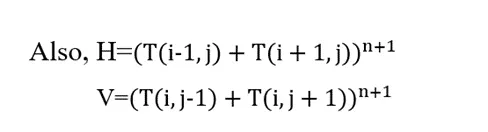

- Jacobi Iteration, the equation can be written as
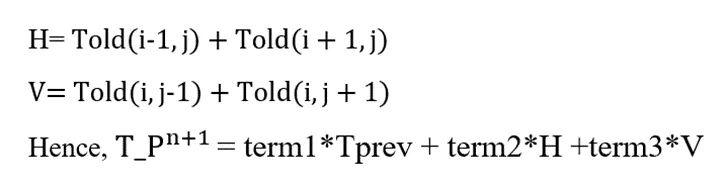
- Gauss-Siedel Iteration, the equation can be written as
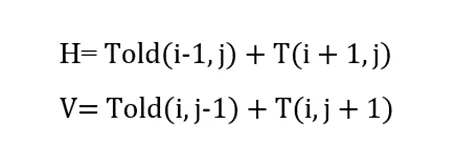
- Successive over Relaxation Iteration, the equation can be written as

CODE
- Steady State Heat Conduction-IMPLICIT
%challenge 5.1
%2d STEADY STATE heat conduction equation
%d^2T/dx^2+d^2T/dy^2=0
clear all
close all
clcnx=10;
ny=nx;x=linspace(0,1,nx);
y=linspace(0,1,ny);dx=x(2)-x(1);
dy=y(2)-y(1);T_l=400;
T_r=800;
T_t=600;
T_b=900;T_in=300; %value of T in all other points except the boundaries
T=T_in*ones(10,1)*ones(1,10); %creating a square grid of temperature
%Introducing the boundary conditions except the corners
T(2:ny-1,1)=T_l;%2nd to 9th row of first column
T(2:ny-1,ny)=T_r;%2nd to 9th row of last column column
T(1,2:nx-1)=T_t;%2nd to 9th column of first row
T(ny,2:nx-1)=T_b;%2nd to 9th column of last row%computing corner values
T(1,1)=(T_t+T_l)/2;
T(10,1)=(T_b+T_l)/2;
T(1,10)=(T_t+T_r)/2;
T(10,10)=(T_b+T_r)/2;error=9e9;
tol=1e-4;
k=2*(dx^2+dy^2)/(dx^2*dy^2);Told=T;
iteration_number=3;%can be changed to access different methods
%JACOBI ITERATIONif iteration_number==1
jacobi=1;
while(error>tol)
for i=2:nx-1
for j=2:ny-1
term1=(Told(i-1,j)+Told(i+1,j))/(k*dx^2);
term2=(Told(i,j-1)+Told(i,j+1))/(k*dy^2);
T(i,j)=term1+term2;
end
end
error=max(max(abs(Told-T)));
Told=T;
jacobi=jacobi+1;
contourf(x,y,T,'ShowText','on')
set(gca,'YDIR','reverse')
c=colorbar;
c.Label.String='Temperature (K)';
title_text=sprintf('no: of jacobi iterations=%d',jacobi);
title(title_text);
pause(0.03);
end
end
%GAUSS SIEDEL ITERATION
if iteration_number==2
gauss=1;
while(error>tol)
for i=2:nx-1
for j=2:nx-1
term1=(T(i-1,j)+Told(i+1,j))/(k*dx^2);
term2=(T(i,j-1)+Told(i,j+1))/(k*dx^2);
T(i,j)=term1+term2;
end
end
error=max(max(abs(Told-T)));
Told=T;
gauss=gauss+1;
contourf(x,y,T,'ShowText','on')
set(gca,'YDIR','reverse')
c=colorbar;
c.Label.String='Temperature (K)';
title_text=sprintf('no: of gauss iterations=%d',gauss);
title(title_text);
pause(0.03);
end
end
%SUCCESSIVE OVER RELAXATION
omega=1.2; %relaxation factor
if iteration_number==3
SOR=1;
while(error>tol)
for i=2:nx-1
for j=2:nx-1
term1=(T(i-1,j)+Told(i+1,j))/(k*dx^2);
term2=(T(i,j-1)+Told(i,j+1))/(k*dx^2);
T(i,j)=(1-omega)*Told(i,j)+omega*(term1+term2);
end
end
error=max(max(abs(Told-T)));
Told=T;
SOR=SOR+1;
contourf(x,y,T,'ShowText','on')
set(gca,'YDIR','reverse')
c=colorbar;
c.Label.String='Temperature (K)';
title_text=sprintf('no: of sor iterations=%d',SOR);
title(title_text);
pause(0.03);
end
end2) TRANSIENT HEAT CONDUCTION-EXPLICIT
clear all
close all
clcnx=10;
ny=nx;x=linspace(0,1,nx);
y=linspace(0,1,ny);dx=x(2)-x(1);
dy=y(2)-y(1);T_l=400;
T_r=800;
T_t=600;
T_b=900;T_in=300; %value of T in all other points except the boundaries
T=T_in*ones(10,1)*ones(1,10); %creating a square grid of temperature
%Introducing the boundary conditions except the corners
T(2:ny-1,1)=T_l;%2nd to 9th row of first column
T(2:ny-1,ny)=T_r;%2nd to 9th row of last column column
T(1,2:nx-1)=T_t;%2nd to 9th column of first row
T(ny,2:nx-1)=T_b;%2nd to 9th column of last row%computing corner values
T(1,1)=(T_t+T_l)/2;
T(10,1)=(T_b+T_l)/2;
T(1,10)=(T_t+T_r)/2;
T(10,10)=(T_b+T_r)/2;Told=T;
dt=1e-3;
alpha=1.4;
k1=alpha*dt/dx^2;
k2=k1;
CFL=k1+k2;
error=1;
tol=1e-4;iteration=1;
while(error>tol)
for i=2:nx-1
for j=2:ny-1
term1=Told(i-1,j)-2*Told(i,j)+Told(i+1,j);
term2=Told(i,j-1)-2*Told(i,j)+Told(i,j+1);
T(i,j)=Told(i,j)+k1*term1+k2*term2 ;
end
end
error=max(max(abs(T-Told)));
Told=T;
iteration=iteration+1;contourf(x,y,T,'ShowText','on')
set(gca,'YDIR','reverse')
c=colorbar;
c.Label.String='Temperature (K)';
title_text=sprintf('no: of iterations=%d',iteration);
title(title_text);
pause(0.03);
end3) TRANSIENT HEAT CONDUCTION-IMPLICIT
clear all
close all
clc%inputs
nx=10;
ny=nx;%creating x and y grids
x=linspace(0,1,nx);
y=linspace(0,1,ny);dx=x(2)-x(1);
dy=y(2)-y(1);
%boundary conditions
T_l=400;
T_r=800;
T_t=600;
T_b=900;T_in=300; %value of T in all other points except the boundaries
T=T_in*ones(10,1)*ones(1,10); %creating a square grid of temperature
%Introducing the boundary conditions except the corners
T(2:ny-1,1)=T_l;%2nd to 9th row of first column
T(2:ny-1,ny)=T_r;%2nd to 9th row of last column column
T(1,2:nx-1)=T_t;%2nd to 9th column of first row
T(ny,2:nx-1)=T_b;%2nd to 9th column of last row%computing corner values
T(1,1)=(T_t+T_l)/2;
T(10,1)=(T_b+T_l)/2;
T(1,10)=(T_t+T_r)/2;
T(10,10)=(T_b+T_r)/2;alpha=1.4; %thermal diffusion
omega=1.2; %relaxation factor
dt=1e-3;
nt=1400;k1=alpha*dt/dx^2;
k2=k1;
CFL=k1+k2;error=9e9;
t_error=9e9;
tol=1e-4;
jacobi_implicit=1;
gauss_implicit=1;
SOR_implicit=1;
Told=T; %for the old iteration
Tprev=T; %for the old time step
Tinitial=T;
%JACOBI
while(t_error>tol)
error=9e9;
while(error>tol)
for i=2:nx-1
for j=2:ny-1
term1=(1+2*k1+2*k2)^-1;
term2=k1*term1;
term3=k2*term1;
H=Told(i-1,j)+Told(i+1,j);
V=Told(i,j-1)+Told(i,j+1);
T(i,j)=(Tprev(i,j)*term1)+H*term2+V*term3;
end
end
error=max(max(abs(Told-T)));
Told=T;
jacobi_implicit=jacobi_implicit+1;
end
t_error = max(max(abs(Tprev-T)));
Tprev=T;
endfigure(1)
contourf(x,y,T,'ShowText','on')
set(gca,'YDIR','reverse')
c=colorbar;
c.Label.String='Temperature (K)';
title_text=sprintf('no: of jacobi iterations=%d',jacobi_implicit);
title(title_text);
pause(0.03);%GAUSS
T = Tinitial;
Told = Tinitial;
Tprev = Tinitial;
t_error=9e9;
while(t_error>tol)
error=9e9;
while(error>tol)
for i=2:nx-1
for j=2:ny-1
term1=(1+2*k1+2*k2)^-1;
term2=k1*term1;
term3=k2*term1;
H=T(i-1,j)+Told(i+1,j);
V=T(i,j-1)+Told(i,j+1);
T(i,j)=(Tprev(i,j)*term1)+H*term2+V*term3;
end
end
error=max(max(abs(Told-T)));
Told=T;
gauss_implicit=gauss_implicit+1;
end
t_error = max(max(abs(Tprev-T)));
Tprev=T;
endfigure(2)
contourf(x,y,T,'ShowText','on')
set(gca,'YDIR','reverse')
c=colorbar;
c.Label.String='Temperature (K)';
title_text=sprintf('no: of gauss iterations=%d',gauss_implicit);
title(title_text);
pause(0.03);%SOR
T = Tinitial;
Told = Tinitial;
Tprev = Tinitial;
t_error=9e9;while(t_error>tol)
error=9e9;
while(error>tol)
for i=2:nx-1
for j=2:ny-1
term1=(1+2*k1+2*k2)^-1;
term2=k1*term1;
term3=k2*term1;
H=T(i-1,j)+Told(i+1,j);
V=T(i,j-1)+Told(i,j+1);
T(i,j)=(1-omega)*Told(i,j)+omega*(Tprev(i,j)*term1+H*term2+V*term3);
end
end
error=max(max(abs(Told-T)));
Told=T;
SOR_implicit=SOR_implicit+1;
end
t_error = max(max(abs(Tprev-T)));
Tprev=T;
endfigure(3)
contourf(x,y,T,'ShowText','on')
set(gca,'YDIR','reverse')
c=colorbar;
c.Label.String='Temperature (K)';
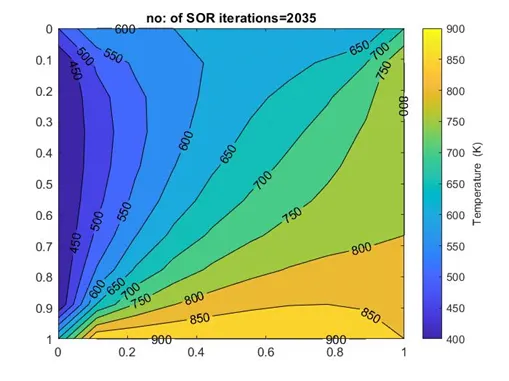
title_text=sprintf('no: of SOR iterations=%d',SOR_implicit);
title(title_text);
pause(0.03);GRAPHS
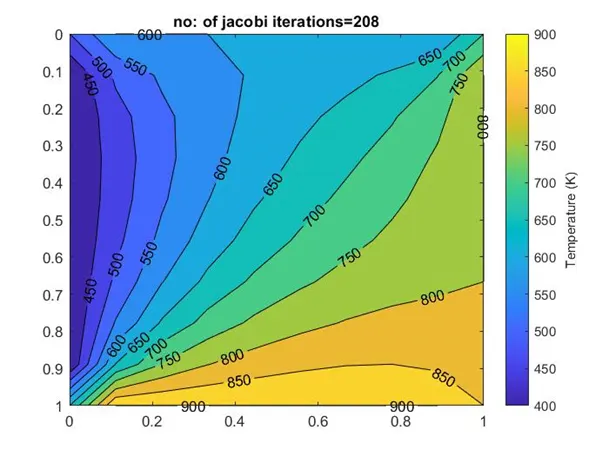
- Steady State Heat Conduction-IMPLICIT
1) Jacobi Iteration
 2) Gauss Siedel Iteration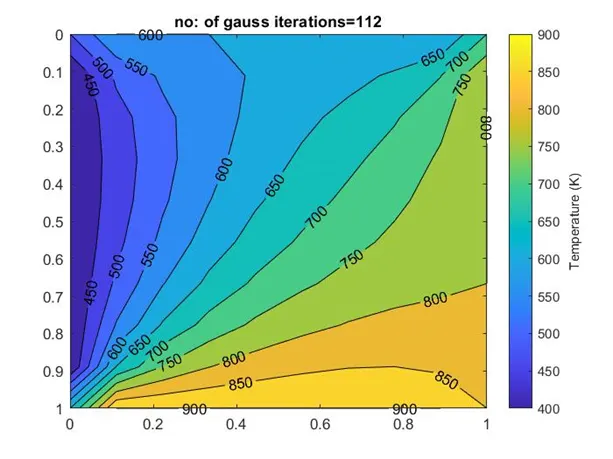
- 3) Successive over Relaxation Iteration
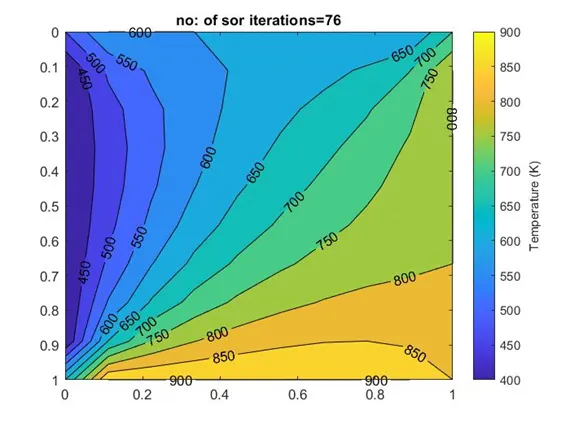
- Transient State Analysis-EXPLICIT
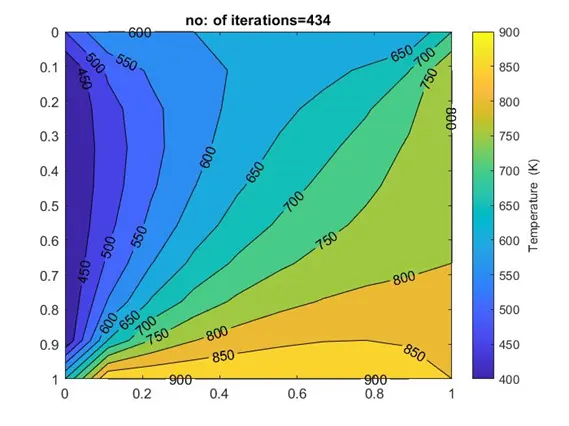
- Transient State Analysis-IMPLICIT
1) Jacobi Iteration
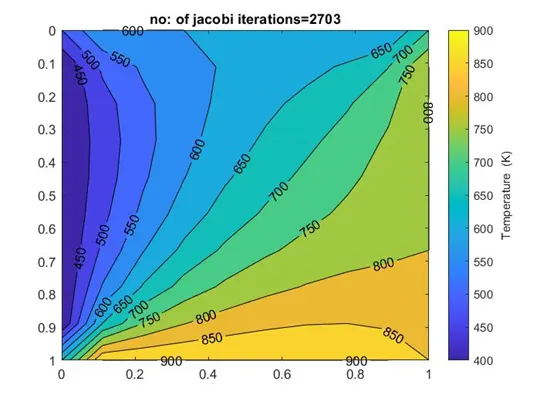
-
2) Gauss Siedel Iteration
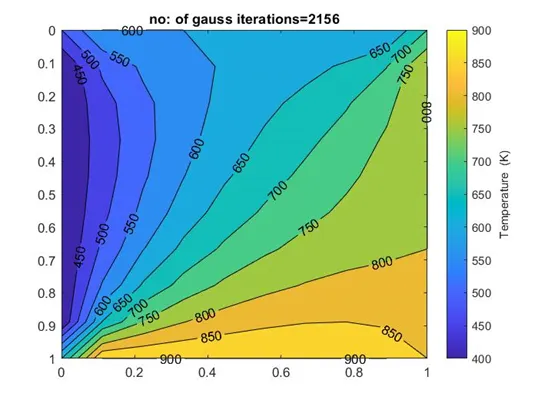
-
3) Successive over Relaxation Iteration
-
RESULTS
Scheme
Iteration Type
Number of iterations
Steady State- Implicit
Jacobi
Gauss-Siedel
SOR
208
112
76
Transient State-Implicit
Jacobi
Gauss-Siedel
SOR
2703
2156
2035
Transient State-EXplicit
434
CONCLUSION
From the obtained results and contour plots, it can be concluded that
- the number of iterations follow the order Jacobi>Gauss-Siedel>SOR.
- among the three iterative methods, SOR is better, as the number of iterations was less than Jacobi and Gauss-Siedel, for both steady and transient states.
- Steady State Heat Conduction-IMPLICIT