Week 5.1 - Compact Notation Derivation for a simple Mechanism
Aim : In this challenge the production rates of the reactions given is solved by using chemical kinetics.
Procedure: To solve this first we identify the number of species and make matrices of reactants and products and formulate a reaction matrix , which will be eventually utilized to formulate the production rates.
The number of species given in the four chemical reactions are
| S.no | Species |
| 1 | CO |
| 2 | O2 |
| 3 | CO2 |
| 4 | O |
| 5 | H2O |
| 6 | OH |
| 7 | H |
Now we formulate the reactants matrix with respect to the occurance of the reactants in the reactions side, the reactants number will be corresponding to coloumns where as the chemical reaction is represented by row's
`nu_(ji)^' =`
`[[1,1,0,0,0,0,0],[0,0,0,1,1,0,0],[1,0,0,0,0,1,0],[0,1,0,0,0,0,1]]`
similarly the products side matrix
`nu_(ji)^('') =[[0,0,1,1,0,0,0],[0,0,0,0,0,2,0],[0,0,1,0,0,0,1],[0,0,0,1,0,1,0]]`
`nu_(ji)=nu_(ji)^('')-nu_(ji)^(')`
`=[[-1,-1,1,1,0,0,0],[0,0,0,-1,-1,2,0],[-1,0,1,0,0,-1,1],[0,-1,0,1,0,1,-1]]`
from these the reaction rates are given by
`q_(i)=K_(fi)prod_(j=1)^(N)[X_j]^(nu_(ji)^')-K_(ri)prod_(j=1)^(N)[X_j]^(nu_(ji)^('')`
when applied to our matrices these give us
`q_(1)=K_(f1)[CO][O_2]-K_(r1)[CO_2][O]`
`q_(2)=K_(f2)[O][H_2O]-K_(r2)[OH]^2`
`q_(3)=K_(f3)[CO][OH]-K_(r3)[CO_2][H]`
`q_(4)=K_(f4)[H][O_2]-K_(r4)[OH][O]`
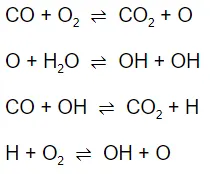
Net production rates are calculated by using the relation
`omega_j =sum_(i=1)^L nu_(ji)*q_i`
that is for CO
`omega_1 = nu_(11)*q_1+nu_(12)*q_2 +nu_(13)*q_3+nu_(14)*q_4`
`omega_1 = -K_(f1)[CO][O_2]+K_(r1)[CO_2]-[K_(f3)[CO][OH]+K_(r3)[CO_2][H]`
For O2
`omega_2 = nu_(21)*q_1+nu_(22)*q_2 +nu_(23)*q_3+nu_(24)*q_4`
`omega_2=-K_(f1)[CO][O_2]+K_(r1)[CO_2]-K_(f4)[H][O_2]+K_(r4)[OH][O]`
for CO2
`omega_3 = nu_(31)*q_1+nu_(32)*q_2 +nu_(33)*q_3+nu_(34)*q_4`
`omega_3=K_(f1)[CO][O_2]-K_(r1)[CO_2][O] +K_(f3)[CO][OH]-K_(r3)[CO_2][H]`
for O
`omega_4 = nu_(41)*q_1+nu_(42)*q_2 +nu_(43)*q_3+nu_(44)*q_4`
`omega_4=K_(f1)[CO][O_2]-K_(r1)[CO_2][O] -K_(f2)[O][H_2O]+K_(r2)[OH]^2+K_(f4)[H][O_2]-K_(r4)[OH][O]`
for H2O
`omega_5 = nu_(51)*q_1+nu_(52)*q_2 +nu_(53)*q_3+nu_(54)*q_4`
`omega_5 =-K_(f2)[O][H_2O]+K_(r2)[OH]^2 `
for OH
`omega_6 = nu_(61)*q_1+nu_(62)*q_2 +nu_(63)*q_3+nu_(64)*q_4`
`omega_6 =2*(K_(f2)[O][H_2O]-K_(r2)[OH]^2)-K_(f3)[CO][OH]+K_(r3)[CO_2][H]+K_(f4)[H][O_2]-K_(r4)[OH][O]`
for H
`omega_7 = nu_(71)*q_1+nu_(72)*q_2 +nu_(73)*q_3+nu_(74)*q_4`
`omega_7 =K_(f3)[CO][OH]-K_(r3)[CO_2][H]-K_(f4)[H][O_2]+K_(r4)[OH][O]`
Hence, by using the above production rates of individual species the species problem is solved.