Week 5.1 - Compact Notation Derivation for a simple Mechanism
Compact Notation Derivation for a simple Mechanism
OBJECTIVE: The main objective is to derive the ODE's for the given reaction mechanism by using compact notation.
THEORY:
In general, we know that the combustion forms products from reactants after some time. But when it comes to reality, before forming the products there will be a number of elementary reactions which involve a lof of intermediary species. Moreover, the time frame at which this combustion takes place plays a major role. To find out the reaction pathways and reactions taking place we need to find the reaction rate of each species. The study of the reaction mechanisms is called Chemical Kinetics which gives information on the reaction rate and reaction order of each species before forming into products. Chemical kinetics is mainly required two inputs which are operating conditions and rate of reaction.
In practical applications, it is very difficult to note all the reaction rates as the involvement of a number of intermediary species and elementary reactions are more. So to feed these data into a computer, we will derive these reactions into a form of ODE's which saves lot of time and data. We are deriving the ODE's for the following reactions:
R1:CO+O2⇔kf1kr1CO2+OR1:CO+O2⇔kr1kf1CO2+O
R2:O+H2O⇔kf2kr2OH+OHR2:O+H2O⇔kr2kf2OH+OH
R3:CO+OH⇔kf3kr3CO2+OHR3:CO+OH⇔kr3kf3CO2+OH
R4:H+O2⇔kf4kr4OH+OHR4:H+O2⇔kr4kf4OH+OH
Letuslisttheνmberofspecies(i) and reactions(j) ∈volved:
| j | species |
| 1 | O2 |
| 2 | CO2 |
| 3 | H2O |
| 4 | O |
| 5 | CO |
| 6 | H |
| 7 | OH |
| i | Reactions |
| 1 | R1 |
| 2 | R2 |
| 3 | R3 |
| 4 | R4 |
Let us create the stoichiometric Coefficient matrix for both reactants and products which are represented by vj′vj′ and vj'' vj''. This indicates us the number of species (j) in reaction (i).
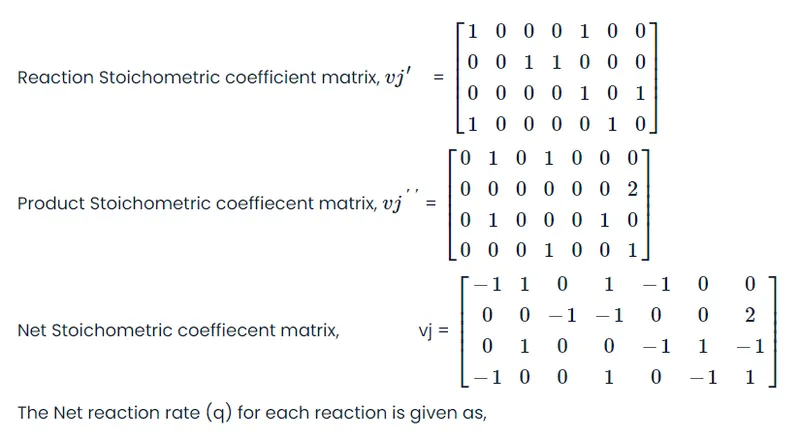
The Net reaction rate (q) for each reaction is given as

As we know i is reaction and j is the species index:
q1=kf1[O2]1[CO2]0[H2O]0[O]0[CO]1[H]0[OH]0−kr1[O2]0[CO2]1[H2O]0[O]1[CO]0[H]0[OH]0
Any thing to power zero equals one, the above equation forms into,
q1=kf1[O2][CO]−kr1[CO2][O]
Similarly,
q2=kf2[O][H2O]−kr2[OH]2
q3=kf3[CO][OH]−kr3[CO2][H]
q4=kf4[O2][H]−kr4[O][OH]
Now, calculating the production rate for each species,
As we have seven species,
W1 = Vu ql + V12q2 + V13q3 + V 14q4
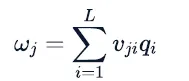
Similarly substituting all the data from the vji matrix and qi matrix, we get
w1 = - (kfi [0 2] [CO] - kr1 [CO2] [OJ) - (k/4 [0 2] [HJ - kr4 [OJ [OH])
w2 = (kf1 [02] [CO] - kr1 [CO2] [OJ) + (kf3 [CO] [OH] - kr3 [C O2] [HJ)
W3 = - (k/2 [0] [H20] - kr 2[0 H J2)
w4 = (kfi [02] [CO] - kr1 [C O2] [OJ) - ( k/2 [OJ [H20] - kr 2[0 H J2) + (kf4 [0 2] [HJ - kr4 [OJ [OH])
w5 = - (kf1 [02] [CO] - kr1 [CO2] [OJ) - (k/3 [C O] [OH] - kr3 [CO2] [HJ)
W6 = (k/3 [02] [Co] - kri [CO2] [OJ) - (k/3 [CO] [OH] - kr3 [CO2] [HJ)
w7 = (2kh [02] [H 20 ] - kr 2[0 H J2) - (k/3 [CO] [OH] - kr3 [CO2] [HJ)+ ( k f4 [02] [H J - kr4 [OJ [OH])
The rate of production is nothing but the rate of reaction of species,
 = wj
= wj
`s we have the data for the rate of production, we can form the matrix for rate of reaction of each species as follows`
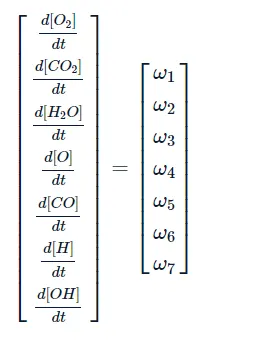
The reaction rate for each species is
d[O2]dt=kr1[CO2][O]−kf1[O2][CO]+kr4[O][OH]−kf4[O2][H]
d[CO2]dt=d[CO2]dt=kf1[O2][CO]−kr1[CO2][O]+kf3[CO][OH]−kr3[CO2][H]
d[H2O]dt=kr2[OH]2−kf2[O][H2O]
d[O]dt=kf1[O2][CO]−kr1[CO2][O]+kr2[OH]2−kf2[O][H2O]+kr4[O][OH]−kf4[O2][H]
d[CO]dt=kr1[CO2][O]−kf1[O2][CO]+kr3[CO2][H]−kf3[CO][OH]
d[H]dt=kf3[O2][Co]−kr1[CO2][O]+kr3[CO2][H]−kf3[CO][OH]
d[OH]dt=2kf2[O2][H2O]−kr2[OH]2+kr3[CO2][H]−kf3[CO][OH]+kr4[O][OH]−kf4[O2][H]
Hence, we have derived a system of coupled ODE for the given reaction mechanism which can be solved by using any integration technique.