Week 4 -Wire Bending Challenge
AIM :
To perform an analysis to simulate the bending of a wire
OBJECTIVE:
The main objective of the challenge is to compare the result for Equivalent stress and Strain on the wire only using three different materials.
1) Copper Alloy (Non-Linear)
2) Aluminium Alloy (Non-Linear)
3) Magnesium Alloy (Non -Linear)
PROCEDURE:
. Select Static Structural, drag and drop into Project Schematic
. Choose material i.e Copper Alloy NL, Magnesium Alloy NL and Aluminium Alloy NL under Engineering Data.
. Under geometry tab, import the given Big wheel, wire and rotating die geometry, double-click to open Space Claim to register the model and right click to update it.
. Then open Mechanical Module, assign material to the wire according to the case. The other models can remain at structural steel.
Case 1: Copper Alloy NL.Case 2: Aluminium Alloy NL Case 3: Magnesium Alloy NL
. Assign a frictional connection between Wire to Rotating Die with coefficient of friction = 0.2
. Assign a frictional connection between Big wheel to Wire with coefficient of friction = 0.2.
. Add a revolute joint to the rotating die.
. The mesh size was set to default and the mesh method was set to Tetrahedrons
. The faces of the parts coming in contact i.e lever and wire is provided with 1mm mesh.
. A sphere of influence of radius 7mm and with element size 0.5mm with the other surface of wire. The coordinate system is set to the point where the wire starts to bend.
. Under static structural tab, we set the analysis to 8 steps with auto timestep on and defined by time.
. Fixed supports are given to rotating die and the tip of the wire to hold them in place.
. Joint load is given to the revolute joint with 20deg increments.
. Equivalent Strain and Equivalent Stress plots are requested from the solver as outputs
. Run the simulation by clicking on SOLVE.
These contacts,loads and materials used in the analysis are shown below.
MATERIAL PROPERTIES:
COPPER ALLOY NL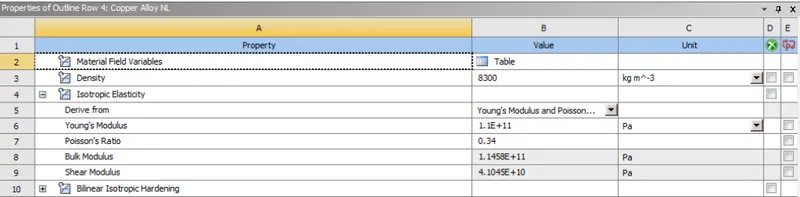
ALUMINIUM ALLOY NL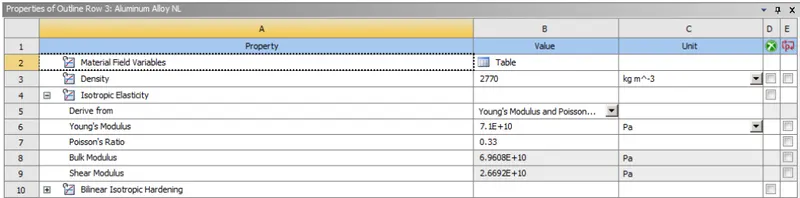
MAGNESIUM ALLOY NL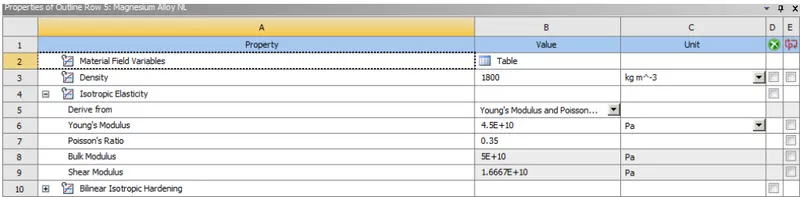
CONTACTS
CONTACT 1: Frictional lever to wire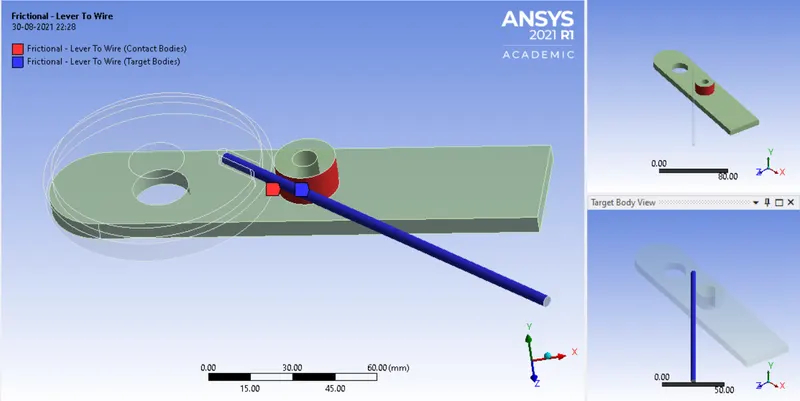
CONTACT 2: Frictional wire to wheel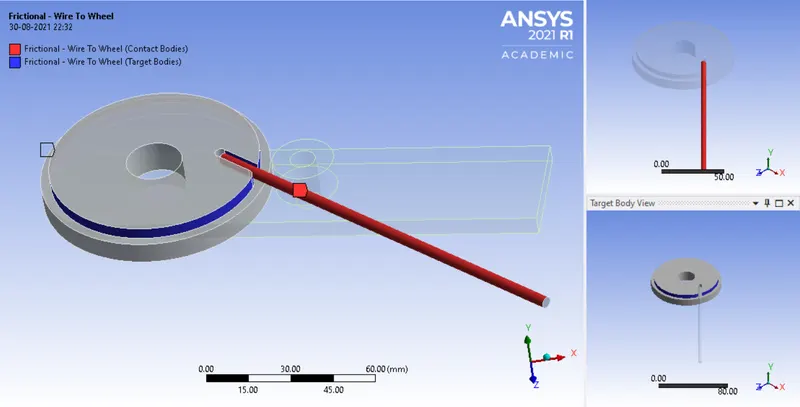
JOINT: Revolute ground to lever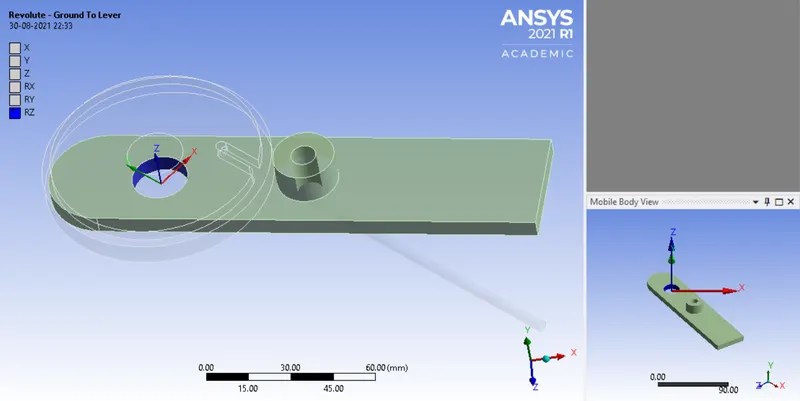
LOADS
FIXED SUPPORT 1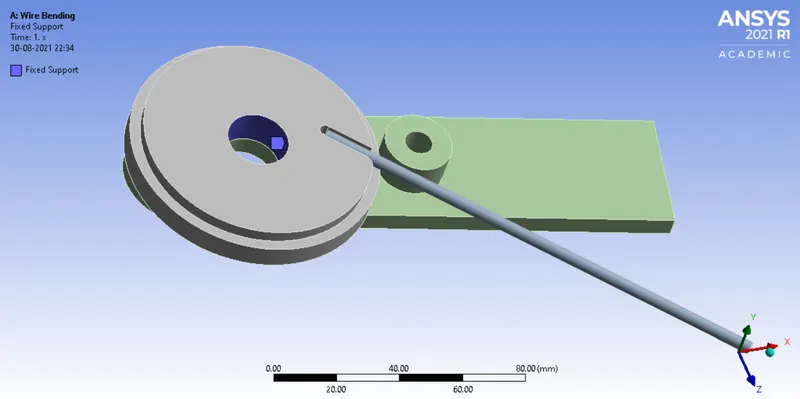
FIXED SUPPORT 2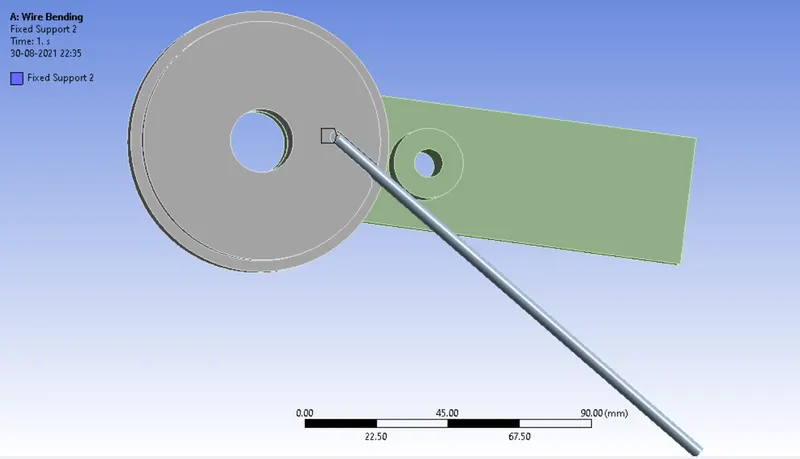
JOINT ROTATION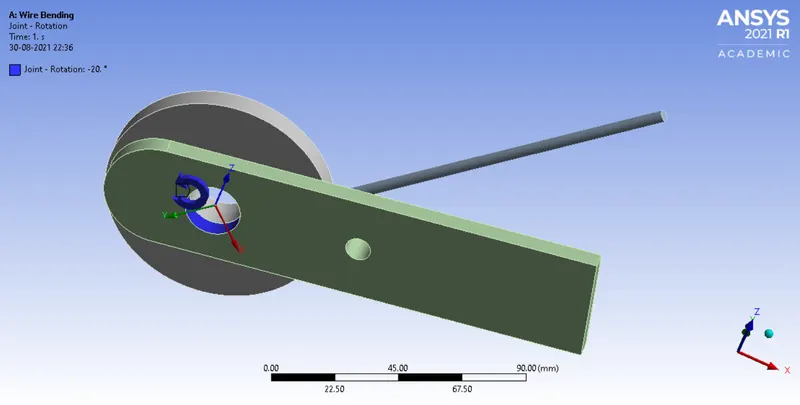
MESHING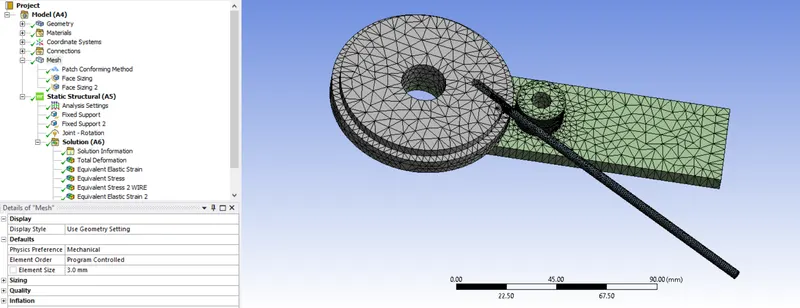
CASE 1: COPPER ALLOY NL WIRE
EQUIVALENT STRESS ON WIRE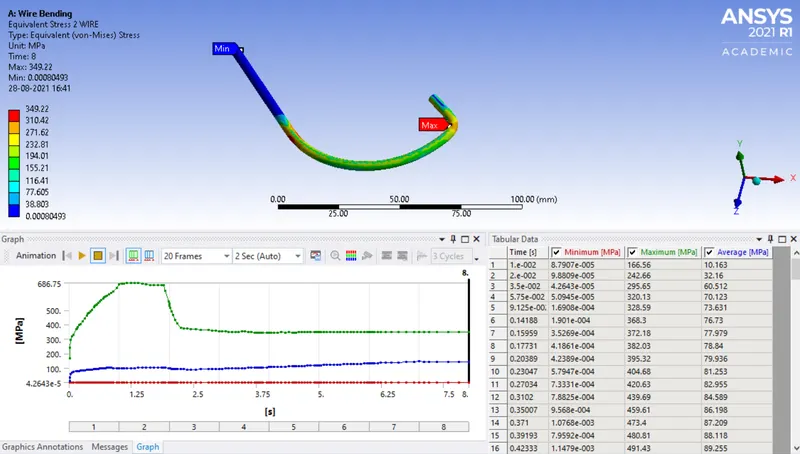
EQUIVALENT ELASTIC STRAIN ON WIRE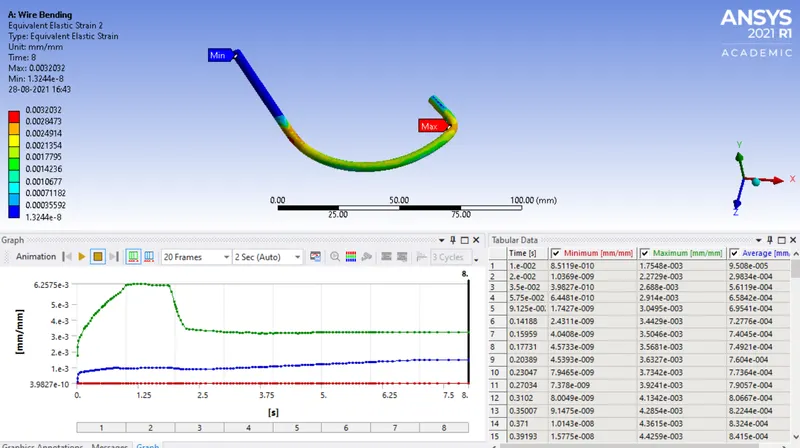
CASE 2: ALUMINIUM ALLOY NL WIRE
EQUIVALENT STRESS ON WIRE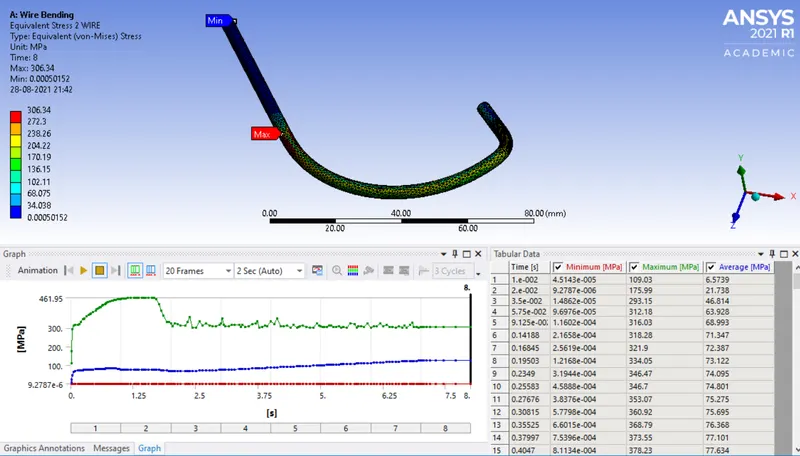
EQUIVALENT ELASTIC STRAIN ON WIRE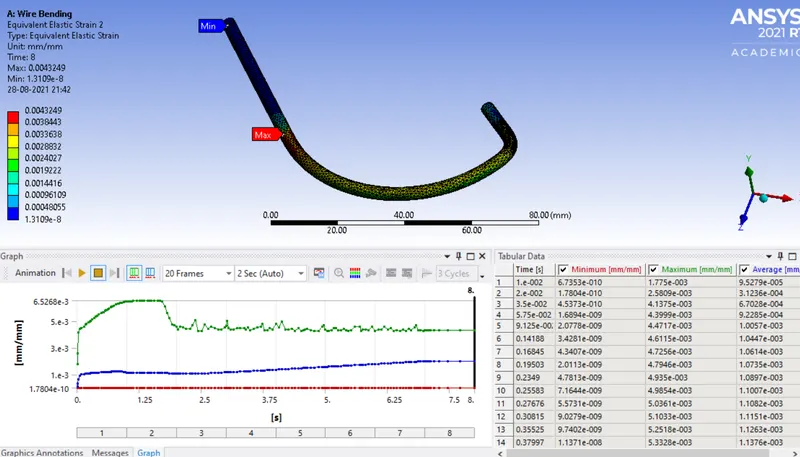
CASE 3: MAGNESIUM ALLOY NL WIRE
EQUIVALENT STRESS ON WIRE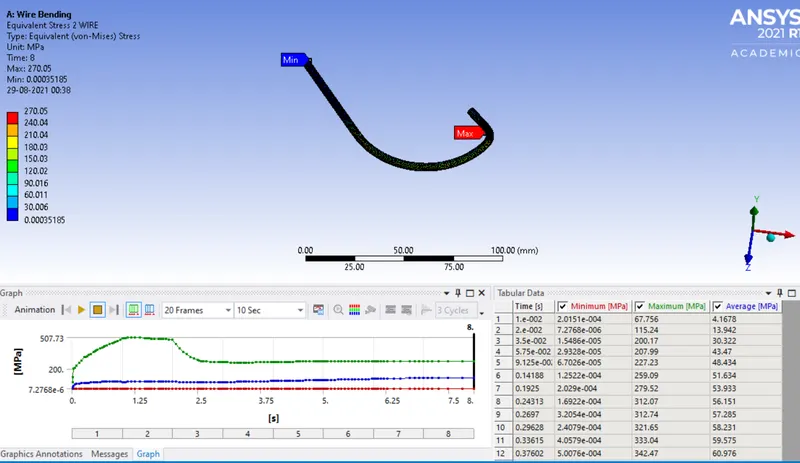
EQUIVALENT ELASTIC STRAIN ON WIRE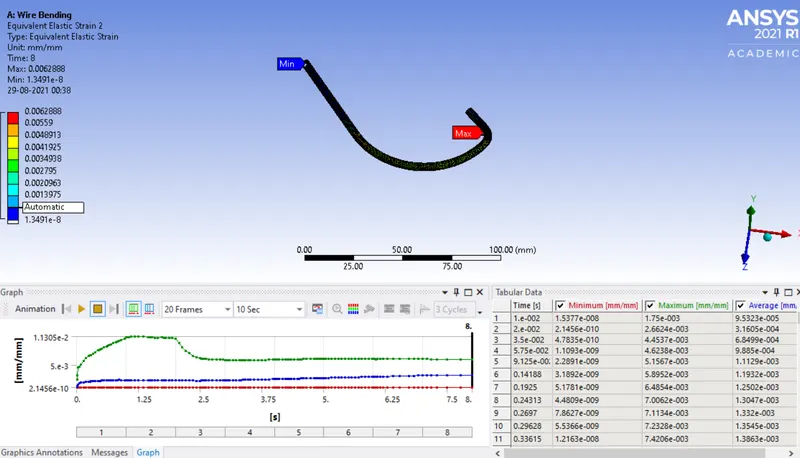
RESULTS AND CONCLUSION:
|
Case - Material of Wire |
Equivalent Stress on wire (N/mm2) |
Equivalent Strain on wire |
|
Case 1 - Copper Alloy NL |
349.22 |
0.0032032 |
|
Case 2 - Aluminium Alloy NL |
306.34 |
0.0043249 |
|
Case 3 - Magnesium Alloy NL |
270.05 |
0.0062688 |
We can see the maximum stress was undergone by Copper Alloy NL wire and the maximum strain was undergone by Magnesium Alloy NL wire.