Week 4 -Wire Bending Challenge
Objective
i.We will have to perform an analysis to simulate the bending of a wire in ANSYS.We will assign non linear materials for the wire-
Copper Alloy NL
Aluminium Alloy NL
Magnesium Alloy NL
ii. Find out the equivalent stress and equivalent strain on the wire.
Case setup
- After opening ANSYS Workbench, we are met with the Project Schematic window. Here, we can select the 'System Structural' analysis system on the left. Doing so creates a new project. Here, we can rename the project and also change the material if needed. We will need to right-click 'Geometry' and select 'import'. The file provided for this project should be selected.
- To create/edit new materias go to engineering data sources - general non linear materials - select required materials.
Material properties :-
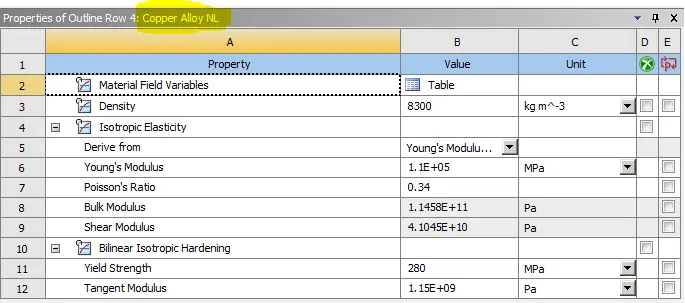
Copper Alloy NL
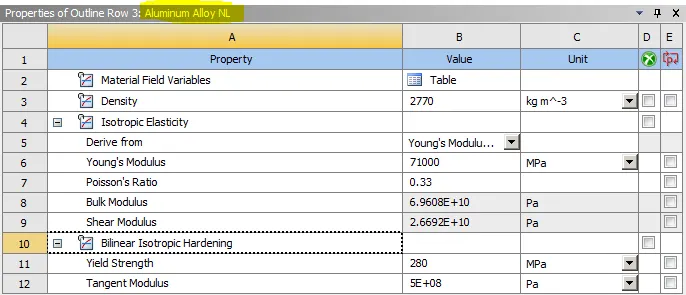
Aluminium Alloy NL
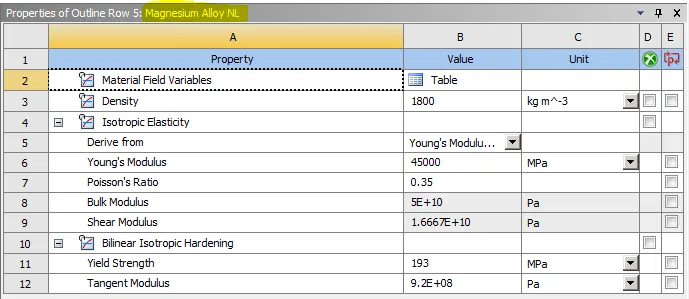
Magnesium Alloy NL
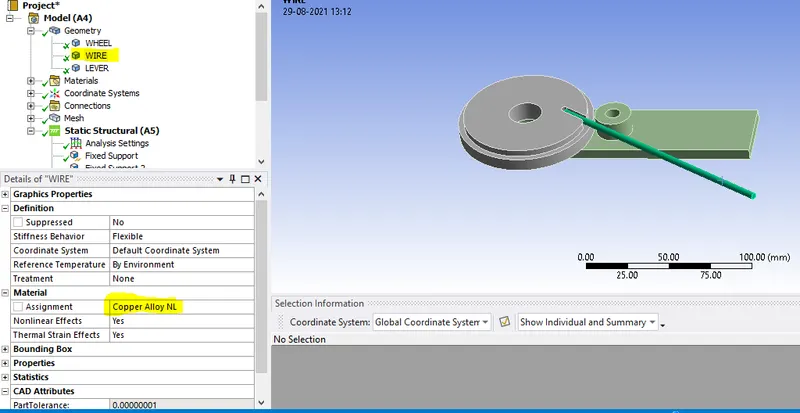
- Import the geometry and assign copper alloy non-linear material to the wire. We will follow the same procedure to assign other materials (Aluminium Alloy NL & Magnesium Alloy NL)to the wire for analysis.
Connections-
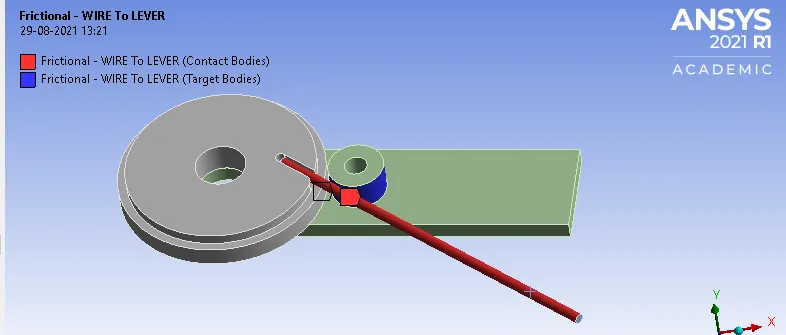
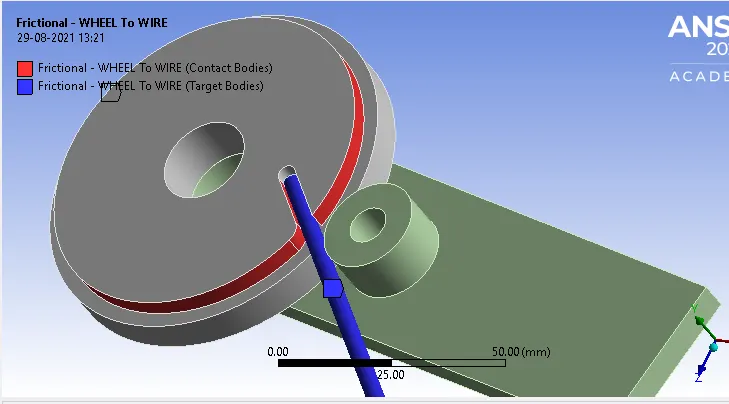
Friction contacts are provided between the lever-wire and Wheel-wire with a frictional coefficient set to 0.2.Contact and target body assignment must be taken care of while providing contacts.
Formulation: Augmented Lagrange.
Normal Stiffness: factor.
Normal Stiffness Factor: 0.1.
Update Stiffness: Each Iteration.
Interface Treatment: Add Offset, Ramped Effects.
Revolute Joint-
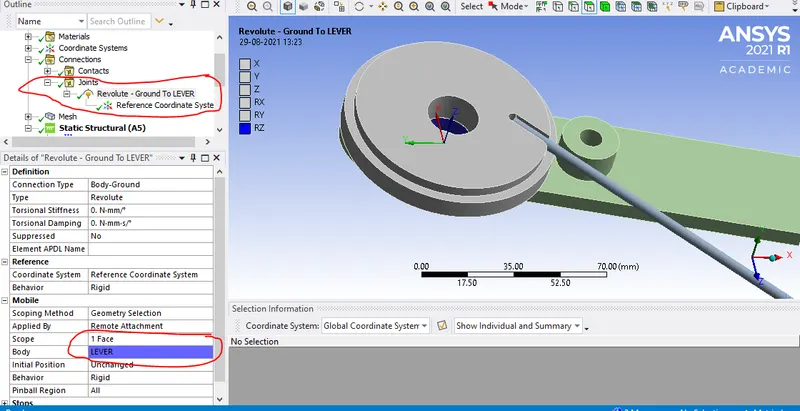
Revolute Joint is provided to the lever in Z- direction that will perform the bending of the wire. use Reference coordinate system option to define the axis position.
MESHING-
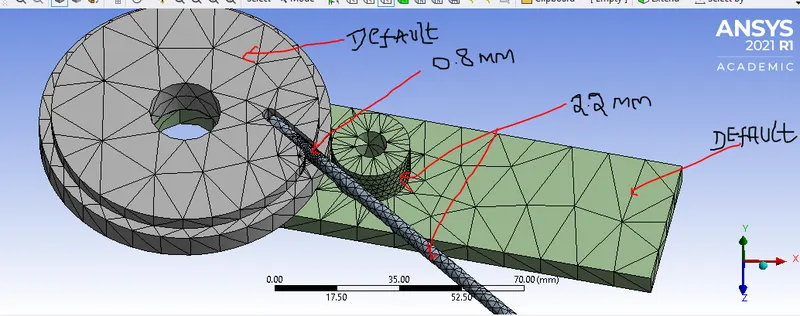
The meshing of the model is done using tetrahedron elements.Wire, wheel and lever has importance regions that will come in contact with each other while moving.We have to mesh these areas with an element size of 2.2mm and also another face sizing between the wire and the wheel with an element size of 0.8 mm using sphere of influence.
ANALYSIS SETTINGS-
An analysis is performed using 8 steps with Auto Time stepping ON and the type of solver we use is direct which is one of the many methods to solve simultaneous equations and with additional settings provided as shown below.
1st step:
Initial time – 0.1
Minimum Time step – 1E-2
Maximum Time step – 0.2
and switching to yes in the Output Controls.
2-8 steps:
Turn on the Carry over time step
Minimum Time step – 1E-2
Maximum Time step – 1
For all steps, all the output controls should be enabled ('yes' should be selected).
BOUNDARY CONDITIONS:
Fixed support is applied to the wheel and at the tip of the wire to restrict the movement of the wire during the simulation which otherwise would result in an error.
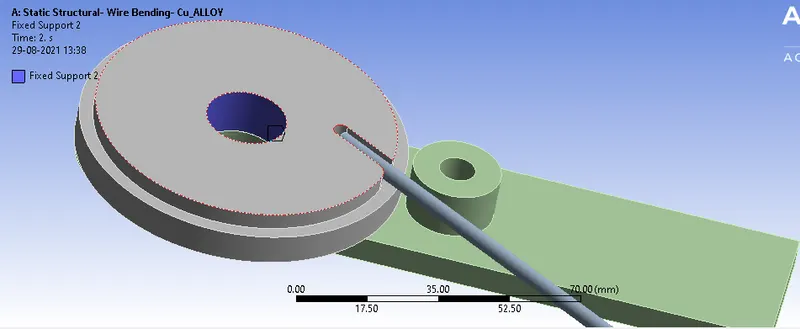
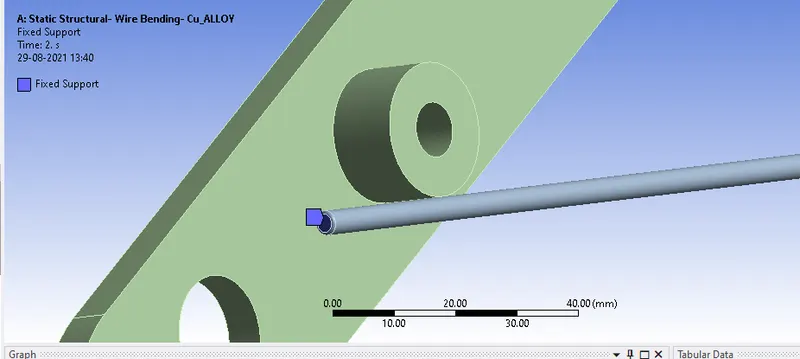
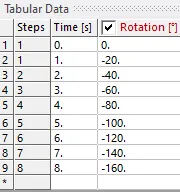
Next, Insert > Joint Load. We are to add a joint load for the revolute joint. The type would be rotation and we need to create a displacement-time table with decrements of 20 degrees for each step as shown:
Now we can generate the outputs. To do this, Solution > Insert > Strain > Equivalent (Von-Mises) (for equivalent strain) and right-click Solution > Insert > Stress > Equivalent (Von-Mises) (for stress). Each of these outputs will be solely for the wire body only
RESULTS
Material = copper alloy NL
Equivalent Stress
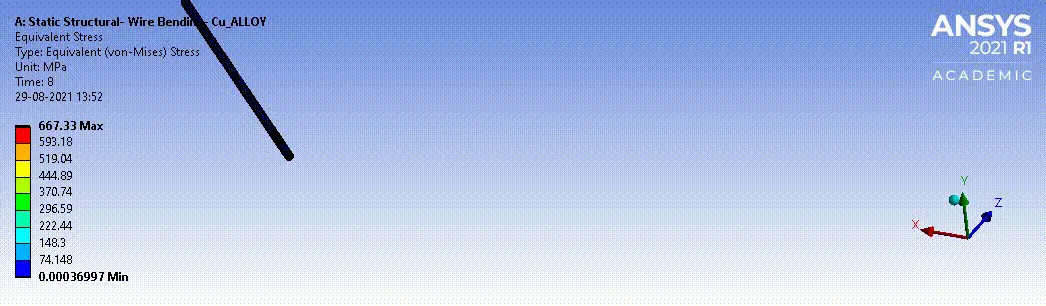
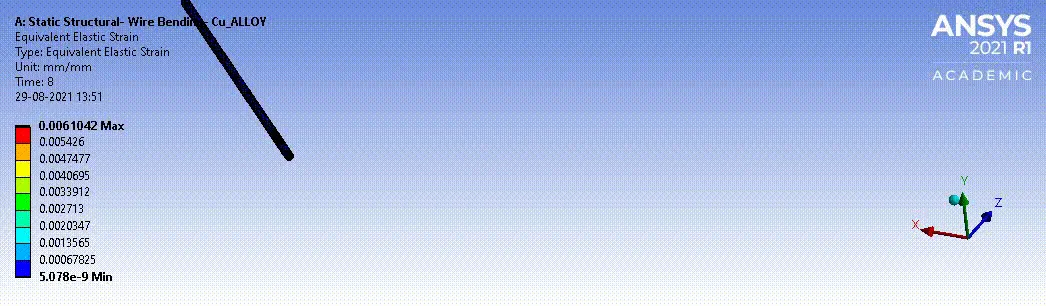
Equivalent Strain
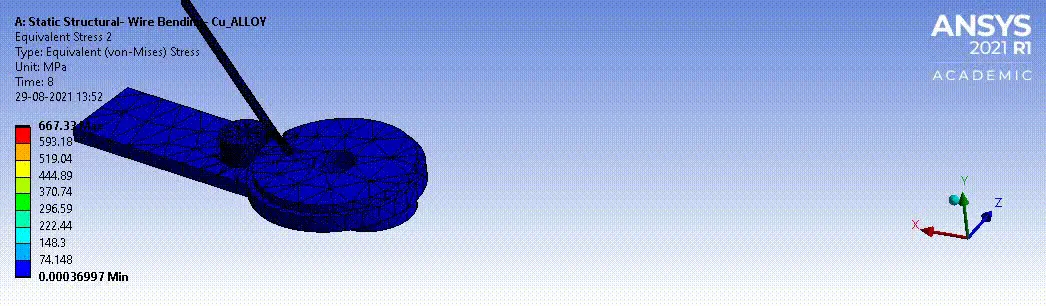
Equivalent Stress - All Bodies ( wheel, wire and lever)
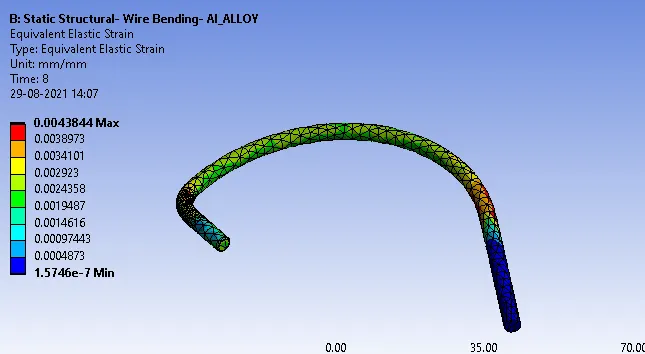
Material = Aluminium alloy NL
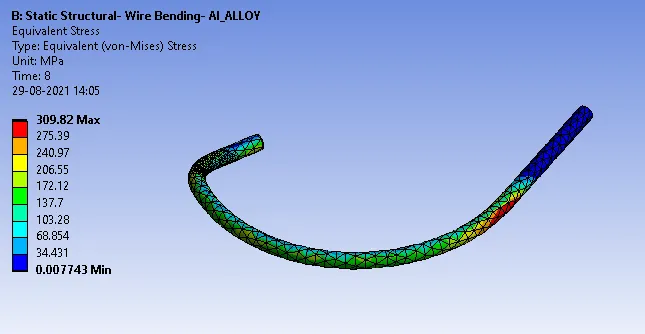
Equivalent Stress
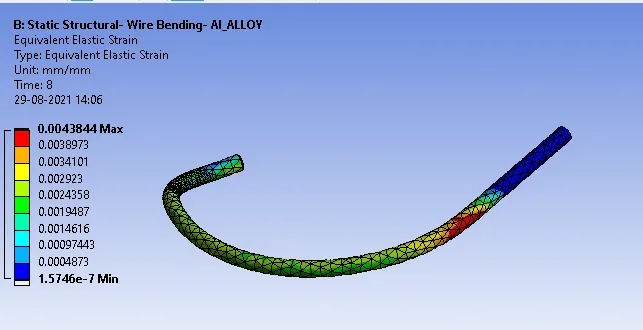
Equivalent Strain
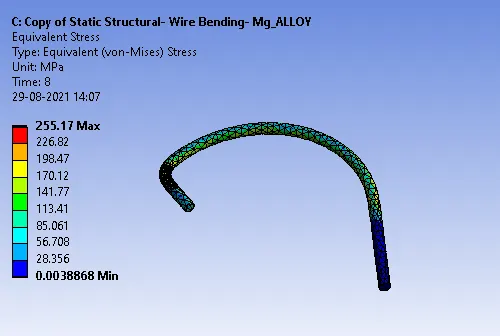
Material = Magnesium Alloy NL
Equivalent Stress
Equivalent Strain
comparision of results
| Equivalent Stress (Mpa) | Equivalent Strain | Deformation (mm) | |
| Coppr alloy NL | 336.68 | 0.0031 | 224.09 |
| Aluminium alloy NL | 309.82 | 0.0043844 | 224.14 |
| Magnesium Alloy NL | 255.17 | 0.0056769 | 224.03 |
CONCLUSION
We can see that the highest amount of stresses are generated in the copper alloy wire but it experiences the least amount of strain. Bcz copper has higher Young's Modulus (110000mpa) value compared to aluminium (7100mpa) and magnesium (4500mpa). Magnesium experiences less stresses but it's yield strength (193 mpa) is low compared to copper yield strength (280mpa) so on this basis we can recommend Coppr alloy NL as the material for wires.
google link
https://drive.google.com/file/d/1um2csH8uOiltNAzXi8aIu5zNC-t14nlQ/view?usp=sharing