Week 4 -Wire Bending Challenge
WIRE BENDING
Objective:
To perform an analysis to simulate the bending of a wire in ANSYS using Copper Alloy (Non-Linear), Aluminium Alloy (Non-Linear), and Magnesium Alloy (Non-Linear) for the wire alone and Compare the results of Equivalent stress and Equivalent strain of the wire alone.
Geometry file:
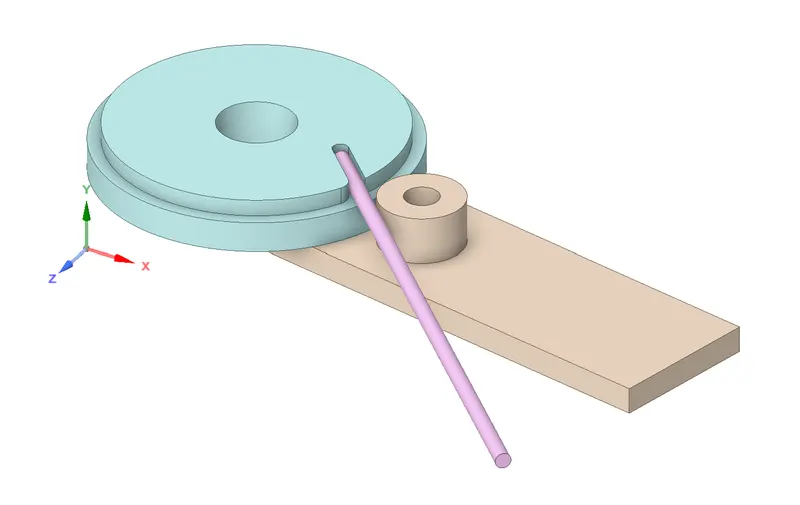
Mesh file:
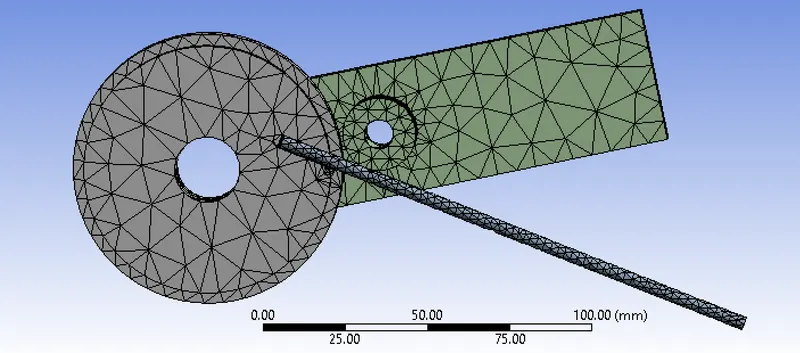
The model meshes with the Ansys mesher. As we want to evaluate the wire and the force exerted by the wire on the lever wheel chose an element size of 2.2 mm for that wheel.
As there is also force exerted by the wire to evaluate that force we chose mainly that area by a sphere of influence type with a 7mm radius and an element size of 0.8mm.
As we are also interested in evaluating the wire alone chose an element size of 5mm.
Contacts Setup:
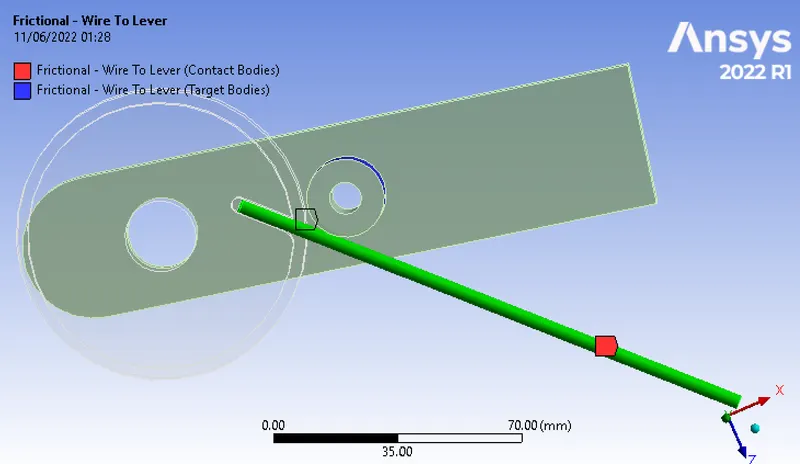
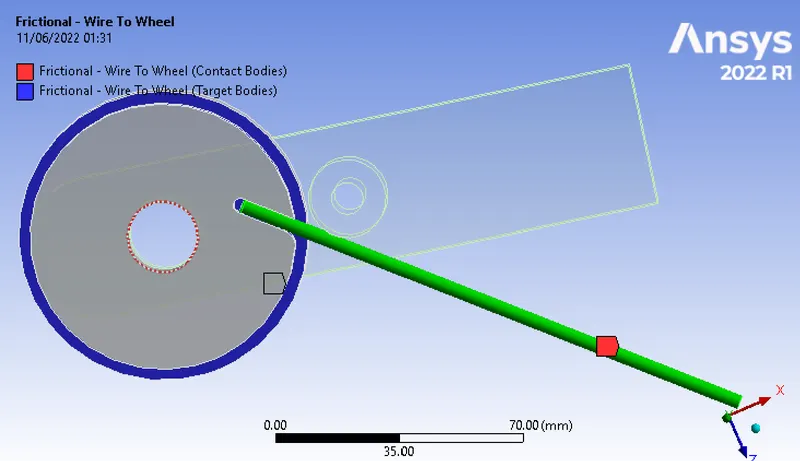
Contacts at the interface were set up for wire to lever and wire to wheel with a frictional co-efficient of 0.2mm performed by Augmented Lagrange formulation.
 `
` 
Joints setup:
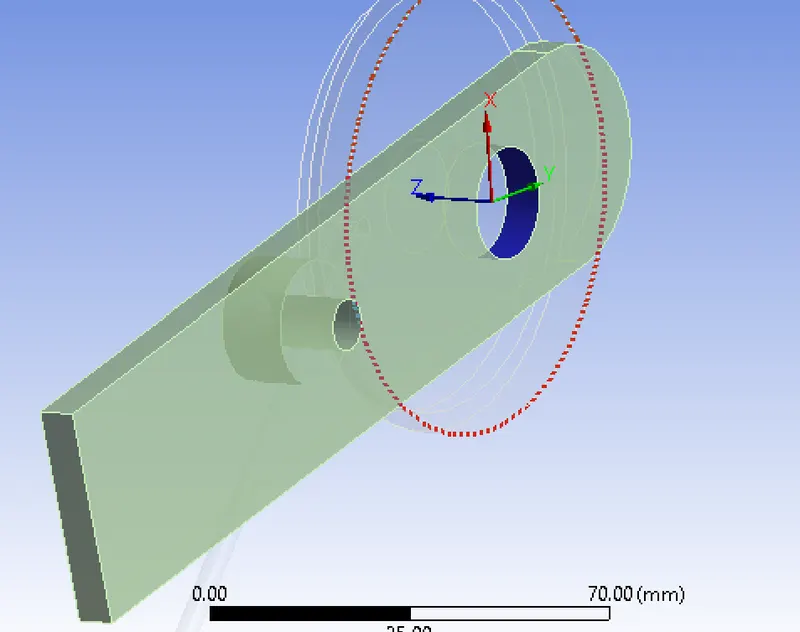
As we are evaluating wire bending in the analysis we had to set up a revolute joint for the lever so took a body ground joint and gave a revolute joint for the lever.
Analysis Setup:
As this is a wire bending analysis along the lever connected to the wheel we chose 8 steps to give the revolute joint a rotation in small intervals to evaluate the deformation of the wire at each interval. To give the lever a displacement as rotation we have to fix a wheel joint fixed support and also the wire such that the wire doesn’t slip from the wheel.
Simulation Results:
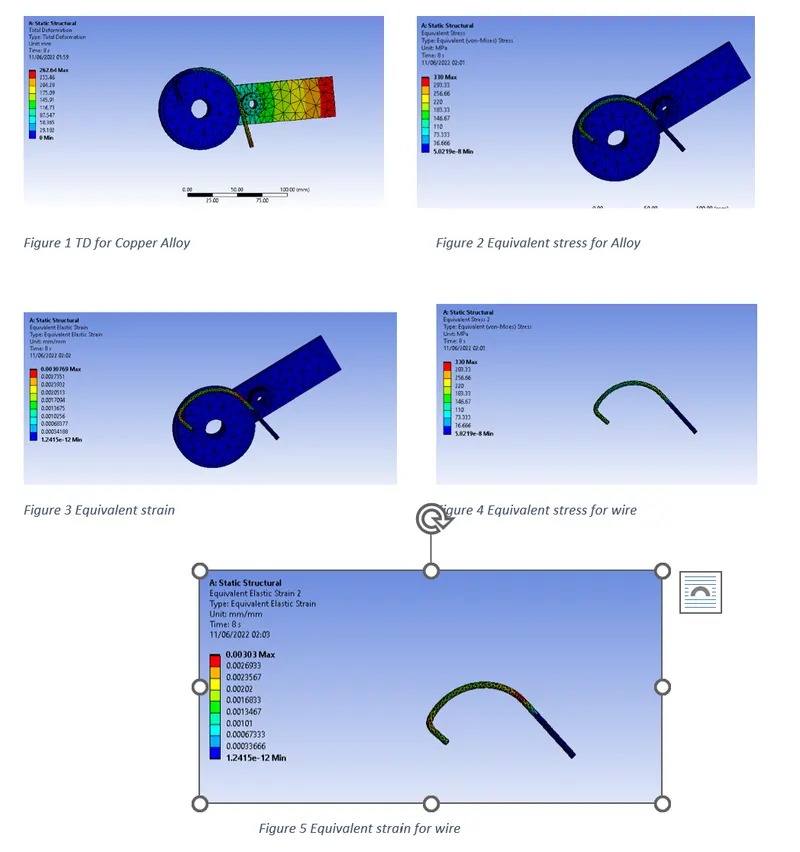
Case 1
Copper Alloy NL
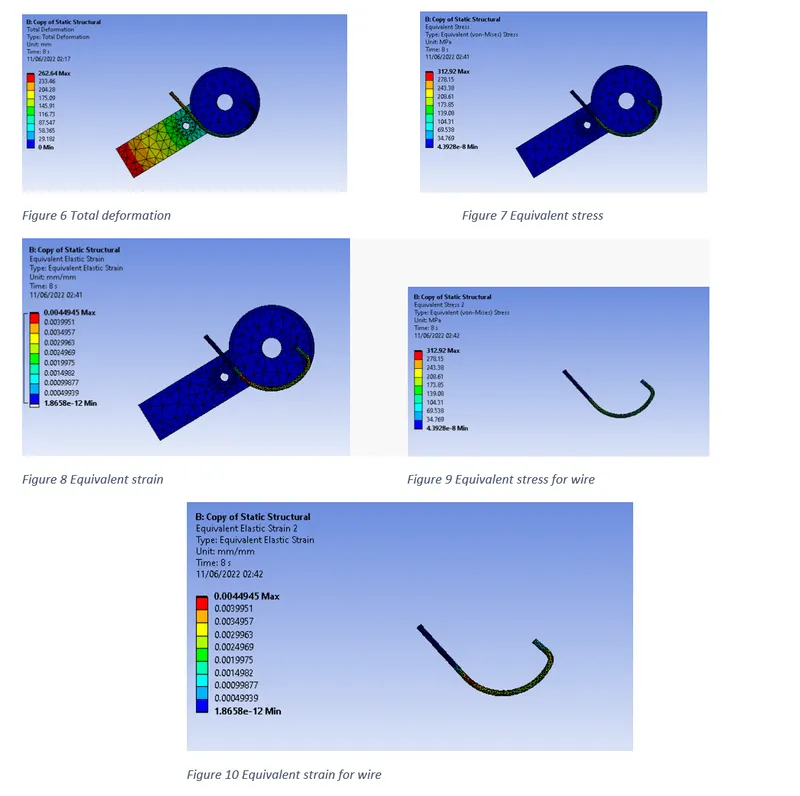
CASE 2
Aluminium Alloy
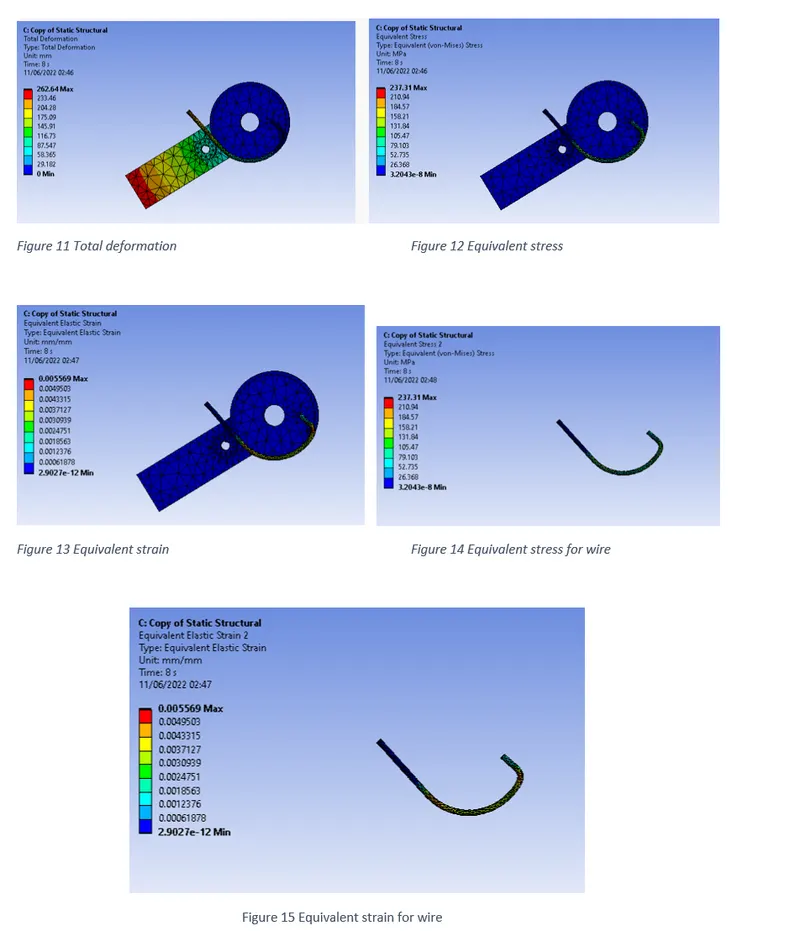
CASE 3
Magnesium Alloy
comparison of Materials applied to the wire:
|
Material |
Maximum |
||||
|
Total Deformation |
Equivalent stress |
Equivalent strain (mm) |
Tensile Yield strength (MPa) |
Young’s Modulus (Pa) |
|
|
Copper Alloy NL |
262.64 mm |
330. MPa |
3.0769e-003 |
2.8E+08 |
7.1E+10 |
|
Aluminium Alloy |
262.64 mm |
312.92 MPa |
4.4945e-003 |
2.8E+08 |
1.1E+11 |
|
Magnesium Alloy NL |
262.64 mm |
237.31 MPa |
5.569e-003 |
1.93E+08 |
4.5E+10 |
Conclusion:
From the table, we can conclude that copper has the least strain due to its high Young’s modulus compared to other materials but experiences the highest stress and magnesium with the least stress, whose yield strength compared to Aluminium Alloy and Copper Alloy is less.