Week 4 Session 5
Voltage Translator (converter)
voltage Regulator (controller)
Classification of Inverter
The buck converter is used for voltage step-down, while the boost converter is used for voltage step-up.
- DC TO DC converter
Auxiliary load:- car air conditioner system, music System, Head Lights, Dimmer.
- This type of converter is also known as a chopper.
- When decelerating, the vehicle's momentum turns the motor, which is now acting as a generator, drives power back through the inverter, and charges the battery.
example:- 48v ------DCM-----400v----for Battery
48v-------DCM(regulated)-------12v-----component
48v-------NBM (fixed rated)-----12v----
48v-------PRM(regulated)--------48v---
- DCM = Discontunaus mode
- NBM = non-bus isolated moduled
- prm = power regulation module
- DC TO AC converter
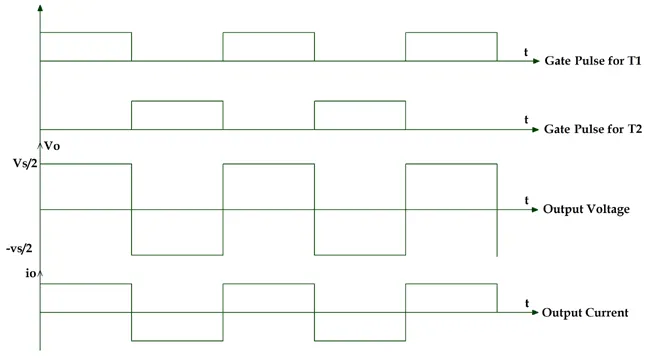
- DC-AC converter changes a dc input voltage to a symmetric ac output voltage of desired magnitude and frequency.
- This type of converter is also known as an inverter.
- The inverter can change the speed at which the motor rotates by adjusting the frequency.
- AC TO DC converter
- AC-DC converter takes a harmonic AC input and converts it to a DC output.
- These converters are also known as rectifiers.
- Inverters are used in Ev/Hev mainly for onboard charging purposes. Since the charging stations use AC power to charge the vehicle and the battery stores DC power, rectifiers are used to convert AC-DC.
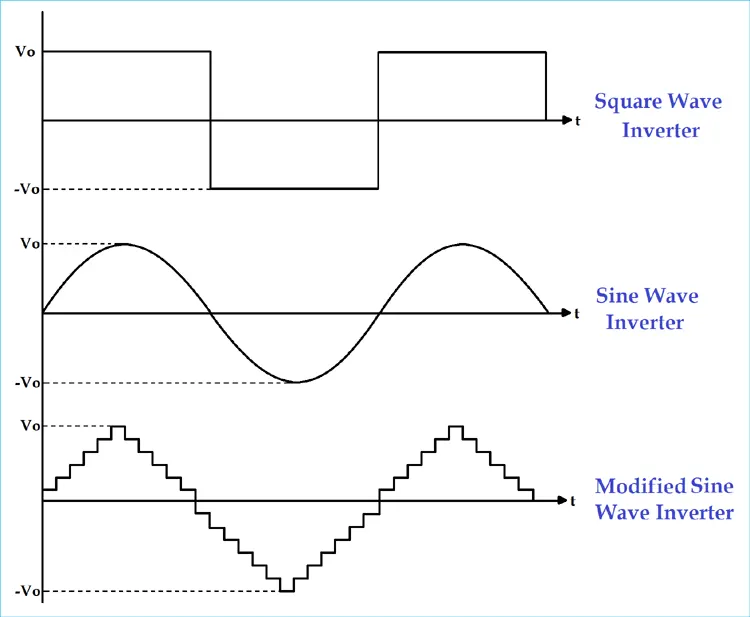
Inverters can be classified into many types based on output, source, type of load, etc. Below is the complete classification of the inverter circuits:
(I) According to the Output Characteristic
- Square Wave Inverter
- Sine Wave Inverter
- Modified Sine Wave Inverter
(II) According to the Source of Inverter
- Current Source Inverter
- Voltage Source Inverter
(III) According to the Type of Load
- Single Phase Inverter
- Half Bridge Inverter
- Full Bridge Inverter
- Three Phase Inverter
- 180-degree mode
- 120-degree mode
(iV) According to the Number of Output Level
- Regular Two-Level Inverter
- Multi-Level Inverter
1) Square wave inverter
The output waveform of the voltage for this inverter is a square wave. This type of inverter is least used among all other types of inverter because all appliances are designed for sine wave supply. If we supply square wave to sine wave based appliance, it may get damaged or losses are very high. The cost of this inverter is very low but the application is very rare. It can be used in simple tools with a universal motor.
2) Sine wave
The output waveform of the voltage is a sine wave and it gives us a very similar output to the utility supply. This is the major advantage of this inverter because all the appliances we are using, are designed for the sine wave. So, this is the perfect output and gives a guarantee that the equipment will work properly. This type of inverter is more expensive but widely used in residential and commercial applications.
3) Modified sine wave
The construction of this type of inverter is more complex than a simple square wave inverter but easier compared to the pure sine wave inverter. The output of this inverter is neither pure sine wave nor square wave. The output of such an inverter is some of two square waves. The output waveform is not exactly a sine wave but it resembles the shape of a sine wave sinewave;-
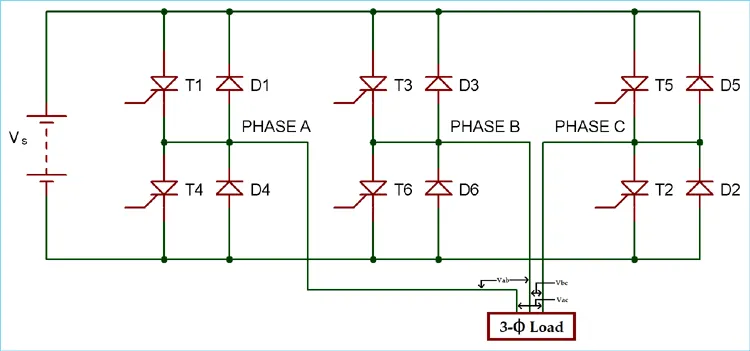
Three-Phase Bridge Inverter
in the case of industrial load, a three-phase ac supply is used and for this, we have to use a three-phase inverter. In this type of inverter, six thyristors and six diodes are used and they are connected as shown in the below figure.