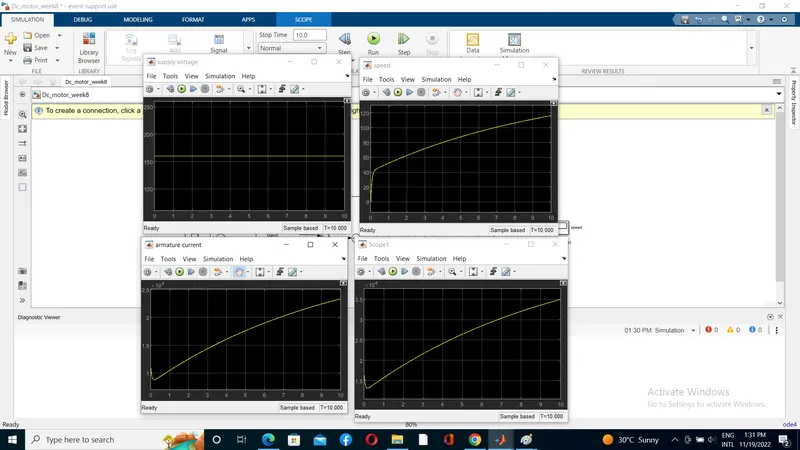
Project - Speed Control of a Direct Current (DC) motor
mathematical modeling Ga(s)=o(s)/v(s )= KT/s[(LS+R)(Js+B+KT*Kb] =transfer function out put angle.
Ga(s)=w(s)/v(s)=KT/[(LS +R)(JS+B)+KB]= Transfer function of angular velocity.
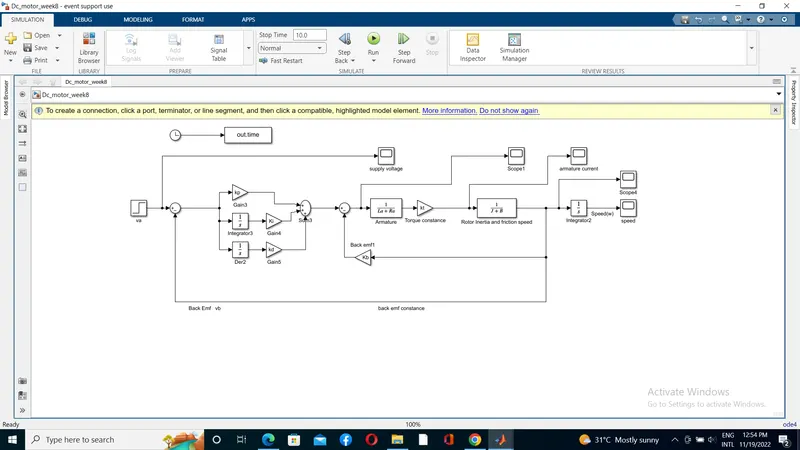
% This file contains the design parameters to model a DC motor
J= 0.01; % Moment of inertia of the rotor in kg-m^2
B= 0.1; % Motor viscous fricous friction constant in N-M-S
Km= 0.01;% Back EMF constant in v/rad/s
kt= 0.01;% motor torque constant in N-M/amp
Ra= 1;% Resistance of the armature circuit ohms
La= 0.5;% Inductance of the armature circuit in henries
Kb = 0;
%%Design of the PID controller
A=[-B/J kt/J; -Km/La -Ra/La];
B=[0 ; 1/La];
%% placement of poles
fn=1;
wn=2*pi*fn;
zeta=0.5;
P1=-zeta*wn+wn*sqrt(zeta^2-1);
P2=-zeta*wn-wn*sqrt(zeta^2-1);
P=[P1;P2]
K=place(A,B,P)
% pole placement design
k = place(A,B,P);
kp=k(1)
* controller gain parameters Kp and Kd from the location of poles P1 and p2 using 'place command'
The Ki is Tuned manually Kp, Kd value was taken from the place command.
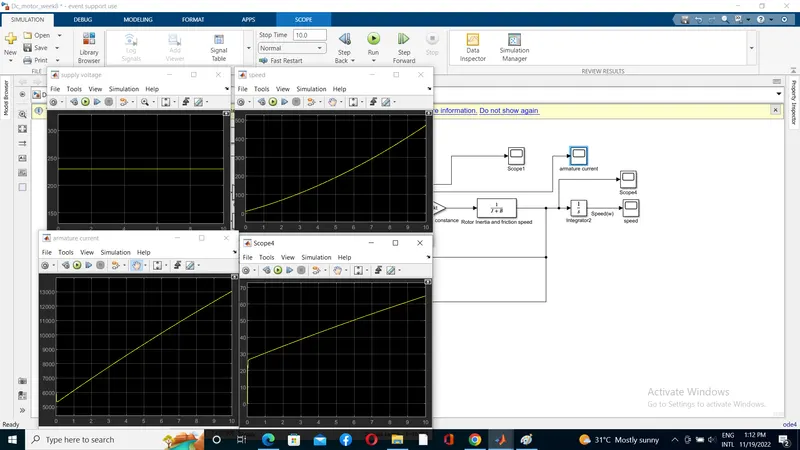
KP, Ki, Kd value. change
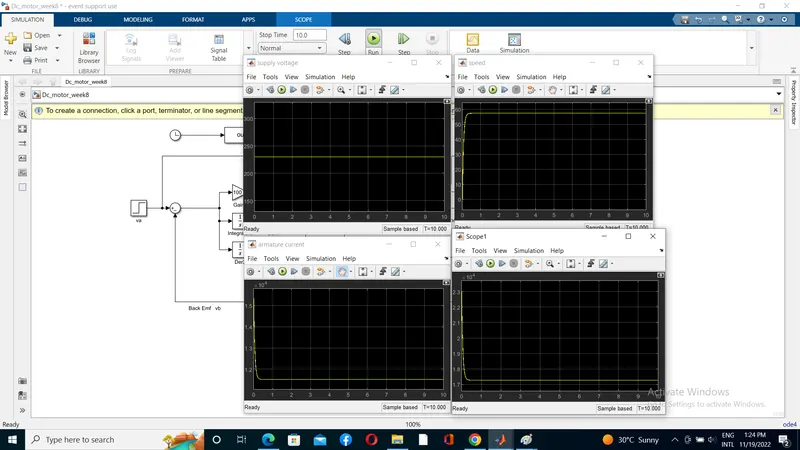
Ki value and input supply different