Week 4 Session 5
Explain the various applications of Power converters in an Electric vehicle. For Example what type of converter will you use for Horn which requires DC and less than 10V. Likewise come up with different applications.
A power converter is an electrical circuit that converts the electrical energy from one form into another, usually utilizing a high-frequency switching action. This conversion can be from direct current to alternating current or alternating current to direct current to increase or decrease the voltage or change the polarity. Also, the converter acts as a link between the power source and the power supply output. It works to process and control the flow of electric energy by supplying currents and voltage in the form needed for the end-user loads. Converters are available in the form of a simple transformer or maybe more complex, depending on the application.
Types of power converters
The type of conversion categorizes power converters. They generally fall into four categories:
- AC to DC converters: AC to DC convertersconvert alternating current to direct current using a rectifier.
- DC to AC converters: DC to AC converters take direct current and convert it to an alternating current of the desired voltage and frequency. These are inverters.
- DC to DC converters: These converters convert either a constant current to a variable or a constant direct current. These devices are also called choppers.
- AC to AC converters: AC to AC converters are often called cycloconverter or matrix converters. These devices convert an alternating current of a specific frequency or voltage from a line alternating current source to a different alternating voltage.
AC to DC converters
One of the essential elements in electrical conversion is going from alternating currents to direct currents. The applications, known as AC - DC converters, convert the alternating current to a direct, one-directional current. Transformers adjust the AC source, reducing the voltage for a better operational range for the DC supply. This conversion from alternating current to direct current has become significant during recent years because of the amount of technology in homes that require DC to charge them.
This converting alternating current to direct current is rectification, and the converter is called a rectifier. Also, a series of diodes convert the AC supply into DC. This transforms the sinusoidal AC wave into a series of positive peaks. A transformer adjusts the current from the source to a more manageable voltage for use at the direct current supply.
AC to DC conversion process
The alternating current supply from the step-down transformer is converted to the DC at the load end connection using the rectifier. Not all rectifiers are alike, and the different types refer to their functions, namely the half-wave, full-wave, and bridge rectifiers.
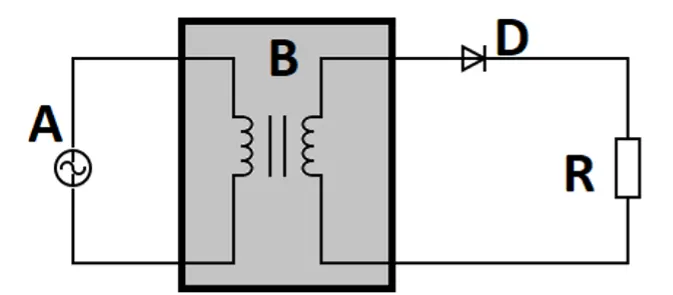
A half-wave rectifier or a full-wave rectifier can be used to convert an alternating voltage to DC voltage. An alternating voltage (labeled A) is applied to the primary windings of the step-down transformer (Figure 2 labeled B). A corresponding voltage is induced at the secondary windings. Frequently, transformers decrease the voltage for use in equipment that needs power at a lower level. When there is an available 230 volts of alternating current, the step-down transformer can convert it into 12 volts.
The diode (Figure 2 labeled D) becomes forward biased (ON state) and conducts current initiating current flow through the load resistor (Figure 2 labeled R). A diode allows the current to flow in one direction. During the negative cycle of the input voltage, a corresponding negative voltage is induced in the secondary side, and the diode doesn’t conduct. Hence, there is no flow through the output resistor during the negative cycle of the input voltage as the diode behaves as an open circuit. Therefore the output gives only alternate positive cycles.
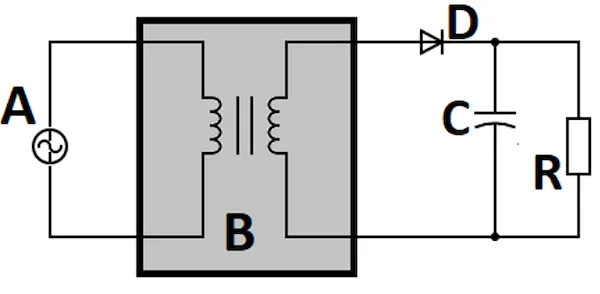
For practical applications, a capacitor is connected to the output in parallel with the resistor (See Figure 3). The capacitor acts as a filter to smooth out the pulsating output voltage to the appropriate DC level. Read our article on AC to DC transformers for more details on the rectification process.
A voltage regulator integrated circuit regulates the output voltage to the fixed desired value. This is the final step in converting alternating current to direct current in the output voltage at the desired volume.
Benefits of an AC-DC Converter
There are three significant benefits to an alternating current to a direct current converter.
- Compact: Devices that require AC-DC converters utilize the smallest possible sizes to convert the current efficiently, offering smaller devices. In an industrial setting, AC-DC converters are lightweight and easy to install.
- Energy Efficient: AC-DC converters eliminate the need for additional inverters and converters because they perform efficiently and reduce equipment failure.
- Less Expensive: Converting the current to a lower voltage saves users money on energy usage.
Applications
AC to DC converters are used in most household appliances, such as refrigerators, computers, televisions, and chargers for handheld electronics such as cell phones or tablets. Also, they play an essential role in medical equipment, the aerospace industry, and transportation systems. Household and industrial use rely heavily on AC-DC converters.
DC to AC converters
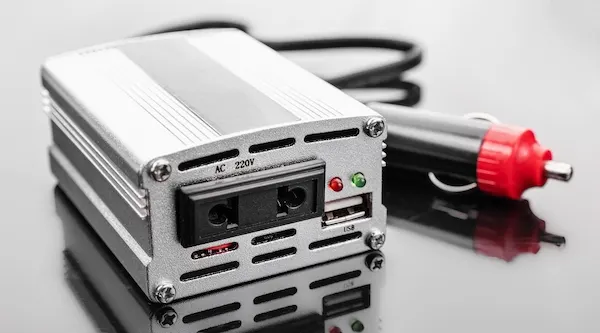
Perhaps a less frequent conversion is Direct Current to Alternating Current. An inverter converts a direct, one-directional current into an alternating, reversing current. DC to AC converters can be designed in multiple ways. One common method is to employ an oscillator and a step-up transformer.
An oscillator is an electronic circuit employing transistors and other semiconductor devices used to generate an alternating signal from a small DC voltage source. The AC signal can then be stepped up using a step-up transformer to the desired voltage magnitude.
Limitations of DC to AC conversion
There are a couple of limitations in converting direct current to alternating current.
- Transistor usage reduces circuit efficiency.
- Switching transistors can result in cross-over distortion but can be reduced by blasing diodes.
Applications
DC/AC converters (inverters) are used primarily in UPS or renewable energy systems or emergency lighting systems. Mains power charges the DC battery. If the mains fails, an inverter produces AC electricity at mains voltage from the DC battery. Solar inverter, both smaller string and larger central inverters, as well as solar micro-inverter are used in photovoltaics as a component of a PV system.
DC to DC converters
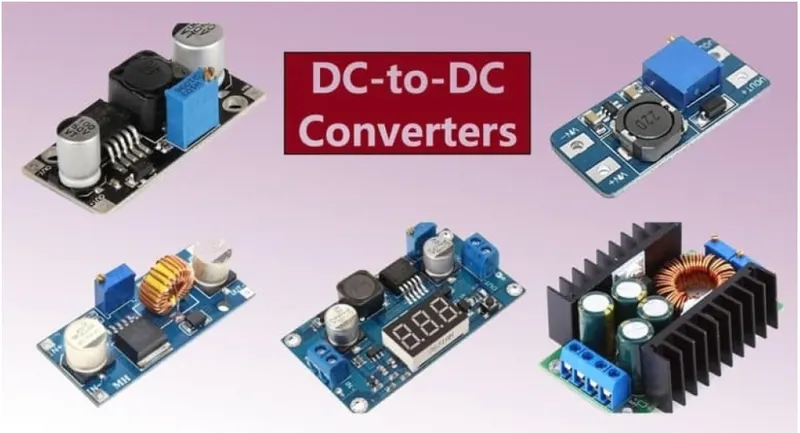
Some applications involve converting one source of direct current to another voltage of direct current. A DC to DC converter draws a DC input voltage at its input and delivers a different DC voltage. The output DC voltage can be lower or higher than the input voltage applied. DC to DC converters are available as individual integrated circuits (ICs), requiring very few additional components for their operation.
Applications
DC/DC converters are used in most mobile devices (mobile phones, PDA etc.) to maintain the voltage at a fixed value whatever the voltage level of the battery is. These converters are also used for electronic isolation and power factor correction. A power optimizer is a type of DC/DC converter developed to maximize the energy harvest from solar photovoltaic or wind turbine systems.
AC to AC converters
AC to AC converters refers to a device that converts an alternating current waveform from one form into another. The output voltage and frequency are managed according to the device's usage and requirements. One way of achieving this is to use special semiconductor devices (like thyristors) to switch on and off the input voltage supply in a circuit so that the average voltage at the output can be varied according to the application.
AC to AC Converters Process
AC to AC voltage conversion without changing the frequency can be performed in two ways. One is On-off control and another is AC phase control. On-off control process is also known as Integral cycle control.
In On-off control method the load power can be managed or controlled by connecting the source to the load for few numbers of complete cycles and then disconnecting it from source for another few numbers of cycles and then repeating the switching this cycling process again and again. This kind of conversion is suitable for system which has large time constant. It can be used in heating loads applications and average power of load can be varied from 0% to 10%.
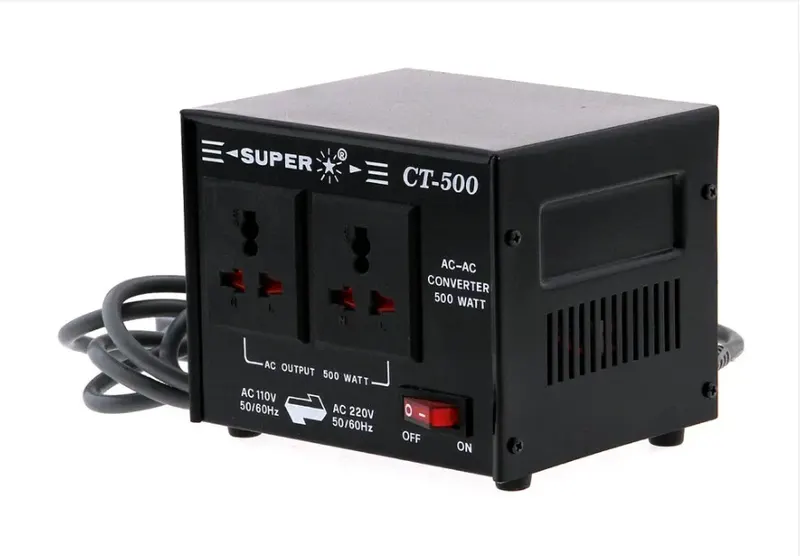
Applications
AC/AC converters are used to change either the voltage level or the frequency (international power adapters, light dimmer). In power distribution networks, AC/AC converters may be used to exchange power between utility frequency 50 Hz and 60 Hz power grids.