Week 4 Session 5
Power Converters in EV
Types of Power Converters in Electric Vehicles
Commercial electric vehicles may be broadly classified as:
- Battery electric vehicles (BEVs),
- Hybrid electric vehicles (HEVs) and
- Fuel cell vehicles (FCVs).
BEVs are purely electric vehicles (EVs), whereas HEVs combine EVs and internal combustion engines (ICEs). FCVs use power from both the battery and fuel cell stack.
The different configurations of EV power supply show that at least one DC/DC converter is necessary to interface the FC, the battery, or the supercapacitors module to the DC-link.
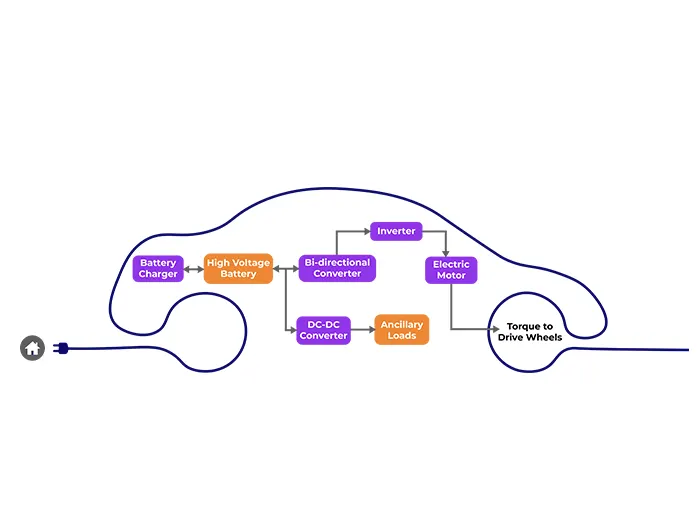
The main components of an Electric Vehicle are a DC-AC inverter, a DC-DC converter, a battery, and an electric motor.
There are two major power electronic units in the general configuration
- DC-DC converter
- DC-AC inverter
Usually, AC motors are used in HEVs or EVs for traction and they are fed by an inverter and it is fed by a DC-DC converter.
An Overview of DC-DC Converters
DC-DC converters in an electric vehicle may be classified into unidirectional and bidirectional converters. Unidirectional DC-DC converters cater to various onboard loads such as sensors, controls, entertainment, utility, and safety equipment. They are also used in DC motor drives and electric traction. Bidirectional DC-DC converters find applications in places where battery charging, regenerative braking, and backup power are required. The power flow in a bidirectional converter is usually from a low voltage end such as a battery or a supercapacitor to a high voltage side and is referred to as boost operation.
During regenerative braking, the power flows back to the low voltage bus to recharge the battery (buck mode). As a backup power system, the bidirectional DC-DC converter facilitates the safe operation of the vehicle when ICEs or electric drives fail to drive the motor. Due to the aforementioned reasons, high-power bidirectional DC-DC converters have gained a lot of importance in the recent past.
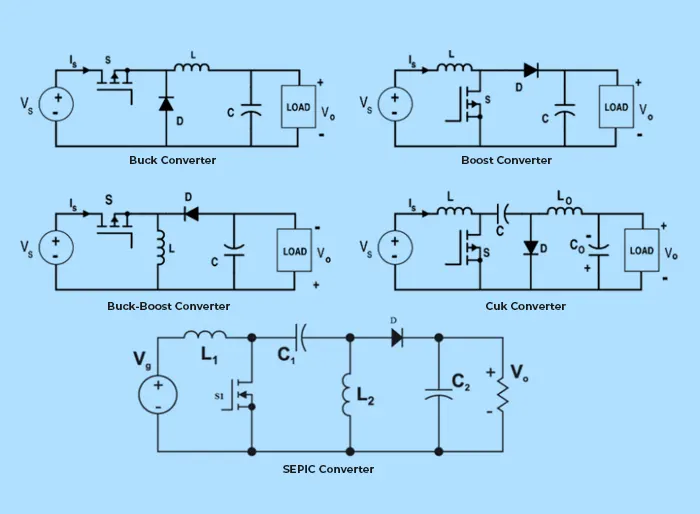
The converter topologies are classified as:
- Buck Converter:
The buck converter is a step-down converter and produces a lower average output voltage than the dc input voltage.
- Boost converter:
In the boost converter, the output voltage is always greater than the input voltage.
- Buck-Boost converter:
In a buck-boost converter, the output voltage can be either higher or lower than the input voltage.
- Cuk converter:
The output voltage can be either higher or lower than the input voltage providing some advantages over buck-boost (like a continuous current, less current ripple etc.)
- SEPIC converter:
The output voltage can be either higher or lower than the input voltage (with no polarity reversal compared to Buck-boost or Cuk converter).
- Isolated DC-DC converter:
In this type, the input and output stages are separated and there is a presence of a transformer which can further reduce (or increase) the output voltage apart from being done by the duty cycle. Forward, Flyback, Half bridge, Full bridge, and Push-pull converters fall under this category.
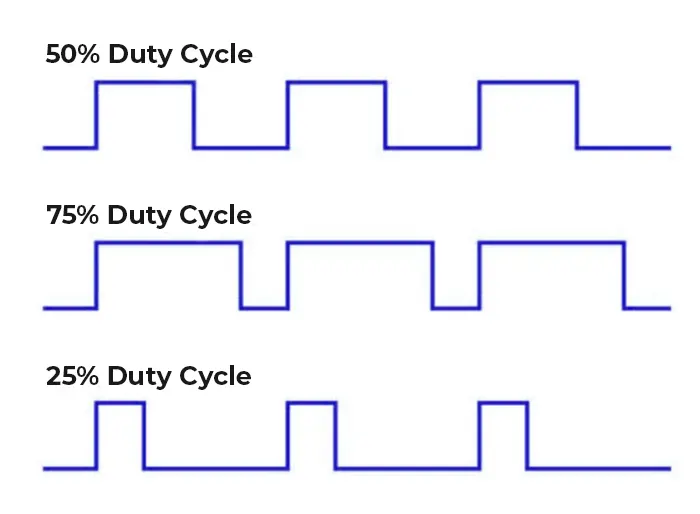
The amount of power flow between the input and the output can be controlled by adjusting the duty cycle (ratio of on/off time of the switch). Usually, this is done to control the output voltage, the input current, and the output current or to maintain constant power.
The Importance of DC/DC Converters
While DC/DC converters can be based on several different designs, the underlying function remains the same. A step-up converter, which turns a low-voltage input into a high-voltage output, or a step-down converter, which does the exact opposite.
In electric vehicles that use a DC motor, the running motor can use up to three times the voltage provided by the battery. With the help of the right converter, we can bridge this gap without having to use a larger, heavier battery.
DC-AC converters (Inverters)
An inverter is a device that converts DC power from the battery to AC power in an electric vehicle motor. The inverter can change the speed at which the motor rotates by adjusting the frequency of the alternating current.
The Significance of DC/AC Converters
The use of inverters can increase or decrease the power or torque of the motor by adjusting the amplitude of the signal.
It plays a significant role in capturing energy from regenerative braking and feeding it back to the battery. The key component is that it has a direct impact on on-road performance, driving range, and reliability of the vehicle also as a consequence of their weight and size.
The output voltage waveform of ideal inverters should be sinusoidal. However, the waveform of practical inverters is non-sinusoidal and contains certain harmonics.