Week 4:- Pin Unit Design Challenge
Challenge-4 week-4 Pin Unit Design Challenge
Aim:
1. Design 2 different types of fixed pin unit with different pin, riser, blade and block.
2. Design 2 different types of retractable pin unit with different pins, riser, blade, cylinder, and block.
Make a detailed report describing the process and attach a relevant image.
Introduction
3-2-1 principle
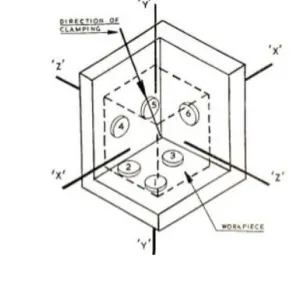
Any 3D body/part has three axes running along the x-axis, y-axis, and z-axis. It can move along any of these axes, or it can direct its movement to one of these three axes. At the same time, the body can rotate around these axes. So the total degree of freedom with which the body can move is six. To process the body, all degrees of freedom (DOF) must be restricted by arranging suitable locating points and then clamping it in a fixed and required position.
Locating a part to be machined involves mainly three steps: Supporting, Positioning, and Clamping.
Two main purposes of placing a part on a jig/fixture are:
Accurately positioning the part at the required coordinates.
Restricting all six degrees of movement so that the part cannot move.
An extensively used method for obtaining these objectives is the 3-2-1 principle or six degrees of freedom for part location. The 3-2-1 method is a work-holding principle where three pins are located on the 1st principle plane, i.e., either XY, YZ, ZX. And two pins are located on the 2nd plane perpendicular to the 1st plane, and at last, one pin on the plane is mutually perpendicular to the 1st and 2nd planes. The aim is to constrain the movement of the workpiece along all three axes.
Pin Unit:
It is used to locate the car panel precisely using pins. It is divided into two types.
Types:
Fixed pin unit:
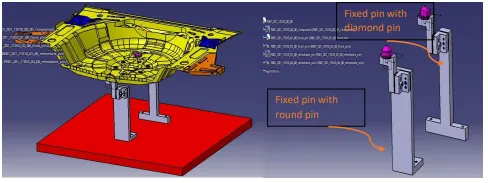
Fixed pin unit is used to locate the part/panel using pins to perform any operation such as welding, riveting screwing etc. It consists of a pin, pin retainer, shims, L block, blades and riser. Below figures represent the figure of the panel located with a fixed pin and the second figure represents the fixed pin with two different pins. One pin is a round pin and the other is a diamond pin.
Retractable pin unit
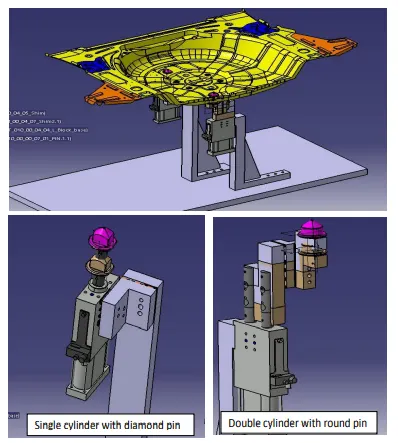
It is used to locate the car panel using pins, but entire pin package parts will be mounted on the retractable pneumatic cylinder. Due to these attachments it can move upward and downwards. Retractable pin unit is very useful for loading and unloading the panel. In this all the components are the same as the fixed unit, only cylinder is used additionally for the movements.
Components used
Pin:
a. Pin must engage 3-5mm from top to avoid slippage.
b. All the pins must be facilitates with two way shims for the adjustments in two direction.
c. The axis of car panel hole and pin should be same.
Pin retainer:
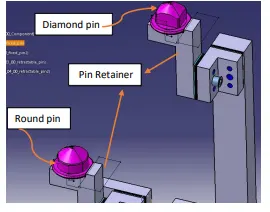
It is a part which hold the pin in the required position as presented in the above figure. It can be a make part or standard part. Mostly it is fixed to block to the riser.
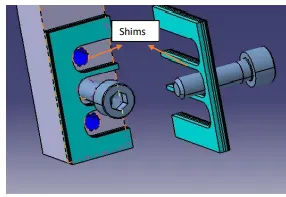
Shims/spacer:
Shim is used to adjust minor position of the panel. It ia made of hard rubber material for better fit and for isolator. Its total thickness can be 5mm, in different stages i.e. 2mm, 1mm,1mm 0.5mm, and 0.5mm.
Riser:
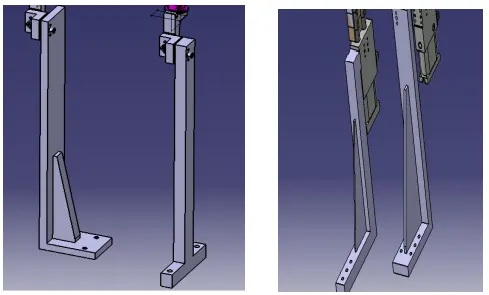
The riser is used to hold all the parts such as pin, pin retainer, shim, block etc. Its bottom part will be supported to the base unit to perform the operation. It can be designed in different fashion as presented in below figures.
Cylinders
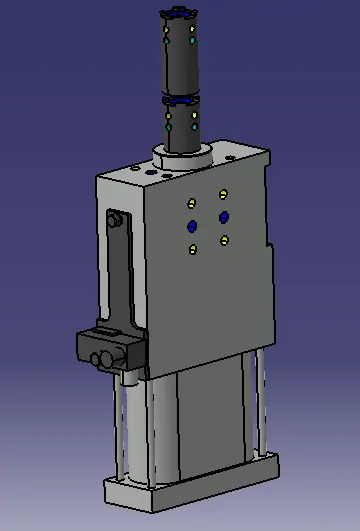
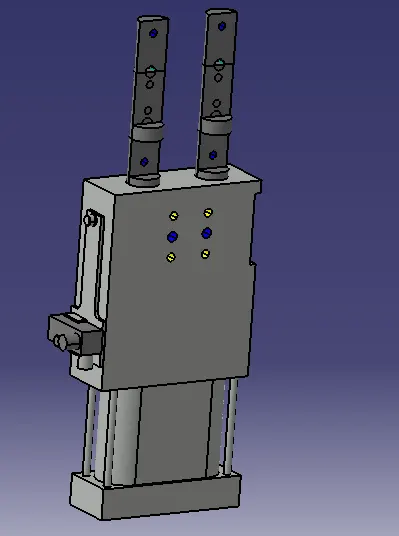
It is component used in the retractable unit to adjust the stroke length during the operation based on the pneumatic hydraulic system. In the present challenge two different cylinder were considered as presented below. One is with single rod and second one with double rod. It can provides a stroke length of 40mm.
Conclusion
In this project we have designed two fixed unit and two retracable pin unit with different attachements.