Hood design-Week 2
Report on: Design and modeling of hood using Siemens NX-CAD
Objectives:
- Design hood outer panel
- Design hood inner panel
- Design of Latch
- Design of Hinge
- Different operations used in hood
A detailed report about the hood components and assembly with all the parameter considered for the design.
Answer:
Hood Introduction:
The hood is a top component of the body in white (BIW). In certain countries, a car hood is also known as a bonnet. It's utilized to protect the engine and other accessories as well it absorbed the most of the impact force across the body which provides safety to the vehicle. It also allows access to the engine and its components for maintenance and repairs work. On front-engine automobiles, the hood may be hinged at either the front or rear edge, or it may be divided into two portions, one on each side, each hinged along the centerline, as on older models (e.g. the Ford Model). Another variation merges the bonnet and wheel arches into a single piece, allowing the entire front bodywork to tilt forward around a pivot at the vehicle's front. It is a front class-A body of the car. Because of these all consideration, a proper design must be considered. The hood design must be in aerodynamic shape, fancy and luxurious looks.
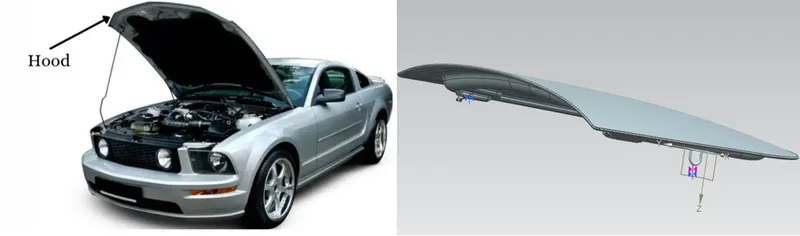
Reduction of weight of car and especially from the front of the vehicle is very significant to improve the performance and efficiency of any automobile as well produces low emission. Considering these all the parameter, Hoods are usually made from the same material as the rest of the body. This can be steel, aluminum, fiberglass, or carbon fiber. However, some aftermarket companies produce fiberglass or carbon fiber steel hood replacements to make the vehicle lighter. The hood release system is common on most vehicles and typically consists of an inner panel, outer panel, hood latch/lock handle, a hood release cable, and hinge assembly. The hood lock handle is usually located under the steering wheel, next to the driver’s seat, or in the door frame.
Hood design consideration:-
The hood of a car is considered as the frontal BIW fully enclosure component. It design must follow the aerodynamic shape to avoid the air resistance from the car. It design also considered for the protecting the passenger seating inside as well as the pedestrians in the event of the accident. The engine noise and vibration also must be considered, and it should be avoid or reduced.
The Hood consists of the following major component as:
The outer panel
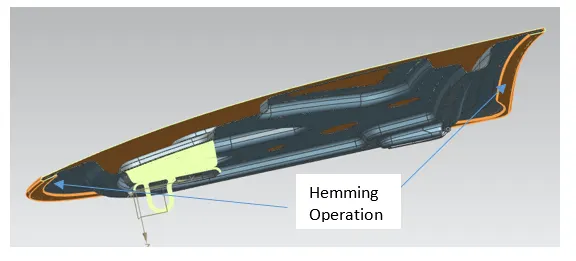
The outer panel, used to cover the inner panel of the hood. It is also considered as the class-A type of the car body, because it is visible from the outside. This component must be considered for the styling. It is first component that subjected to any type of impact. This part is intact with inner panel so to have a perfect combination its edges are wrap around inner panel this type of wrap called hem operation.
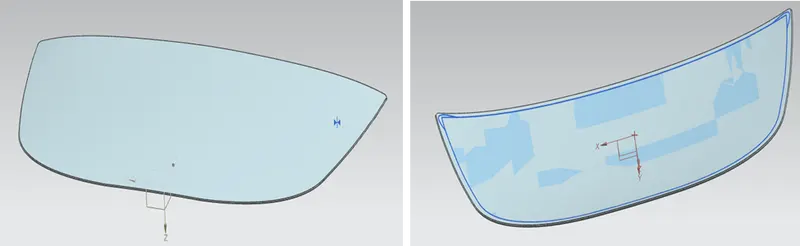
Outer view Inner view
The inner panel
This is a class-B surface, which cannot be visible directly from the outside. The top and bottom section of the inner panel are presented below. For this hood part, many factor must be considered for the designing such as: less weight, high stiffness, good force distribution at the time of impact, good heat remover, minimal harness and vibration. The steps embosses were provided for good stiffness and avoid localization of forces. The sticker and hinge are also attached to it. The half circle space presented in the figure marked with the red line circle also provided for the mastic to provide the proper contact between outer and inner panel.
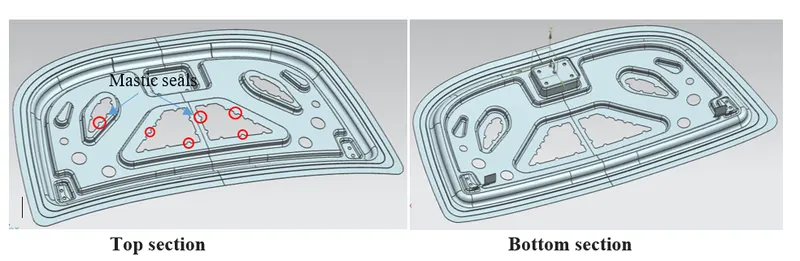
MASTIC: The outer panel cannot be bolted or welded to the inner panel, because of the esthetic requirements. This can be overcome by providing the suitable mastic sealant. An excellent anti-flutter compound, elastic Mastics are an extruded product made in standard, custom, or complex die cut shapes and thicknesses to meet customer requirements for sealing, noise dampening, and vibration reduction. This sealant also increase the strength of the system and has a influence around 80 mm in diameter.
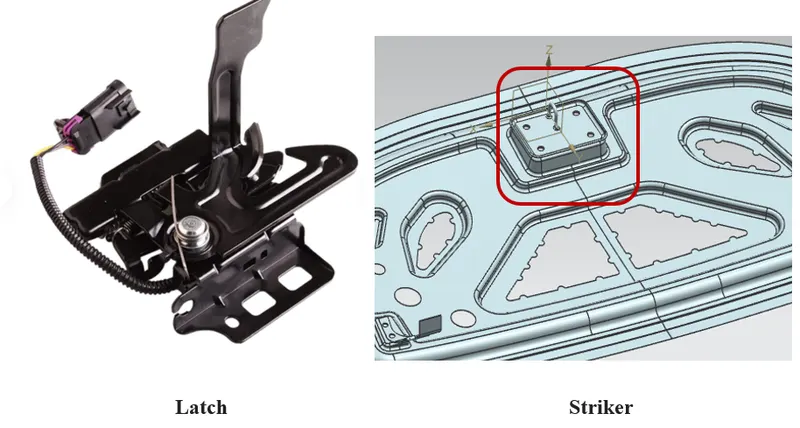
Latch and striker assembly
These both, together used to lock the hood to the body of the car. The reinforcement is provided to compensate loss of the strength.
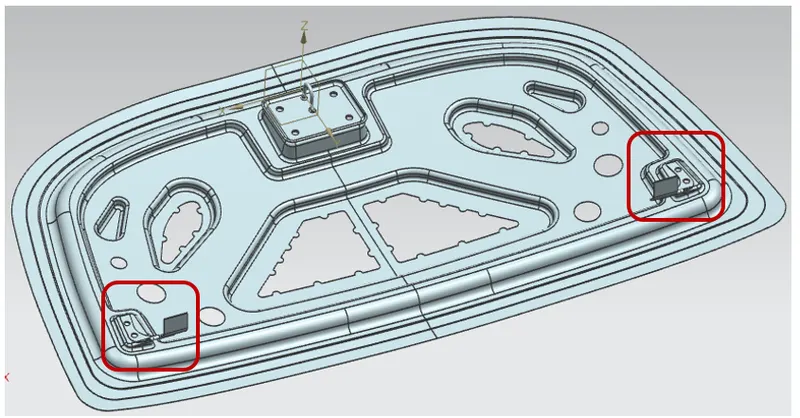
Hinge assembly
Hinges are provided with the hood assembly on the both corner shown with the red line on the below photo. It is used to connect the hood and fender and also it provide the rotation to the hood assembly, so as to open and close hood frequently. It allow only one degree of freedom.
Opening of hood
On newer models, the hood release is often located inside the vehicle, somewhere near the steering column, or on the floor next to the driver’s seat. (Typically, you’ll see the word “hood” or a picture of a car with the hood open.) On older models, the hood release is behind the grill or bumper. With the hood released inside the vehicle, press, push, or pull until the hood pops open. Then push, press, or pull from front to back and side to side until it releases the hood. The hood opens a little but is likely to be stopped by the safety lock of a metal lever, when pushed in one direction or the other, releases the hood so it can be fully opened.
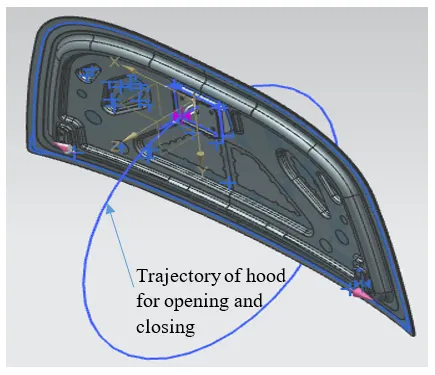
Latch trajectory
Lath trajectory is a path that hood follow for its working i.e. opening and closing operations. The proper working of hood can be achieved by positioning the striker tangential to the trajectory path of the hood. The trajectory path must be drawn from the center of the hinge axis on the mirror plane.
Emboss definition
Sheet metal embossing is a stamping technique that creates raised or sunken images in sheet metal. This procedure can be accomplished using matching male and female roller dies, or by sliding a sheet or a strip of metal between the desired pattern's rollers. It's frequently used in conjunction with foil stamping to produce a gleaming, three-dimensional impression.
Hemming operation
Hemming is a sheet metal forming method that involves bending sheets to an angle of 180 degrees. The hemming technique is used to create automobile body panels and pieces such as deck lids, trunk lids, doors, hoods, and tailgates. In this operation sheet are folded or folded over another part in order to achieve a tight fit. Normally hemming operations are used to connect parts together, to improve the appearance of a part and to reinforce part edges.
Deep drawing operation
Deep drawing is a sheet metal forming process in which a sheet metal blank is radially drawn into a forming die by the mechanical action of a punch. The process is considered "deep" drawing when the depth of the drawn part exceeds its diameter. This is achieved by redrawing the part through a series of dies. The flange region (sheet metal in the die shoulder area) experiences a radial drawing stress and a tangential compressive stress due to the material retention property. These compressive stresses result in flange wrinkles. Wrinkles can be prevented by using a blank holder, the function of which is to facilitate controlled material flow into the die radius.
Tools used in the NX-CAD
Surface tool: Offset surface, trim sheet, face and edge blend, emboss, through curve, extract geometry, low extension, thicken, sew.
Curve tools: curve on surface, offset curve in face, bridge curve, trim curve, offset curve, project curve etc.
Assemblies tools: Move component, assembly constraints, wave geometry linker etc.
Conclusion
It is a very important front component of car body. For the designing of the hood, the parameter such as safety of the inside as well as pedestrian, light weight with good force distribution must be considered. The proper hood design was done using the NX-CAD by considering all the parameters.