Week 4 - CHT Analysis on Exhaust port
OBJECTIVE:
- To understand the concept of CHT (CONJUGATE HEAT TRANSFER) analysis on the exhaust manifold and plot of velocity, temperature heat transfer coefficient.
CHT ANALYSIS
The Conjugate Heat Transfer (CHT) analysis type allows for the simulation of heat transfer between solid and fluid domains by exchanging thermal energy at the interfaces between them.
It requires a multi-region mesh to have a clear definition of the interfaces in the computational domain. Such a mesh can be created with the Hex-dominant parametric operation in the mesh creator.
The physical processes and solutions of the governing equations are considered separately for each object in two subdomains. Matching conditions for these solutions at the interface provide the distributions of temperature and heat flux along the body–flow interface. The CHT approach has an advantage over FE thermal analyses in that wall heat transfer coefficients and their local variations on surfaces are directly calculated within the model rather than based on simplified empirical calculations. The CHT approach, therefore, has benefits for those applications where heat transfer is either non-uniform or difficult to calculate empirically.
Typical applications of this analysis type exist as, but are not limited to, the simulation of heat exchangers, cooling of electronic equipment, and general-purpose cooling and heating systems.
MODELLING OF CHT ANALYSIS OF AN EXHAUST MANIFOLD
GEOMETRY:
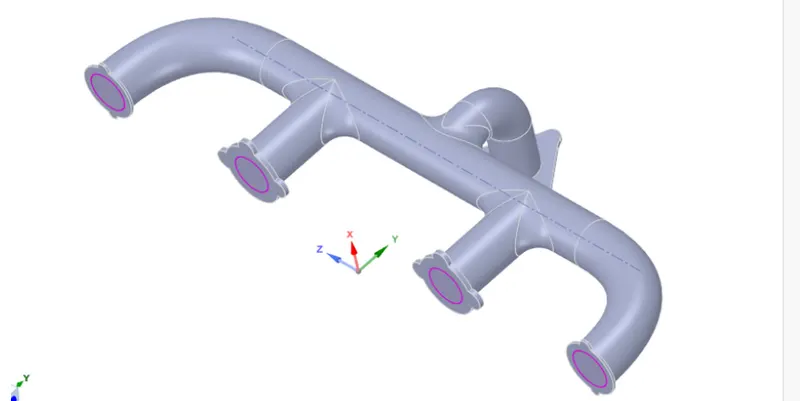
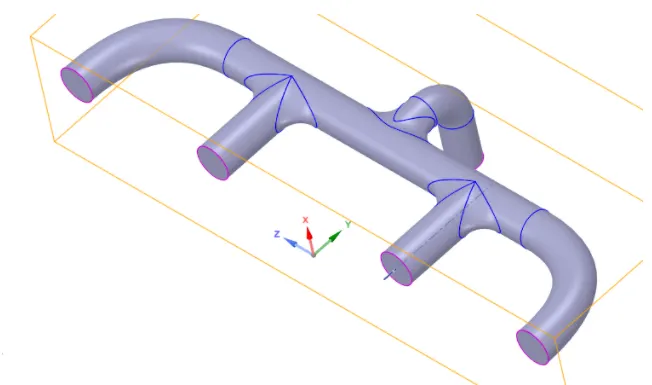
For the geometry shown, the fluid volume is extracted using Ansys SpaceClaim and the outer covering is the solid body where CHT takes place from fluid to solid body. after extracting the fluid volume is shown below :
MESHING:
mesh created between a solid and fluid region share its edges only when topology share is ON
case:1 Base mesh:
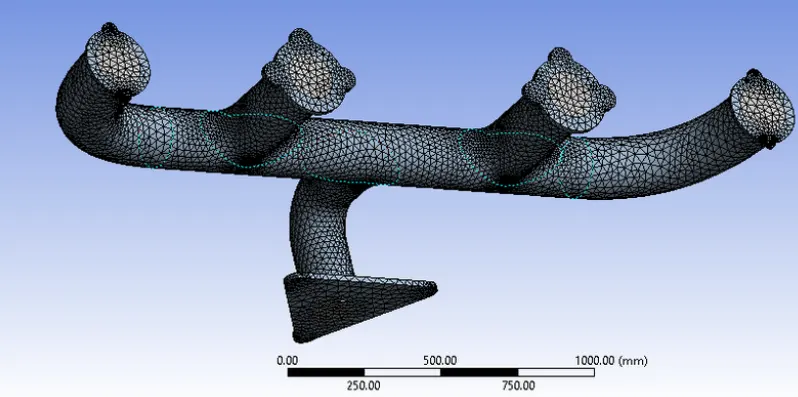
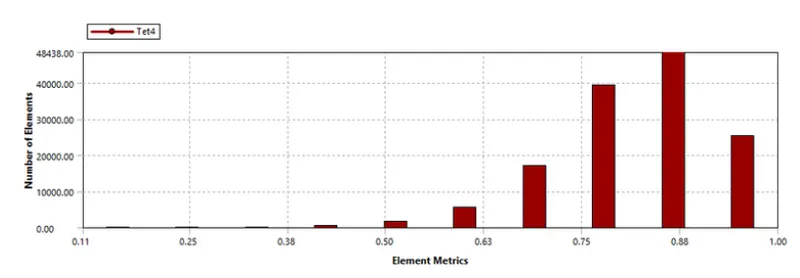
baseline mesh is created to check if all the boundary conditions are correct and to get a general flow pattern to understand the regions where mesh needs to be refined.
- used default mesh generated by Ansys
- element size = default(150mm).

the generated mesh is shown below:
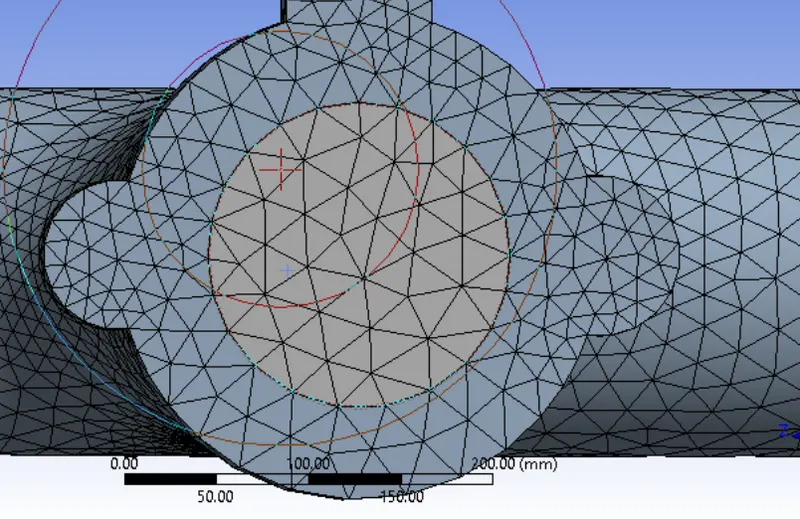
MESH MATRIX IS SHOWN BELOW:
CASE:2 REFINED MESH:
- ELEMENT SIZE: 10mm
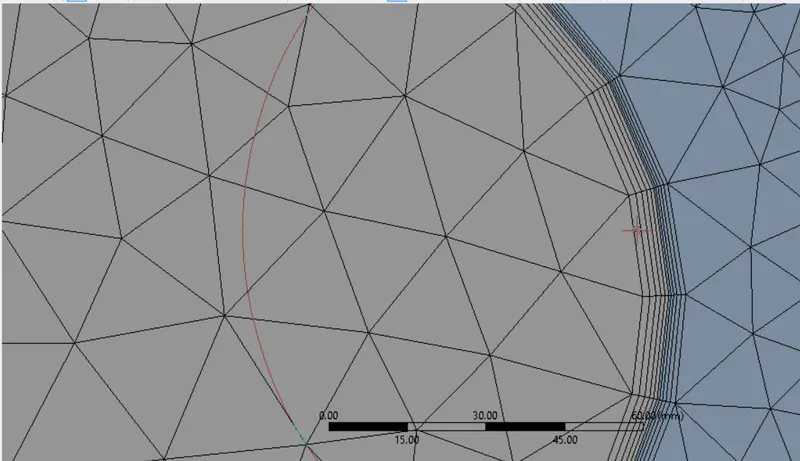
- inflation layer is provided at the interface between solid and fluid with a total inflation thickness of 5mm and growth rate of 1.2.
figure with inflation layer :

MATERIAL:
fluid flow inside domain: Air
solid material outside: Aluminium
BOUNDARY CONDITIONS:
Inlet:
velocity: 5m/sec
temperature = 700k
outer wall:
thermal condition = convection
heat transfer coefficient = 20 watt/m2-k
PLOT AND RESULTS
1. baseline plots:
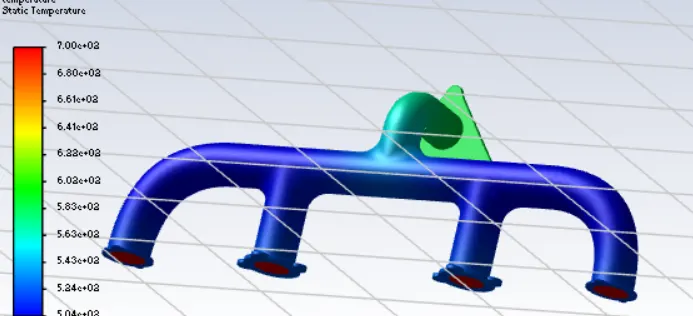
THE TEMPERATURE CONTOUR IS SHOWN BELOW:
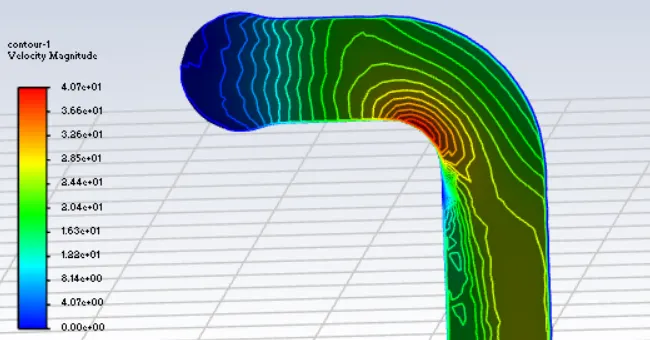
VELOCITY CONTOUR:
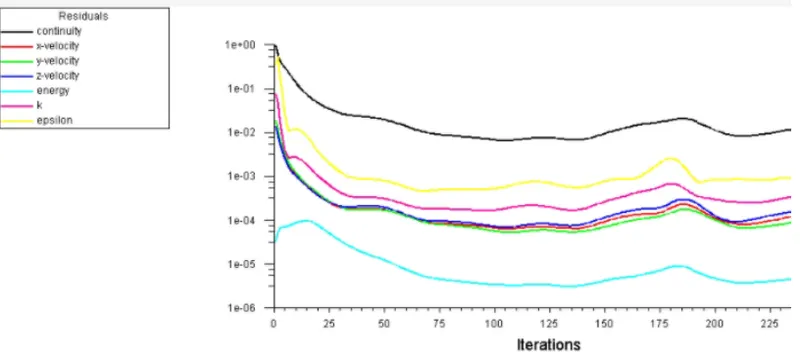
RESIDUAL PLOT:
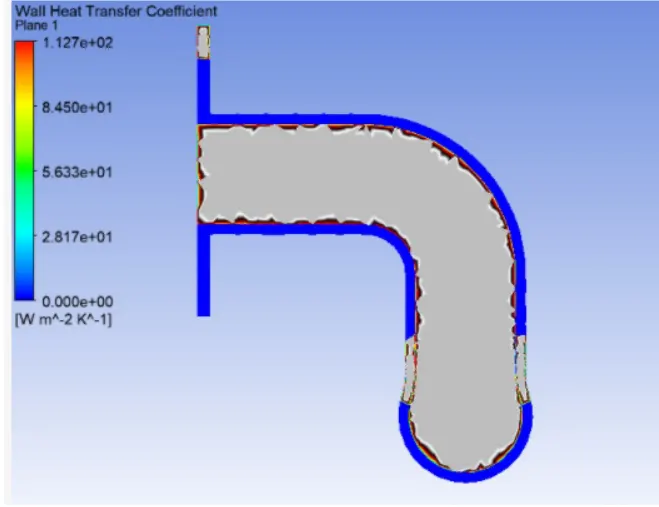
HEAT TRANSFER COEFFICIENT PLOT:
REFINED MESH: PLOTS
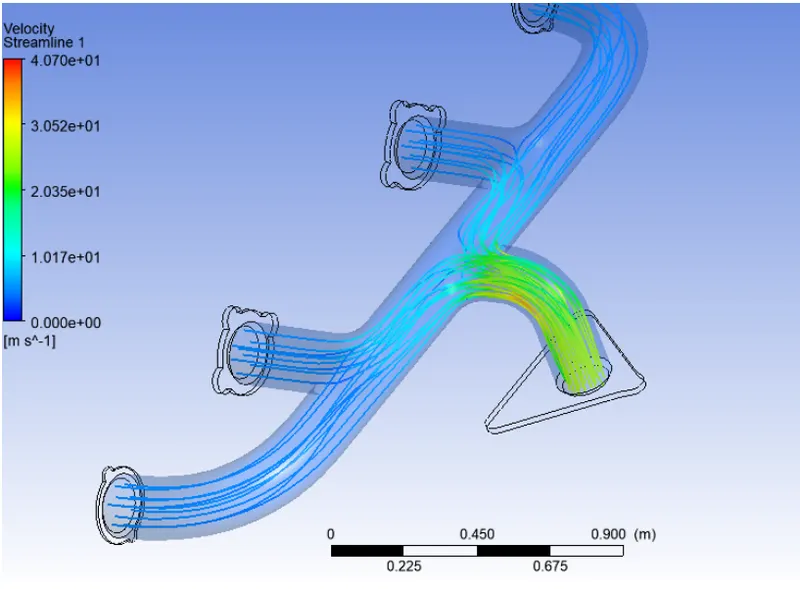
STREAMLINED INSIDE THE FLUID REGION:
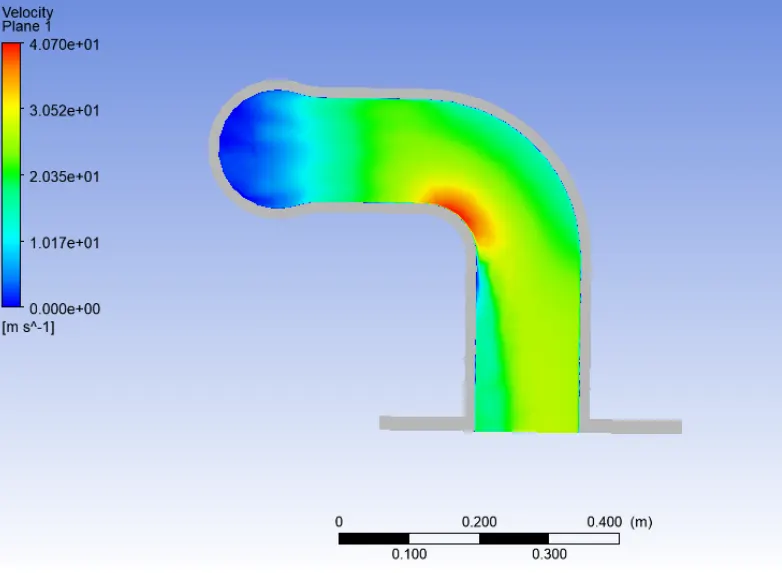
VELOCITY PLOT: Highest velocity at the bend
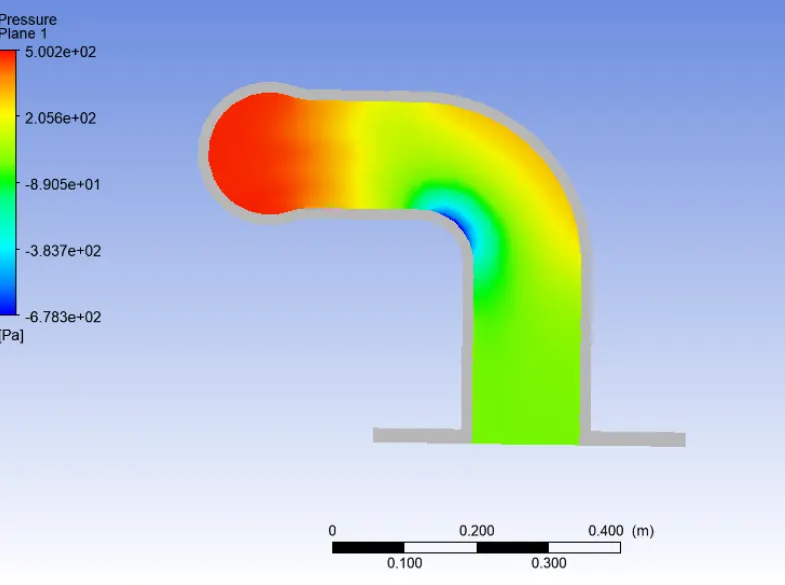
PRESSURE PLOT:
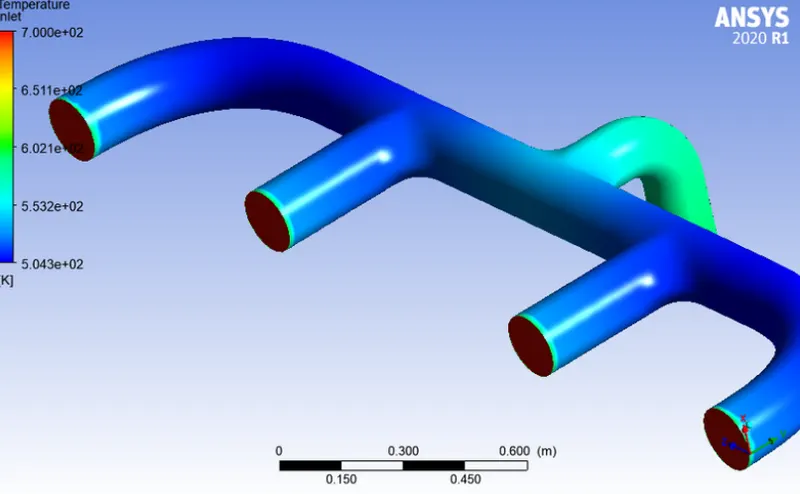
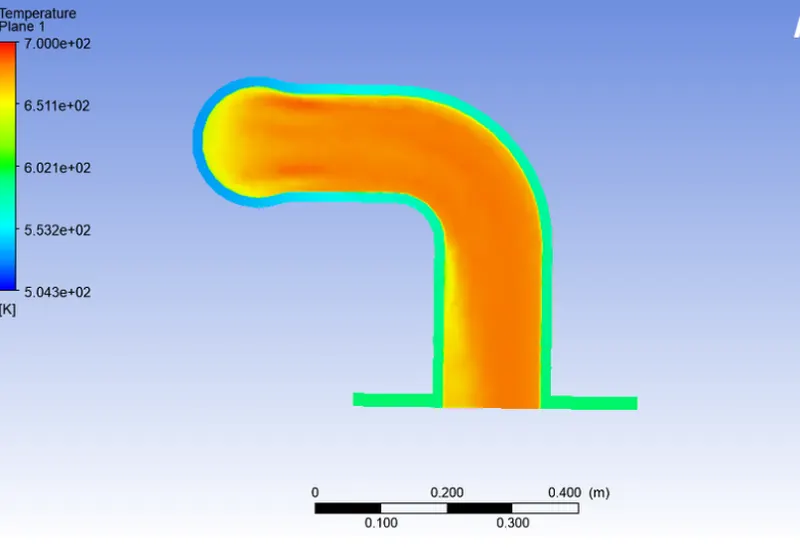
TEMPERATURE OVER THE DOMAIN AND EXHAUST PORT:
THE PLOT OF HEAT TRANSFER COEFFICIENT:
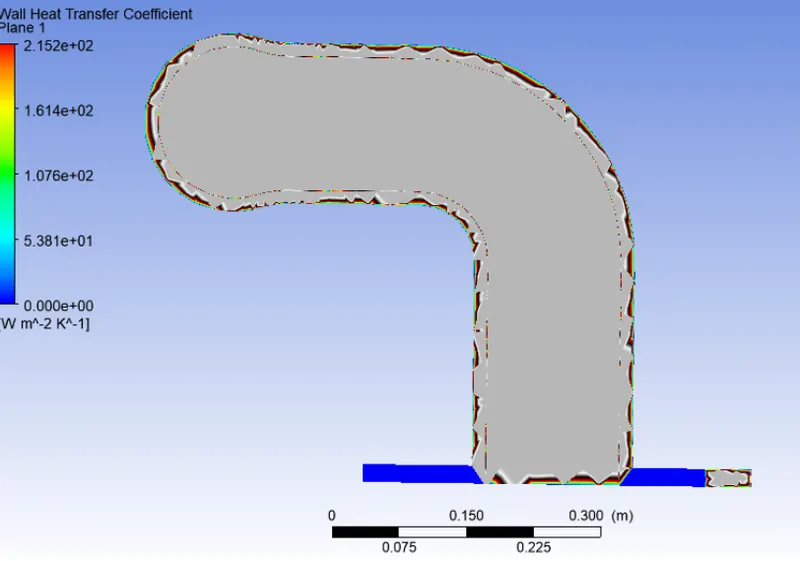
With the inflation layer, notice that the wall heat transfer coefficient is captured accurately along the surface separating solid and fluid volume.
FROM THE TWO MESH PLOTS WE GOT:
CASE1: maximum velocity(v) = 40 m/sec
maximum tempeature = 700 k
max heat transfer coefficient =112.7 w/m^2k
CASE2: maximum velocity = 40.7 m/sec
maximum temp = 700 k
max heat transfer coefficient = 215.2 w/m^2k
METHOD OF VALIDATION OF HEAT TRANSFER COEFFICIENT VALUE:
1) Theoretical verification using method given below
2) Theoretical verification using nusselt number.
(The relationship for turbulent internal flow needs to be used. Dittus Boelter equations is supposedly thought to be useful, but it isn't, as the flow regime is not of fully developed turbulent flow.)
3) Grid independence testing.
# THEORETICAL VERIFICATION USING NUSSELT NUMBER:
It can be done by calculating Nusselts number and heat transfer coefficient and comparing with the results obtained from the simulation.

where,
h = convective heat transfer coefficient of the flow
L = characteristic length
k = thermal conductivity of the fluid.
For free convection, the average Nusselt number is expressed as a function of the Rayleigh number and the Prandtl number, written as:

Otherwise, for forced convection, the Nusselt number is generally a function of the Reynolds number and the Prandtl number, written as:
-

-
Factors on which the results depend on:
1) Element size.
2) Correct application of boundary conditions.
3) Refinement at particular regions.
4) Appropriate solver and viscous models used.
CONCLUSION:
- As seen from the Post-processing plots, the maximum velocity and heat transfer coefficient values are high in the Refined case.
- The velocity tends to increase from the inlet to the outlet because of mass conservation and the mixing of air. hence, the high heat transfer coefficient at the junction is due to that high velocity and also when the transfer of heat from the fluid to solid is high.
- The internal flow velocity and its characteristics are affected by the Initial velocity, Pressure, the physical features of the geometry, etc. that affect the heat transfer rates, and hence CHT analysis is essential prior to experimental analysis for better prediction life of the designed component.
- As shown in the plots, the hot exhaust gases passing through the manifold transfer some of the heat to it via convection. The amount of heat transfer can be related directly to the velocity of the exhaust. The temperature is lower where the flow is stagnating or is moving at the inlet velocity. As the velocity increases, so does the Reynolds number and hence the amount of heat transferred.
- The best method to predict the accuracy of the result is by comparing the nusselt numbers from experiments and numerical results. The other method to verify is by comparing the results from published experimental results.