Week 4 - CHT Analysis on Exhaust port
Aim: Conjugate Heat Transfer analysis on an exhaust port.
Description:
Conjugate heat transfer analysis is based on a mathematically structured problem, which describes the heat transfer between a body and a fluid flowing over or inside it as a result of interaction between two objects. At the matching interface, the details are provided for temperature distribution and heat flux along the interface eliminating the need of calculating the heat transfer coefficient. Moreover, the heat transfer coefficient can be calculated later.
One of the simplest ways to realize conjugation is through numerical methods. The boundary condition for the fluid and solid interface is set and solved through iteration methods. There are no right guesses for the values of the initial boundary condition for the convergence except through the hit and trial method.
Procedure:
Geometry:
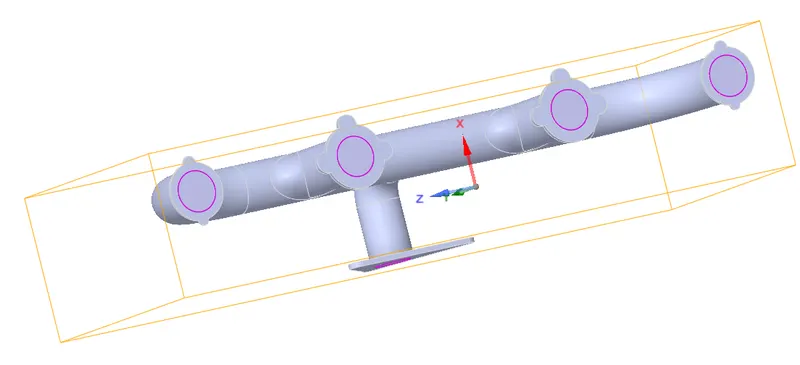
- In fluent module we have to open spaceClaim and import the geometry.
- if you look closely to the geometry it has solid part .So first let us extract the fluid volume.For that we have to go to,
prepare -> volume extract -> select edge selection -> then select all the edges of inlet and outlet -> then click ok.fluid volume will be created .
- Then after the volume has created then in the design change the name of the components i.e., fluidvolume to fluid and solid volume to solid.
- Then if you open meshing and mesh you will see that the mesh is fine,but when you zoom it at the inlets or outlet you will see that the mesh is non conformal ,meaning that one particular vertex of solid part is not connected exactly with the fluid vertex or element.And if you have conformal mesh i.e., when the edges are connected exactly then only the heat is going to transfer smoothly.You may also see physical gap if it non conformal mesh.For CHT simulation we should not have such kind of mesh,We shold have both of the volume overlap perfectly,inorder to fix that we need to share topology.
Meshing:
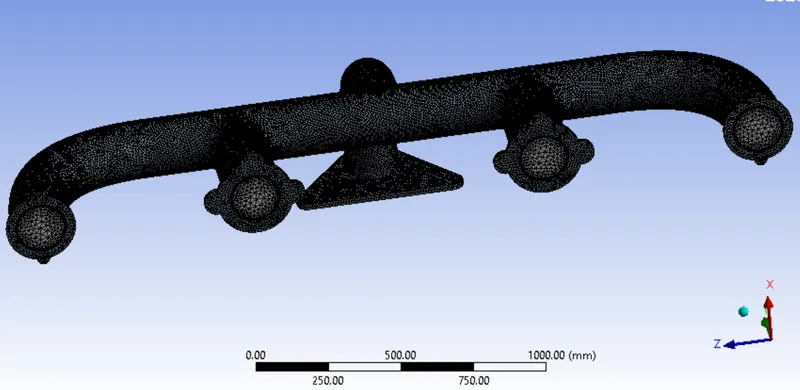
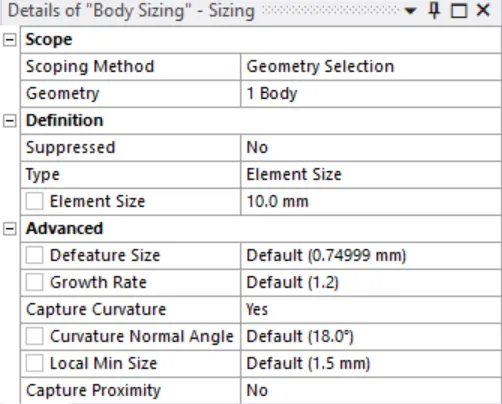
- Go to mesh enter mesh size as 90mm and the max size also 100 mm, insert sizing mesh select the outer-wall-convection enter the element size as 10 mm, select the named selection select inlet in exhaust port enter mesh size as 5mm then generate the mesh for the first refined smulation.
Problem Setup:
- To set up our problem we open Fluent and setup inital conditions , boundary conditions material etc.,
- We first start with checking the mesh quality using perform mesh check under domain.If no error is seen in console window then we can proceed further.
- Then we move move to setting up physics where we select the solver ,viscous model ,initial and boundary conditions etc.,
- We use a steady state pressure based solver to solve our model.
Physics :
General :
Solver type : pressure based
time : steady state
velocity formulation : absolute
models :
viscous model : k-omega SST
Material : Fluid : Air
Solid : aluminum
Zones :
Cell zone : In cell zones you will see fluid volume,it is of type fluid with material air and solid volume it is of type solid with material aluminum.
Boundary conditions :We will basically give our boundary conditions here such as inlet velocity and outlet conditions.
we give,
Inlet :
velocity : 5 m/sec
temperature : 700K
Outlet :
pressure outlet : gauge pressure = 0 pa
Outer wall convection :
type : wall
Theremal conditions => convection : Heat transfer coefficient = 20 W/m^2 K
Flanges or Support :
type : wall
Theremal conditions =>Heat flux : Heat flux = 0 W/m^2 (Adiabatic walls)
Results:
Residuals:
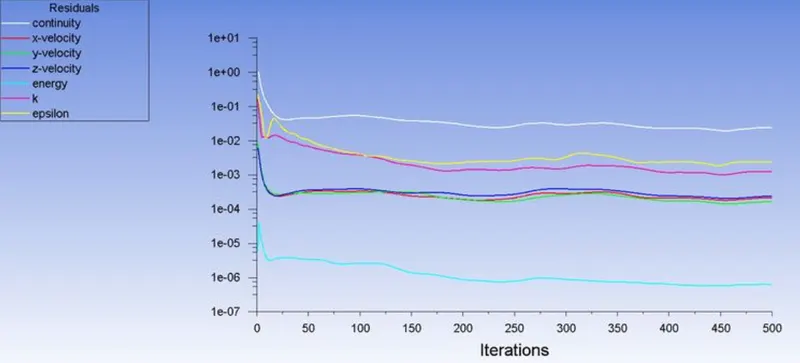
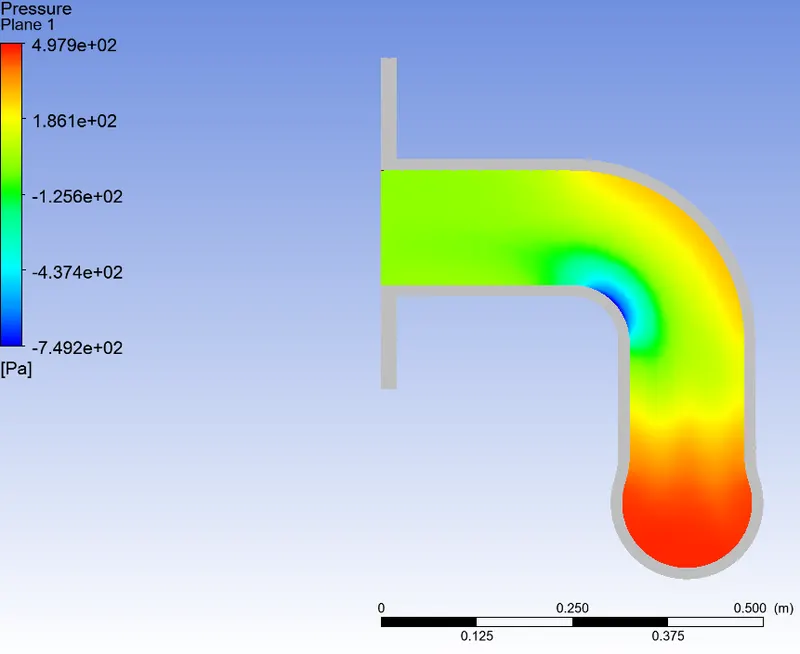
Pressure contour:
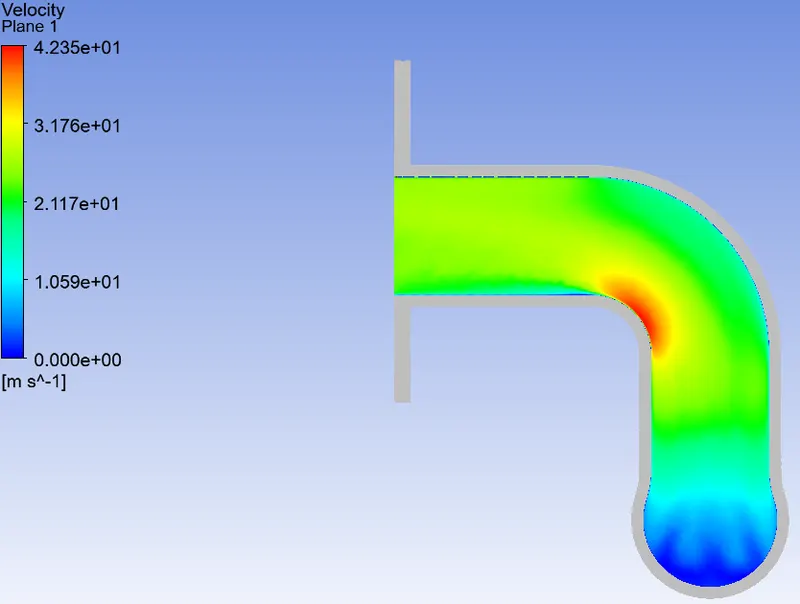
Velocity contour:
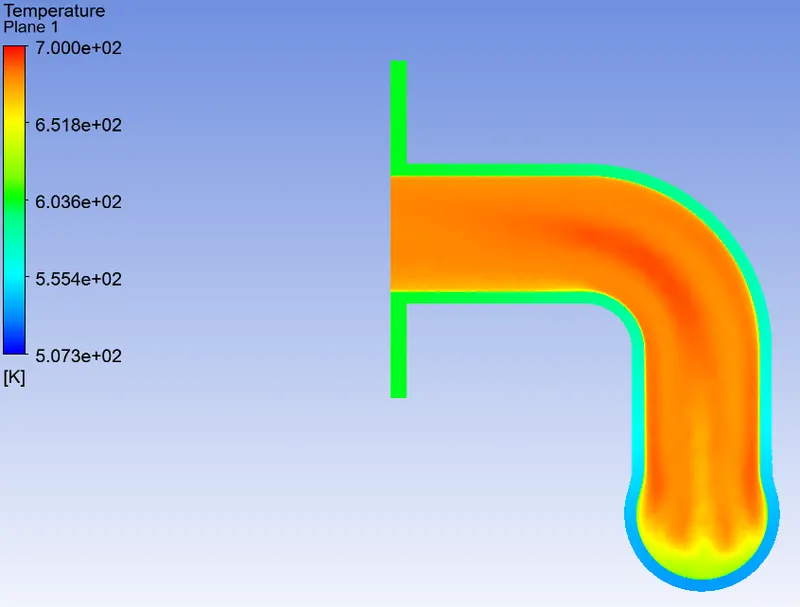
Temperature contour:
Wall heat transfer coefficient contour:
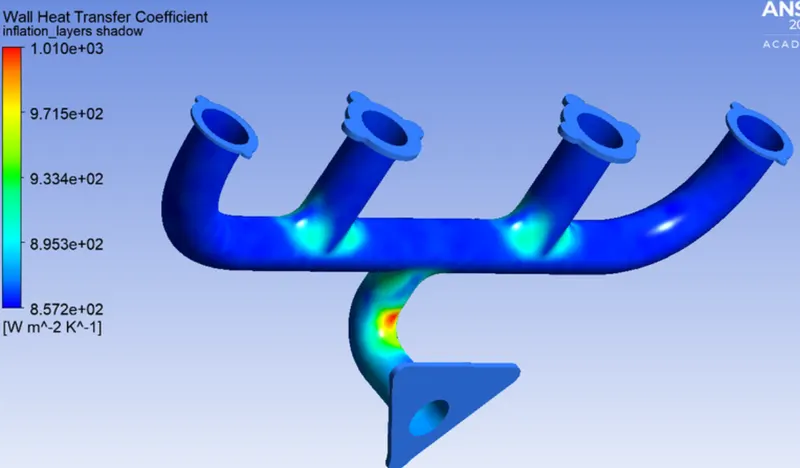
- So it is observed heat transfer coefficinet is directly proportional to the Reynolds number (also to the velocity). So if you increase the velocity then there will be increase in the convective heat transfer coefficient. That's what we have proved and if we run another simulation by increasing the reynolds number of the flow then it will be observed that there will be increase in the overall convective heat transfer coefficient or at a particular location than in the previous low reynolds number simulation.
Accuracy of HTC prediction :
Accuracy of the predictions depends on several things like,
1. Accurate geometry of model.
2. Its Mesh quality.
3. Inflation layers
4. Properties of material being used.
5. Turbulence models.