Week 4 - CHT Analysis on Exhaust port
CHT Analysis on Exhaust port
Aim: To run simulation on echausst port to perform Conjugate heat transfer co-effecient.
Objective:
- Give a brief description of why and where a CHT analysis is used.
- Maintain the y+ value according to the turbulence model and justify the results.
- Calculate the wall/surface heat transfer coefficient on the internal solid surface & show the velocity & temperature contours in appropriate areas.
- How would you verify if the HTC predictions from the simulations are right? On what factors does the accuracy of the prediction depend on?
Theory:
Conjugate heat transfer analysis, which describes the heat transfer between a body and a fluid flowing over or inside it as a result of interaction between two objects. At the interface, the details are provided for temperature distribution and heat flux along the interface eliminating the need of calculating the heat transfer coefficient.
CHT Analysis is used in the field of
Pumps and Compressors
Aftertreatment
Electromobility
Internal Combustion Engines
Accuracy of HTC predictions depend on:
1. Accurate geometry of model.
2. Its Mesh quality.
3. Inflation layers
4. Properties of material being used.
5. Turbulence models
Y+ value according to turbulence model:
Hybrid wall function is applicable for all Y+ values but these are designed for SA and K-Omega type models. However, K-Epsilon type models are designed for wall functions i.e. Y+ >30. But with one equation treatment for K-Epsilon models you can integrate them to viscous sub-layer. In this case K-Epsilon type models requires Y+<0.2. This is also known as enhanced wall treatment.
Procedure:
Geometry:
Open the geometry in space claim of Ansys Fluent
Extract the fluid flow volume using extract volume.
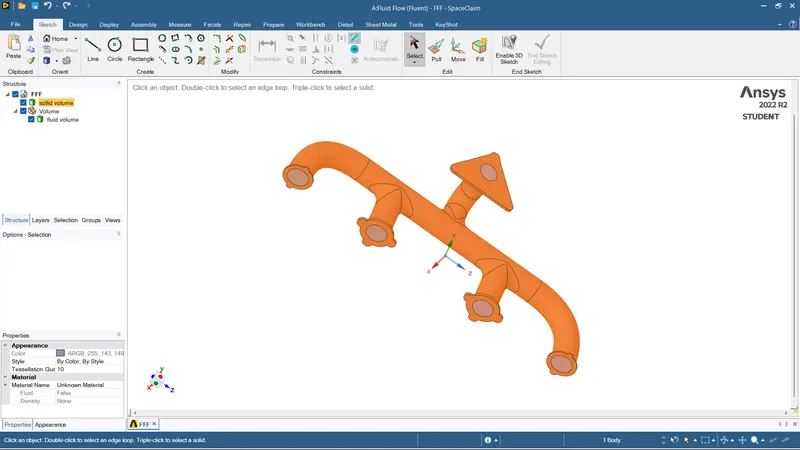
Share the topology
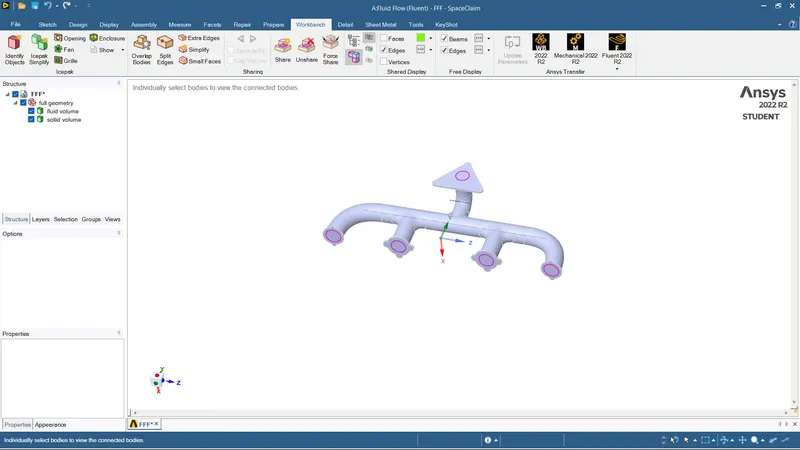
Meshing:
Assign the name selection accordingly
Body sizing = 10mm
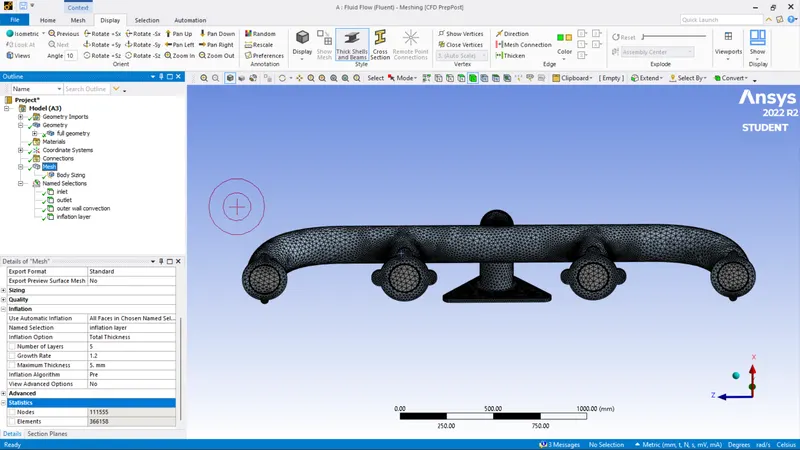
Inflation = 5 mm
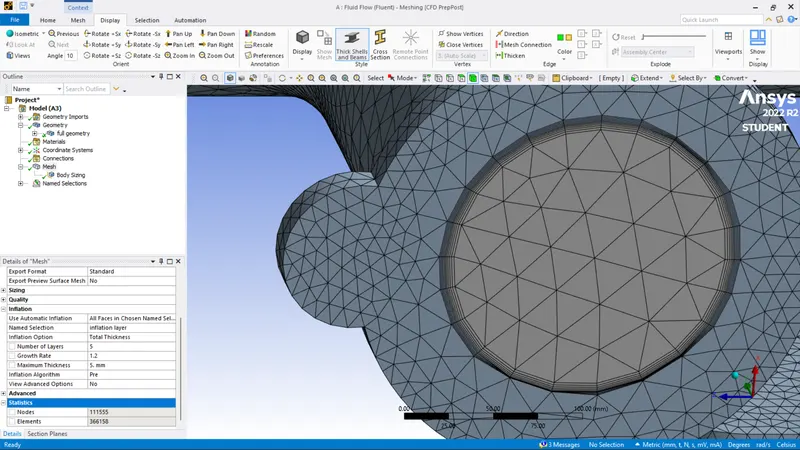
Setup:
Solver :
Pressure- based
Steady state
Viscous model: K-epsilon
Fluid= Air
Solid= Aluminium
Energy selection - To mesure the temperature
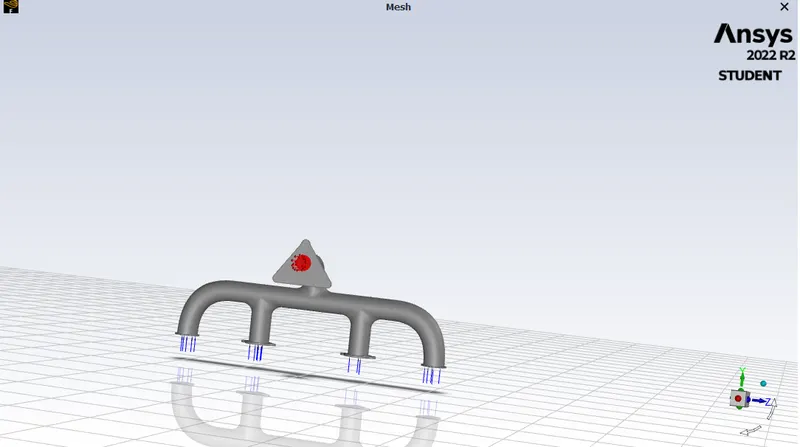
Inlet: Velocity= 5 m/s Temperature= 700K
Heat transfer co-effecient= 20 W/m^2 K.
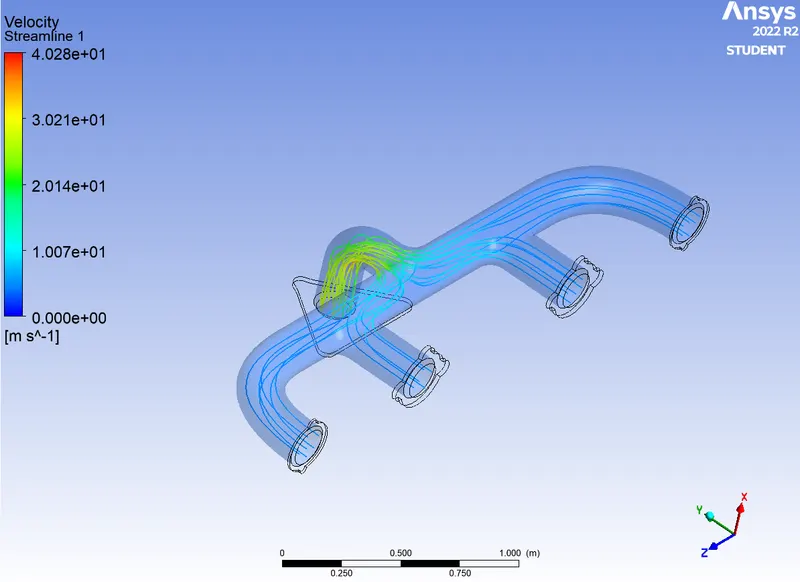
Velocity streamline and temperature contour:
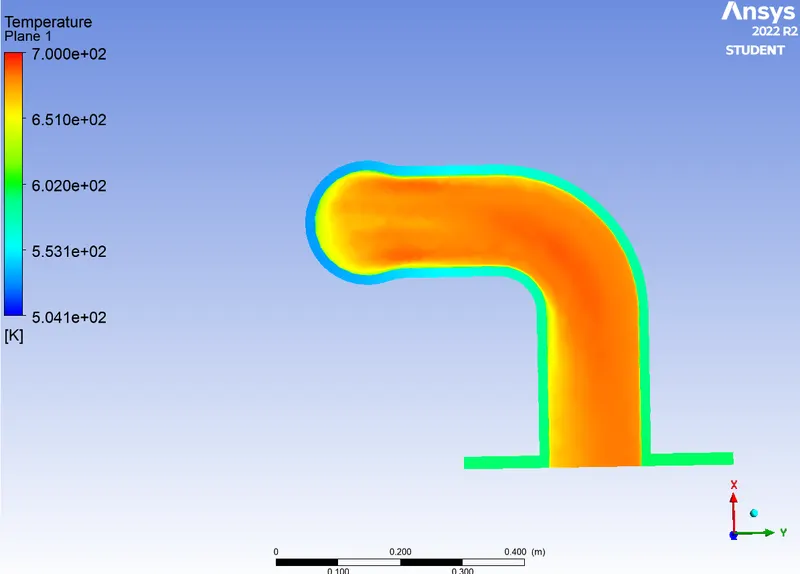
Temperature plot at outlet:
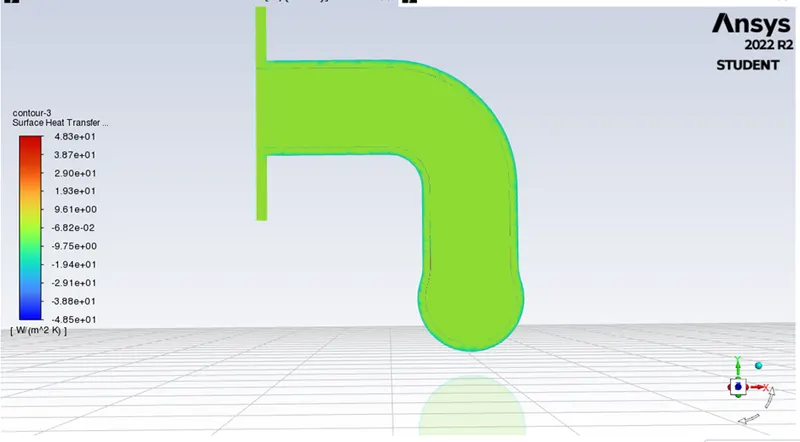
Heat transfer co-effecient:
Conclusion:
Obtained Conjugate heat transfer analysis for the Exhaust port.
Turbulence model of K-epsilon model is used.
Heat Transfer co-effecient is obtained on the internal solid surface.