Week 4 - CHT Analysis on Exhaust port
CHT analysis: CHT stands for Conjugate Heat Transfer Analysis. This type of analysis allows for simulation of heat transfer between Solids and Fluids by an interchange of thermal energy at its interfaces.
CHT analysis is used to create simulations of heat exchangers, cooling of electronic equipment and general-purpose air-conditioning devices
They are also used in determining the outcomes of
- Heat Transfer coefficient Analysis
- Heat Flux analysis
- CFD Thermal Analysis
- Temperature Distribution Analysis
CHT analysis
Case 1:Baseline mesh
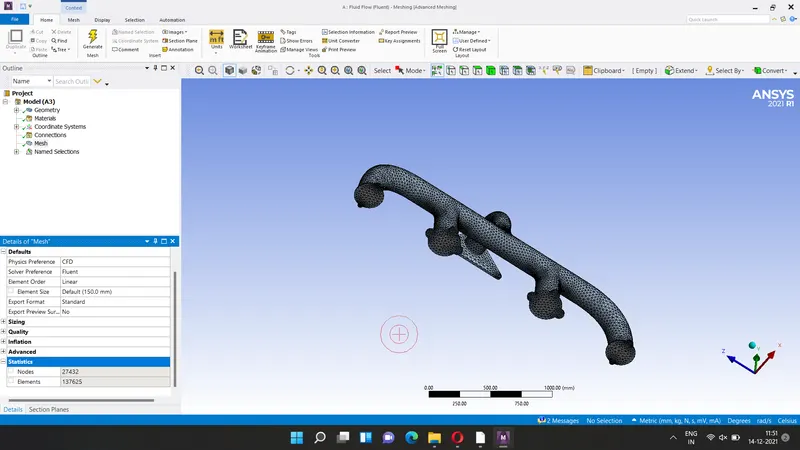
This mesh is completely generated by the system, without any local setting. this baseline mesh has 137434 elements. For fluent setting, K-epsilon Model is used and parameters are solved by first-order approximations. The solution is run for 450 iterations.
Meshing:
Streamlines:
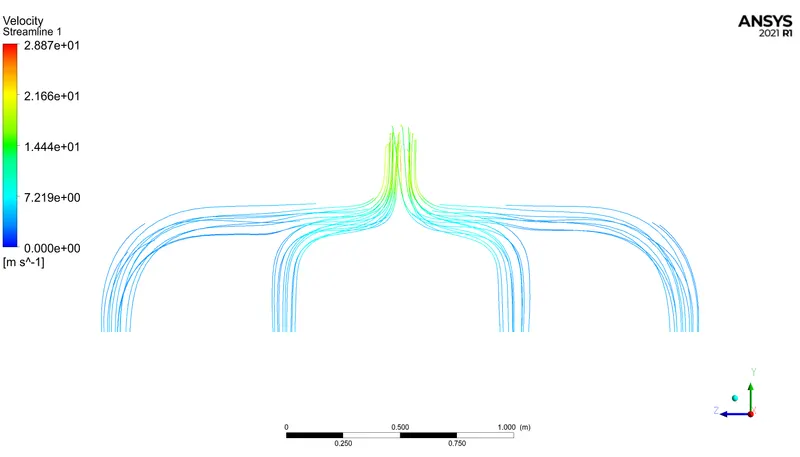
The Stream of air reached max velocity=28.87m/s in the throat region of the exhaust port.
Velocity
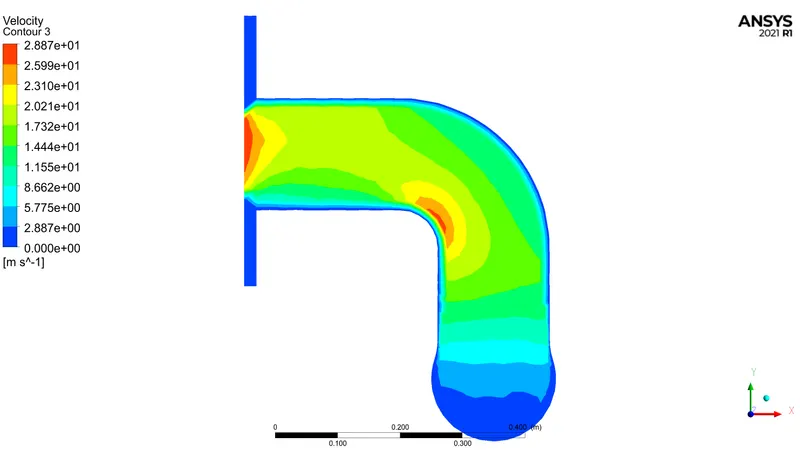
The velocity of the air stream maxes out at the inner throat area of the outlet.
Temperature:
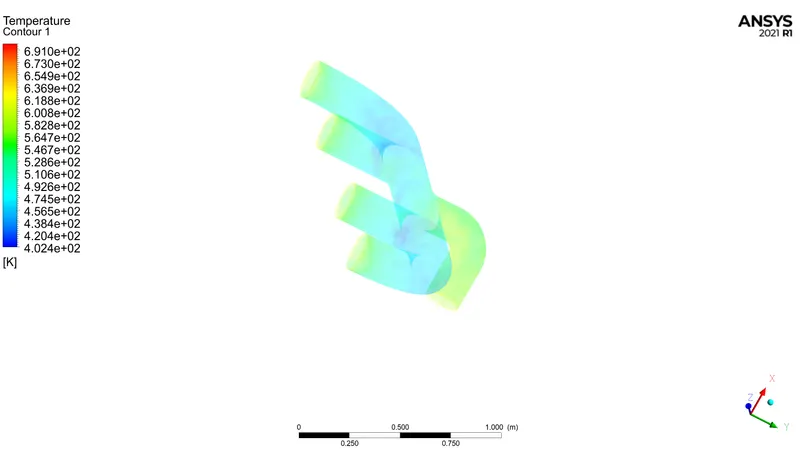
Max temperature reached at the throat area where all the inlet air streams converge and temperature is found to be 554.098k
Wall Function Heat Transfer Coefficient:
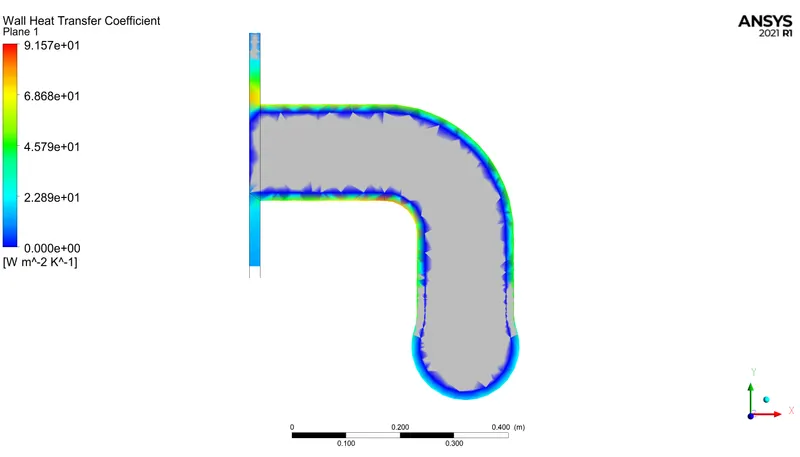
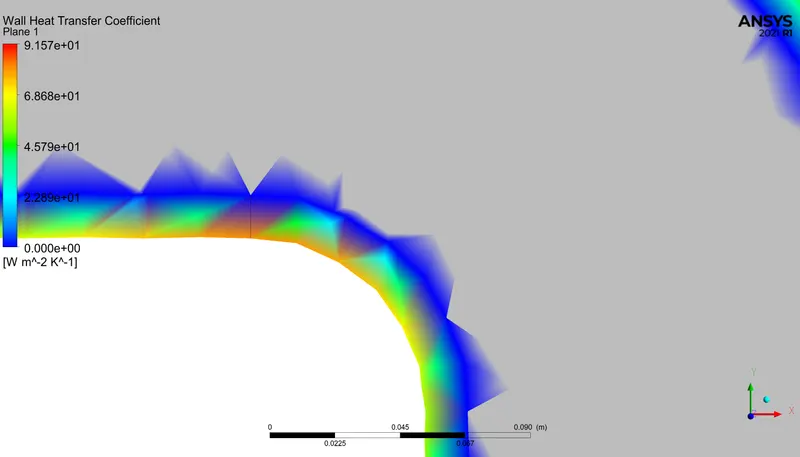
Max heat transfer coefficient is found to be 91.5719 W/m^2-k
Wall y-plus:
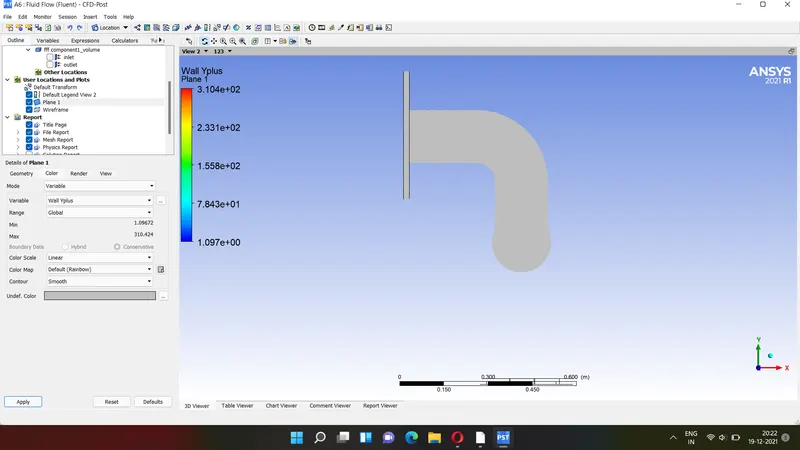
minimum y-plus value =1.09672
Case 2: Refined Mesh.
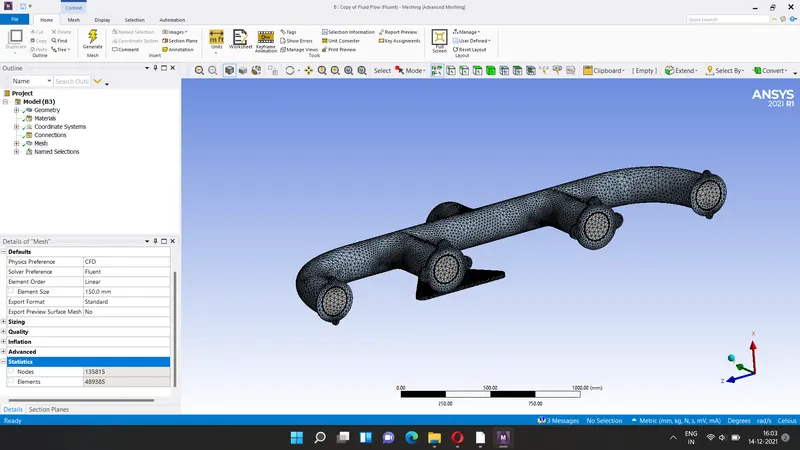
Mesh refinement has been done all over the model and Edge sizing is done on all the inlets and Inflation layers are added up to 7 layers. A total number of meshing cells are added up to 454654 cells.
Meshing:
Streamlines:
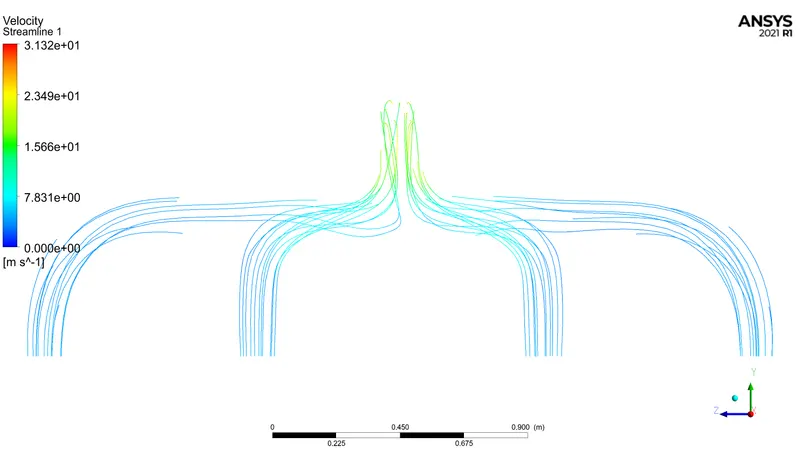
The Stream of air reached max velocity=31.32m/s in the throat region of the exhaust port.
Velocity:
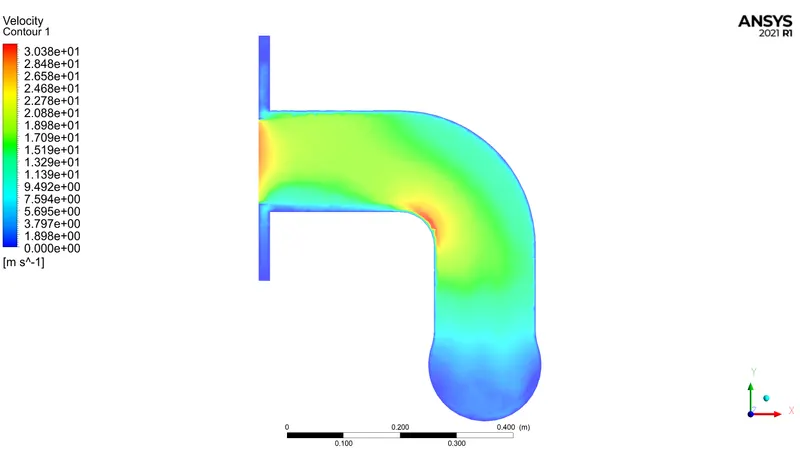
The velocity of the air stream maxes out at the inner throat area of the outlet.
Temperature:
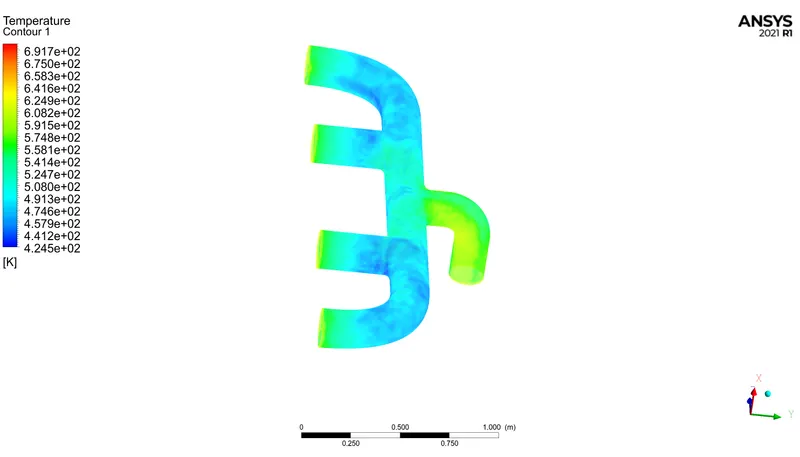
Max temperature reached at the throat area where all the inlet air streams converge and temperature is found to be 562.788k
Wall Function Heat transfer:
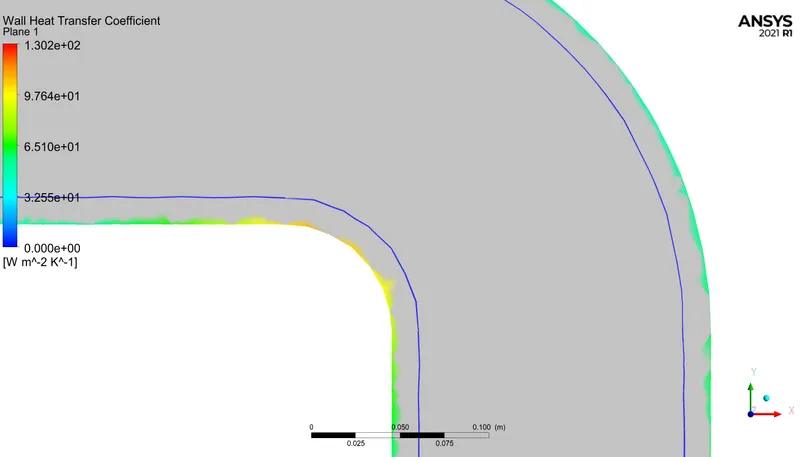
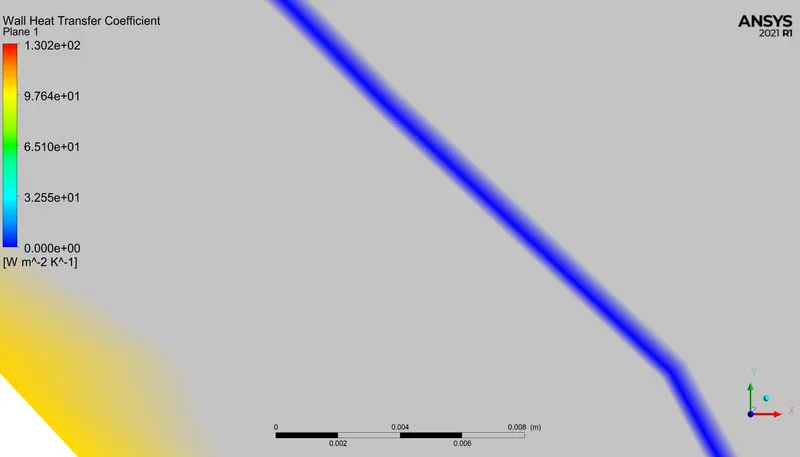
Max heat transfer coefficient is found to be 130.191 W/m^2-k
Wall y-plus:
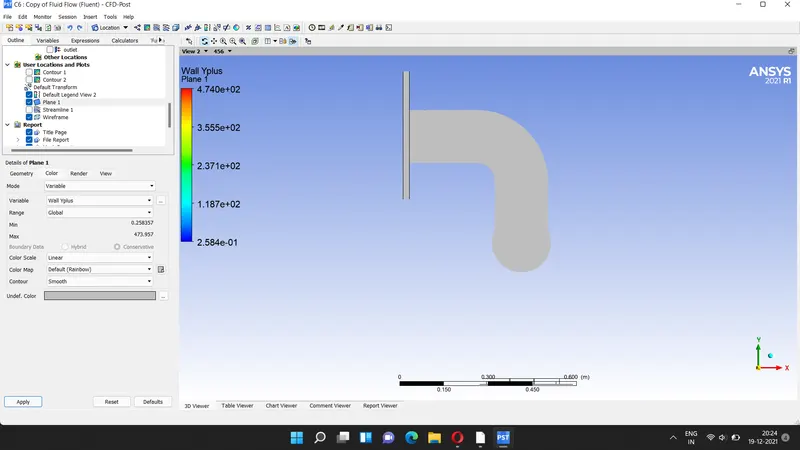
minimum y-plus value =0.258357
Conclusions:
- Even though the inlet temperature of the port is given as 700k, the temperature doesn't transfer to the outer solid body as it is the lowest over there, but gradually increases as the inlet stream converges near the outlet. As meshing gets refined, the temperatures also increase along the solid body.
- The velocity increases near the outlet due to conservation of mass, since, there are 4 inlets and one outlet.
- Velocity is directly proportional to temperature, in this case, hence maximum temperature is produced at the throat region of the outlet, where velocity is maximum.
- The Wall Heat Transfer Coefficient increases from 91.5719 W/m^2-k to 130.191W/m^2-k as the mesh is refined.
- Velocity, Temperature, and Wall Heat Transfer Coefficient increase as the number of elements keep increasing.
Verification of results:
- Results can be verified by physical experimentation of the model and comparing it with the CFD results.
- Grid independency test can also prove the credibility of the results.
- by calculating the nusselts number, we can find the heat transfer coefficient and compare it with the obtained results.
Nu=hLc/k
Nu= Nusselts number
Lc= characteristic length
k= thermal conductivity of the material
h= convective Heat Transfer Coefficient.
Factors Affecting Simulation:
- For Conjugate Heat Transfer, the geometry must be shared using the "share" option in the SpaceClaim, which allows for the smooth transition of heat between the solid and fluid volumes.
- The number of elements also makes quite a difference in the results, the more the number of materials and finer the mesh, the more accurate results are obtained.
- Inflation layers also play a role in keeping the mesh body fitted to obtain accurate results.
- Wall y+ values according to the turbulence model of k-epsilon must be less than 1 to get accurate results