Week 4 - CHT Analysis on Exhaust port
Conjugate Heat Transfer: In this simulation, there is a transfer of heat between solid and fluid mediums and there are two forms are heat transfers viz., Conduction and Convection. The typical applications include heat exchangers. etc
Aim: To conduct a CHT analysis on an exhaust port, with four inlets and one outlet
Procedure: Firstly the model is loaded in space claim and the following steps are followed in sequence.
- Edge removal operation is conducted from the workbench in the toolbar, which deletes free edges if available.
- Creating a volume by selecting the edges of inlets and outlet by using the prepare.
- Using the share topology from the properties tab of the component and moving fluid volume and solid to new component and deleting the old component.
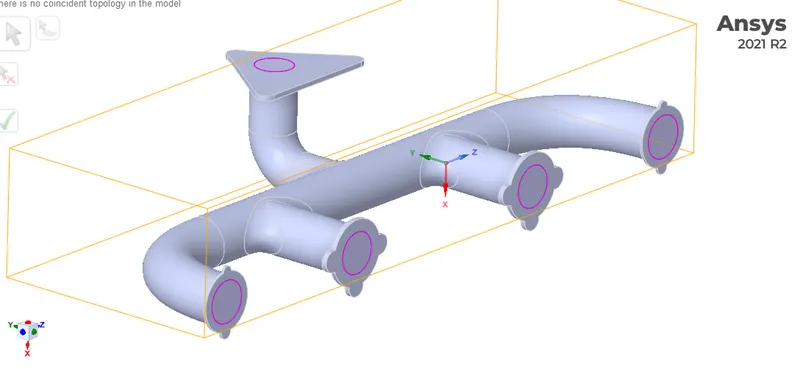
The above figure represents the final model if all the operations are done successfully.
Meshing:
The meshing is undergone by using body sizing for the outer walls and inner fluid walls, whereas for the inner wall we have used the 5 inflation layers which are calculated according to the y+ assumed.
Using the Appropriate Y+ Values: In this simulation, we are using a K-Omega turbulence model, To capture the appropriate, for achieving this the required Y+ should be in the range of 0.1 to 5, for our mesh we have considered a y+ value of 4.5 and found the first layer thickness as 0.000280m, with that we calculated the total thickness of 0.008373 m
After this the mesh is generated, the below figure depicts the mesh after the above steps
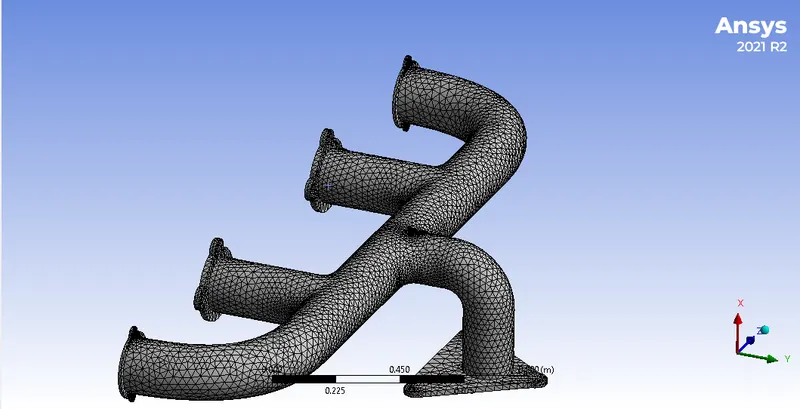
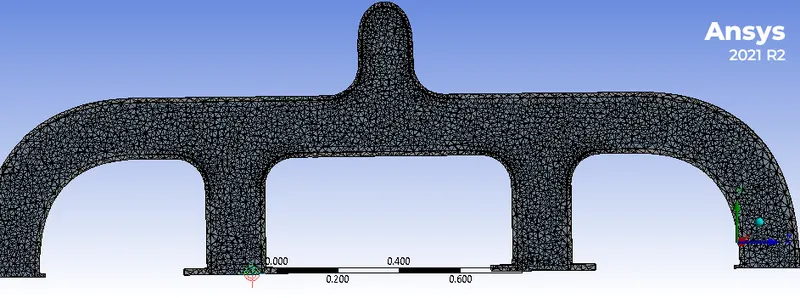
Above is the sectional view of the mesh with inflation layers shown.
Setting up the case in Fluent:
- Check the mesh which is imported into the fluent, whether all the named selections which are given at the time of meshing are available in the fluent.
- Setting up the case as a pressure-based with steady-state simulation, since we need to check the heat transfer as well we select the energy equation.
- Select the viscous model from the physics and the turbulence model as K-Omega SST.
- Selecting the zones for fluid body giving air as a material, and for the outer solid-body as aluminum.
- From the boundaries select inlets as 5 m/s and with a temperature of 700 K.
- For the outlet as pressure outlet.
- For the inner wall as coupled wall.
- For the outer wall having the convection with heat transfer coefficient of 20 W/m2-K
- Selecting the solution with hybrid initialization.
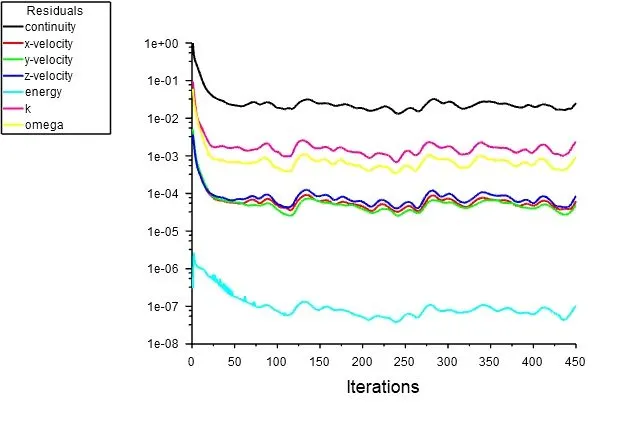
- Run the calculation for 450 iterations
Below are the results obtained for the above calculations
Residuals
Wall Heat Transfer Coefficient
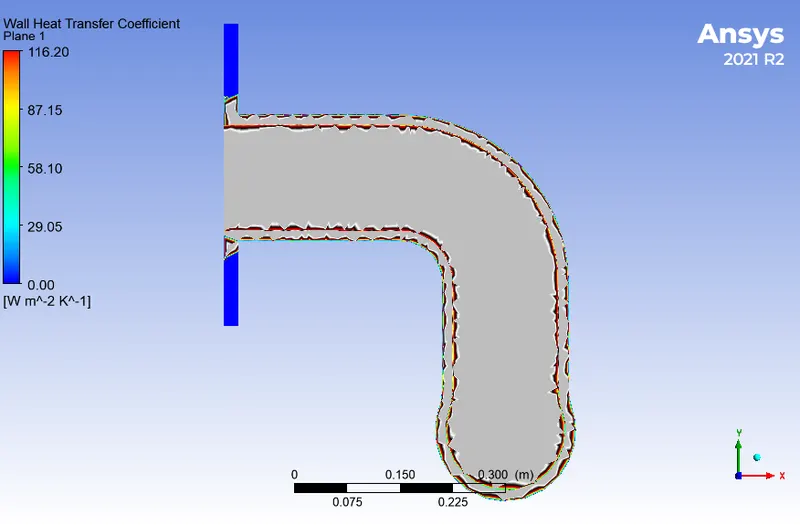
The wall heat transfer coeffcient which is here calculated numerically can also be validated by using the dimensional analysis since the flow is turbulent the relation is given by
`Nu =f(Re.Pr)`
where Nu is Nusselt number = `(h.l)/k`
where h = heat transfer coefficient.
Pr = prandtl number
Re is reynolds number .
By using this relation we can calculate the heat transfer coefficient and also validate it with the numerical results obtained.
Velocity contours:
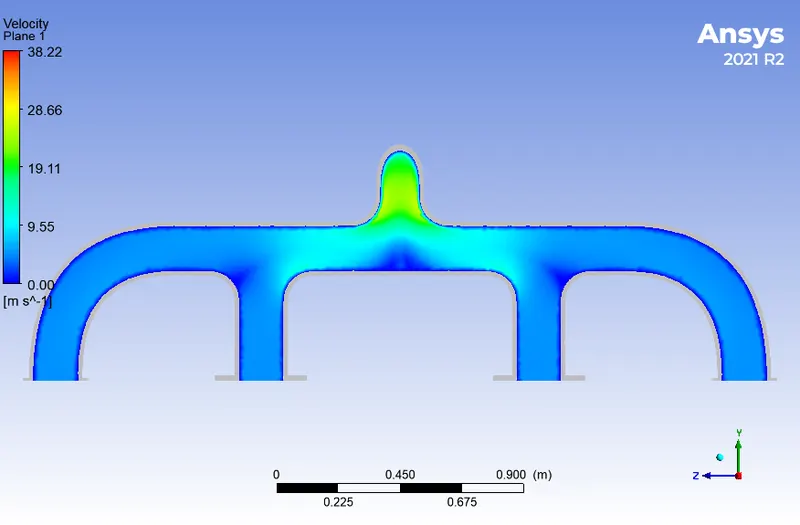
The velocity contours shows that the outlet has a higher velocity since it has to balance the mass flow rate of all four inlets (i.e from continuity equation)
Temperature contours:
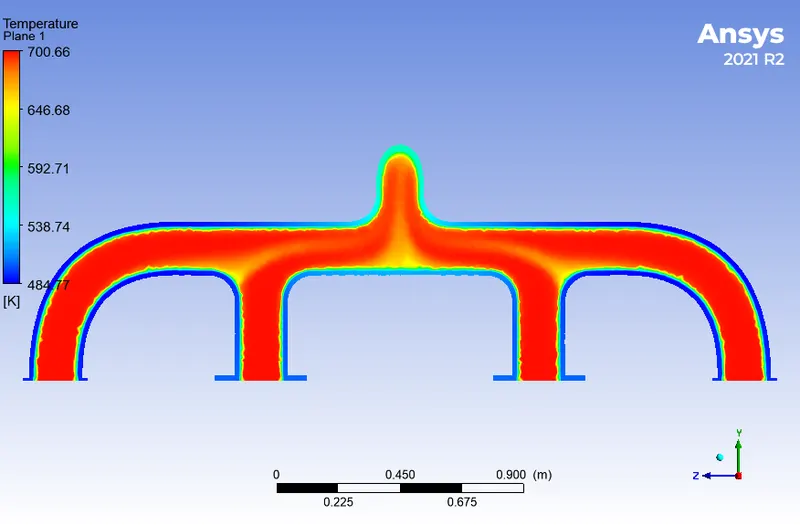
The temperature contour shows the variaion in temperatures and also the temperature variation across the walls, at the outer wall at the outlet we can observe a rise in temperature since we have applied a constant heat transfer coefficient of 20 W/m2-K.
Wall Y+
For an efficient simulation especially in the case of turbulence we need to know whether our turbulence is captured or not, that can be achieved by choosing right range of boundary elements to cpature the near wall activity. This can be achieved by choosing a proper Y+value .