WOT Condition
Aim:
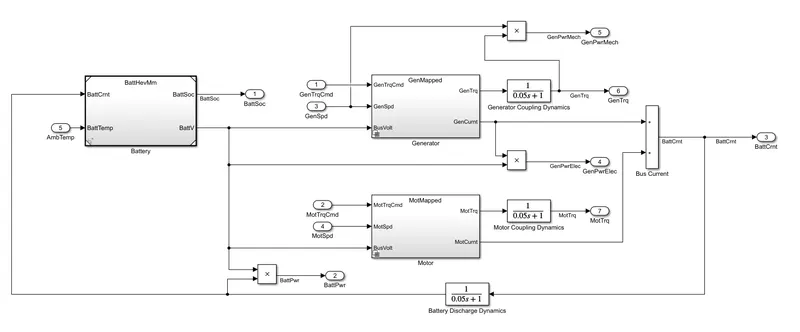
- What is the difference between the mapped and dynamic model of engine, motor and generator? How can you change the model type?
- How does the model calculate miles per gallon? Which factors are considered to model fuel flow?
- Run the HEV ReferenceApplication with WOT drive cycle. Change the grade and wind velocity in the environment block. Comment on the results.
- Keeping all other parameters same, compare the simulated results of hybrid and pure electric powertrains.
Objectives:
- To determine the difference between the mapped and the dynamic engine, motor and the generator model and to change the model based on the required type.
- To determine the factors considered and method used by the model to calculate miles per gallon of fuel consumed.
- To determine the results obtained from wot drive cycle while changing the grade and wind velocity.
- To compare the simulation results of hybrid and pure electric powertrains.
Question 1:
Mapped Model:
The mapped model data are taken from a set of predefined lookup tables where the engine behavioural characteristics are represented in the form of lookup tables. These features are mostly utilized in the analysis of the engine with predefined conditions without any dynamic changes in the model. As the data are mapped, the overall computation time is reduced thereby providing faster results. Mapped engines represent macro engine behaviour as a set of lookup tables (brake torque, fuel flow, air mass flow, exhaust temperature, efficiency, and emissions) as functions of commanded load and measured engine speed.
Dynamic Model:
The dynamic model can be used for detailed study of motor or generator or the engine performance based on component-level data. Dynamic engine models are suitable for designing control, estimator, and diagnostic algorithms that depend on dynamic subsystem states. Dynamic engine breaks the engine behaviour into a small individual component that impacts on the engine dynamics.
Changing The Model Type:
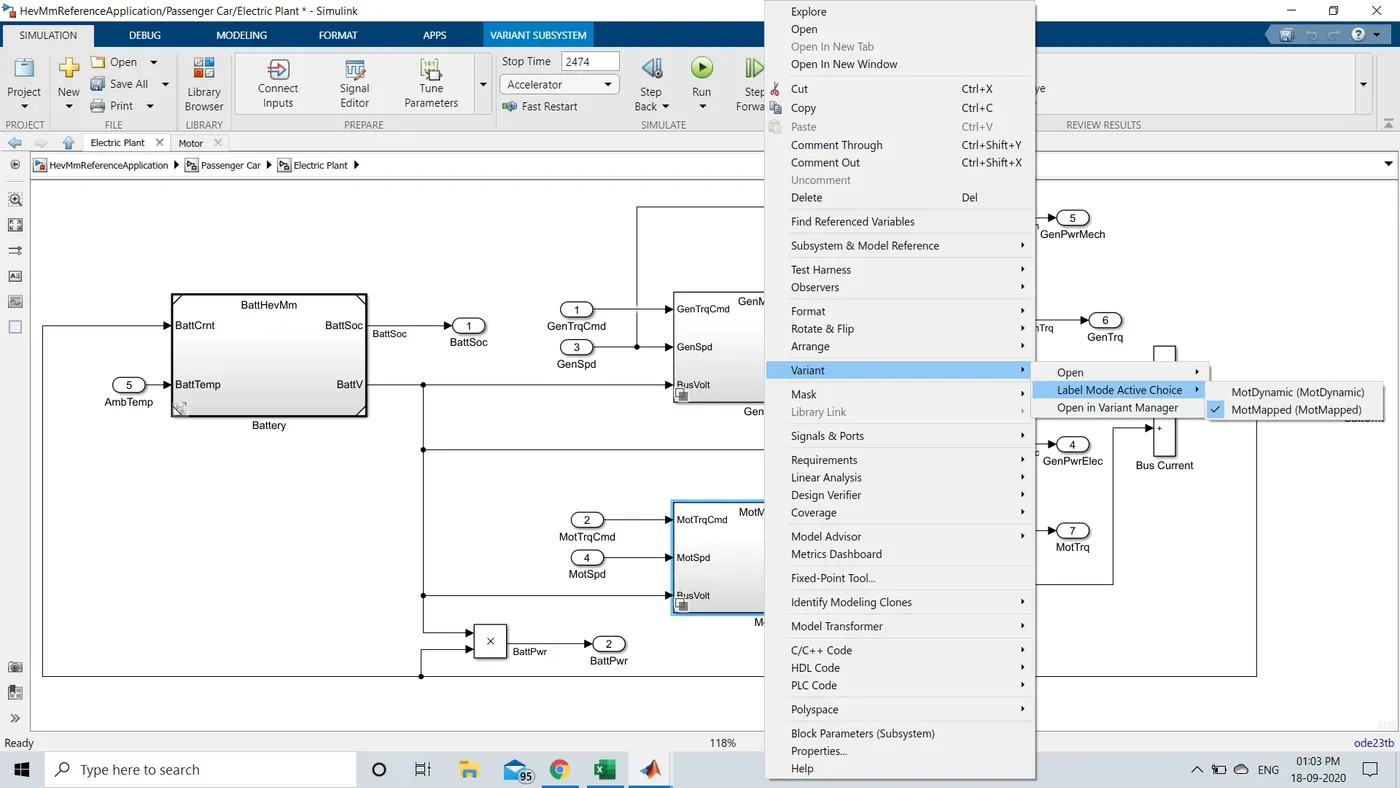
- Open the powertrain blockset for the required vehicle and go to passenger vehicle block and select the electric plant or engine plant.
- Next, Right-click on the Engine/Motor/Generator based on vehicle model, select the variant and select label model active choice and choose mapped or dynamic for the required calculation.
Question 2:
The fuel economy of an automobile relates distance travelled by a vehicle and the amount of fuel consumed. Consumption can be expressed in terms of volume of fuel to travel a distance, or the distance travelled per unit volume of fuel consumed. MPG (Miles Per Gallon) is a Fuel economy rating determined by how far a car can travel on a gallon of gasoline or diesel. Although the metric version would be kilometres per litre, MPG is adopted in many metric-system countries like Canada, UK.
The above image depicts the MPG to L/100 Km conversion chart with the blue one, the US gallon and the red, imperial standard. It represents the decrease in fuel consumption concerning increasing in miles per gallon and this relation between MPG and fuel per 100 Km is not linear.
Model for converting to Miles per Gallon:
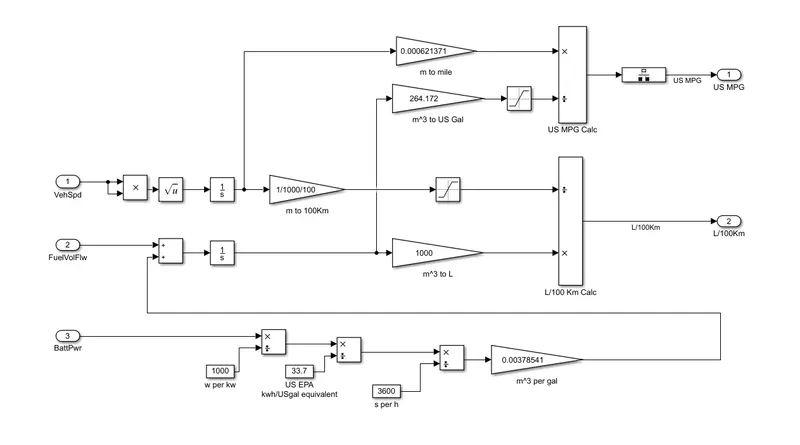
With the vehicle speed, fuel volume flow and the battery power as input parameters, the miles per gallon is determined. Conversions are made to US standards while the speed, the volume is converted to Km and m^3 and then the volume is converted to litres. The resultant data are converted to US MPG and L/100 Km value.
Factors affecting the fuel economy:
- Frequent short trips
- Heavy acceleration
- Heavy braking
- High vehicle load
- Lack of maintenance
Question 3:
The example used is an HEV multimode reference application. The HEV multimode reference application configuration and the energy transfer diagram is as follows:
- Mapped motor and generator
- 1.5L SI engine (dynamic)
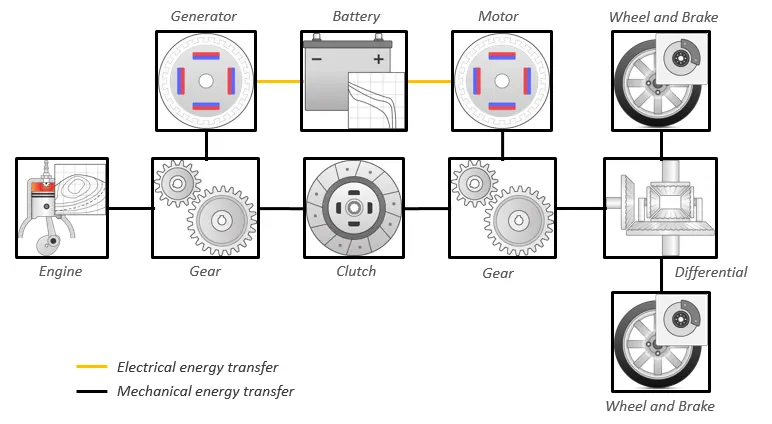
The above is an example of the series-parallel energy transfer model where the power can be delivered either from the IC engine or from the battery or both based on the torque requirements and the efficiency. The battery can be charged by the working of IC engine by converting the mechanical energy to electrical energy with the help of the generator.
The model is as follows:
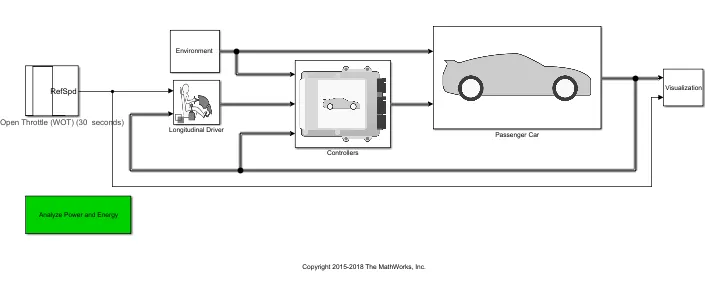
The environment block holds the data including the temperature, pressure, gradability and the wind flow. Driver block holds the acceleration based on the drive cycle provided in the drive cycle block. Controller block provides the control functions for both SI and battery modules based on the provided inputs. Passenger block is where the entire computations are performed and the results are provided to the vehicle plant including the engine feedback for recalculating. The entire calculation is done multiple times till the cycle is completed. The results are provided to the visualization block where the performance and emission curves are plotted.
Here the drive cycle is changed to wide-open throttle for 30 seconds and the conditions are;
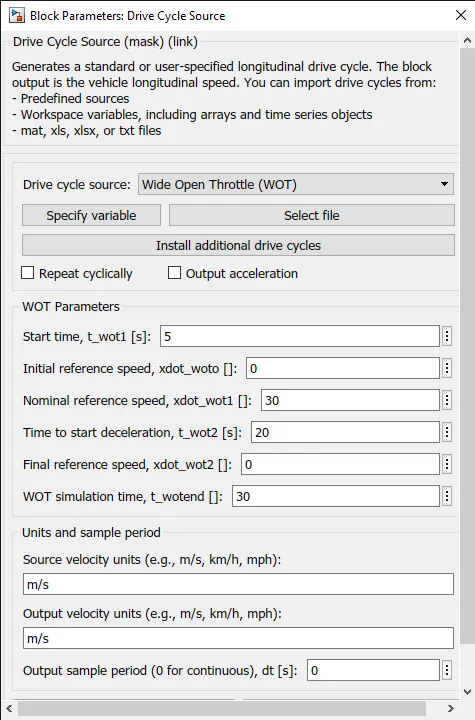
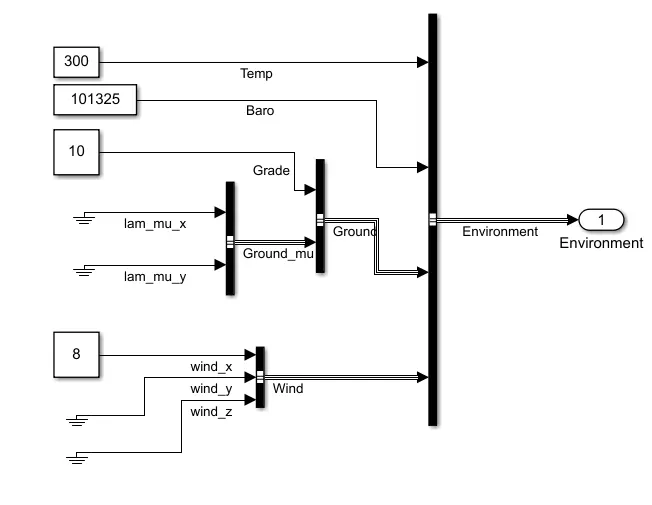
The program is run without any changes and for the second time the wind velocity at x-axis and the gradability is changed and the model is run again. The grade value is assumed to be 10 and the wind velocity w.r.t x-axis is to 8 (positive direction).
The model is run with both the configurations and the results are obtained.
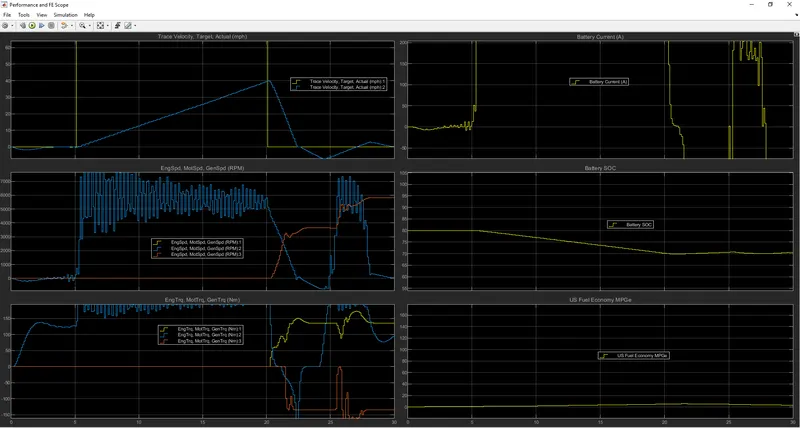
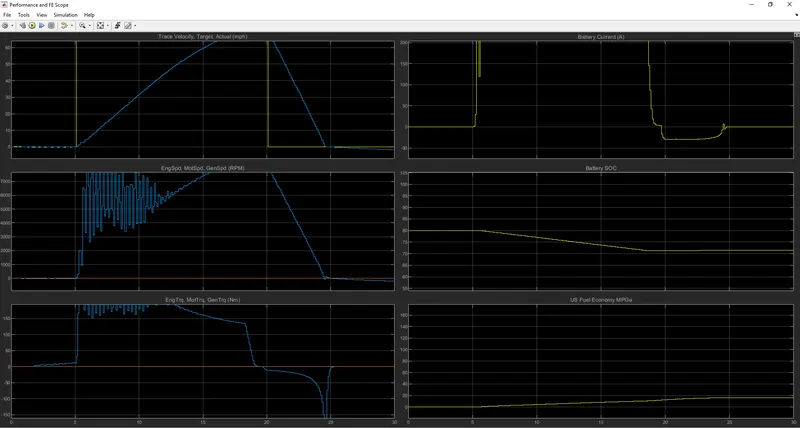
Graph without wind speed and grade values:
Graph with wind velocity and grade values:
Emission Graphs:
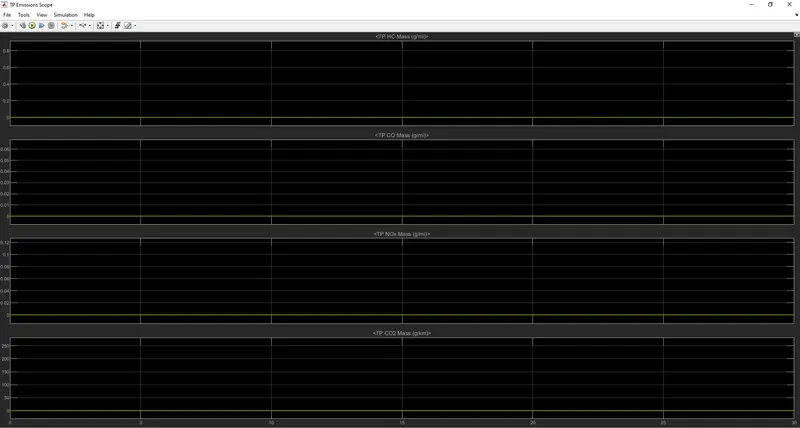
Graph without wind velocity and grade values:
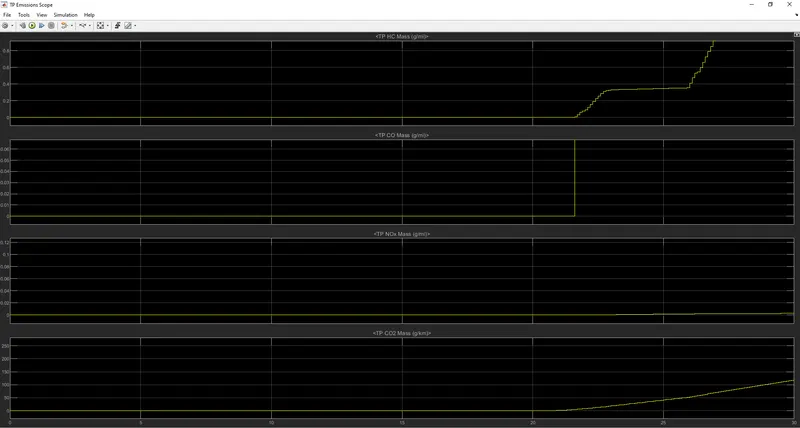
Graph with wind velocity and grade values:
Inference from the performance and emission curves:
- As the torque requirement for the case without wind velocity and grade value is low, it is provided from the battery. after a particular period of time, the motor/generator speed is in negative that provides the battery is getting charge in the first case. Thereby we could find an increase in the SOC of the battery source. Also we could find that battery was the only power source based on the emission curves as there are no emissions in first case.
- In the second case, the one with wind velocity and grade value, the torque requirement is higher than that the battery could provide. So till a particular point of time, the battery is used as the driving power and later the IC engine was used. The motor speed graph and the emission graphs provides the usage of IC engine and charging of battery.
- From the SOC graph the charge levels are between 70-80%.
Question 4:
Conditions:
The wind velocity and the grade values are kept constant for both the cases. the model used for HEV is HEV multimode reference application and for EV is the EV reference application. Other parameters are kept constant. WOT drive cyc le is used for the performing the comparing the performance curves. In the case of EV, there are no emission graphs. 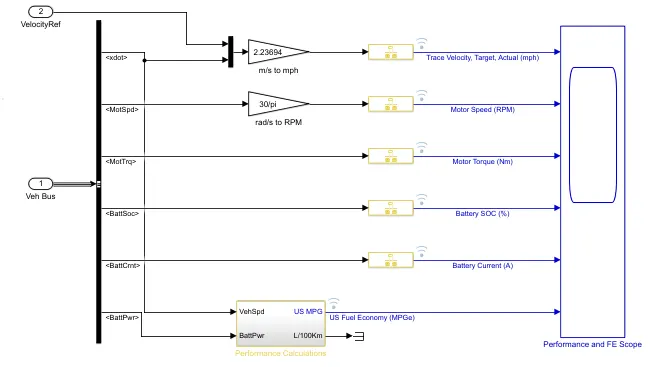
EV configuration:
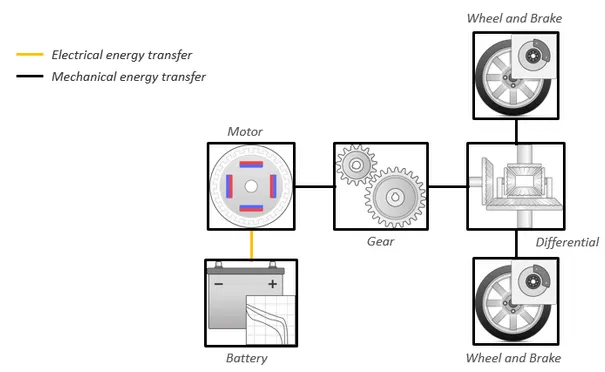
In EV, the power is provided from the battery source with the help of controllers, the required power is provided to run the motor which transmits the power to the drivetrain.
WOT configuration:
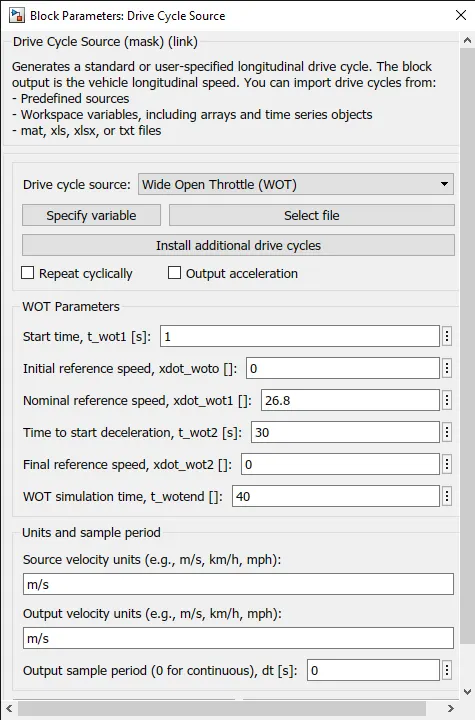
Simulation results:
HEV:
EV:
Inference from the simulated results:
It can be clearly seen that based on the torque and SOC requirements, the HEV uses both iC engine and the battery source to run the vehicle. In the case of EV, Motor torques were varying all over the period of time to run the vehicle. In the case of HEV, there is slight but gradual increase in the SOC when the IC engine was running and for the case of EV, charging occurs when the generator is running with negative RPM at a particular period of time.
Bibliograpgy:
Hybrid electric vehicle - Wikipedia
Help and Documentation - MATLAB & Simulink - MathWorks India
Powertrain Reference Applications - MATLAB & Simulink - MathWorks India