Week-4 Challenge WOT Condition Part-2
Question 1 :
What is the difference between mapped and dynamic model of engine, motor and generator? How can you change model type?
Question 1 Solution :
The prime difference between mapped & dynamic model of the Motor, Generator or any other machine is that , the mapped model of any machine is built on the base of no. of data gathered by running it/performing experiments on it. In this mapped model the data is used as a reference to set different thresholds,
characteristics equations and achieve optimum performance of machine.
This control strategy has some limitations as follow
1) The model is restricted to act because of limited data input has used to built the model.
2) The output will be not as accurated that we got like in Dynamic model.
3) The system response is fast in nature compared to dynamic model because of limitaded data, equations, conditions executions.
4) It has sample rate of 1 second or above it ,Contray to mapped model.
Dynamic model has continuous full control over the system even in exponential different behaviour of inputs.It uses power-electronics blocks to perform system essentials.Also the sample rate for the system is less than one due to which it takes more amount of time compared to mapped model.As per its precise & more detailed output, analysis of more complex system one has to use dynamic model to get clear behaviour of the system.
How to change Model type from mapped model to dynamic model ?
If you open up the EV reference model, Than in the Electric plant you can see the motor is by default would be mapped model as shown below...
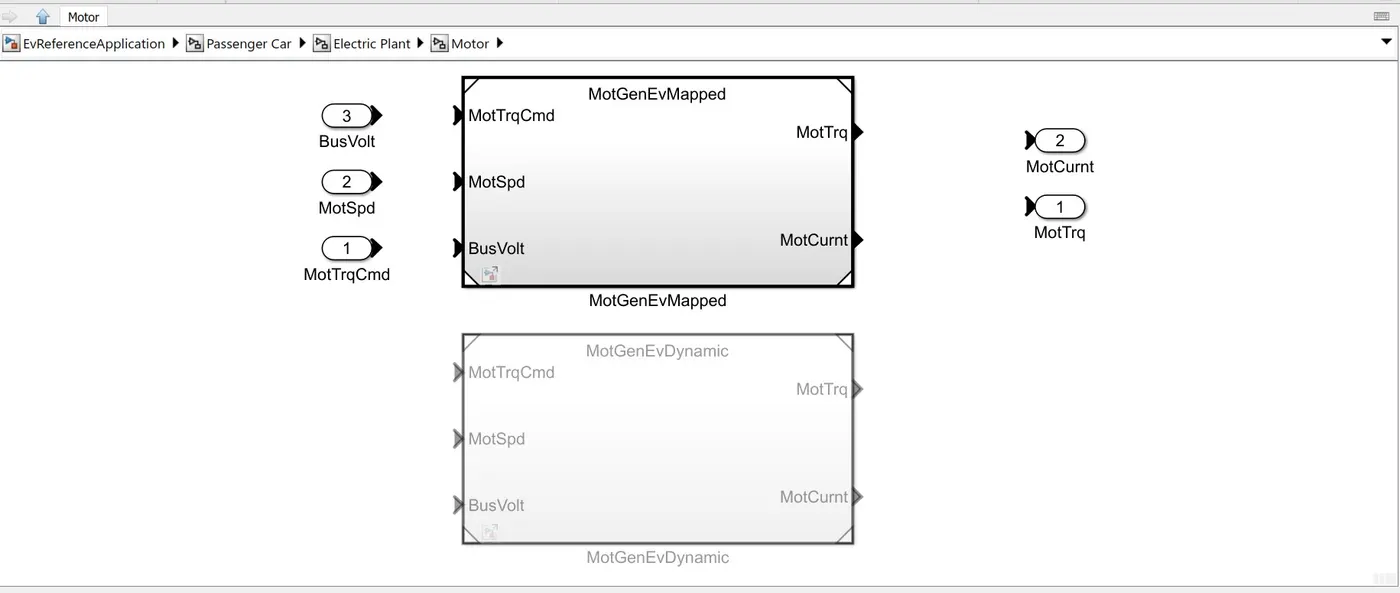
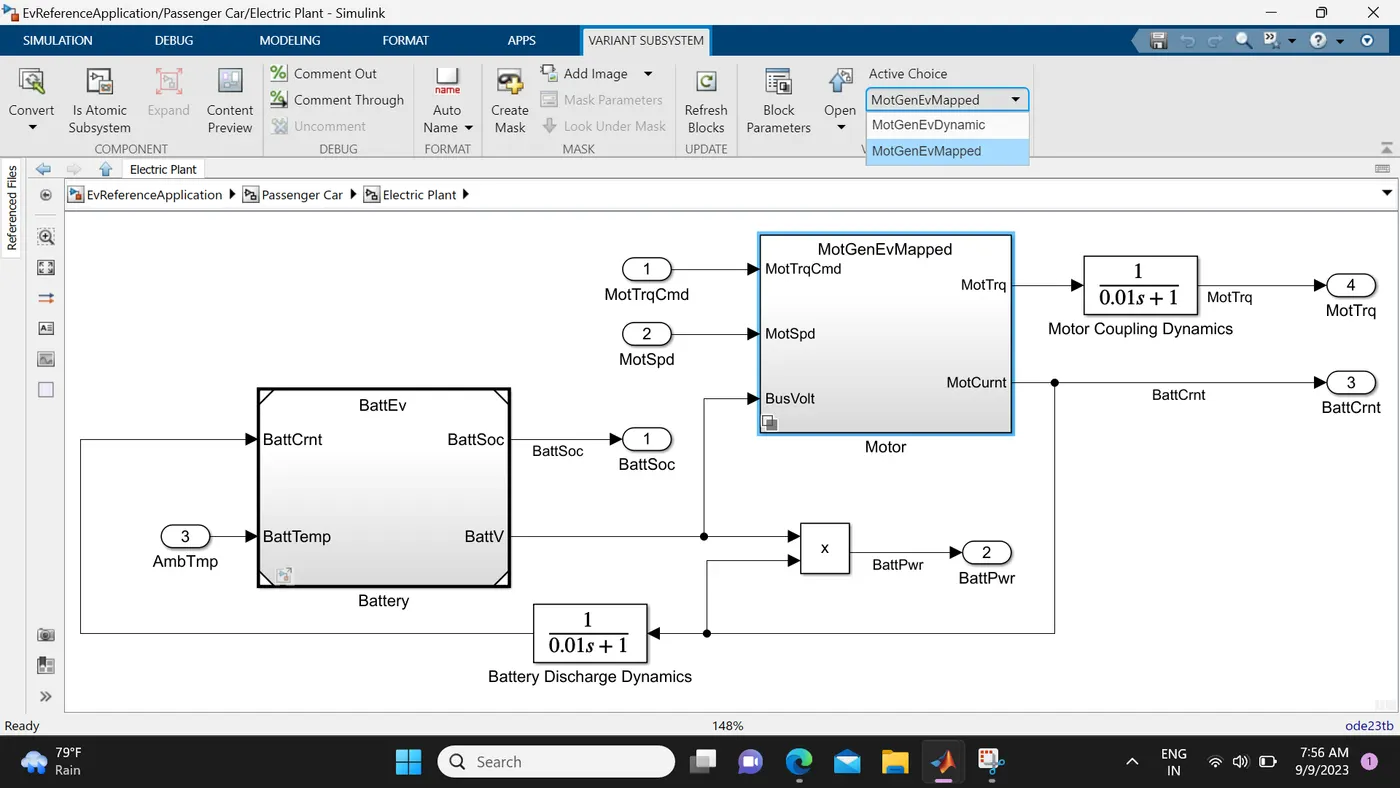
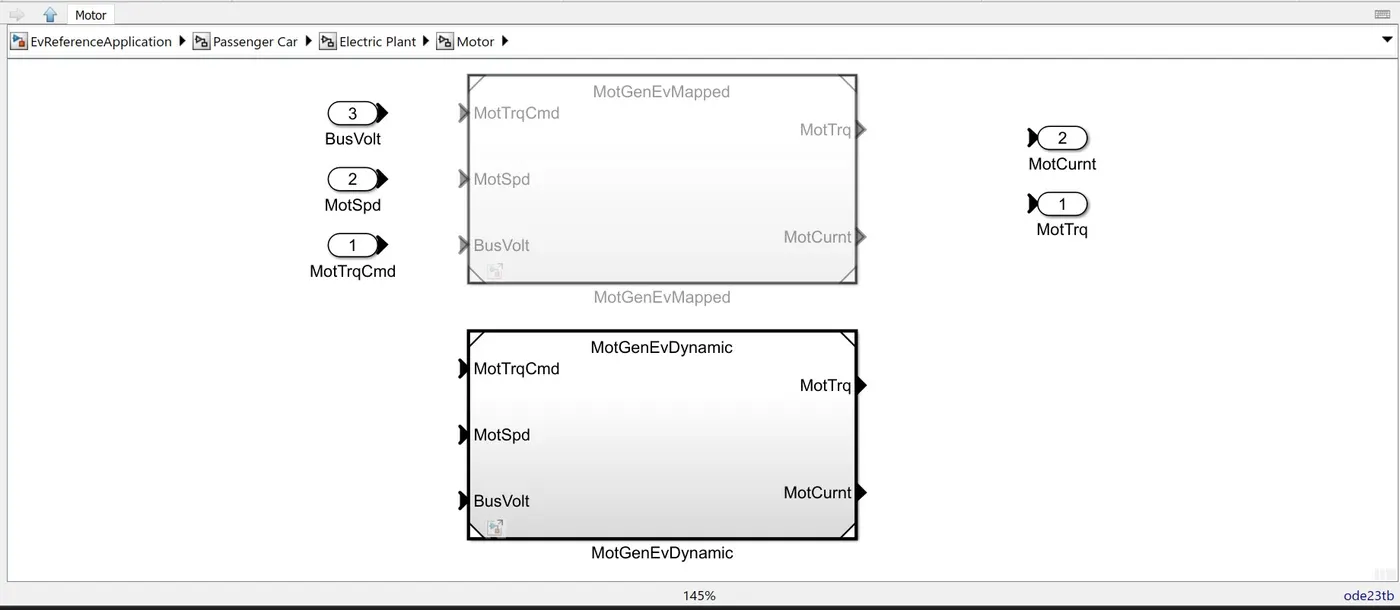
To make it dynamic Open the EV Referance Application > Passenger Car > Electric Plant > In Varient System , Choose (MotGenEvDynamic) and your model will be switched to Dynamic model.
Question 2 :
How does the model calculate miles per gallon? Which factors are considered to model fuel flow?
Question 2 Solution :
As we know in the US,the standard unit for fuel economy of the vehicle as a miles/gallons. It is a standard unit which is very essential to estimate the vehicle fuel economy.In our country sometimes it referred as an Average kilometers travelled by the vehicle per litre of the fuel.So with respect to economy point of view higher the MPG (miles/gallon) more economically beneficiary to the vehicle owner.
Our Application model is pure EV here, So the vehicle does not use any kind of fuel to generate the propulsive torques of the vehicle. Gasoline gallon equivalent (GGE) or gasoline-equivalent gallon (GEG) is the amount of an alternative fuel it takes to equal the energy content of one liquid gallon of gasoline.In the table shown below the Gasoline galon equivalent (GGE) is represented for the different kind of fuel that are used in the vehicle.
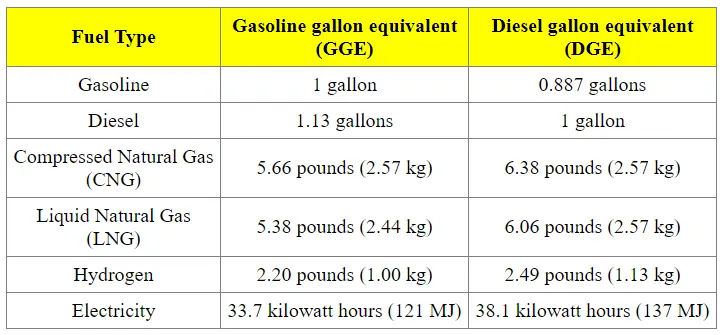
From the table we can see that 33.7 KWh ( Electrical energy ) would be equivalent to the energy of the one gallon gasoline. So in the vehicle model the factor of the 33.7 has been used to calculate the MPG of the vehicle.
In perticular visualization block we can see the performance calculation block, Inside it the battery's electric power is first converted into KWh unit & than after it is divided by 33.7 as per (GGE) conversion & than finally it is divided again by 3600 to convert it into hours.
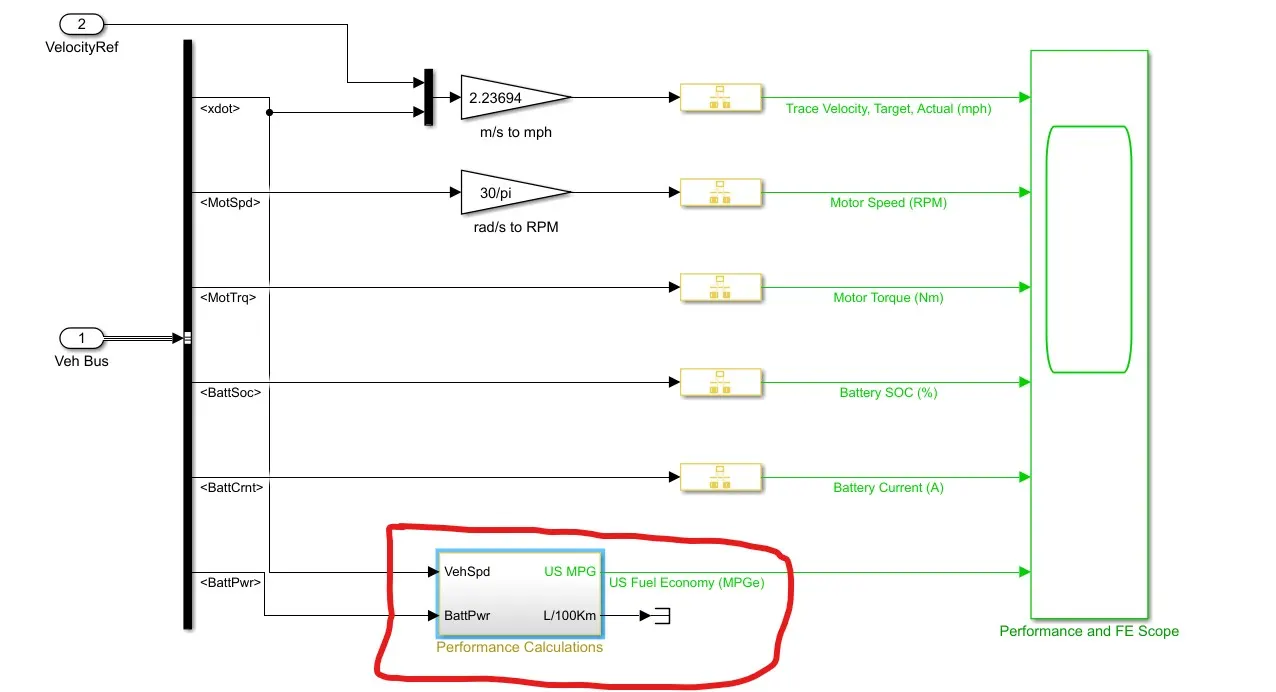
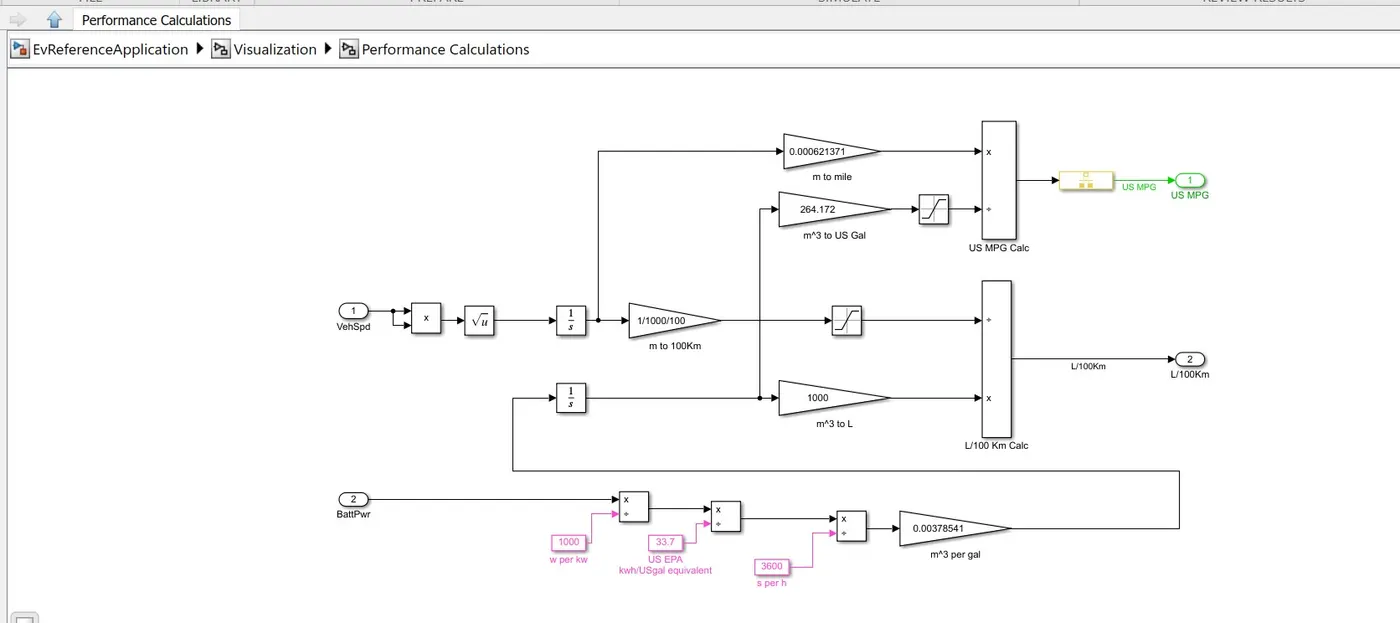

For the fuel flow calculation vehicle speed , Battery output power has been used in this perticular model.
Question 3 :
Run the HEV ReferenceApplication with WOT drive cycle. Change the grade and wind velocity in the environment block. Comment on the results.
Question 3 Solution :
For the HEV Reference application I wnt to MATLAB official website & downloaded the code for the same.
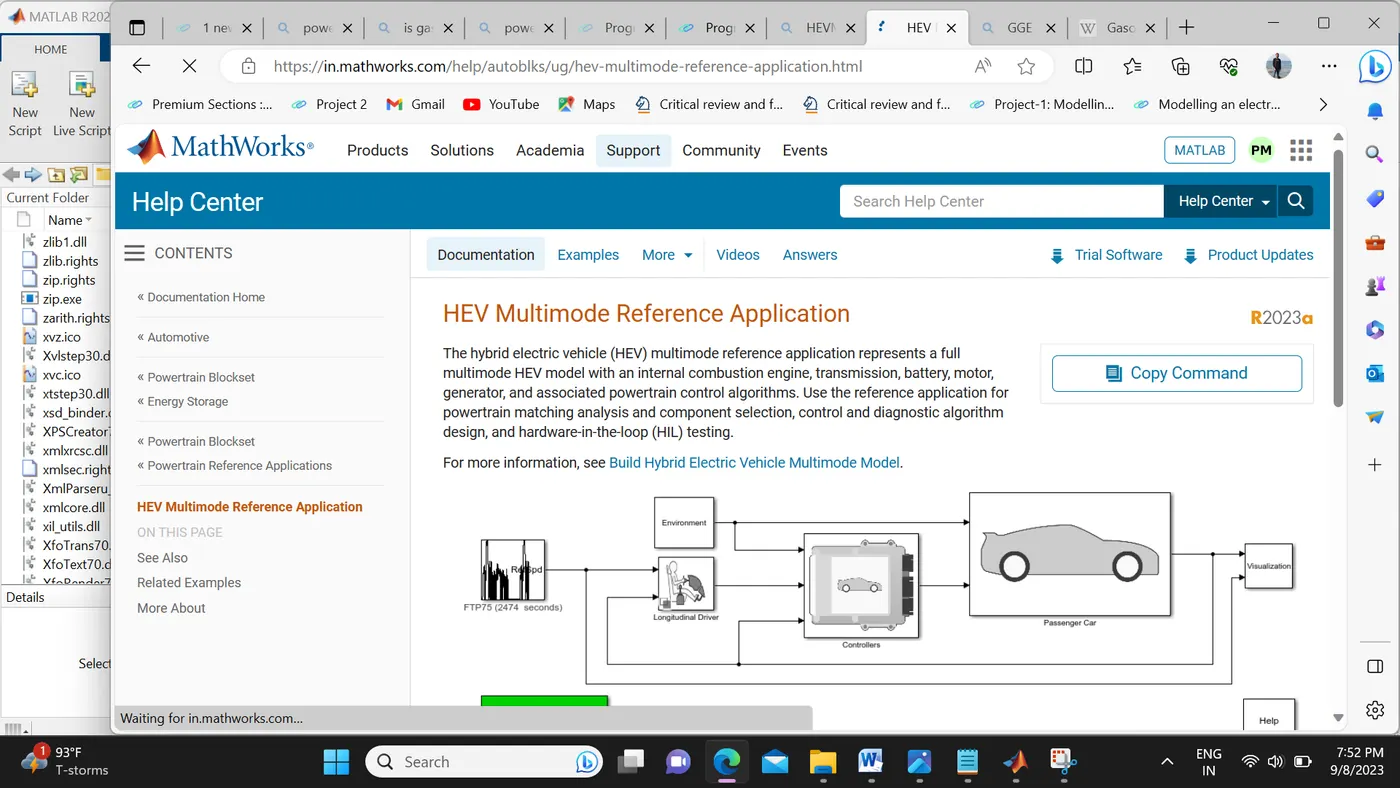
I I changed the Grade from 0 to 10. & windage force from 0 to 5 as a constant. The resut for the normal & updated values has shown below...
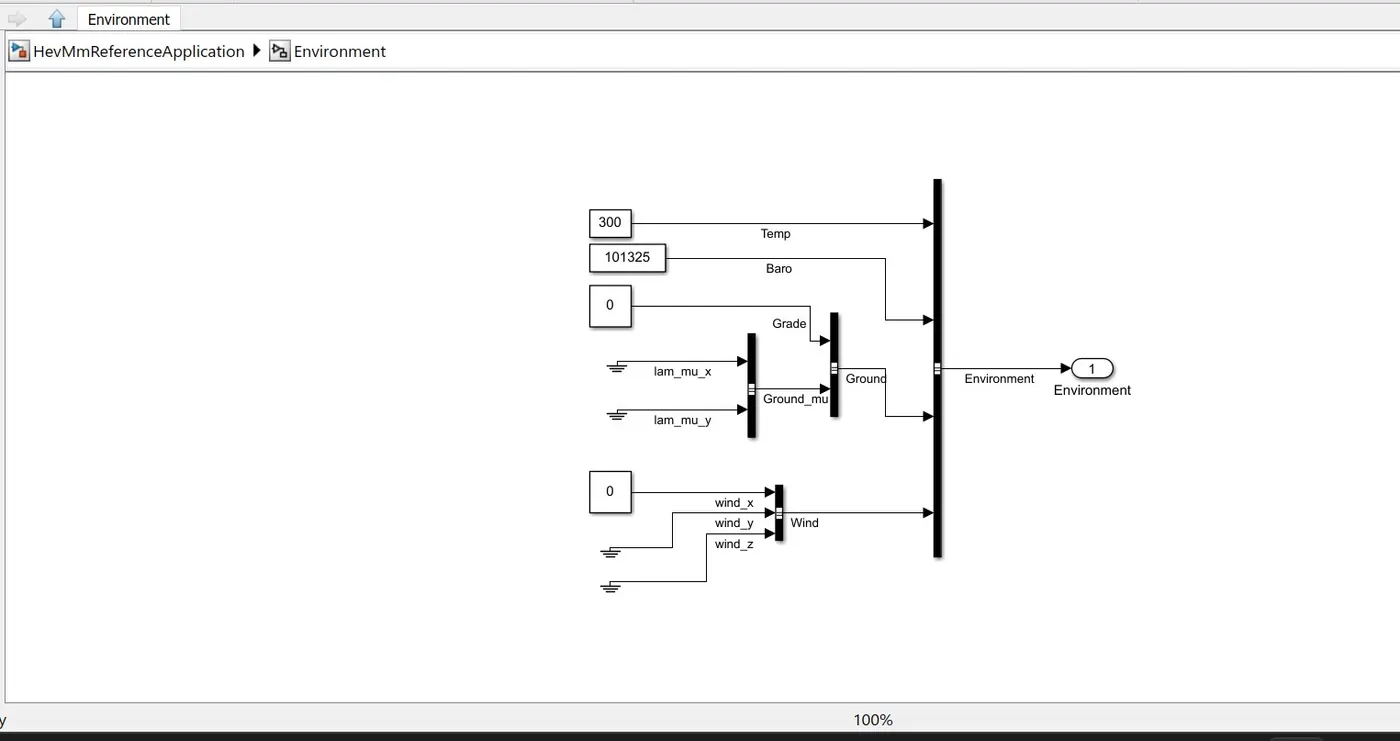
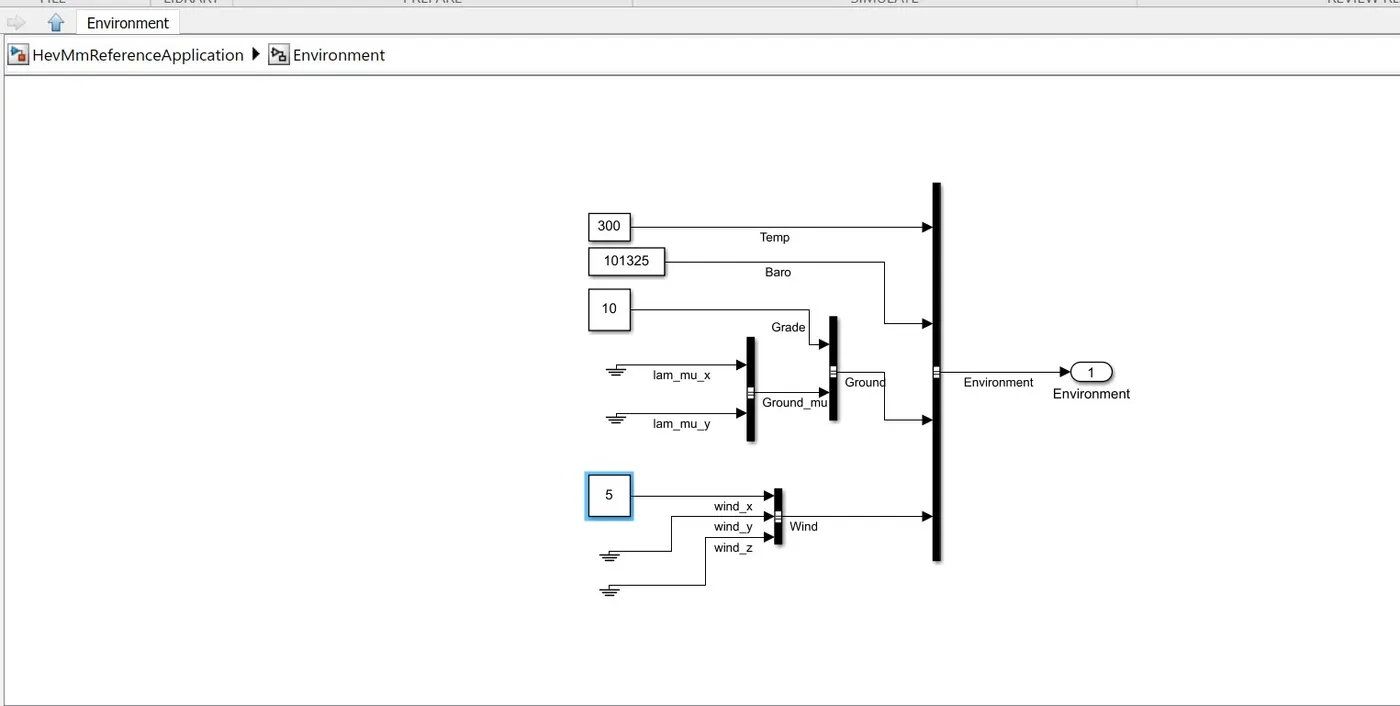
The output for both the initial & changed vlues are shown below too.
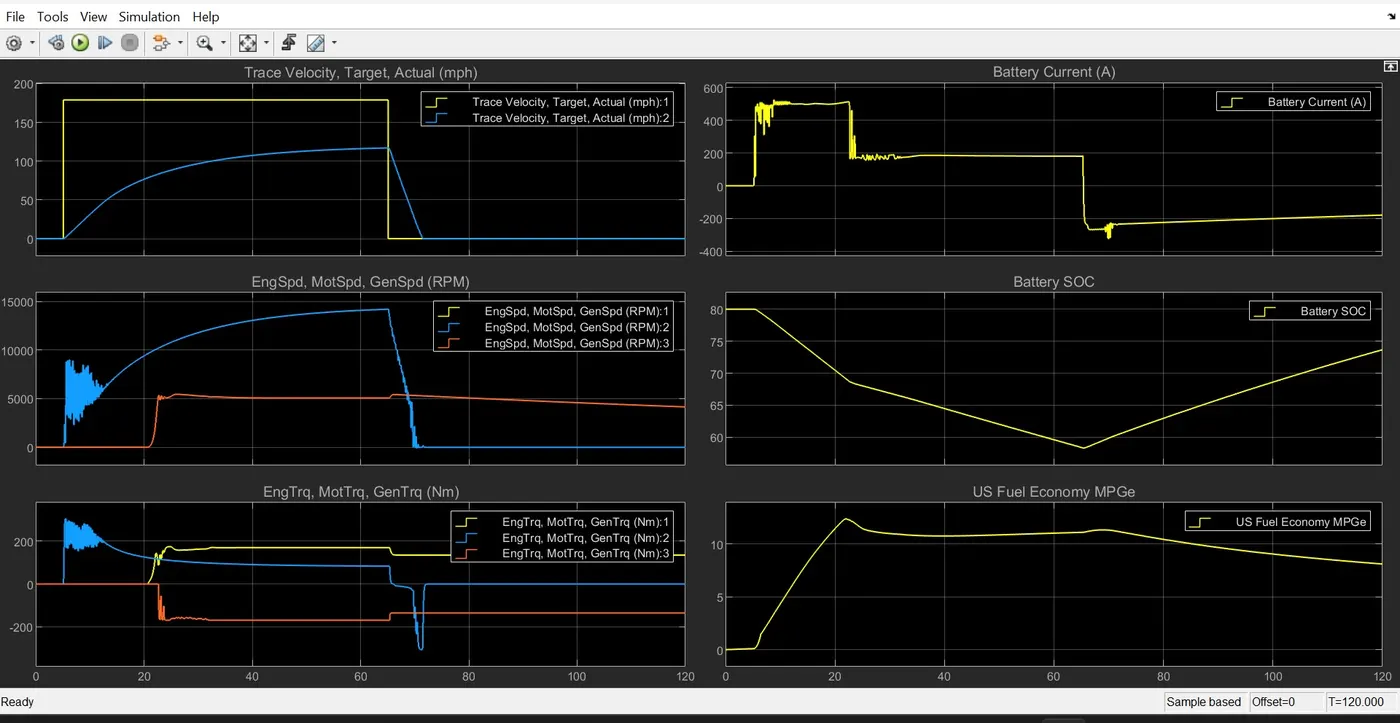
( Output for the 0 Grade & 0 Wind Force as a constant )
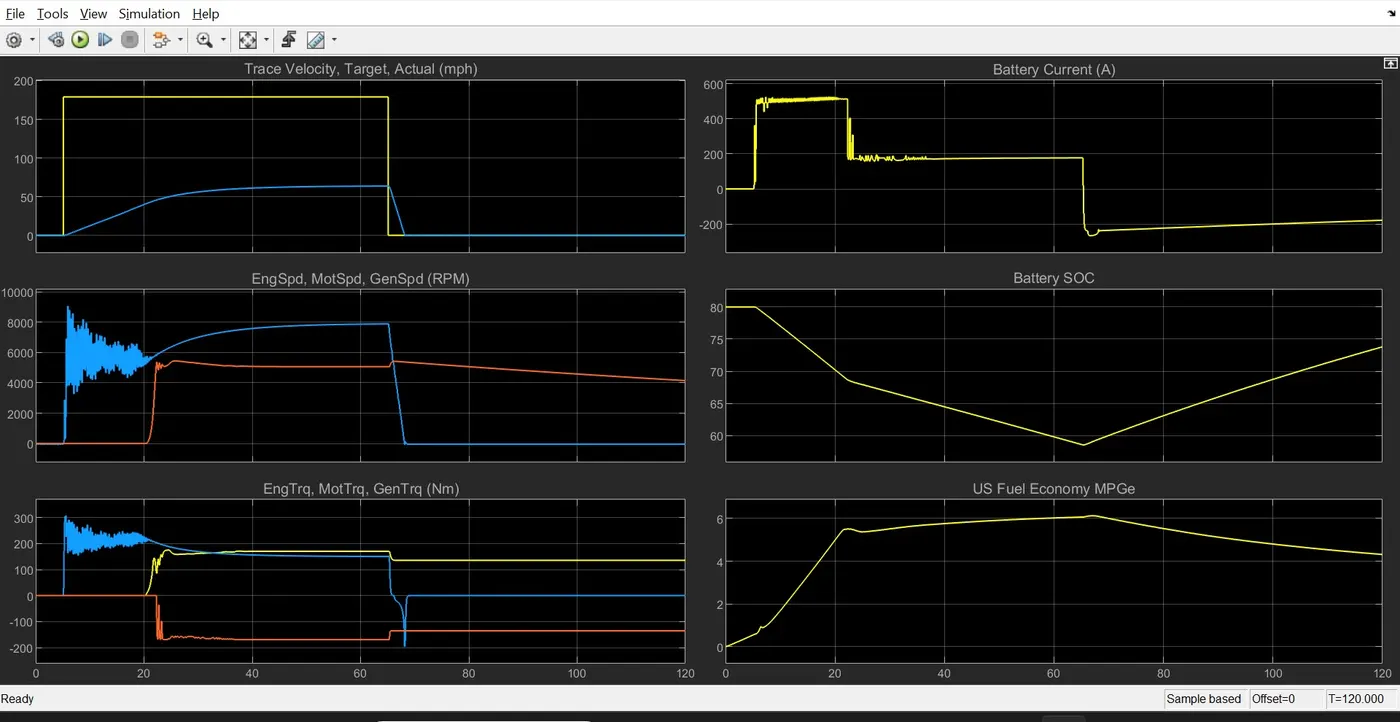
( Output for the Garde 10 & Windage force to be 5 as a constant )
Result : From the results of the simulation attatched above we can see that as we increase the grade & windage force applied to the environment, the Force required to overcome & propell the vehicle forward increases & as result the velocity reduces significantly. Also the if we compare last graphs of both results than we can see that MPG ( Miles per gallon ) will be reduces too. The second plot which depicts the vehicle motor , generator & engine speed also reduced because of the increase in the total load in the system
Question 4 :
Keeping all other parameters same, compare the simulated results of hybrid and pure electric powertrains.
Question 4 Solution :
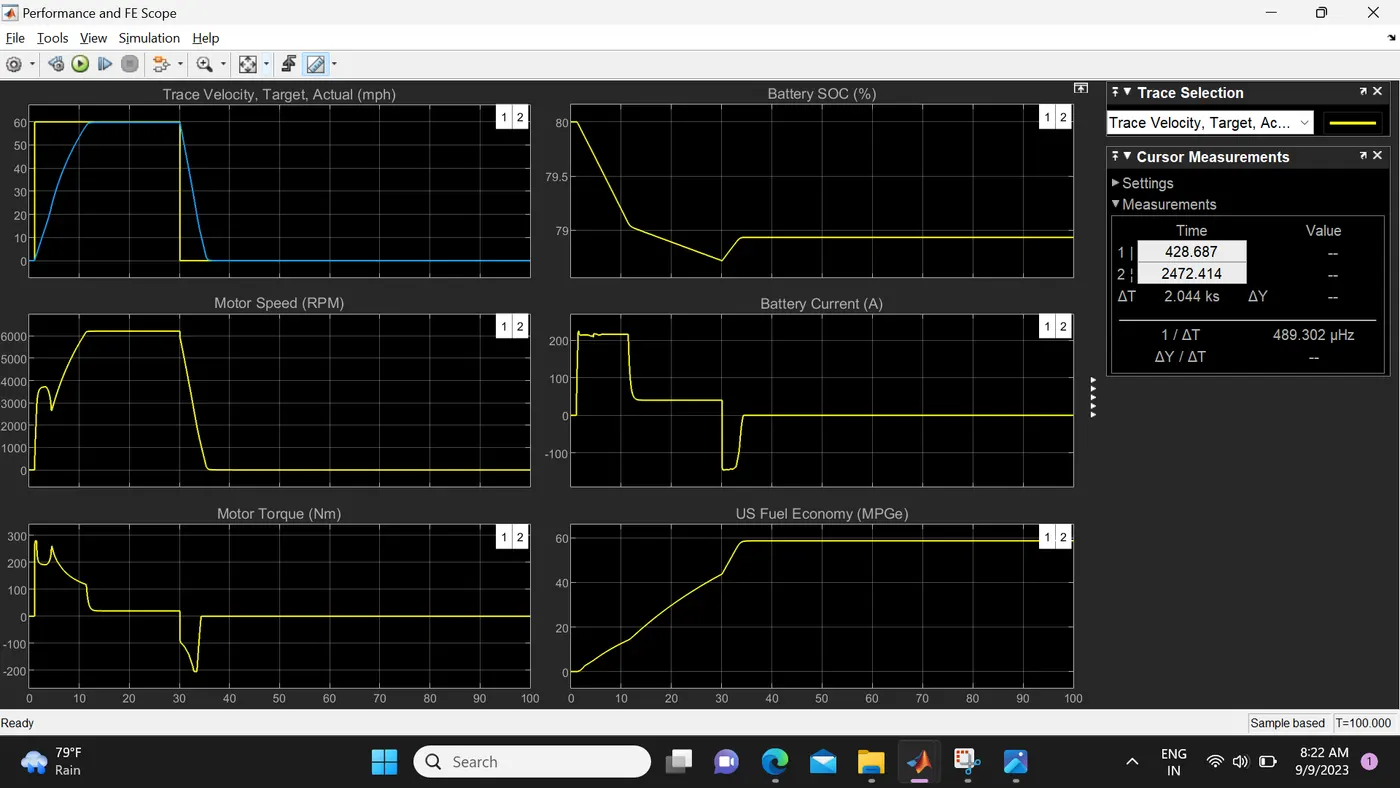
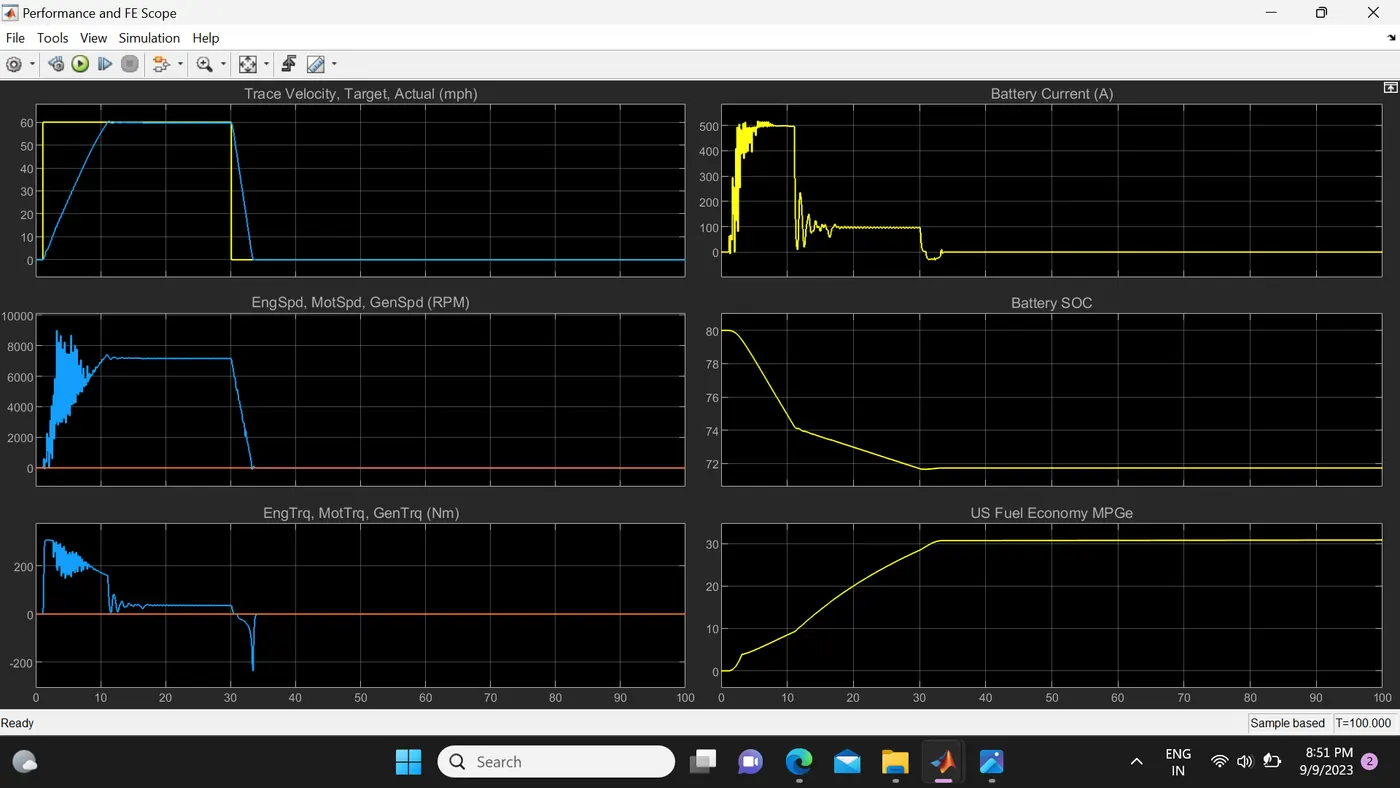
I copied the EV referance application & HEV Multimode referance application & run the simulation for the wide open throttle (WOT) drive cycle with same acceleration & decelaration timing the results for both are shown in below...
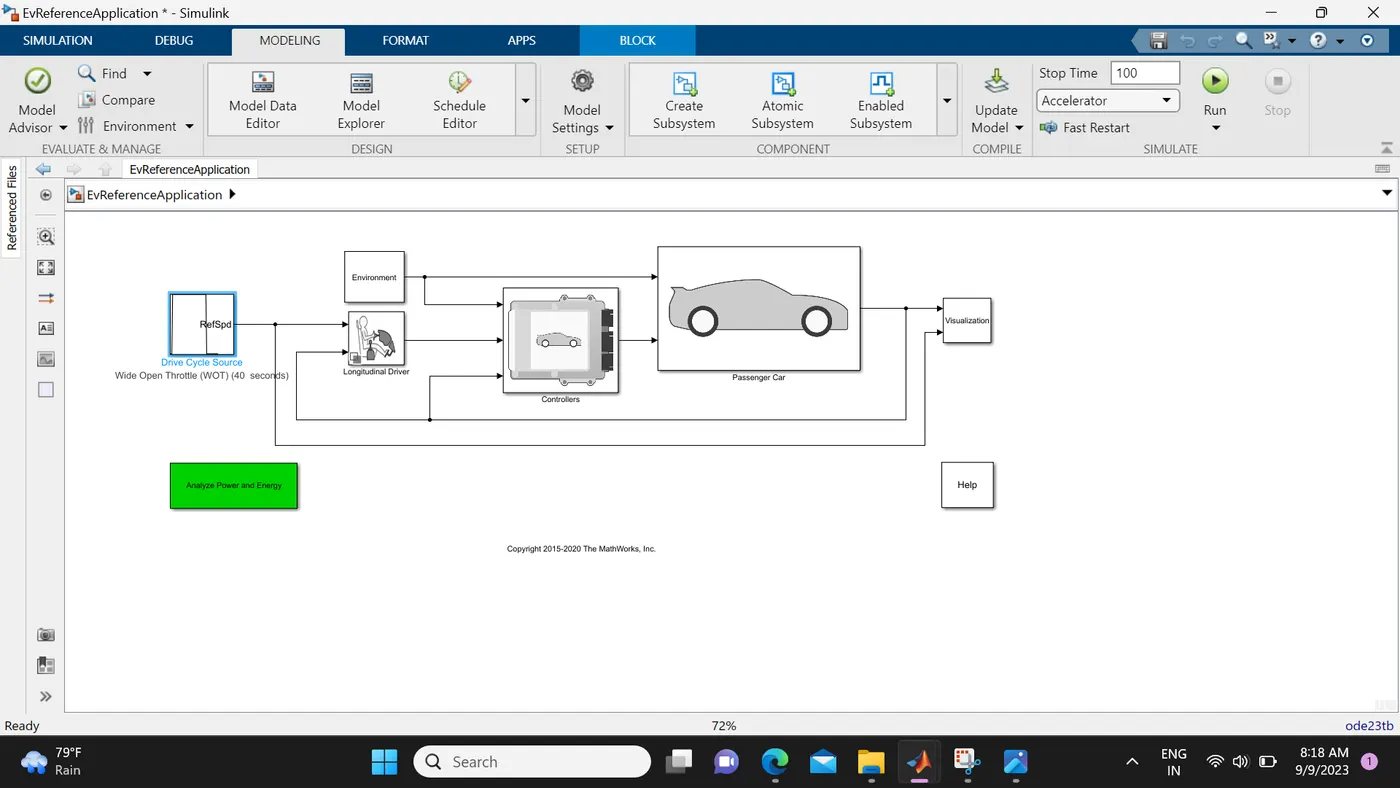
The Input WOT parameter for both of the referance model is shown below..
Results for EV is shown as below:
Result plor for the HEV is shown below :
Comparasion of the result plots :
1) In the HEV referance application model the fuel economy is comparatively less because of two fuel source.
2)Velocity & Acceleration of the vehicle is almost same for both of the model.
3) Motor speed rpm is high due to compound fuel combination.
4) The battery current for the electric vehicle is somw what more smooth in nature compare to HEV. This is because the HEV is sort of balancing between fuel & battery.