Project - Speed Control of a Direct Current (DC) motor
Explanation :
The objective of the project is to make mathematical model of separately excited DC Motor & design the closed loop design with Proportional,Deriivative & Integral gains with speed control of motor.
The Mathematical model is the main key to unlock the simulink design & parameter equations for the closed loop system. Thus here some basic steps to get state control equations & entities for speed control
of the motor has derived.
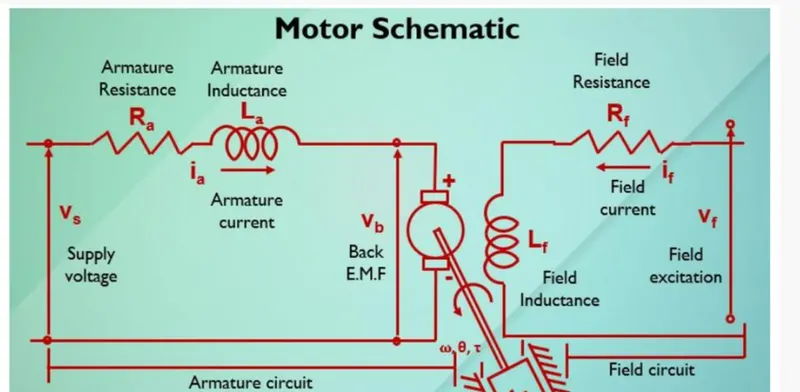
Here,
Ra= Armature reisistance
La= Armature Inductance
V(a)= Armature Voltage
E(b)= Back Emf Voltage
dia/dt= change in field circuit current
V(s)= R(ia)+ La(dia/dt) +E(b) ...............(1)
Above equations is for the armature circuit.
For the field Circuit,
V(f)= Field Voltage
Rf= Field Resistance
if= field current
Lf= Field Inductance
dif/dt= change in field circuit current
V(f)= Rf(if)+Lf(dif/dt)......................(2)
we are assuming here constant field so (if)=field current will be also constant so the speed control will be depending upon the Armature voltages because of following relations
as Ia= V(s)-E(b)/[Ra+s*La] thus if V(s) increases Ia(Armature current) increases and relation between Ia and Torque is T=Ia*w where (w)= speed of the motor.
So if for the constant torque if (ia) increases the speed(w) will decreases. Thus we can say that speed will depend on Armature current and Armature current is dependend on the
Armature voltages.
So further simplifying the equation (1),
La(dia/dt)= -E(b)- Ra(ia) + V(a)
(dia/dt)= -(kb/La)*w -Ra/La + V(a)/La........(3) as E(b)=Kb*w where Kb is back emf constant, W = speed of the system
Now for the mechanical system
J = MOment of Inertia
B = Damping Constant
Alpha = Angular acceleration
w = Angular velocity
theta = Angular displacement
T(L) = Load torque
T = Total torque
T = J*Alpha + B*w + T(L)
J*Alpha = T - B*w ...................... Assuming the zero load torque
J*w_dot = T - B*w Alpha = Derivative of Angular velocity (w)
w_dot = (Kt/J)*Ia - (B/J)*w .......................(4)
we will build state space equations based on equation (3) and (4)
[w ia] = [-B/J Kt/J ; -Kb/La -Ra/La] [w ia] + [0 1/La]*v(a) ........(5)
y = [1 0][w ia] + [0]*V(a) ........(6)
The simulink model is shown below,
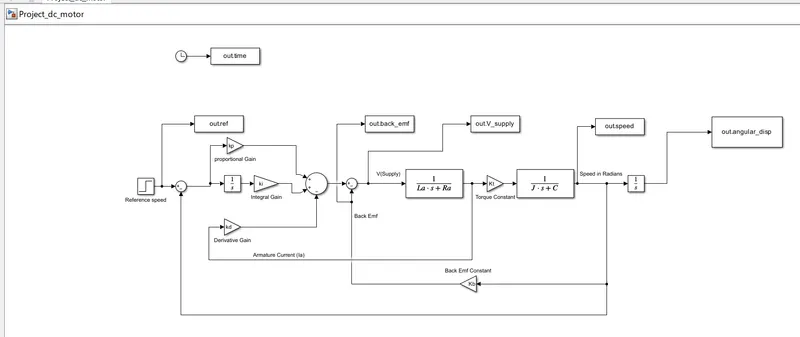
choosing the constant values as per following,
Ra = 1.0 ohms
La = 0.5 Henry
J = 0.05 kg*m^2
B = 0.1 N*M*sec
kb = 0.01 Back emf Constant in volts
kt = 0.01 Torque constant in N*M/Amp
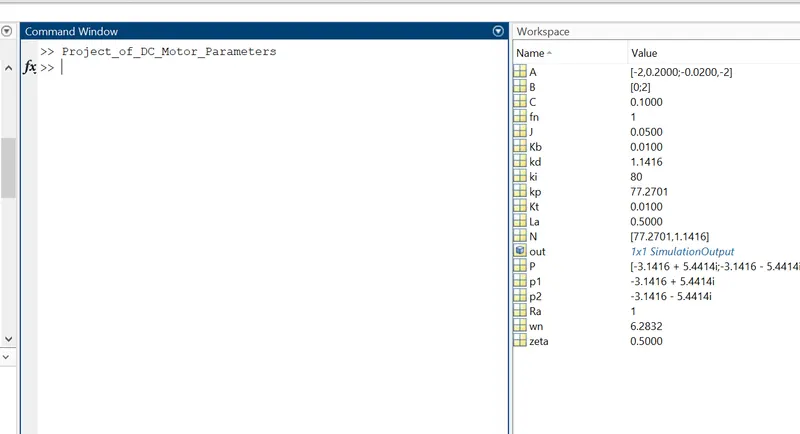
now designing the closed loop control model of DC motor based on above information, also the pole placement design paarameters are described in the script itself.
The plots for different Reference Speed,Zeta and Integration Gain Ki is shown below..
For zeta= 0.5 , Ki= -50 , Reference speed = 50 rad/sec
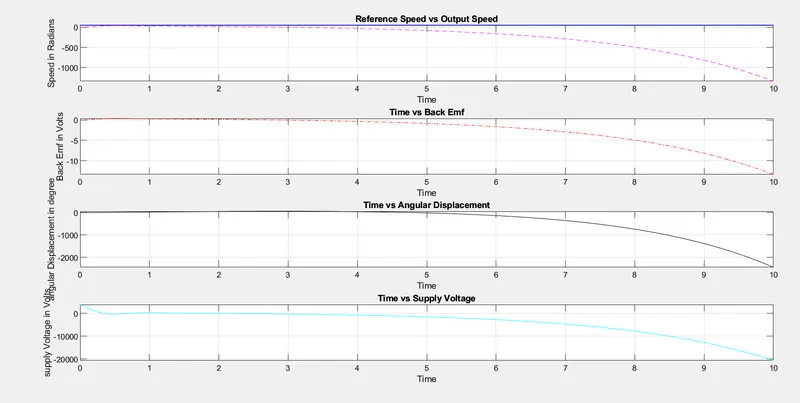
For zeta= 0.5 , Ki= -5 , Reference speed = 50 rad/sec
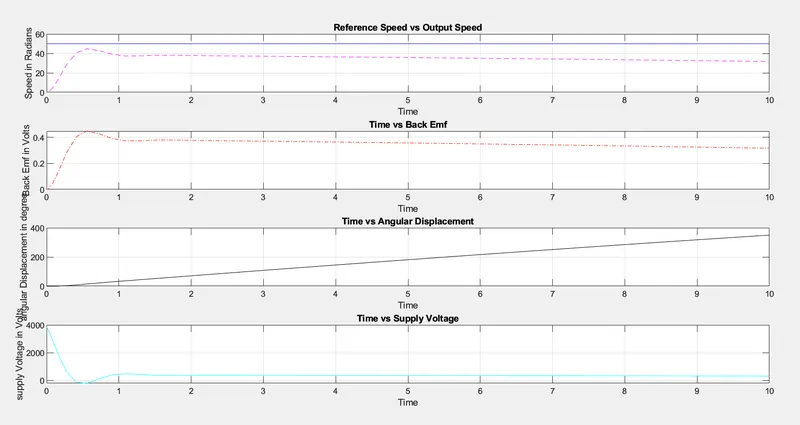
zeta= 0.5 , Ki= -0.5 , Reference speed = 50 rad/sec
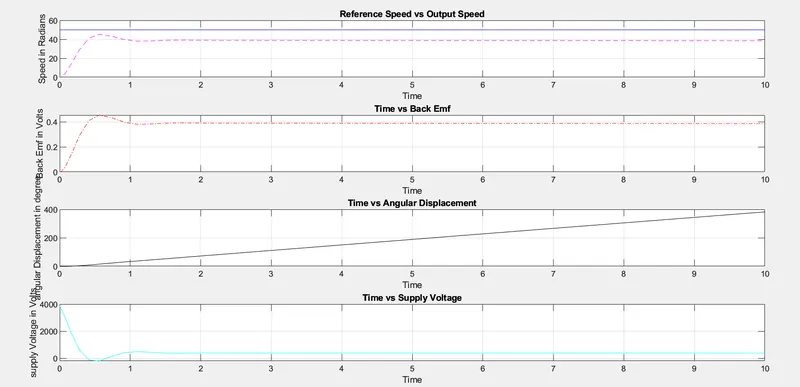
zeta= 0.5 , Ki= 50 , Reference speed = 50 rad/sec
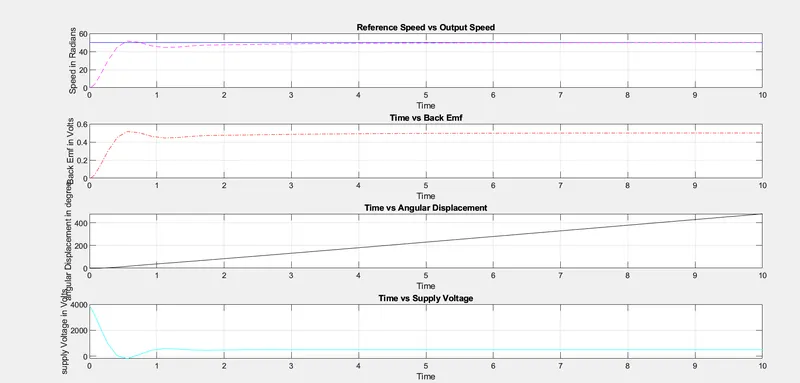
zeta= 0.5 , Ki= 80 , Reference speed = 50 rad/sec
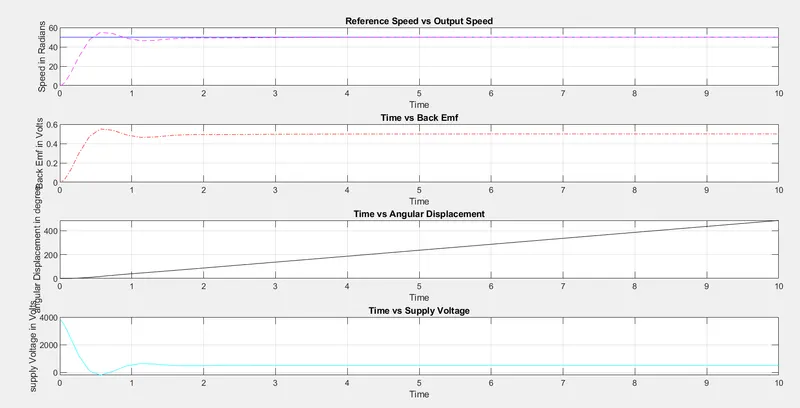
zeta= 0.5 , Ki= 100 , Reference speed = 50 rad/sec
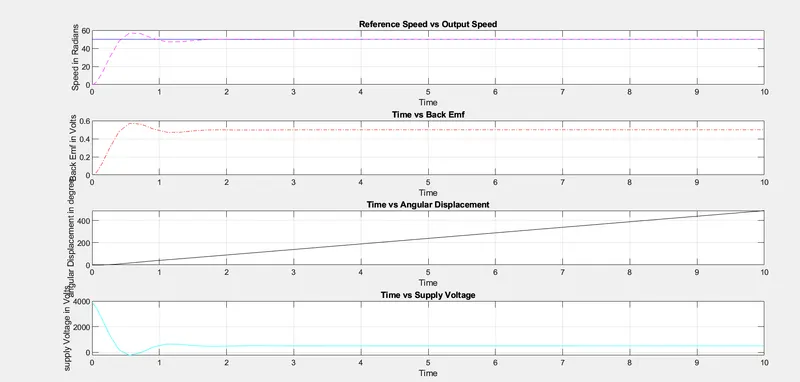
zeta= 0.5 , Ki= 150 , Reference speed = 50 rad/sec
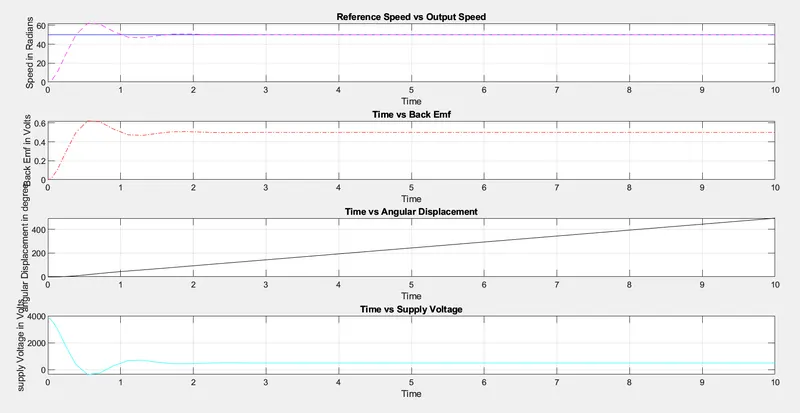
zeta= 0.99 , Ki= -0.5 , Reference speed = 50 rad/sec
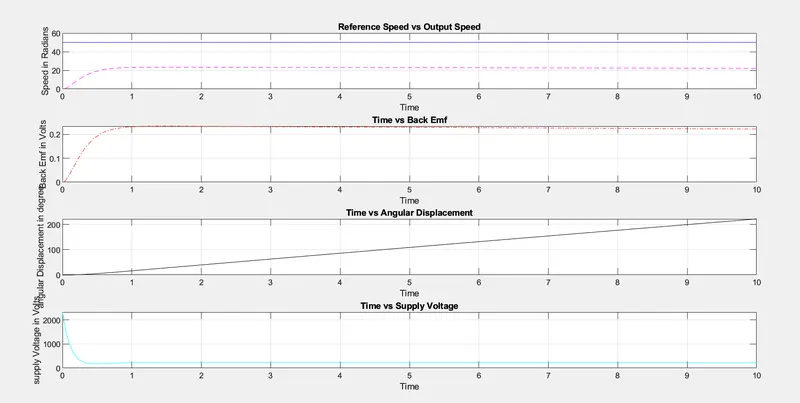
zeta= 0.99 , Ki= 1 , Reference speed = 50 rad/sec
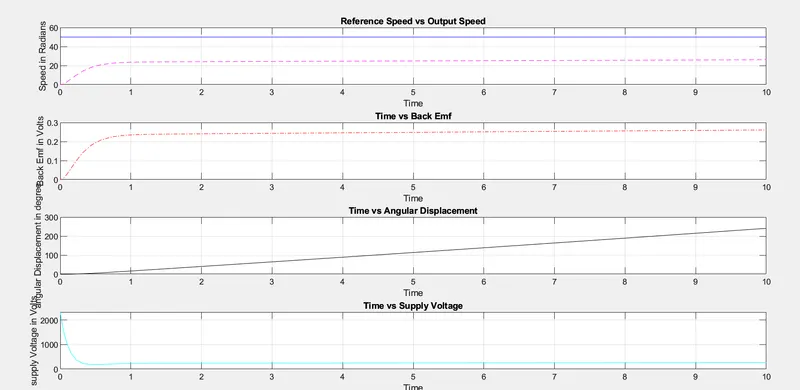
zeta= 0.99 , Ki= 50 , Reference speed = 50 rad/sec
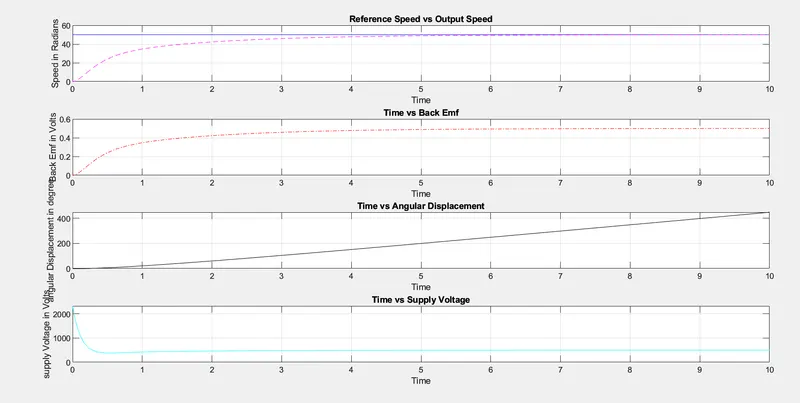
zeta= 0.99 , Ki= 80, Reference speed = 50 rad/sec
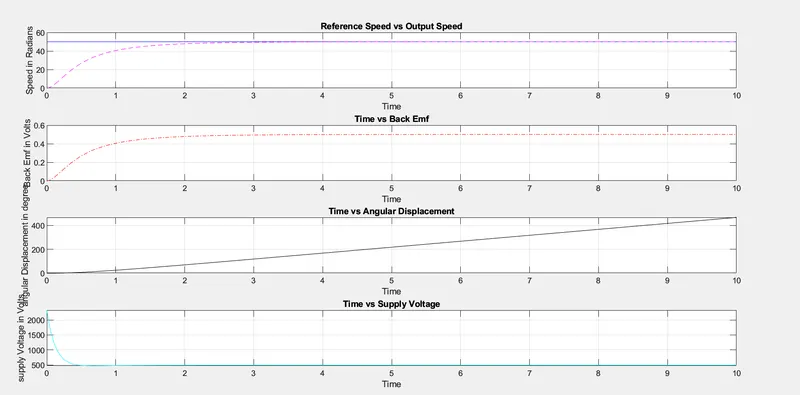
zeta= 0.99 , Ki= 150 , Reference speed = 50 rad/sec
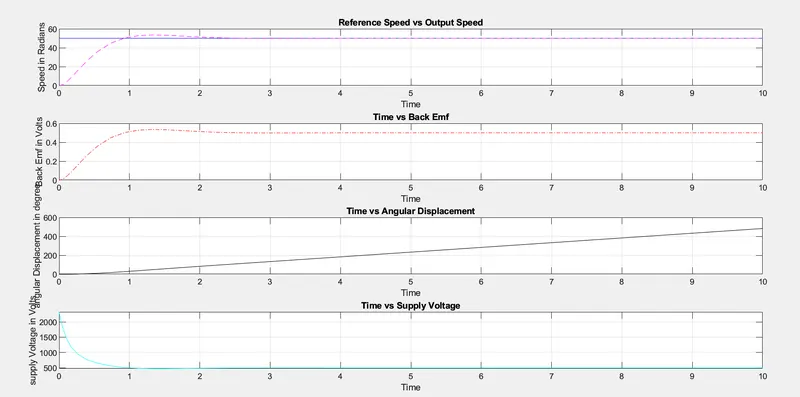
zeta= 1.5 , Ki= -20 , Reference speed = 50 rad/sec
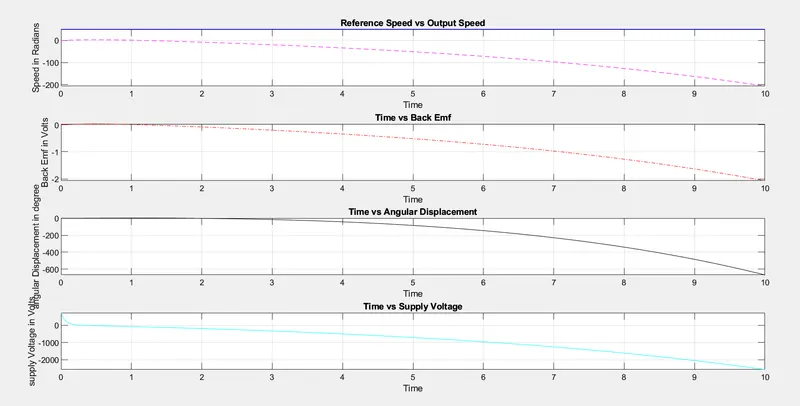
zeta= 1.5 , Ki= 5 , Reference speed = 50 rad/sec
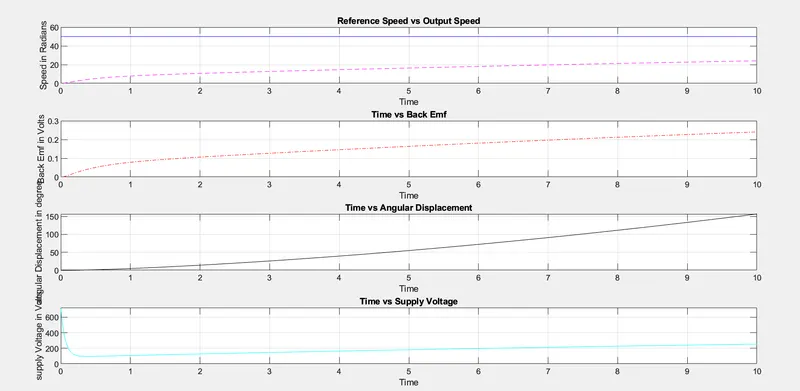
zeta= 1.5 , Ki= 50 , Reference speed = 50 rad/sec
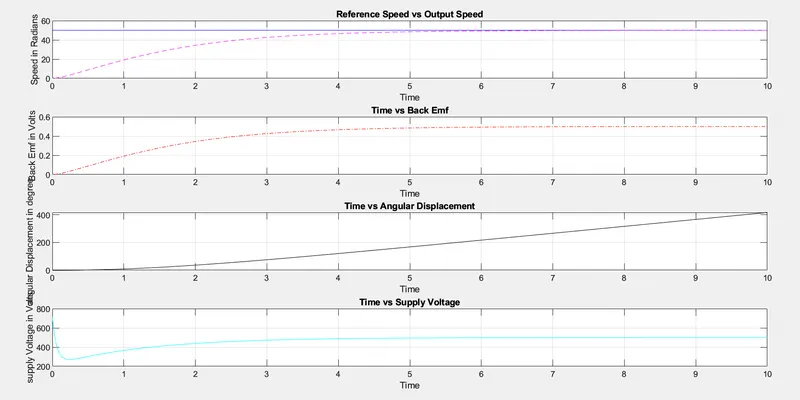
zeta= 1.5 , Ki= 150 , Reference speed = 50 rad/sec
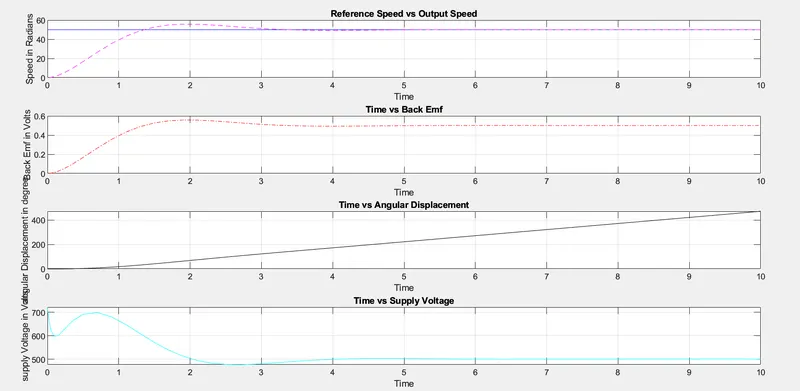
By Analyzing the results that have displayed above we can say that the system having good response for the zeta=0.99 & ki= 100 ,without any overshoot but having longer settling time of about 2 seconds.
If you have unnderdamped system than you will get best output for zeta=0.5,ki=80 with less settling time compared to critically damped system also it contains overshoots in positive & negative sides (ki= Integral Gain).
In all of the parameters for neative value of (ki) makes output very poor & speed gets worse in negative direction.
output for zeta=0.99,ki=100, Reference speed = 50 rad/sec
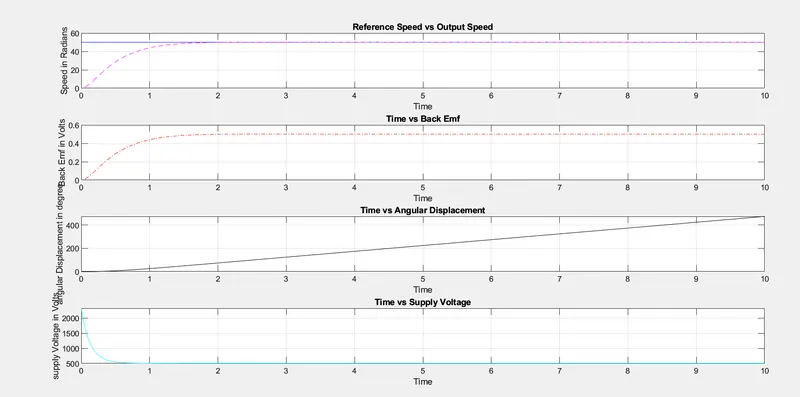
output for zeta=0.5, ki=100, Reference Speed = 50 rad/sec
Thank You..