Week-4 Challenge WOT Condition Part-2
Answer to question 1:
Mapped Model:
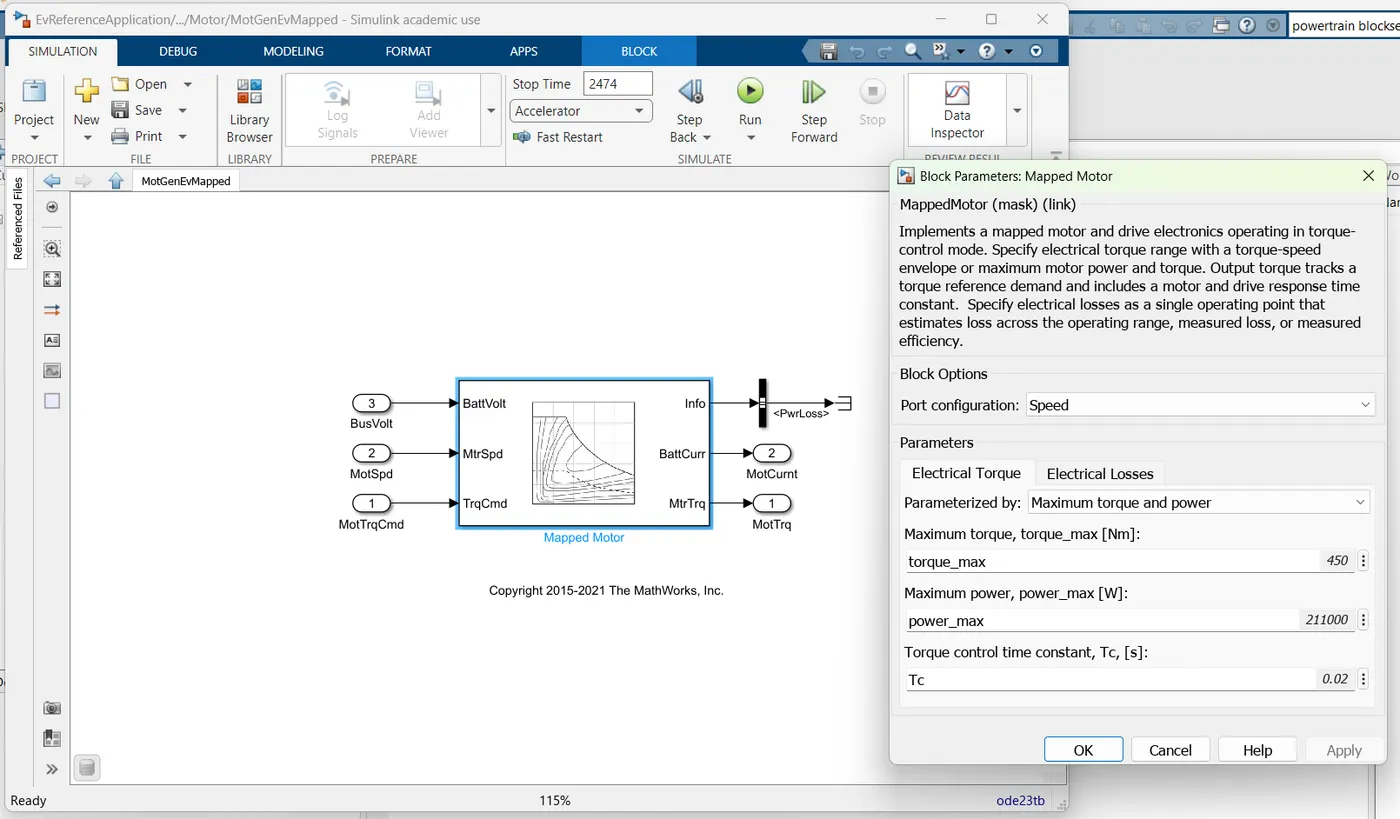
Mapped modeling approach models simulate the component using look-up tables, that is, pre-defined data that characterize the component's behavior. These look-up tables are derived from experiments conducted and are data-defined in the form of efficiency or performance maps. This type of modeling approach simulates steady-state conditions.
For example, a mapped motor model maps the efficiency curves in a motor's torque-speed characteristics. Based on driving conditions and operating points on the map, it gives the motor's performance as the output.
Dynamic Model:
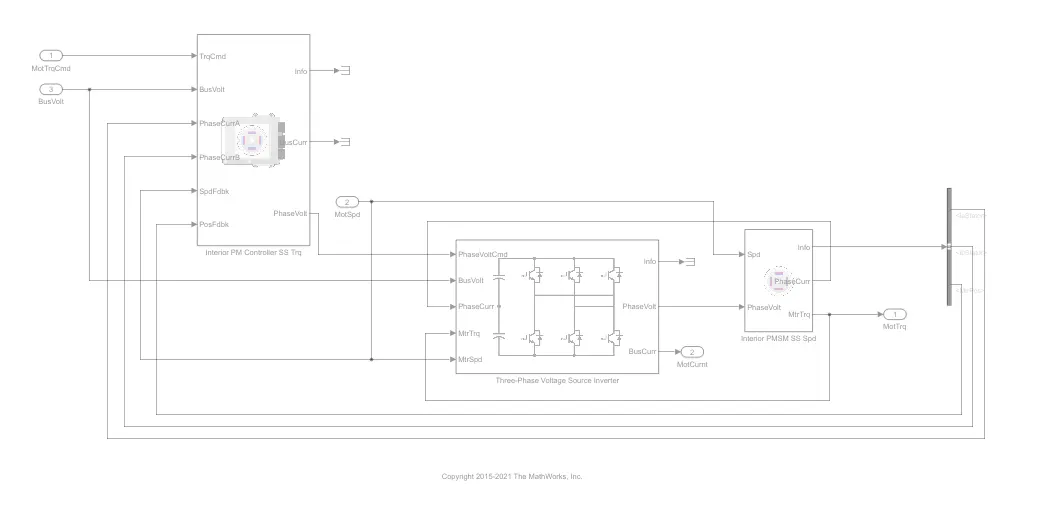
The dynamic modeling approach models the component and its internal response to time-varying conditions. This simulates the behavior of the component in real-time scenarios and can simulate transient conditions. In this modeling approach, physics-based equations are used to simulate under time-varying conditions.
For example, in this Simulink model, a motor is simulated in a circuit at component level. The motor's performance can be studied at real-time with the influence of the inverters and battery pack. There is no data required to conduct these investigations and advanced algorithms are used to predict the behaviour of the system.
To change the model type, the following steps are taken:
- In Modeling Tab >> click on Variant Manager in Design.
- In the variant manager, click on Passenger Car >> then Electric plant >> Powertrain Blockset >> Motor >> right click on MotGenEvDynamic >> Set as Label Mode Active Choice.
Answer to question 2:
The miles/gallon is the mileage of the vehicle, which is defined as the distance traveled by the vehicle per gallon of fuel. It belongs to the American system of measurements.
This can be calculated by dividing the miles traveled by the vehicle by total fuel the vehicle consumed to travel (gallons of fuel it took to be refilled).
mileage = Total distance travelled (in miles) / Total fuel consumed (in gallons)
Factors :
- Mass flow rate
- Vehicle Speed
- Vehicle mass
- Fuel stoichiometric ratio
- Battery power
- Aerodynamics and vehicle power demand
Answer to question 3:
The HEV Reference model is in image as shown below:
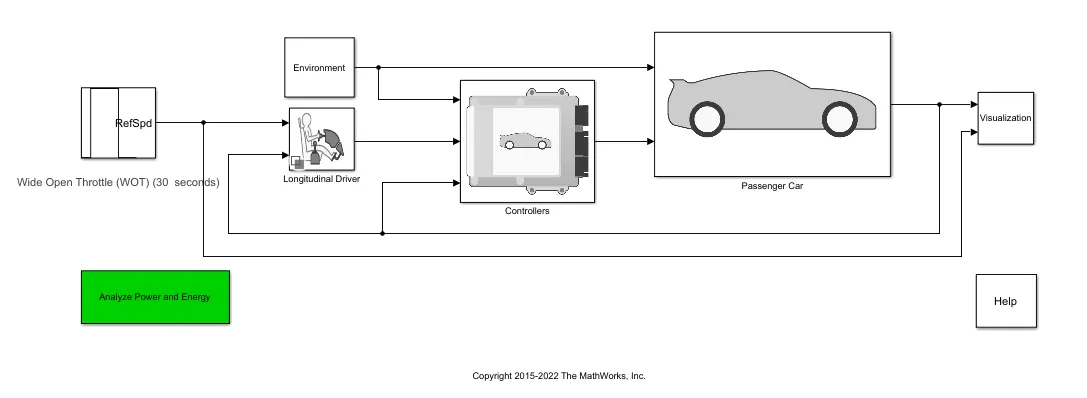
The longitudinal driver block simulates the driver's response to acceleration or deceleration using the Wide Open Throttle (WOT) driving cycles. The environment block simulates the vehicle's surrounding conditions. The controller block controls the power splitting function between the ICE and motor for traction. The passenger car block simulates the vehicle's properties.
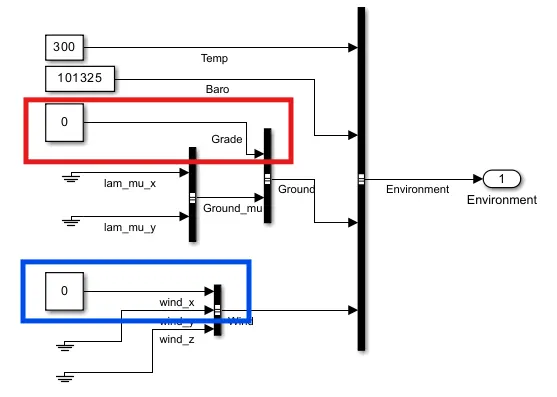
The image below describes the environment block. The focus for this task is on Grade (higlighted in red rectangle) which is the road inclination such as climbing a flyover, and wind velocity (highlighted in blue rectangle).
Considering, flat road and no wind acting on the vehicle the energy and power split is shown in the image below -
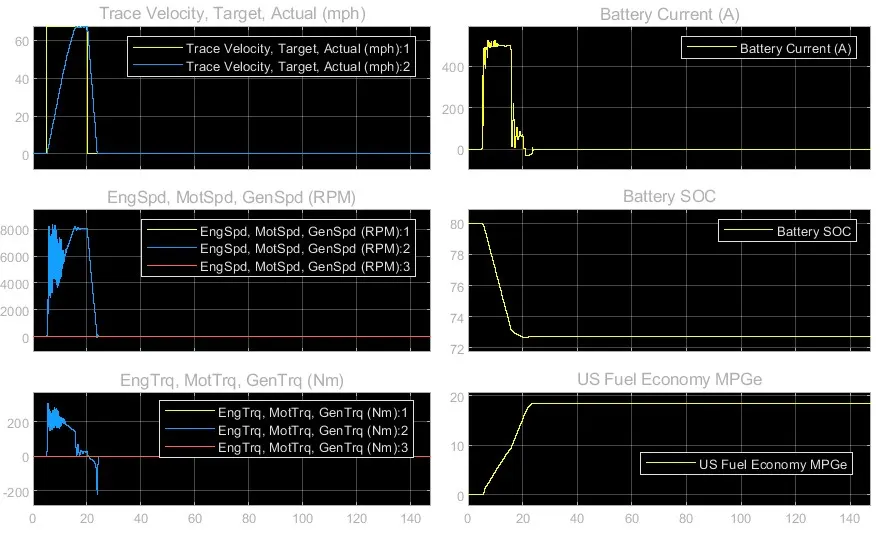
When the vehicle travels on flat road with on wind, the vehicle is fuel economical since the traction force is less and the energy is completely utilized in driving. The torque and current by battery is less.
The image below describes the energy requirements of the powertrain when the vehicle is traveling on 10 degree inclination and wind velocity of 5 m/s -
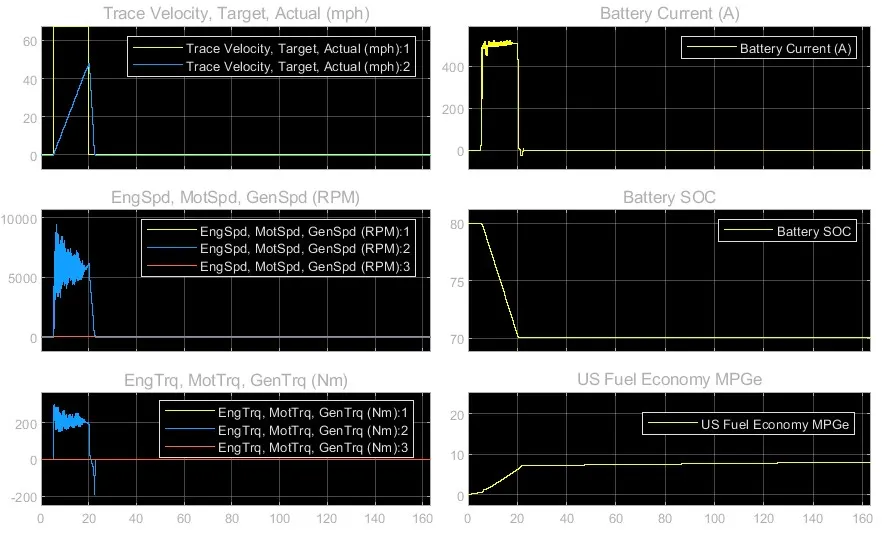
However, when there is an inclination and wind velocity acting on the vehicle the traction forces required to be overcome increases leading to higher energy requirement by the powertrain for the vehicle to travel. As shown in the graphs, the fuel economy is reduced compared to the previous case as the engine due to higher energy requirement. There are more charging cycles as compared to the previous scenario, with battery giving higher current to meet the power demands.
Answer to question 4:
This model is a pure electric vehicle where the battery is the power source and the motor is the primeover. The architecture is as shown in the below image:
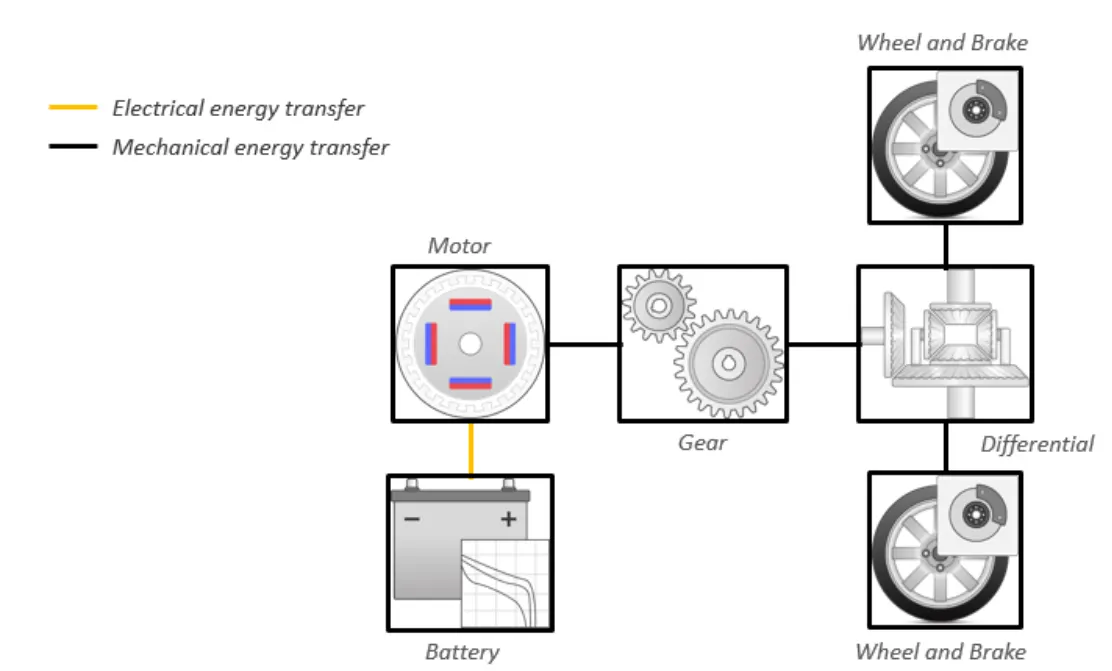
This model is similar to a hybrid model; the only difference is that it does not have an IC Engine. The conditions applied to simulate the environmental condition are 10 degrees of inclination and a wind speed of 5 m/s.
The image below shows the output of the EV with the above environmental conditions:
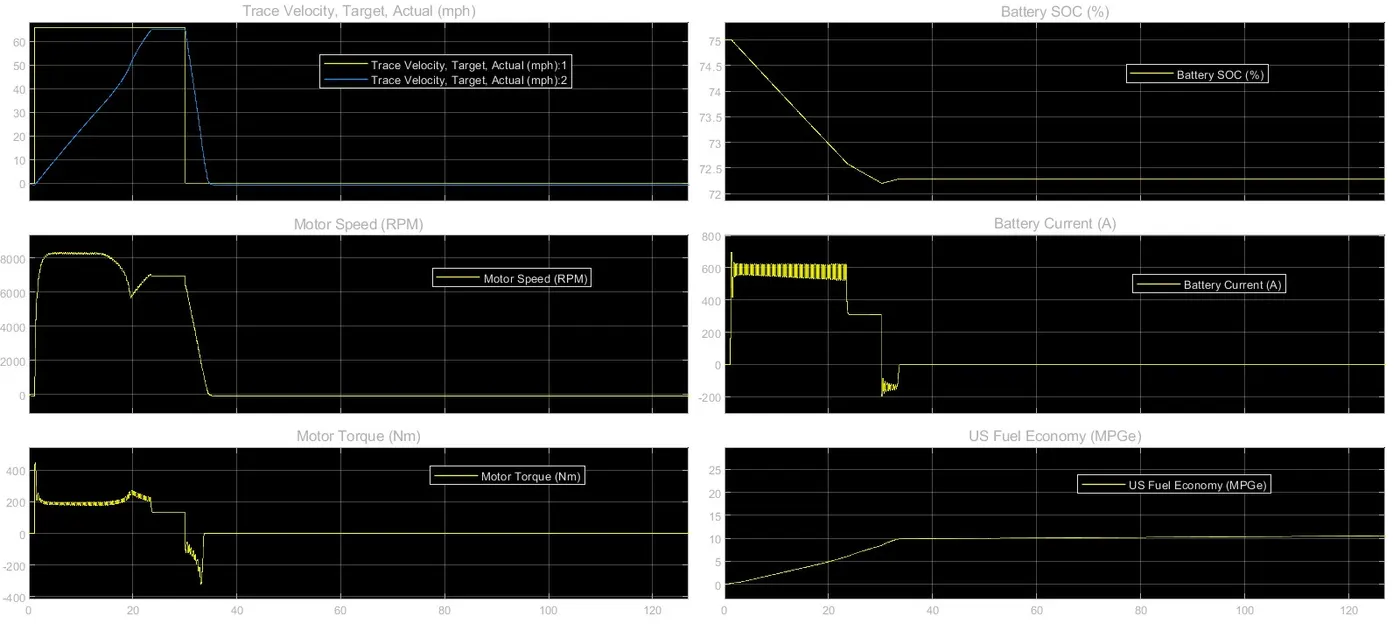
Since there is no Internal Combustion Engine, the battery is the only source of energy. As seen in the above image, the battery does not charge due to the absence of ICE. Having additonal forces due to wind and inclination, the additional of the vehicle is reduced and the battery is discharging higher currents to meet the power demands. The motor is the only traction component that converts electrical energy to mechanical energy in the form of torque and power.