Week-4 Challenge WOT Condition Part-2
Q1.
A)What is the difference between the mapped and dynamic model of engine, motor, and generator
| ENGINE | |||
| TYPE | IMPLEMENTATION | When to use | |
| Mapped | Ci Mapped Engine | The model uses a set of steady-state lookup tables to characterize engine performance. The tables provide overall engine characteristics, including actual torque, fuel flow rate, Break specific fuel consumption, and engine-out exhaust emissions. |
If you have engine data from a dynamometer or a design tool like GT-POWER. For quasi-steady-state engine simulations. |
| Si Mapped Engine | |||
| Dynamic | Ci Engine | Model decomposes the engine behavior into engine characteristics that are separated into lower-level components. By combining components in this way, the models capture the dynamic effects. | If you need a more detailed dynamic model and have component-level data. To analyze the impact of individual engine components on the overall performance. |
| Si Engine | |||
| MOTOR | IMPLEMENTATION | |
| Type | Mapped Motor | The Mapped Motor block implements a mapped motor and drive electronics operating in torque-control mode. The output torque tracks the torque reference demand and includes a motor-response and drive-response time constant. Use the block for fast system-level simulations when you do not know detailed motor parameters, for example, for motor power and torque tradeoff studies. The block assumes that the speed fluctuations due to mechanical load do not affect the motor torque tracking. |
| Dynamic Motor | The Dynamic motor implements the DC motor circuit model and is inclusive of integrators, delays, transfer functions, state-space models, and system equations, then run the simulation in Matlab and do the assessment of Performance analysis | |
| GENERATOR | IMPLEMENTATION | |
| Type | Mapped Generator | The Mapped generator is the same as mapped motors whereas the input values of generator blocks are predefined or taken from the lookup tables here also simulation time is very less. |
| Dynamic Generator | The Dynamic Generator is the same as the Dynamic motor model where the actual generator is used and it is inclusive of integrators, delays, transfer functions, state-space models, and system equations, then run the simulation in Matlab and do the assessment of Performance analysis | |
B) How can you change model type?
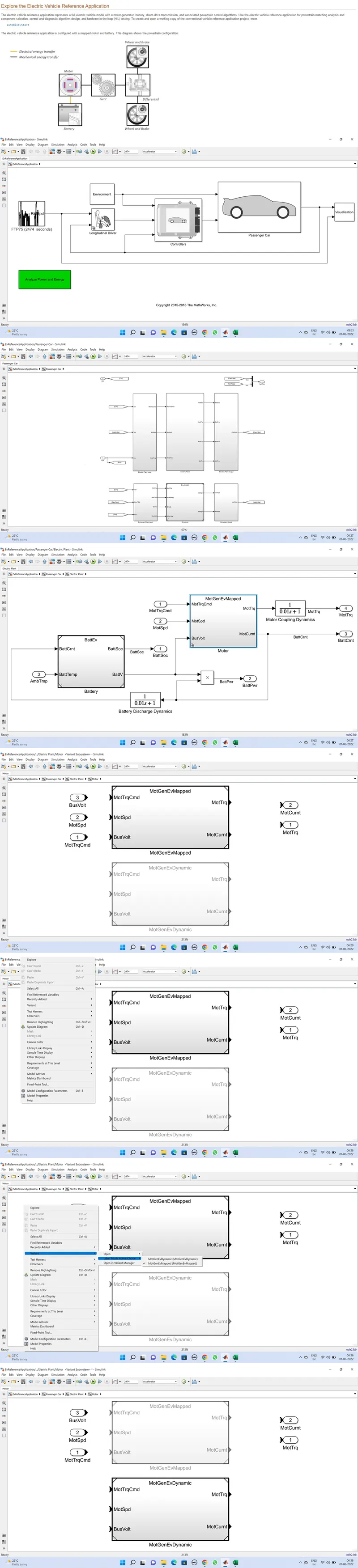
For Explanation purpose considering the EV Reference Application
EV Reference application simulation model ->Passenger car ->Electric Plant->Motor Block
we can see that MotGen EVMapped model was selected,to change the model to MotGen EV Dynamic need to be followed the below steps
right-click on the empty space of the workspace, we can see the options then select the variant, then Label mode active choice,select the MotGen Ev Dyanmic
Q2.
Miles Per Gallon (MPG): It is the distance, measured in miles, that a vehicle can travel per gallon of fuel. MPG is also the primary measurement of a vehicle's fuel efficiency: The higher a vehicle's MPG, the more fuel-efficient it is.
The U.S. Environmental Protection Agency, or the EPA, is the government agency responsible for certifying a vehicle's MPG figures, MPG tells you how many miles your vehicle can travel on a single gallon of gas. If, for example, your vehicle gets 34 miles per gallon, then traveling 34 miles should consume exactly one gallon of gas.
A vehicle's MPG can be inconsistent because it is affected by several different factors, so it is difficult to get an accurate measurement. For example, factors like traffic and road conditions can affect MPG in any given context. That's why the EPA runs tests over a standard set of courses, then averages the results to calculate a vehicle's official MPG.
The EPA gives each vehicle three different MPG ratings,
Highway MPG: the average a vehicle will get while driving on an open stretch of road without stopping or starting, typically at a higher speed.
City MPG: the score a vehicle will get on average in city conditions, with stopping and starting at lower speeds.
And, combined MPG, a combined average of highway and city MPG.
These figures are determined by the federal EPA, which rates the fuel economies of new vehicles after rigorous testing on a dynamometer. City MPG refers to driving with occasional stopping and braking, simulating the conditions you're likely to run into while driving on city streets. Highway MPG is based on more continuous acceleration, which usually yields a higher figure because it's a more efficient use of the engine.
However, these figures aren't necessarily the same as what you would get in everyday life. Everyone drives differently. These tests don't take into account how fast a driver drives, when they choose to shift gears (if they use a manual transmission), or road conditions unique to your area. In other words, your results may vary.
“Here's how to figure out your vehicle MPG: First, fill your gas tank and then reset the trip odometer. Drive until your vehicle's gas tank is nearly empty, or close enough to it that you need more gas immediately. Look at how many gallons of gas it took to fill up the tank completely. Now take the reading on the odometer -- the number of miles you've driven since your last fill-up and divide it by the number of gallons used.”
The model calculates miles per gallon
To calculate the fuel flow of a vehicle, one needs to consider the speed of the vehicle, and battery capacity.
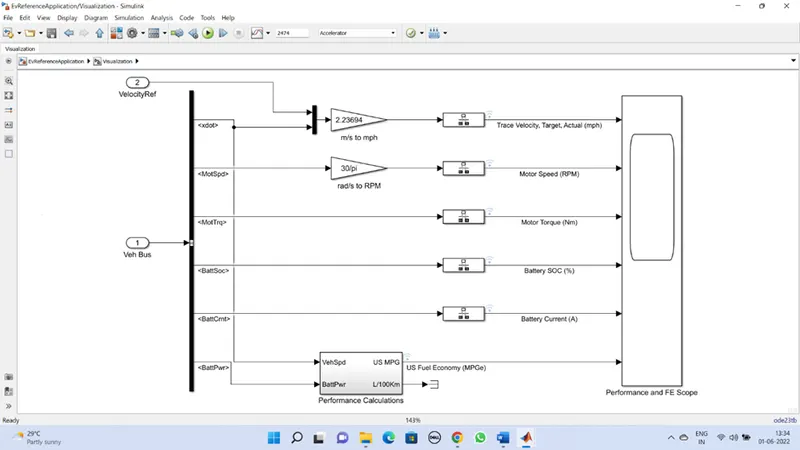
From the EV reference application, go to the visualization block we can use for MPG calculation
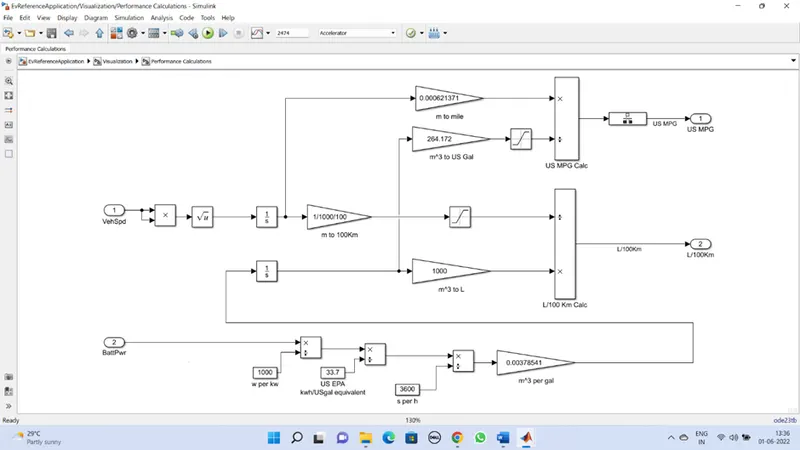
Then go to a Performance calculation block
Note
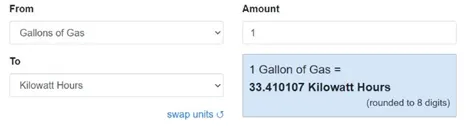
a.1 Gallon =33.41kwh
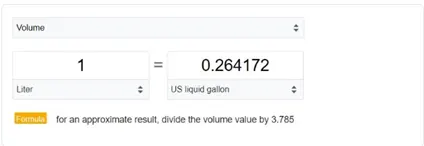
b.1 Litre = 0.2641 Gallon;1000 L =264.1 Gallons
From above picture
- The vehicle speed (x) gets multiplied itself and then square rooted. The value is then integrated(1/s) and converted into meters. Then the meters are converted into miles in the block(m to mile) then the value is divided by US Gal to get the value of US MPG.
- For US Gal value, Battery Power divided by 1000 and again divide by 33.41. Then the value needs to convert from sec to hours by dividing by 3600, now it got converted into m^3 per gal. This value is used to get US MPG as mentioned in the above statement.'
Factors are considered to model fuel flow:
- Speed of the Vehicle
- Battery Capacity
Low Power consumption of vehicles will have high MPG.
Q3
“Run the HEV Reference Application with WOT drive cycle. Change the grade and wind velocity in the environment block. Comment on the results.”
HEV Reference Application
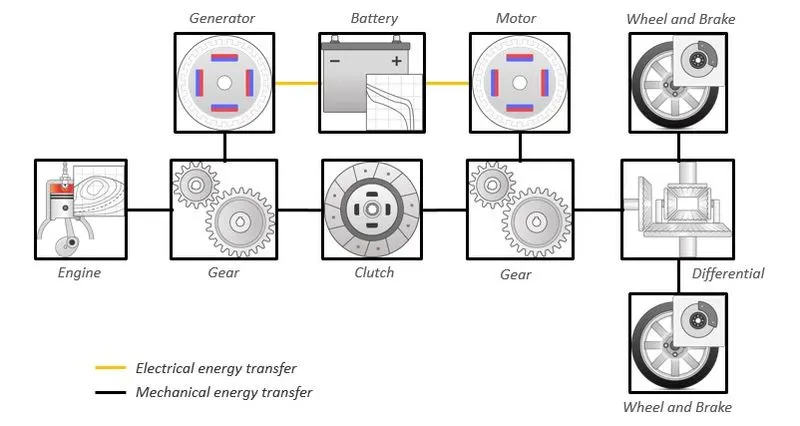
The hybrid electric vehicle reference application represents a full multimode hybrid electric vehicle (HEV) model with an internal combustion engine, transmission, battery, motor, generator, and associated powertrain control algorithms. Use the reference application for powertrain matching analysis and component selection, control and diagnostic algorithm design, and hardware-in-the-loop (HIL) testing.
By default, the HEV multimode reference application is configured with:
- Mapped motor and generator
- 5–L spark-ignition (SI) dynamic engine
This diagram shows the powertrain configuration.
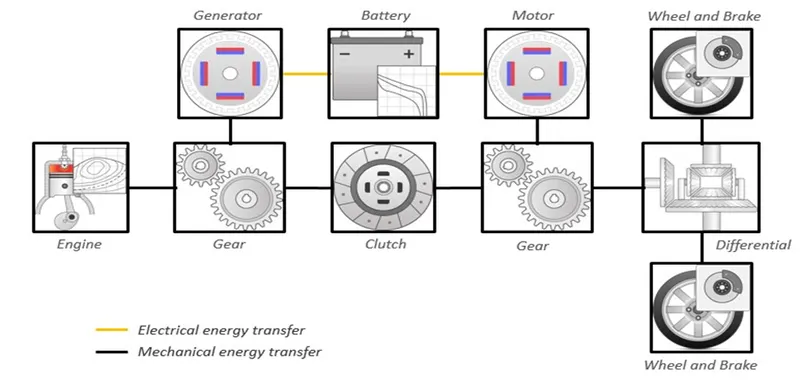
HEV Reference Application Model
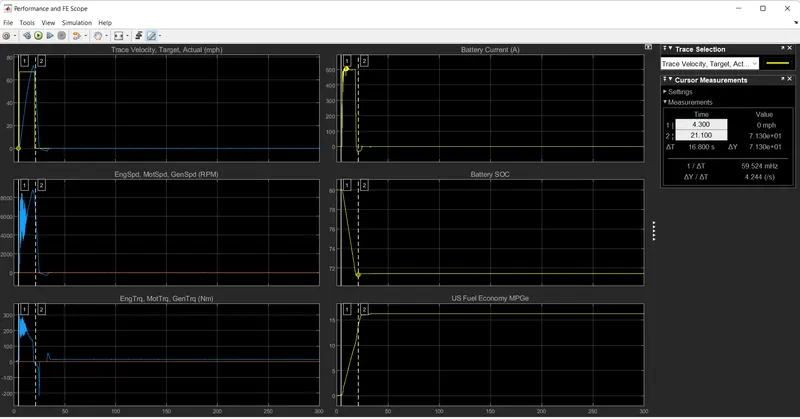
Case.1:
Changing the default drive cycle to WOT drive cycle keeping the simulation run time for 300 sec
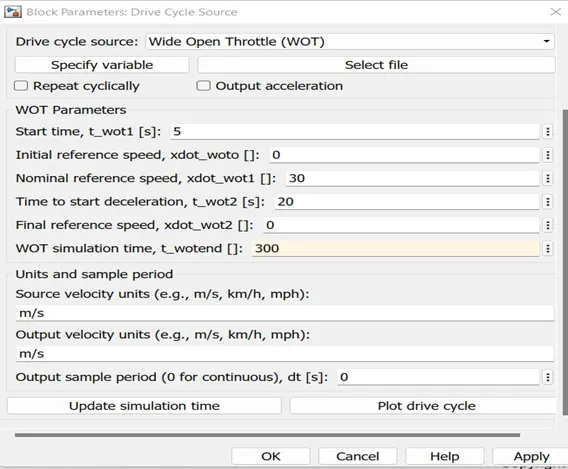
The remaining parameters were kept as default and to run the simulation changed the stop time to 300 sec
Results:
- The desired velocity was achieved at 67.1mph, battery current increased up to 500A, and maintained for 14 sec.
- Engine speed/Motor speed achieved the maximum of 8700 rpm and the battery SOC was dropped from 80 to 72(%).
- Engine torque increased initially, achieved max torque 275 Nm, and dropped to negative axis after the 20th sec then later at 32nd-sec torque increased up to 57 Nm, from 35th-sec torque came to 17Nm and remains constant. The fuel economy was increased up to 16 and remains constant.
Case.2:
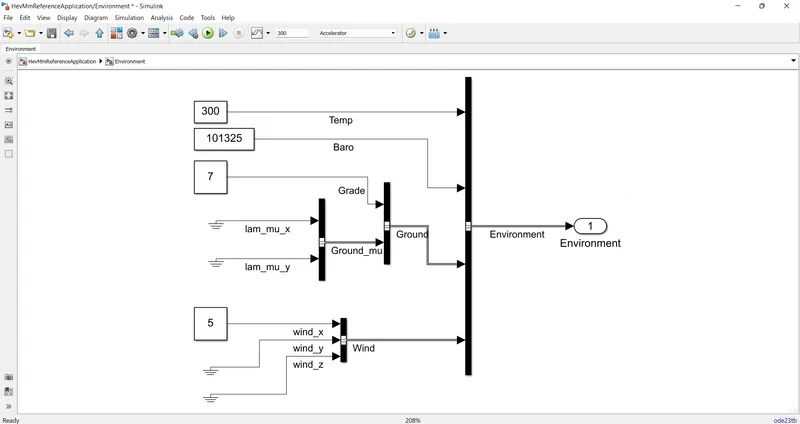
Changed the Grade from 0 to 7 and wind velocity from 0 to 4 mph and kept the drive cycle parameters as same as case.1 then run the simulation.
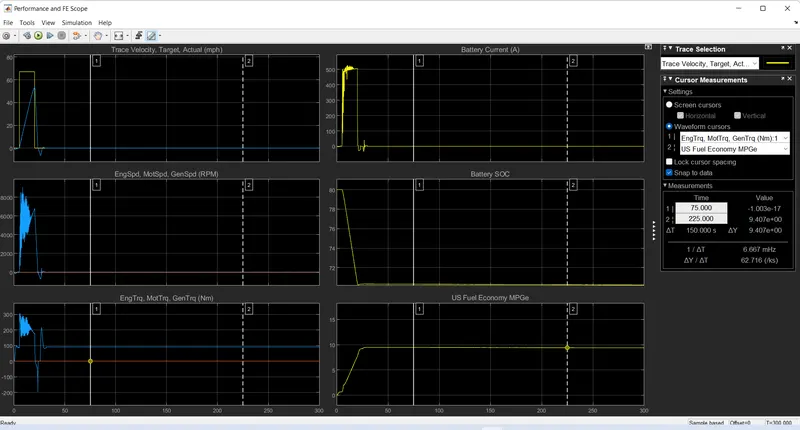
Results:
- The desired velocity was achieved at 54.3mph, battery current increased up to 500A,)( and maintained for 15 sec.
- Engine speed/Motor speed achieved the maximum of 9000 rpm and the battery SOC was dropped from 80 to 70(%).
- Engine torque increased initially, achieved max torque 304 Nm, and dropped to negative axis after the 20th sec then later at 30th-sec torque increased up to 200 Nm, from 32nd-sec torque came to 86Nm and remains constant. The fuel economy was increased up to 9.45 and remains constant.
Q4.
“Keeping all other parameters, the same, compare the simulated results of hybrid and pure electric powertrains. “
HEV Multimode Reference Application:
MODEL:
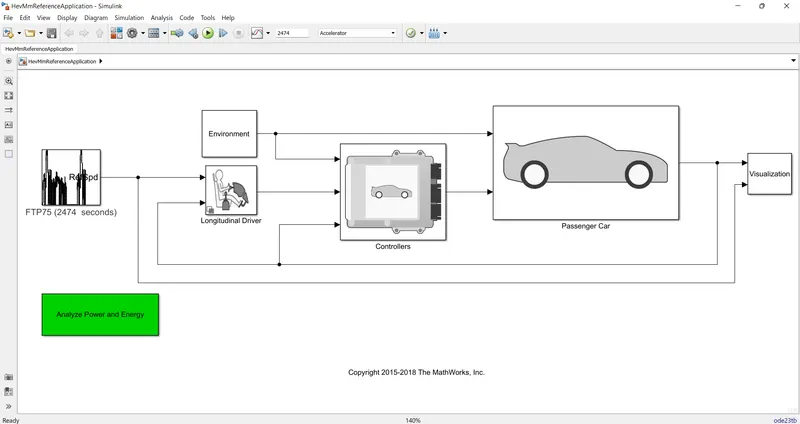
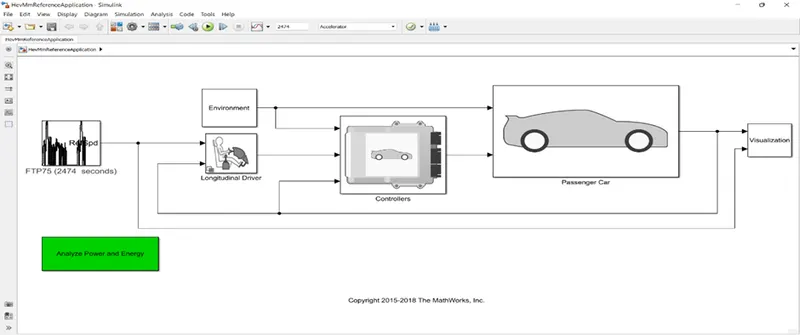
- Model consists of subsystems whereas Environment, Drive Cycle, Driver block, Controllers, Passenger car, and Visualization.
- Changing the parameters, Grade 0 to 7 and Wind velocity 0 to 5mph in Environment subsystem.
- Keeping the default drive cycle FTP75 with the simulation period of 2474 secs and running the simulation for results
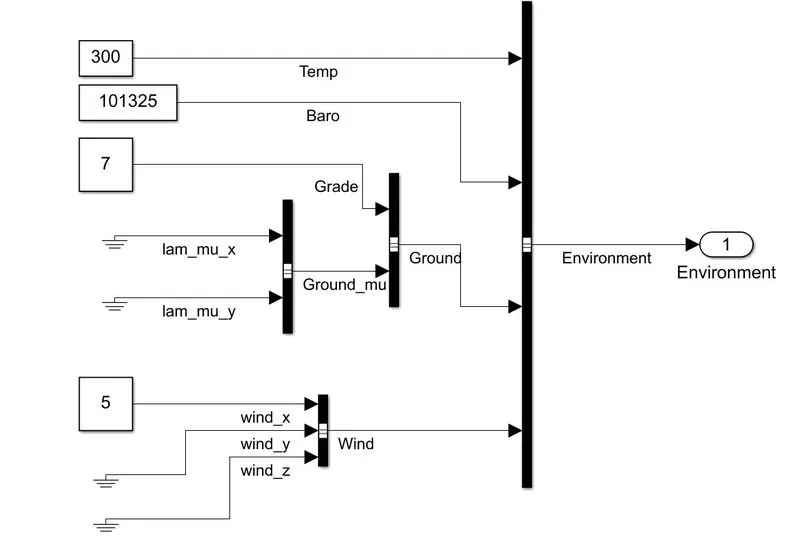
Results:
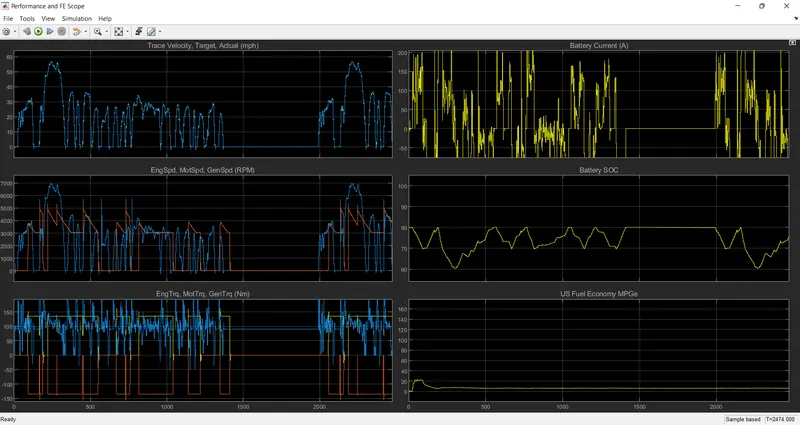
- The desired velocity achieved:57.23mph
- Battery current achieved max 200A and continuously charging and discharging.
- Engine/Motor achieved the max speed of 7000 rpm.
- Battery SOC has been maintained between 80 to 60 (%).
- Max MPG achieved 23 mph and later decreased to 7.4 mph and remains constant.
EV Reference Application:
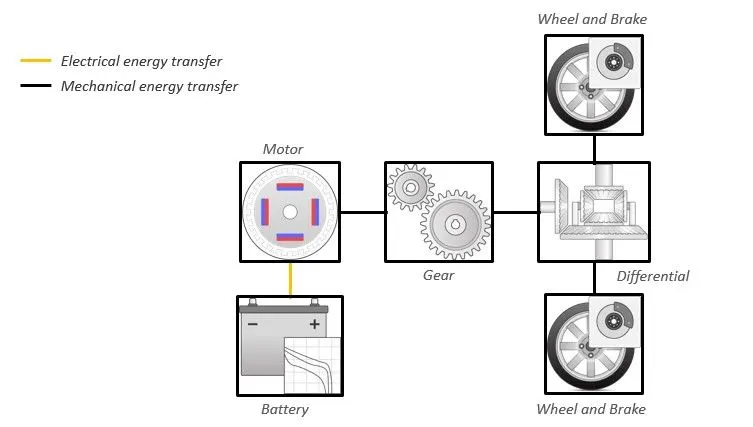
Model:
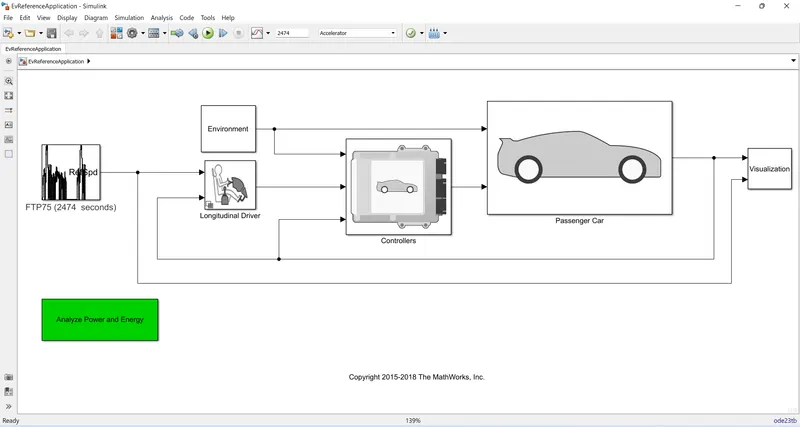
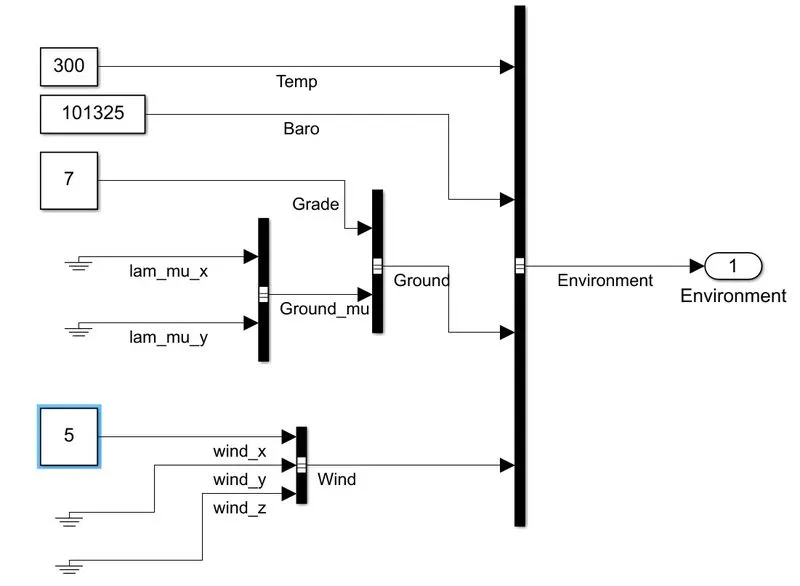
- Changing the parameters, Grade 0 to 7 and Wind velocity 0 to 5mph in Environment subsystem.
- Keeping the default drive cycle FTP75 with the simulation period of 2474 secs and running the simulation for results
Results:
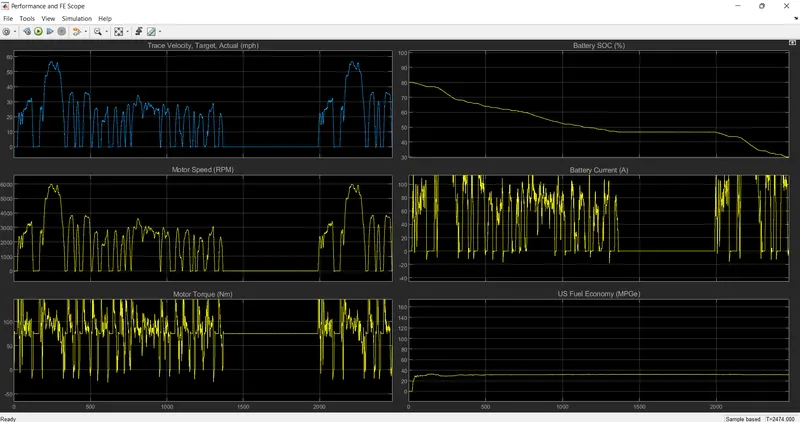
- The desired velocity achieved 56.7mph
- Battery current consistently dropping, Battery SOC dropped 80 to 30(%).
- Engine/Motor achieved the max speed of 6000 rpm.
- Max MPG achieved 30.6mph and remains constant.
Conclusion:
- Motor speed and desired velocity are high in HEV compared to EV.
- Battery current is consistently dropping in EV and continuously changing in HEV due to charging and discharging.
- High Fuel economy achieved in EV compared to HEV.