Week-4 Challenge WOT Condition Part-2
EV BATCH 16 STUDENT
- What is the difference between mapped and dynamic model of engine, motor and generator? How can you change model type?
AIM: 1.Difference Between mapped and dynamic model of engine, motor and generator.
Mapped Model: The model which uses the Macro statistics (Data is converted into statistics) of two variables of a component into a graph With respect to Base variable.
- It uses look-up table for mapping the data.
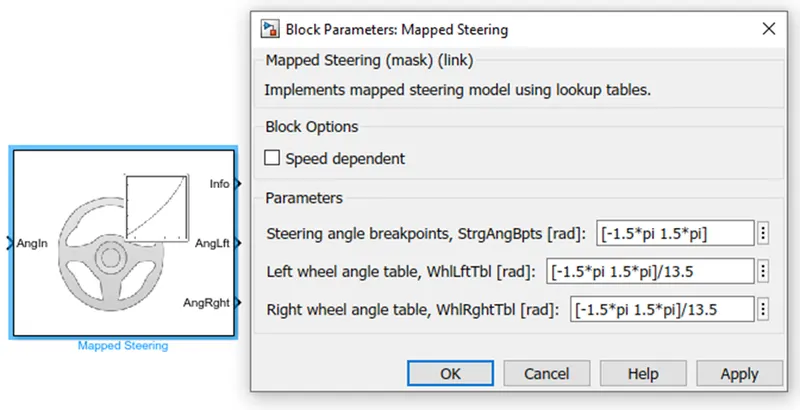
- With Respect to steering angle(base variable) left and Right wheel angles are mapped in a lookup table internally.
- Steering angle acts as input, Left and Right wheel angles are acts as output.
- Both Outputs and inputs data are predefined
Dynamic model:This model uses the Function obtained from input and output and calculate the output according to input given.
- This model requires additional information as constants(coefficients), parameters,Limits and range of component for simulation
- Sample time also to be given for simulation iterations.
- It Requires more time for simulation than mapped model
Dynamic Steering:
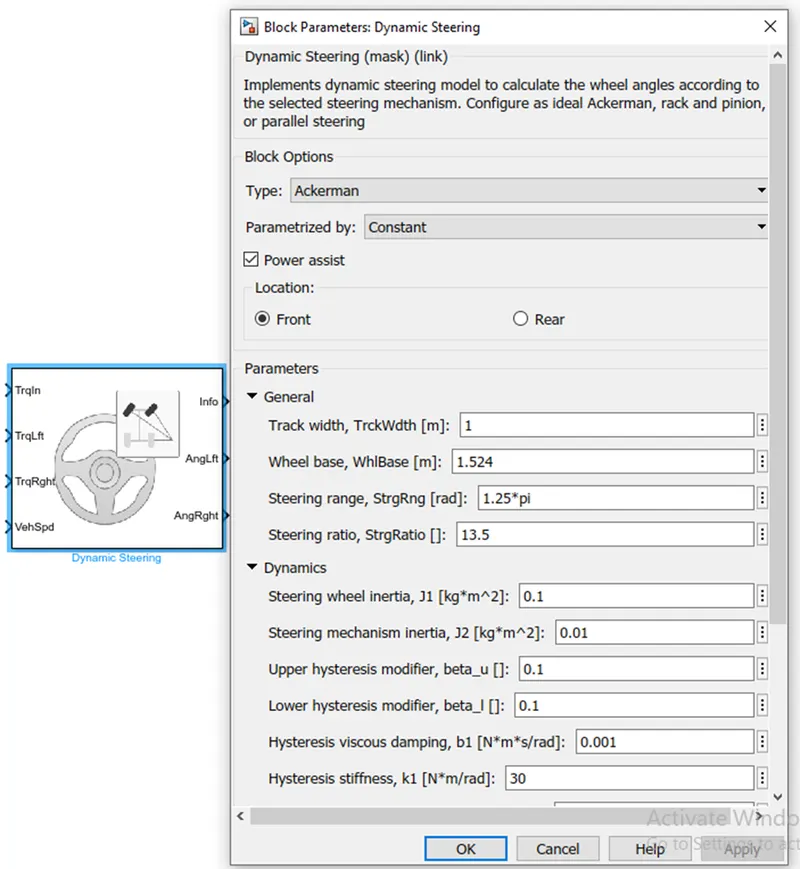
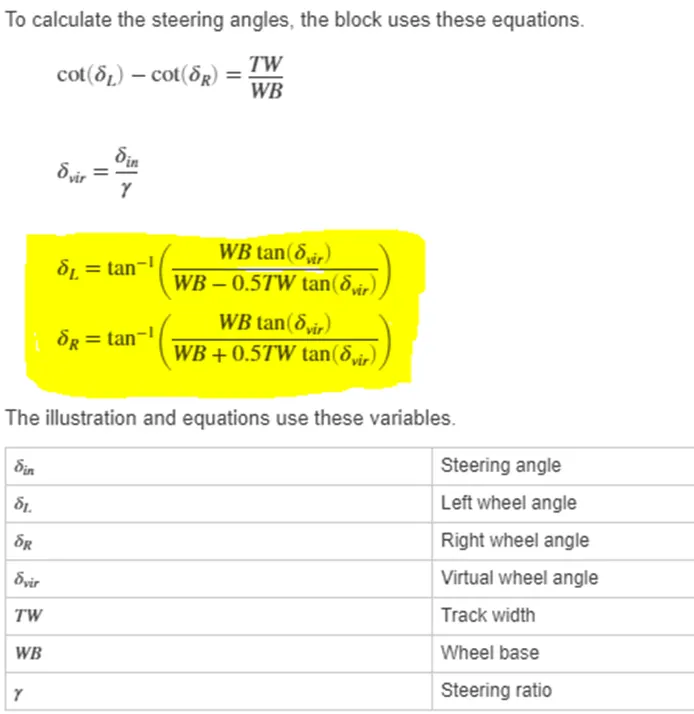
- The Dynamic Steering block implements dynamic steering to calculate the wheel angles for Ackerman, rack-and-pinion, and parallel steering mechanisms. The block uses the steering wheel input torque, right wheel torque, and left wheel torque to calculate the wheel angles. The block uses the vehicle coordinate system.
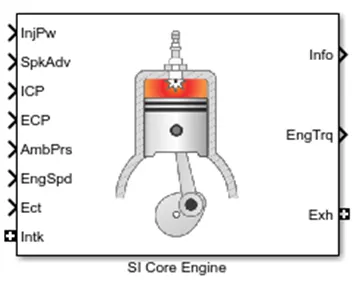
)Difference Between Mapped and Dynamic Engine Model:
|
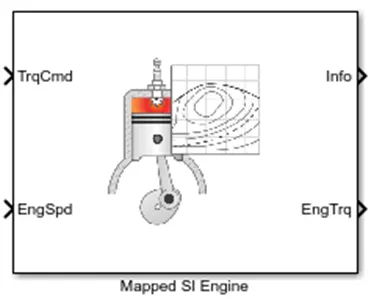
Mapped SI Engine |
Dynamic Engine |
|
2.Engine Speed and Torque data are required to map lookup table. 3.Optional data also can be provide like emission gases, Exhaust air temperature for accurate results. 4.Block is used for:
5.Model uses a set of steady-state lookup tables to characterize engine performance. 6.The tables provide overall engine characteristics, including actual torque, fuel flow rate, BSFC, andengine-out exhaust emissions.If you have engine data from a dynamometer or a design tool like GT-POWER. 7.Mapped Engine used for quasi steady-state engine simulations. |
2.The SI Core Engine block calculates:
3.Block is used for:
4.Model decomposes the engine behavior into engine characteristics that are separated into lower-level components. By combining components in this way, the models capture the dynamic effects. 5.It Provides more detailed dynamic model and have component-level data. 6.To analyze the impact of individual engine components on the overall performance. |
ii)Differences Between Mapped and Dynamic Motor/generator model:
|
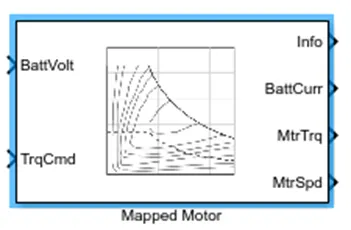
Mapped Motor/Generator |
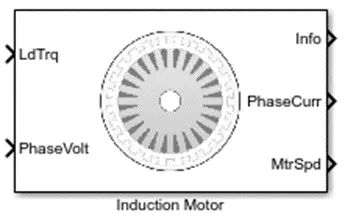
Dynamic Motor/Generator |
|
1.The Mapped Motor block implements a mapped motor and drive electronics operating in torque-control mode. 2.The output torque tracks the torque reference demand and includes a motor-response and drive-response time constant. 3.Use the block for fast system-level simulations 4.If We do not know detailed motor parameters, for example, for motor power and torque tradeoff studies. The block assumes that the speed fluctuations due to mechanical load do not affect the motor torque tracking. 5.Data Provided to be:
|
1.This Block uses the three-phase input voltages to regulate the individual phase currents, allowing control of the motor torque or speed. 2.By default, the block sets the Simulation Type parameter to Continuous to use a continuous sample time during simulation. 3.To generate code for fixed-step double- and single-precision targets, considering setting the parameter to Discrete. Then specify a Sample Time, Ts parameter. 4.The block uses these equations to calculate the electrical speed (ωem) and slip speed (ωslip). ωem=P⋅ωmωem=P⋅ωm ωslip=ωsyn−ωemωslip=ωsyn-ωem |
b)changing model from Mapped to Dynamic.
- To change from mapped to dynamic or vice versa to systems should be present in one sub system block called as variant as shown
- Here in Motor variant subsytem both mapped and dynamic models are created.
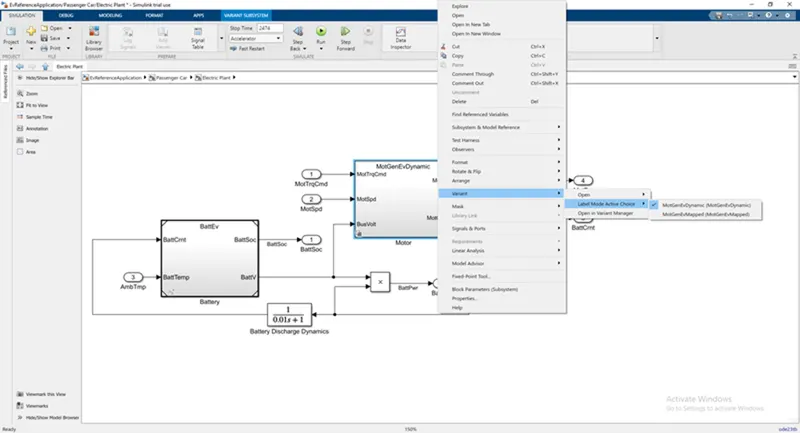
- Go to hepl>EV Reference application>Passenger car>Electric plant>motor>right click to variant to chnage the two mode of operation
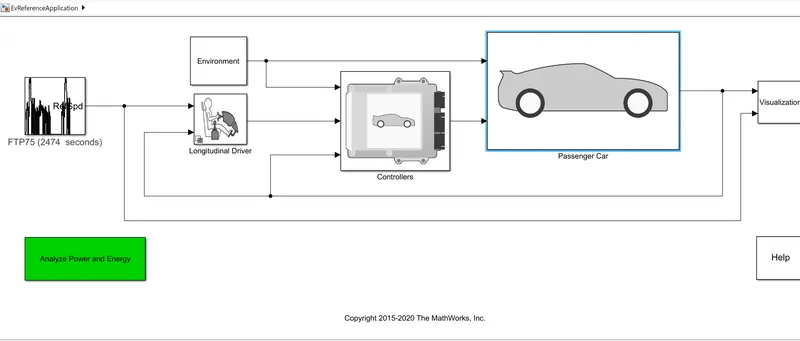
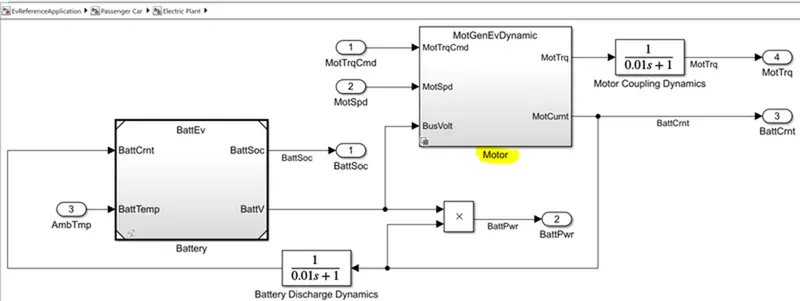
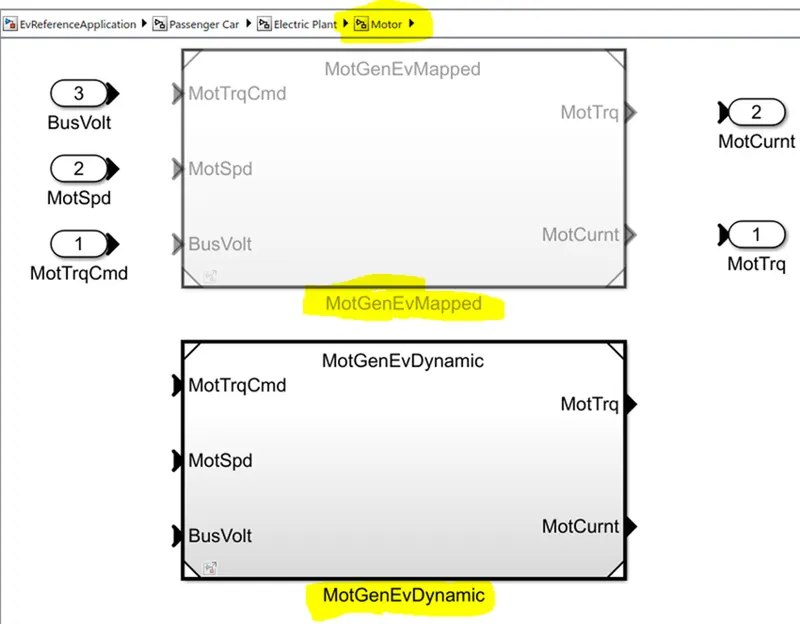
- Right Click on motor subsytem will visualize the different options.
- Click on Variant option then click on Label mode active choice option
- It Will shows the mapped and dynamic model option click on one of it required to simulate.
2.AIM:Miles per gallon model for fuel tank and required factors
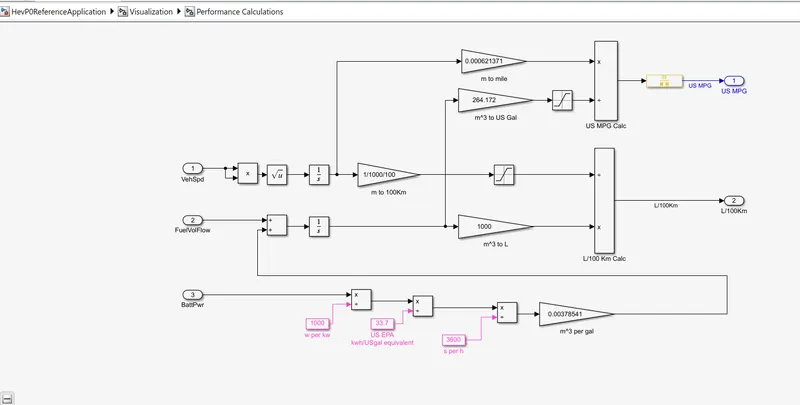
- MILE per GALLON is defined as Number of miles vehicle runs per gallon fuel. To calculate this in simulink is as follows.
- Here it shows conversion of both MILEGALLON and LITRE100KM
To calculate this we mainly require two factors from HEV vehicle output are
- Velocity in meter/sec.
- Battery Power in Watts.
To get miles from velocity:
- Velocity(m/s) is integrated with respect to time to get Distance in Meters.
Distance(m)=∫dvdt
- Meters is converted into miles
1Meter=0.000621371 Miles
By this, we get miles
To get gallons from Power:
- Battery Power(watts) is converted to kilowatts.
1000W=1KW
- KW is converted to gallons/hour.
KW 33.7KWH gallon=gallon/hour
- gallonhour is converted to gallonsec
gallonhr⋅hr3600sec=gallonsec
- gallonsec is converted to m3/sec
gallonsec=0.00378541⋅m3/sec⋅
- m3/sec is integrated with respect to time to convert to m3
- m3 is converted to gallon
1m3=264.172gallons
By this we get gallons
- Thus we get miles per gallon by dividing miles with gallons.
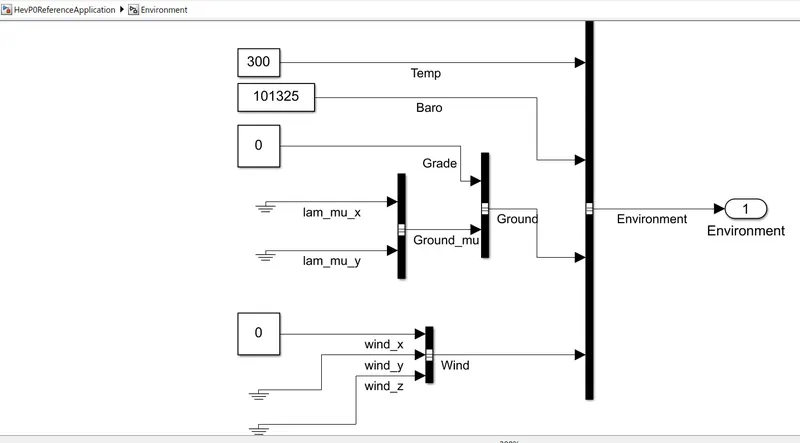
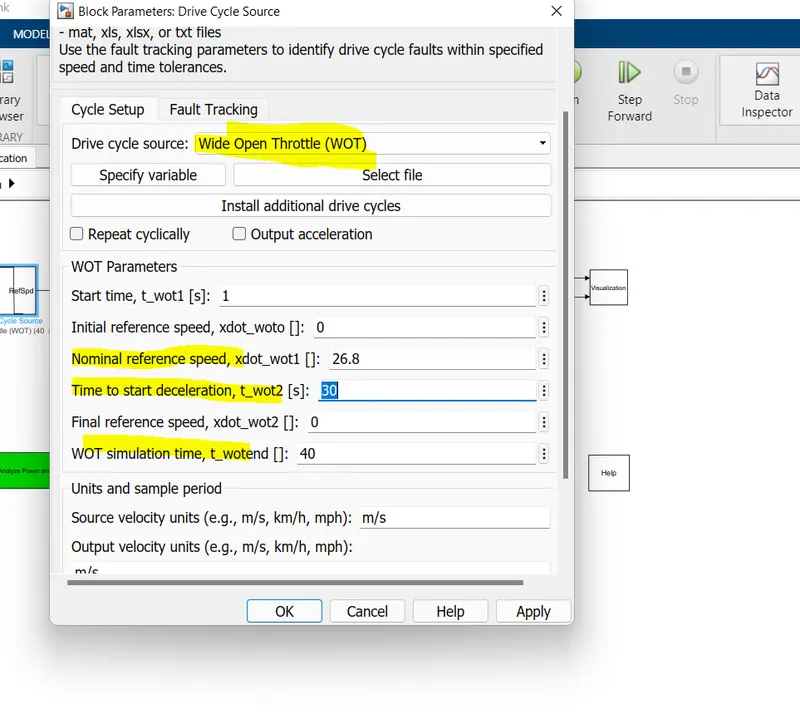
we have to change the parameter In the environment block for grade and wind, and then in the drive cycle source for nominal speed,deceleration and then simulation time
Conclusion:Thus we got miles per gallon by dividing miles with gallons in simulation.Hence satisfied the results