Week-4 Challenge WOT Condition Part-2
Task-1 The difference between the Mapped and Dynamic model of engine, motor and generator
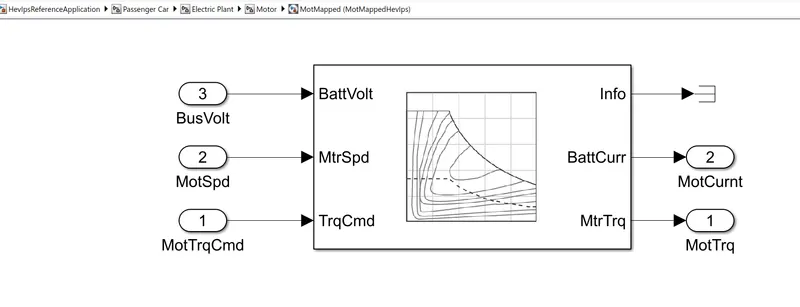
Mapped Model:- are those model which work on a look up table provided and the model perform action and simulation based on those data point provided on the look up table. These model are used to determine the steady-state behaviour of the moto, genrator and engine for the given model using the lookup tables to characterize their performance. They are faster in response when compared with dynamic model and give result in less duration.
We can see that for the motor characterstic a 2D look up table is used and Battery voltage, Motor speed and Torque command is given as input while Motor Current and Torque is generated as output based on the data point of the look up table.
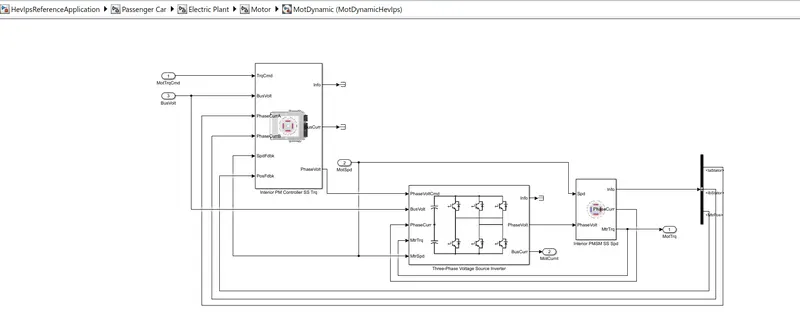
 Dynamic Model :- are those model which work on lower level component compuation and then according to the there value the whole model is characterized. These require more time for simulation as the data point are actual and the computation being done is in the background.
Input for the Dynamic model are Motor Torque Commmand, Bus Voltage and Motor Speed.
Here we can see that Motor Torque cmd, Bus voltage, Phase current A & B, speed feedback and Position Feed back is provided as input of the Interior PM Controller SS Trq and Phase Voltage is generated as output which is then fed to the 3- phase VSI. Voltage Source Inverter (VSI) has inputs like Phase Volt Command, Bus volt, Phase Current, Mtr Torque and speed and git generates Motor Current as output. And the third block is of Int. PMSM SS spd which have inputs like Motor speed and Phase voltage from 3 Phase inverter. And the output of this like Phase Current and Mtr torque is fed back to the 3 phase Inverter. Info from this block is given to a bus selector which give the feedback of Position, Phase current A and B back to the Int. PM Controller SS Trq. These value are calculated on background and takes much longer time as compared with mapped model.
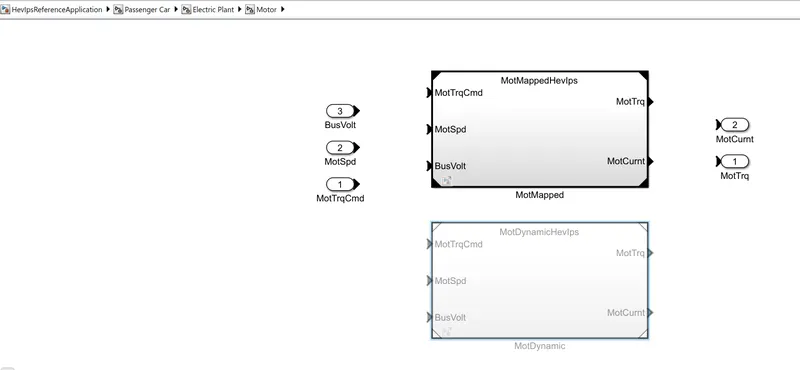
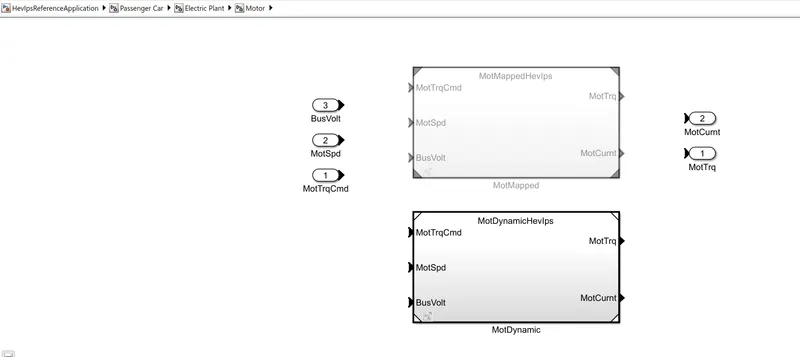
For changing the model type from mapped to Dynamic i have taken motor block. So on opening the Passenger Car it have Engine, Electric Plant and Drive train block, so then going into Electric Plant block we see that there are Battery and DC-Dc converter, Motor and Generator block there. So when entering into motor block Mapped block was selected as default as shown below.
By Right clicking in the model it shows large list under Variant then Label Model active Choice we can see that Mot Mapped is selected now we change it to MotDynamics and then the model look like this.
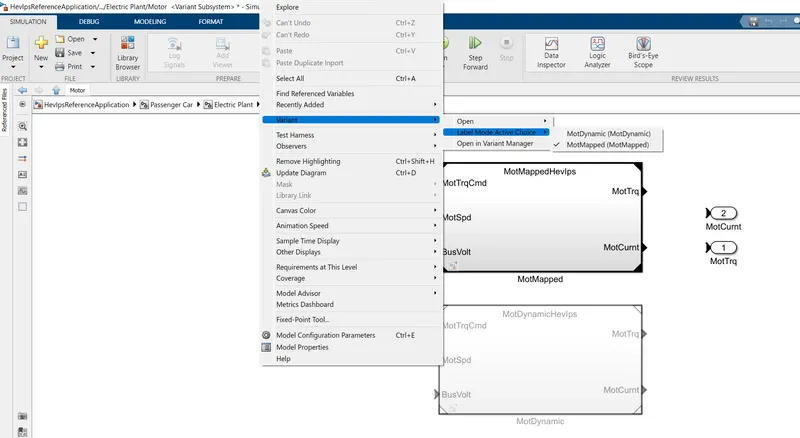
The Motor Model is changed to Dynamic control instead of mapped one.
Task-2 To detmine the factors affecting Miles Per Gallon and its calculation
Miles per Gallon is very vital information when talking about the EV or HEV as it tell us the fuel value which is saved while the model runs with different factors affecting its value.
In the model under visulaization we can see that the scope has given inputs like Trace & actual velocity, Eng., Motor and generator speed, Eng., Motor and generator torque, Battery current, Battery state of charge and US Fuel econmy. Under the performance calculation bock we can see the result as follows:-
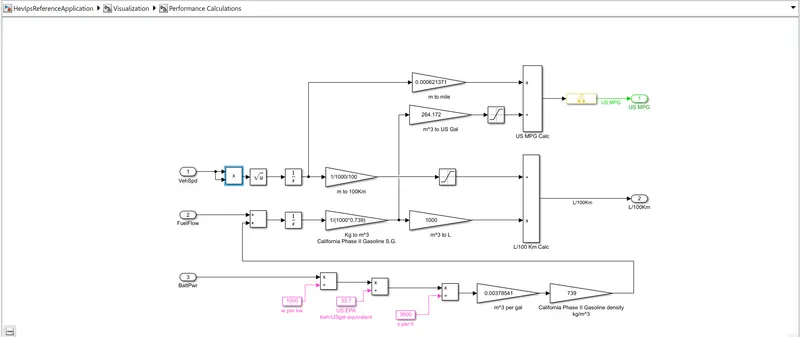
It has three inputs which are Vehicle speed, Fuel Flow and Battery power. These three are the basic factor on which the Fuel Consumption is calculated.
i) Vehicle speed:- Vehicle speed is multiplied twice and then square root is taken to avoid the negative value of speed. It is then fed through the integator to determine the distance travelled by the vehicle. the distance calculated is multiplied to a Gain of 0.000621371 to determine the distnace in miles as earlier was in meter.
ii) Battery Power:- It is given as an input along with the division of constant block having value 1000 and then both these signal are applied to the product block and the output of the product block gives power in kW. then this power is divided by 33.7 to convert power in kWH/ Us gal equivalent and the output of this block is again divided by 3600 to get value in Hour from sec. and the output from the above block is multiplied with the gain of 0.00378541 to convert fuel into m^3 / gal. and again a gain block is there having value 739 to convert the fuel to density in kg/m^3 as per California Phase II Gasoline density.
iii) Fuel Flow:- It is added to the density which is obtained from battery power and then subjected to integrator and the output of the integrator is Converted to Kg to m^3 using California Phase II Gasoline Dpecific Gravity. and then this is given to gain block having value 264.172 which converts it from m^3 to Gal and then applied saturation block which decided its upper and lower limit.
Task- 3 To model the HEV reference Application with WOT drive cycle and see the impact of grade and wind affecting the overall performance of vehicle.
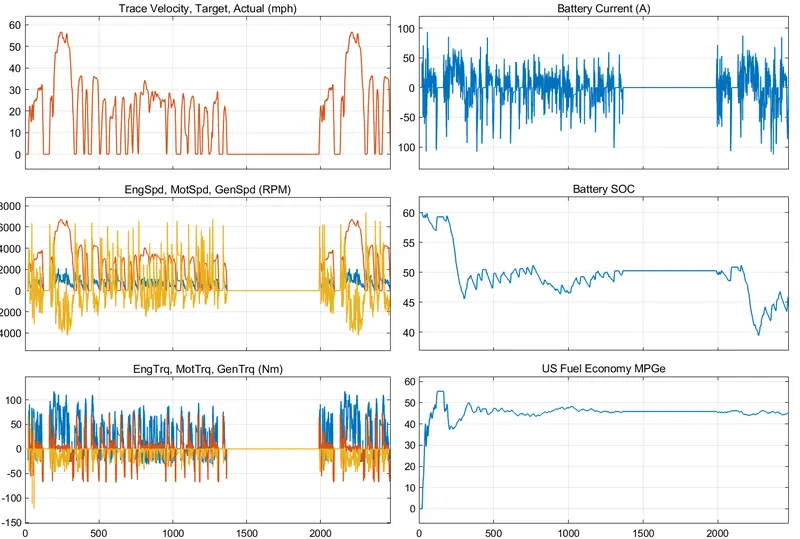
The default drive cycle applied to the Longitudnal Driver was of FTP75 (Federal Test procedure) for 2474 seconds. And we got the result on the visualization block under the scope as follows:-
Now as in the question we have to test the vehicle on Wide Open Throttle so changing the drive cycle to WOT and putting the values of parameter as shown in the below figure.
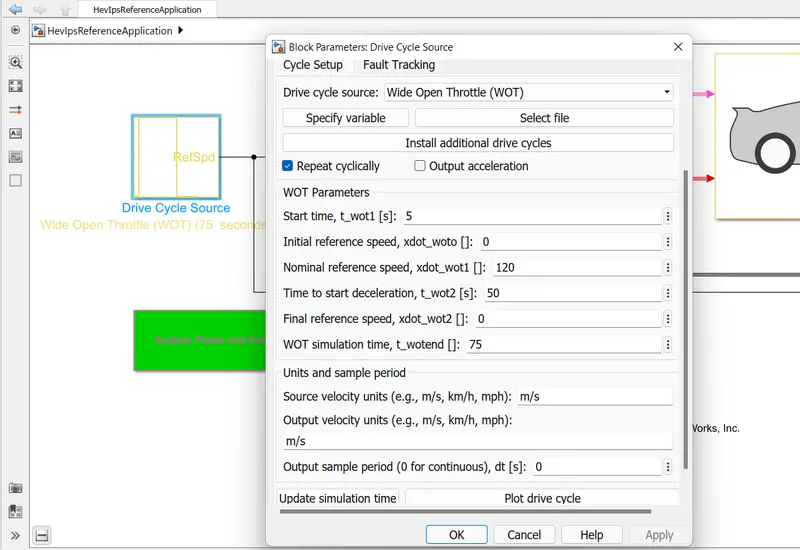
Taking the start time to 5 sec which means the vehicle will start its acceleration after 5 secs. Initial speed was set to Zero m/s. Vehicle was tested for a speed of 120 m/s and the deaccleartion will start after 50sec of the test and the total simulattion time is set as 75 sec.
I have not changed any parameter instead of Drive cycle and the gradeability and air was having the default value of 0.
So after chaging the drive cycle to WOT we make a change in the model run time to and changed it to 75 sec from 2474 sec. Running the program and seeing the result as follows.
Results:-
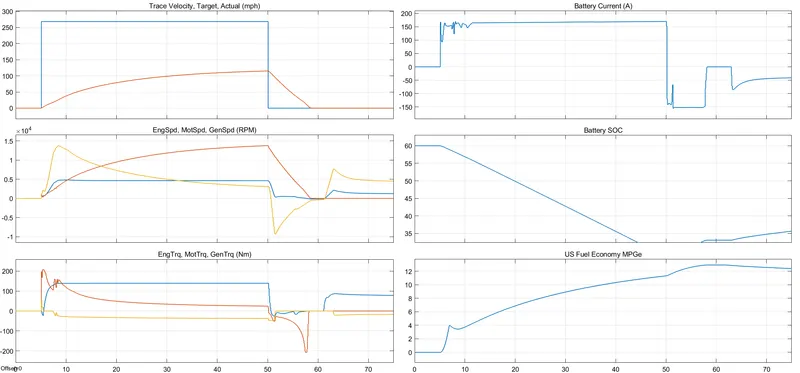
Observation From the results:-
Traget speed after 5 sec of starting:-268 mph actual speed- 115 mph
Engine speed after 5 sec of starting- 564 rev/min, after 50sec 4627.5 rev/min
Motor speed after 5 sec of starting- 625 rev/min, after 50 sec- 13767 rev/min
Generator speed after 5 sec of starting- 1415 rev/min after 50 sec- 3081 rev/min
Engine torque after 5 sec of starting- (-12.75) Nm and after 50 sec - 139 Nm
Motor toque after 5 sec of starting- 167 Nm and after 50 sec- 24.20 Nm
Generator torque after 5 sec of starting- 20.154 Nm and after 50 sec- (-37.442) Nm
Battery current after 5 sec of starting 0 A and after 50 sec - 169.684 A
SOC after 5 sec- 60% and after 50sec- 28.41%
Fuel econmy after 5 sec- 0.00003 MPGe and after 50 sec- 11.31 MPGe
Now as per the question it was asked to change the grade and wind velocity and see their impact on the vehicle performance.
So in the Environment Block we can see that Temp. pressure, Grade and wind velocity in X direction are there.
After considering 8 degree of garde and wind velocity as 2 in x coordinates
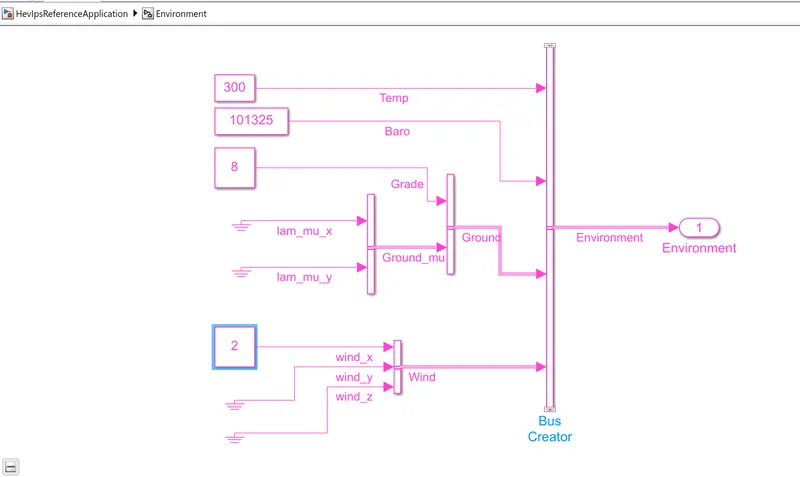
Result:- The result for putting grade as 8 and wind velocity as 2 in X direction we get:-
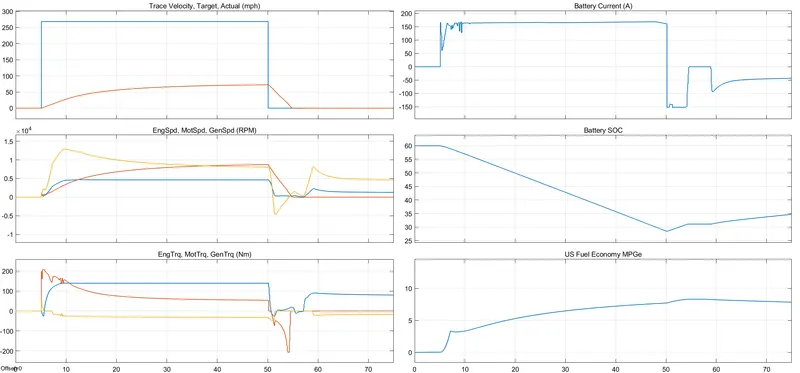
Traget speed after 5 sec of starting:-268 mph actual speed- 71.5 mph
Engine speed after 5 sec of starting- 474 rev/min, after 50sec 4626.7 rev/min
Motor speed after 5 sec of starting- 974 rev/min, after 50 sec- 8611 rev/min
Generator speed after 5 sec of starting- 748 rev/min after 50 sec- 8164 rev/min
Engine torque after 5 sec of starting- (-2.5) Nm and after 50 sec - 139 Nm
Motor toque after 5 sec of starting- 197 Nm and after 50 sec- 53.9 Nm
Generator torque after 5 sec of starting- 53.4 Nm and after 50 sec- (-31.5) Nm
Battery current after 5 sec of starting 0 A and after 50 sec - 161.69 A
SOC after 5 sec- 60% and after 50sec- 28.6%
Fuel econmy after 5 sec- 0.03 MPGe and after 50 sec- 7.63 MPGe
Observation from the result:- We see that the actual velocity of the vehicle reduced from 115 to 71.5 mph
Motor speed reduced from 13767 to 8611 rev/min
Generator speed increases from 3081 to 8164 rev/min
Motor Torque increased from 24.2 to 53.9 Nm
Generator Torque increased from -37.44 to -31.5 Nm
Engine speed and torque is almost same.
Battery current does not have signifcant changes
Battery SOC is also almost similar
Fuel Econmy reduced from 11.31 MPGe to 7.63 MPGe
So we can conclude that with addition of grade the generator unit will come into play when the vehicle is need of extra torque as the Current capacity of the battery is fixed.
Task-4 Comparison of HEV with pure Electric Vehicle
I have applied the same value of grade and wind velocity to the EV in The Enviroment section and monitor the changes as belows:-
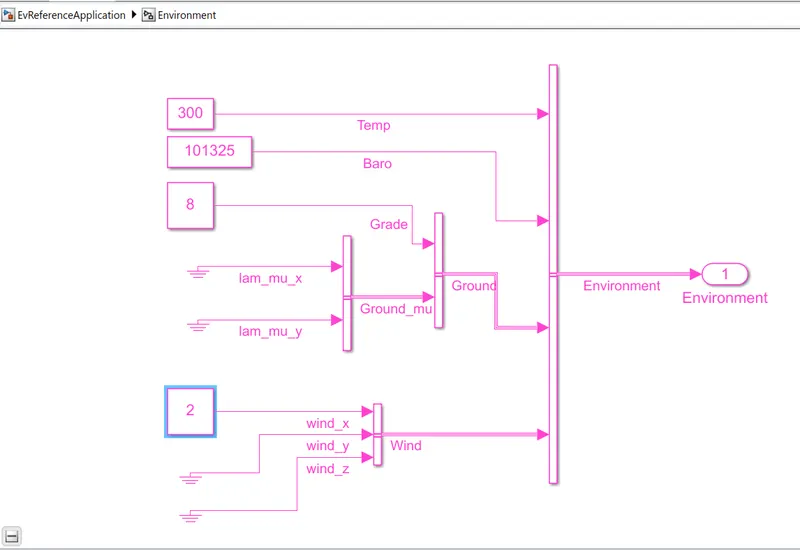
Result:-
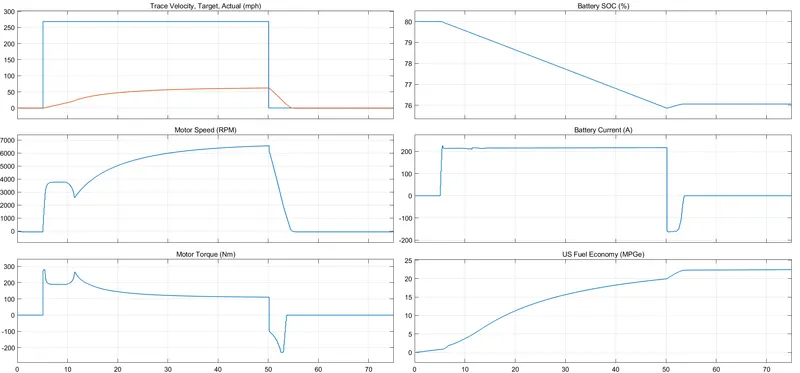
Observation From The Result:-
Traget speed after 5 sec of starting:-268 mph actual speed- 61.95 mph
Motor speed after 5 sec of starting- 0 rev/min, after 50 sec- 6558 rev/min
Motor toque after 5 sec of starting- 0 Nm and after 50 sec- 110.6 Nm
SOC after 5 sec- 80% and after 50sec- 75.89%
Battery current after 5 sec of starting 0 A and after 50 sec - 216 A
Fuel econmy after 5 sec- 0.7 MPGe and after 50 sec- 19.92 MPGe
Conclusion:- The speed obtained by the EV is less then the HEV as in HEV Generator unit help to get some extra torque. Motor torque is greater in case of EV when compared with HEV. SOC of EV is 75.89% much higher to that of HEV 28.6%. Battery in EV is of larger sze so that it can carry a large amount of current i.e. 216 A which was around 162 A in HEV. Fuel Economy is also higher in case of EV which is around 19.92 MPGe as compared to 7.63 MPGe.