Project
Aim Of the project:- To detemine the perfect value of gear ratio and vehicle mass of a BAJA ATV model for which the given Speed vs torque condition holds true for both the open and closed loop system.
Project URL:- https://drive.google.com/drive/folders/188kqnraOURPzpHsgzH_vUgf8PIz5PPIB?usp=sharing
Model-1 To study and analyze the data given for a BAJA ATV CVT based model and monitor the changes made to gear ratio to see the result of an open loop feedback system
Block Used:- Signal Builder block, Goto block, Generic Engine, Solver Configuration, Engine Sensor, CVT block, Simple Gear, Variable ratio Gear, Input and Output shaft Inertia, Ideal Rotational sensor, Vehicle body, Tire Magic Formula, Double Shoe brake, Inertia, Look-Up table, Scope
Working:- As it is BAJA ATV so it is designed to run at an rpm of around 3000-3825 rpm. So in the given model we have throttle input which is coming from a signal builder block which is having a constant value of 0.5 and brake input is given is zero. Now this throttle input is given to a generic engine which has a torque speed vector from a plot of torque speed relation of a typical BAJA engine. Its is converted to data points through the help og GRABIT and is fed to the generic engine as a parameter of speed and torque requirement for a typical BAJA vehicle. It also has P and FC point which are Power and Fuel consumption by the genric engine here we are not considering tose points. Now the output of the Genric engine is connected to a RPM sensor to detect the speed of the engine and is ploted with the help of a scope. Also the input of the genric engine is fed to the CVT primary and rotational sensor is placed to detect the RPM of the Primary CVT also a variable gear ratio block is in between the primary and secondary CVT to change the gear ratio according to the Signal Builder block provided for its change of gear with respect to the time and then the corresponding output of the secondary CVT changes. There is also a Ideal rotational Sensor placed for determining the RPM of secondary CVT along with the output shaft inertia block. Then the output of the secondary CVT is feed through a simple gear to fine tune the speed of rotation. And after that the output of the Simple Gear is fed as an input to the vehicle body considering brake and Output shaft inerrtia of vehicle. We have magical tire block onnected to the vehicle body and othe connection of vehicle body were made accordingly. In the vehicle body block we have velocity as output and integrator of it will twll us the distance travelled by our vehicle. The mass of the vehicle is 250kg, No of wheel per axle is 2, CV Height above ground is 0.7mtr, external mass is set as zero, gravitational force is 9.81 m/sec^2, drag coefficient is 1.92 and air density is 1.18 kg/m^3 and pitch dynamics is off.
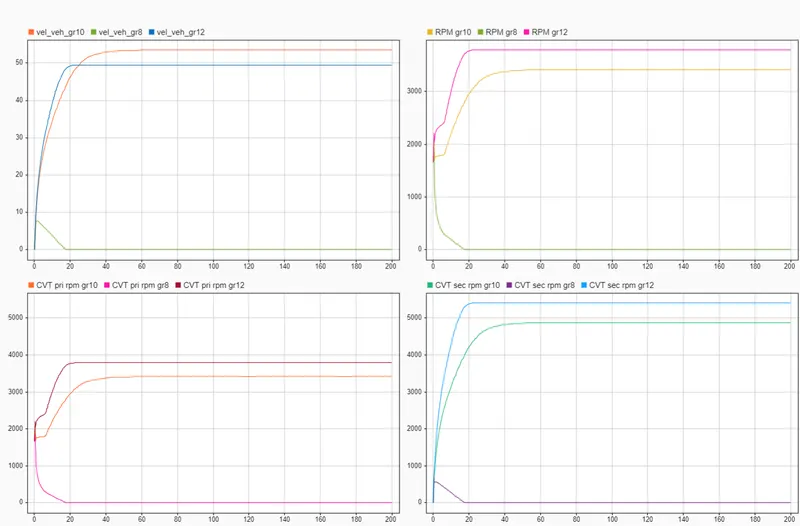
Observation:- WE try to change the gear ratio of simple gear and monitor the changes which we observe in the CVTModel1 its default value was 10 so we will take value of 8 and 12 for assesing the behaviour of velocity and rpm of the BAJA ATV. We found that for the gear ratio value of 8 the vehicle velocity, rpm and CVT rpm were under value so it can not be set as it does not have the ample amount of torque to attain a certain speed. Now we run the model when Simple gear ratio was adjusted to its default value i.e. 10 we got the vehicle velocity near about 50 and the vehicle rpm is around 3500 rpm. So it is quite satisfactory in accordance with the BAJA ATV model. Now when we put the Gear ratio to 12 we got vehicle velocity which is greater then 50 and lies in mid of 50 and 60 and Engine RPM is also about 3800 rpm. So in my observation the best possible gear ratio for the simple gear must be 12. So the model is run for the duration of 200sec and the value of different parameters are plotted in result below.
Results:- Here we can see that the RPM of the vehicle is somewhat similar to that of the secondary CVT output because the output of secondary CVT is associated with the vehicle body input.
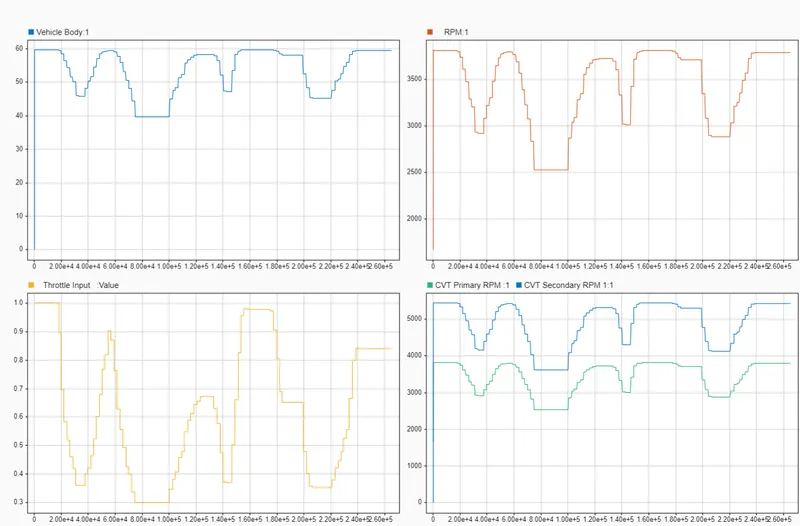
Observation:- Now in Model 1 there is a dashboard model which have several more input such as knob to increase and decrease the throttle input and break and we can directly see the result of it over the RPM and velocity gauge connected in the model itself during the run time. As the run time of this model is inf so we can change throttle input accordingly and monitor the changes in the plot.
Results:- By changing the vehicle throttle we can observe the changes in the vehicle velocity, rpm, CVT primary and secondary speed which is demonstrated below.
Model-2:- When the CVT is given closed loop feedback from the vehicle velocity and the gear ratio of CVT is mapped according to the look up table provided.
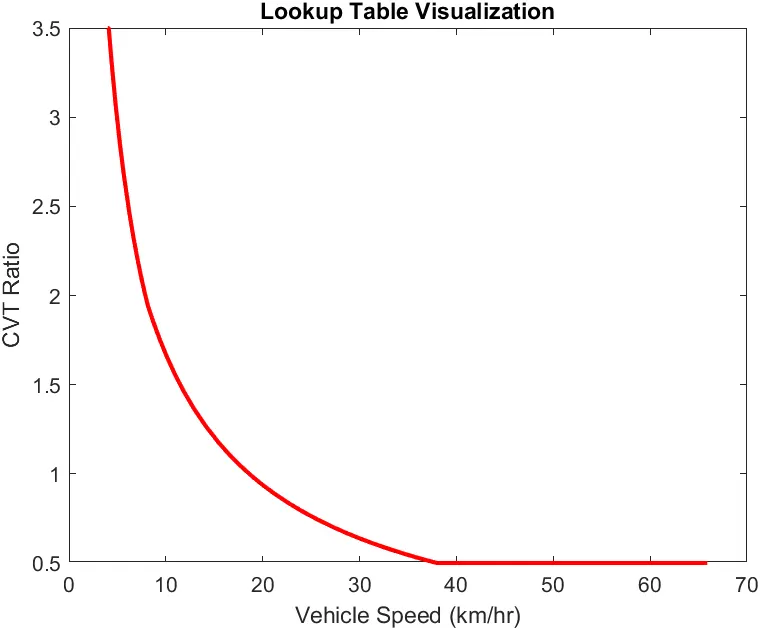
It contain all of the basic elements of the previous model but the difference in this model is that the output velocity feedback is coming to the CVT input and a Look up table is provided which is in scripted form in matlab documentary telling about the gear ratio of the variator for a given input speed from the vehicle velocity. Also in this model the Gear ratio of the simple gear is set to be 12, while in the previous model this was 10.
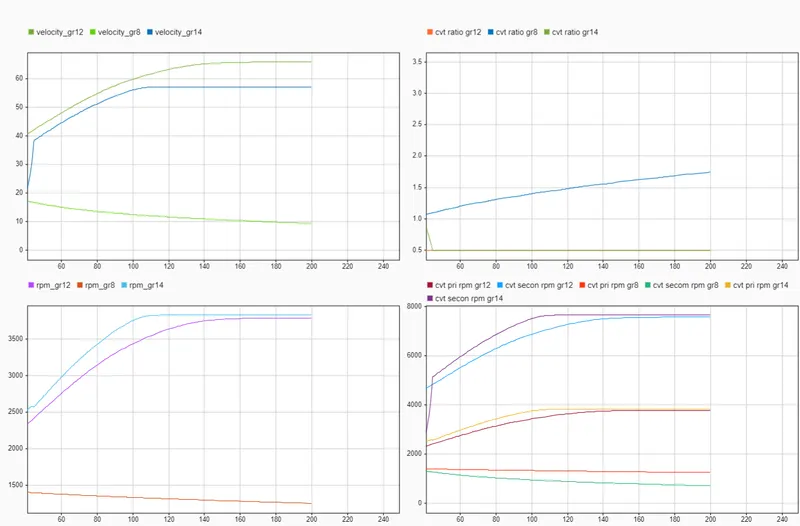
Observation:- In this model we have used different value of gear ratio such as 8, 12 and 14. For the gear ratio value 8 we see that the velocity of vehicle is getting decreased so this gear ratio cannot be considered for designing a BAJA ATV model. For gear ratio 14 we see that the velocity of vehicle is slightly less than that of gear ratio 12 and is below 60 km/hr. So it is also not considered appropiate for designing purpose. Now when we see for the gear ratio of 12 we see that the velocity of vehicle is greater then 65 km/hr and it will be most suitable for the design purpose. Also CVT ratio for gear ratio 12 and 14 is around 0.5 while that for gear ratio 8 is increasing in a linear proportion. The model is running for a time period of 200 sec. Look up table for CVT gear ratio variation is attached below.
Results:- From the above observation we can definitely say that the simple gear ratio must be 12 for getting the most vauable and efficient outcome.