Week-4 Challenge WOT Condition Part-2
Question 1 )
What is the difference between the mapped and dynamic models of engine, motor, and generator? How can you change the model type?
- Difference between the mapped and dynamic model of engine, motor and generator
In the mapped model, if we have all motor-related data that we can put in a lookup table. Everything is measured in mapped. In the Lookup format.
and in the Dynamic model, contains all components like permanent magnet motor, VSI, PMSM so real-time inputs are given to Permanent Magnet motor to work accordingly.
- How can you change the model type
Right click on Motor - Explorer - Change Lable mode active choice to Dynamic (in the right downside)
Question 2 )
- How does the model calculate miles per gallon?
- By taking integration of Vehicle speed and further converted it into meter to miles by taking gain as 0.000621371.
- Battery KW power divided by 33.7 to get USgal and then second to hour and then final this meter^3 galon further this output is went into numerator with Fuel Volume is in numerator and then output of Fuel flow divided to m^3 gal is integrated.
- By taking gain of 264.172 for the above intergrational output so that this is converted into m^3 to USgalon
- Now Miles (from very first point) is divided by USgalon gives USMPG.
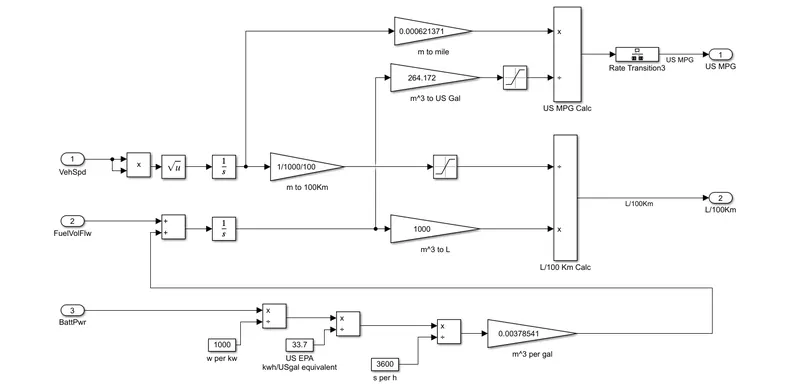
- Which factors are considered to model fuel flow?
- Fuel volume flow
- Vehicle speed
- Battery power
Question 3 )
Run the HEV ReferenceApplication with WOT drive cycle. Change the grade and wind velocity in the environment block. Comment on the results.
- Without changing in Environment parameter
Time to reach max speed is - 12sec
soc - 79.4%
max current - 523amp
max rpm - 8990rpm
max torque - 300NM
The engine doesn't start all load is taken care by Battery itself.
- With changes in Environment parameter Grade 10% and wind velocity
Time to reach max speed is - cant reach the max speed (reach 41mph in 15s)
soc - 70%
max current - 523amp
max rpm - 9075rpm
max torque - 306NM
as the soc of battery is very low so Engine is started to charge the battery and if we simulate for some more time say for 100sec then we can observe that in 50sec battery soc goes from 70% to 80%
and once battery soc reached to 80% Engine will stop.
Question 4 )
Keeping all other parameters the same, compare the simulated results of hybrid and pure electric powertrains.
For HEV :-
Max speed - 56.2mph
max rpm of motor - 6770rpm
max torque generated - 150NM
min soc - 70%
Whenever soc goes below 70% engine starts and the battery gets charged and then again motor starts to carry load till discharge 70%.
For EV:-
Max speed - 56.2mph
max rpm of motor - 5900rpm
max torque generated - 100NM
min soc - 71.4% till last of duty cycle
Summary - As in EV full load has to be carried out by the Battery itself so battery charge max is kept 32.5AH with no. of cells connected in series is 96 and in parallel is 2. In the case of HEV, there are two options to dive wheels so the battery is compared to small that is a max charge of the battery is 76AH.