Week-4 Challenge WOT Condition Part-2
A. Question's :-
1. Run the HEV ReferenceApplication with WOT drive cycle. Change the grade and wind velocity in the environment block. Comment on the results.
2. Keeping all other parameters same, compare the simulated results of hybrid and pure electric powertrains.
3. What is the difference between mapped and dynamic model of engine, motor and generator? How can you change model type?
4. How does the model calculate miles per gallon? Which factors are considered to model fuel flow?
B. Solution's :-
1. Solution to question (1) :-
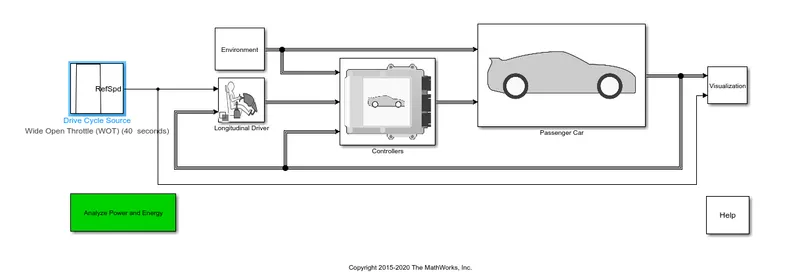
HEV Reference Application model as follows :-
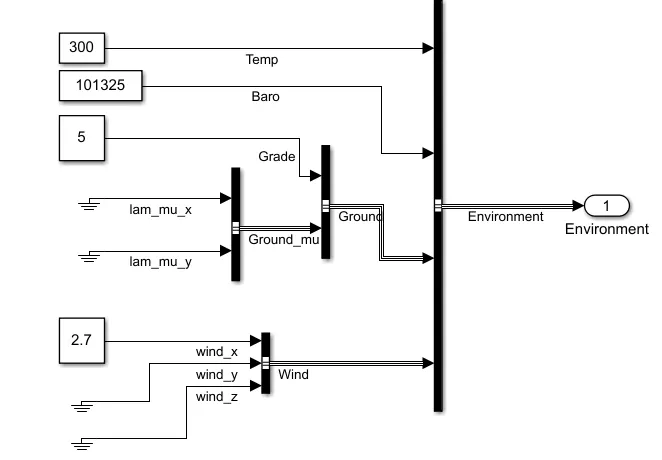
- Grade = 5 units
- Wind velocity = 2.7m/sec.
- WOT drive cycle parameter(in seconds and m/sec) as follows :-
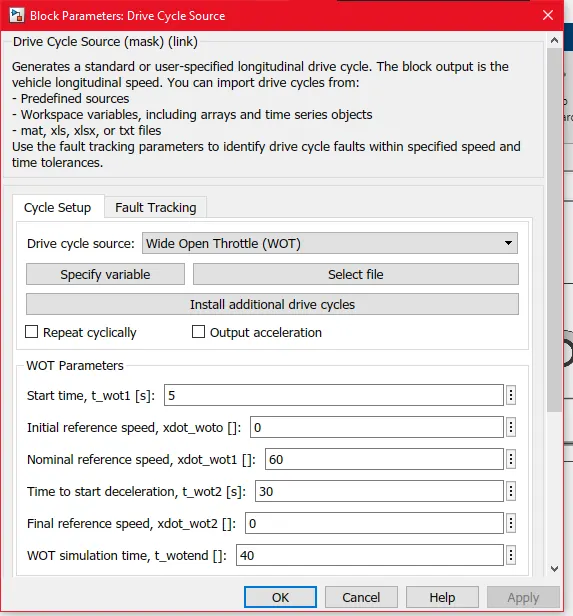
- As, drive cycle is for 40 seconds therefore simulation run time is also for same duration.
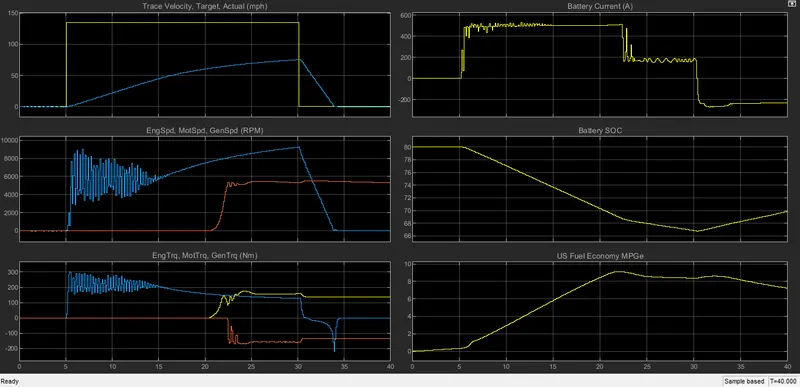
- Above image is the result of the simulation .
- It contains drive cycle plot,speed plot of (engine,motor,generator),torque plot of (engine,motor,generator),battery current, battery SOC and US fuel economy MPGe.
- In drive cycle plot the velocities are in miles per hour (mph) and the value entered in WOT drive cycle is in m/sec .
- So, 60m/sec =135mph.
- If we see in this plot blue graph is not exactly following yellow graph this is because of battery capacity that is battery capacity is not enough to provide that acceleration.
- If we see in battery current graph at 5.5 sec current is 485A and at 22.5sec it is 162 A .
- Upto 22.5sec battery take care of aceleration later on engine starts to look for further acceleration.But it capacity is not enough to trace the yellow graph.
- After 30sec deceleration takes place and battery current goes negative that is battery starts charging .
- If we see battery state of charge intially it is at 80% and at 30sec it is nearly at 67% .It is a thermostat control strategy means after reaching 67% battery stops supplying
- and engine starts to function.
- If,we focus on torque plot of (engine,motor,generator) from 5 to 22.5sec motor provide torque which is represented by blue graph after that battery is not sufficient to supply
- current to motor ,then engine take care of .If, we see when engine starts operating generator torque is negative it means it stars providing energy to battery .
- In speed plot of (engine,motor,generator) when motor is operating generator speed is 0then after 30sec motor speed tends to 0 and generator speed increases.
- If, we see US fuel economy MPGe plot intially its value increases and as soon as engine starts operating its value decreases.
2. Solution to question (2) :-
compare the simulated results of hybrid and pure electric powertrains.
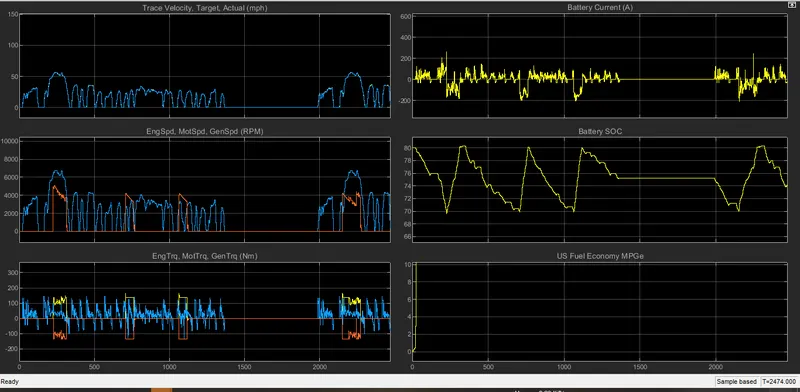
Simulation result for HEV are as follows :-
Simulation result for pure EV are as follows :-
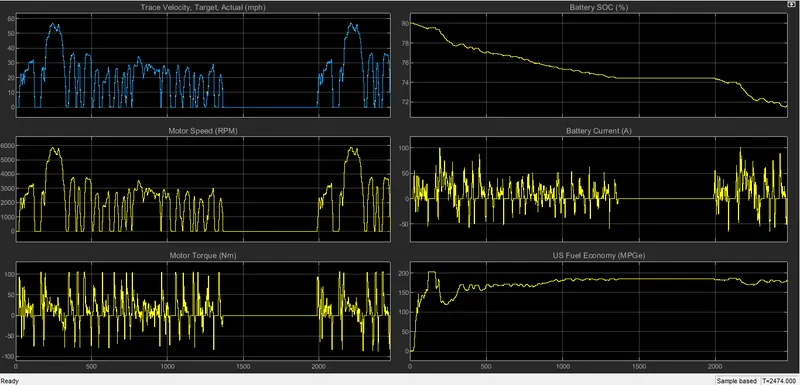
- In this all parameter are same including drive cycle (from 0 to 2474 seconds ).
- Following are some factors on which comparision is made are shown in table:-
-
Battery current SOC Motor speed Motor Torque Pure EV Max=100A
charge upto 53A
80% to 71% Max=5852 Max = 105Nm HEV Max=263.5A
charge upto 220A
80% to 70% Max=6767 Max = 144Nm
3. Solution to question (3) :-
- In mapped model whatever are the data available with us we can enter accordingly that is customize.
- But in dynamic model exact model is there .
- To convert the mapped model to dynamic model follow thr procedure
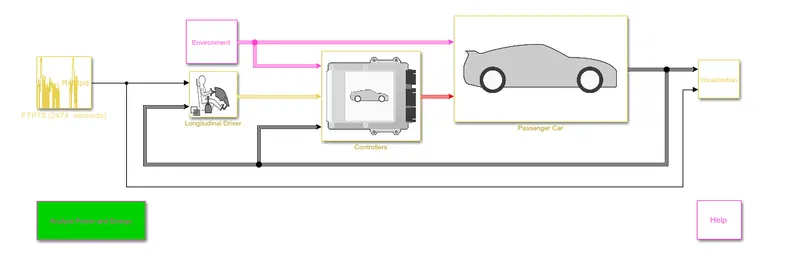
- Click on passanger car block.
-
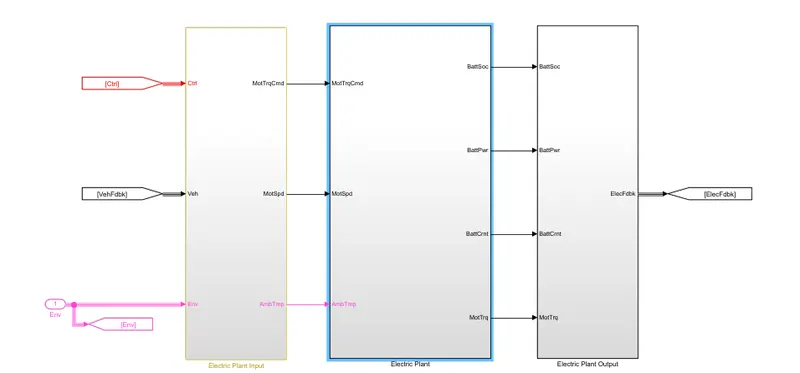
- Then click on electric plant block.
- Click on motor gen block
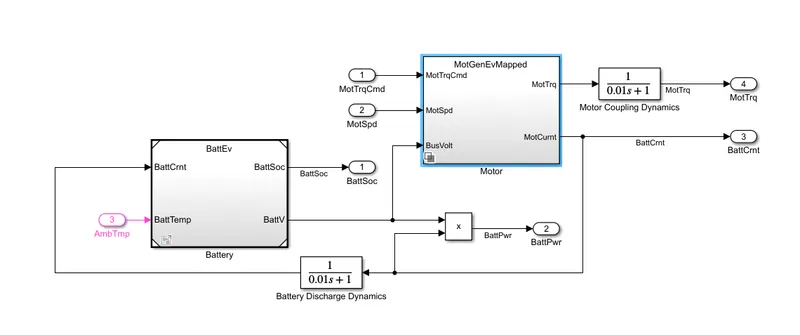
- In this MotGenEv mapped is selected we have to convert into MotGenEv Dynamic.
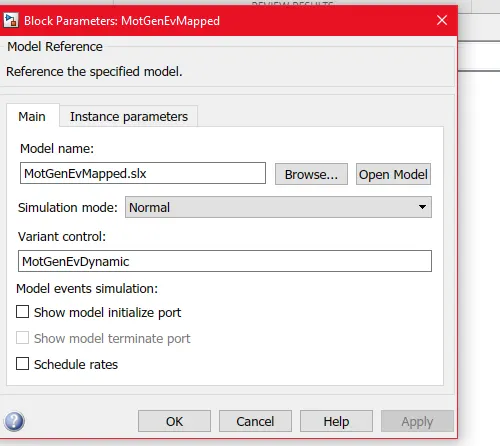
- So, right click on it and select block reference parameter .
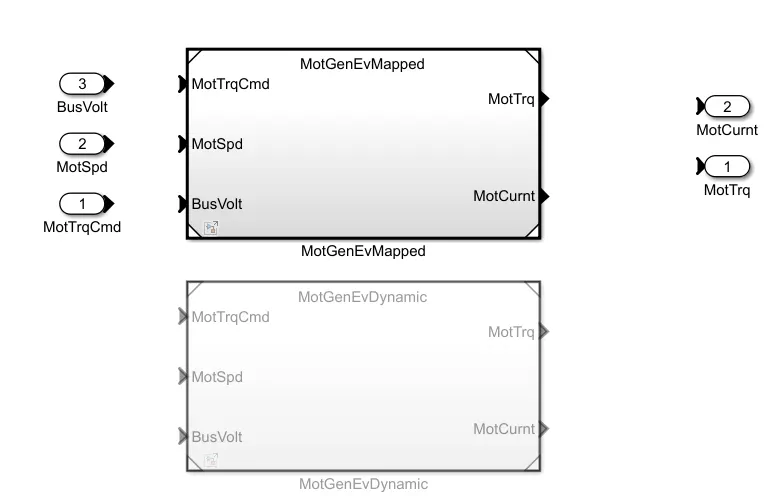
- In variant control write MotGenDynamic
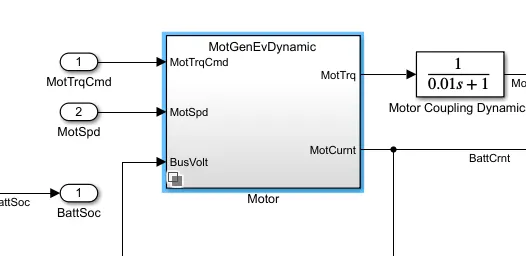
- And finally the block get changed.
4. Solution to question (4) :-
Calculation of miles per gallon :-
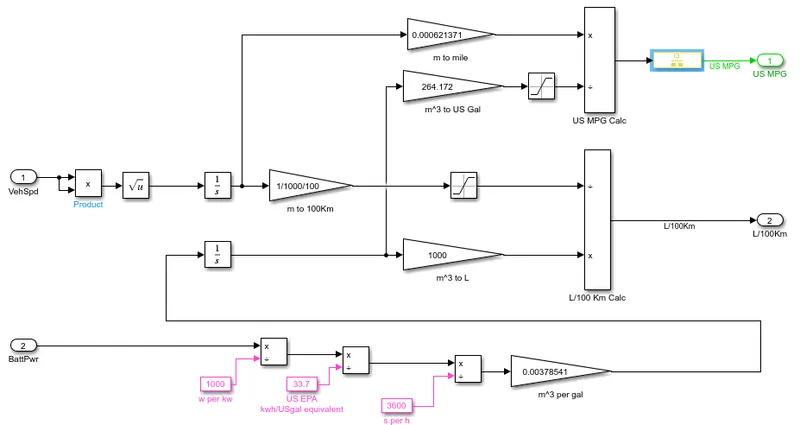
- Miles per gallon (MPG) is one of the unit used in US to determine efficiency of any vehicle.
- 1 mile =1.6km
- 1Gallon = 4.55 liters.
- Above is the simulation model of how to calculate MPG of any vehicle.
- Calculation of distance from velocity,as velocity is passes through some mathematial functional block(product,square root) and result get integrated
- to get distance it is further passes through gain block which convert into m to mile.
- The next input we have is battery power applied to divide block (power/1000=power in kw).
- Again power is divide by 33.7 kwh/us gal equivalent further again divide by 3600 seconds to hour and multplied by gain to get m^3 per gal.
- To convert into energy use integrator then pass through gain block output is in US gallon and pass through saturation block.
- Finally get miles/US gallon which is output od divide block.
Which factors are considered to model fuel flow?
- Engine speed in RPM
- Commanded torque in Nm